Use the Serum Osmolality Calculator
Use our serum osmolality calculator to compute calculated osmolality from sodium, glucose, and BUN, then find the osmolal gap for toxic alcohol screening.
Calculated osmolality
290.3 mOsm/kg
Lab units
Doubled in the formula — it carries chloride and bicarbonate with it (mEq/L = mmol/L)
Divided by 18 to convert mg/dL to mmol/L
Divided by 2.8 (nitrogen weight 28) to reach mmol/L of urea
From the lab osmometer (freezing-point depression) — enables the osmolal gap
Calculated serum osmolality
290.3 mOsm/kg
Within the 275–295 mOsm/kg reference band. ADH and thirst normally hold serum osmolality inside a window of only ±1–2% — a value here means water balance is being defended.
What makes up the 290.3 mOsm/kg
Effective osmolality
285.3 mOsm/kg
Tonicity — excludes urea; > 320 defines HHS
Sodium share
96%
Sodium and its anions normally supply ~90% of total osmolality
Urea + glucose share
4%
Each normally adds only ~5 mOsm/kg of the total
Serum osmolality interpretation — your row is highlighted
| mOsm/kg | Classification | Typical meaning |
|---|---|---|
| < 275 | Hypo-osmolar | Water excess — hypotonic hyponatremia workup (SIADH, polydipsia, diuretics) |
| 275–295 ● | Normal | Reference band defended by ADH and thirst within ±1–2% |
| 296–320 | Hyperosmolar | Free-water deficit, hyperglycemia, uremia, or unmeasured osmoles |
| > 320 | Severe | HHS territory (effective osmolality); confusion and stupor become common |
High gap WITH metabolic acidosis
- Methanol (each 32 mg/dL ≈ 10 mOsm/kg)
- Ethylene glycol (each 62 mg/dL ≈ 10 mOsm/kg)
- Diabetic and alcoholic ketoacidosis
- Lactic acidosis, shock states
- Advanced chronic kidney disease
High gap WITHOUT acidosis
- Ethanol (most common cause overall)
- Isopropanol (ketosis without acidosis)
- Mannitol or glycerol infusions
- Glycine irrigation (TURP syndrome)
- Pseudohyponatremia (severe hyperlipidemia or paraproteinemia)
This tool is for education and clinical decision support only. A calculated osmolality is an estimate — the formula carries a baseline scatter of roughly ±10 mOsm/kg between individuals, and a normal osmolal gap never excludes a toxic alcohol ingestion that presented late. Suspected methanol or ethylene glycol poisoning is an emergency: confirmatory levels and treatment decisions belong with a clinician and a poison control center, not a calculator.
Educational tool, not medical advice. Check this tool’s method and limitations before interpreting a result. Talk to a qualified healthcare professional before making decisions about medication, diet, exercise, or treatment. See our Terms of Use.
Your rating helps improve Serum Osmolality Calculator. We store only an anonymized vote (no personal data).
How to Use Serum Osmolality Calculator
Step 1: Choose your lab units
Pick US (mg/dL) or SI (mmol/L) with the Lab units toggle. Sodium is entered in mmol/L in both systems; the glucose and BUN fields switch units and defaults automatically.
Step 2: Enter sodium, glucose, and BUN
Type the three values from a basic metabolic panel into the Serum sodium, Glucose, and BUN fields. Calculated osmolality updates instantly — a normal profile lands near 290 mOsm/kg.
Step 3: Add a measured osmolality (optional)
If your lab reported a measured osmolality from a freezing-point osmometer, enter it in the Measured osmolality field to unlock the osmolal gap result and its interpretation band.
Step 4: Include ethanol if a level is available
Check the ethanol box and enter the serum ethanol level. The tool adds ethanol ÷ 3.7 to the calculation so any remaining gap points to unmeasured osmoles like methanol or ethylene glycol.
Step 5: Read the breakdown and gap classification
Review calculated and effective osmolality, the color-coded gap badge, and the stacked bar showing how much sodium, glucose, urea, and ethanol each contribute to the total.
Key Features
- Calculated osmolality from sodium, glucose, and BUN
- Osmolal gap with toxicology interpretation bands
- Effective osmolality (tonicity) with the 320 mOsm/kg HHS cutoff
- Optional ethanol correction using the empiric 3.7 divisor
- US and SI units with per-solute contribution breakdown
Understanding Results
Formula
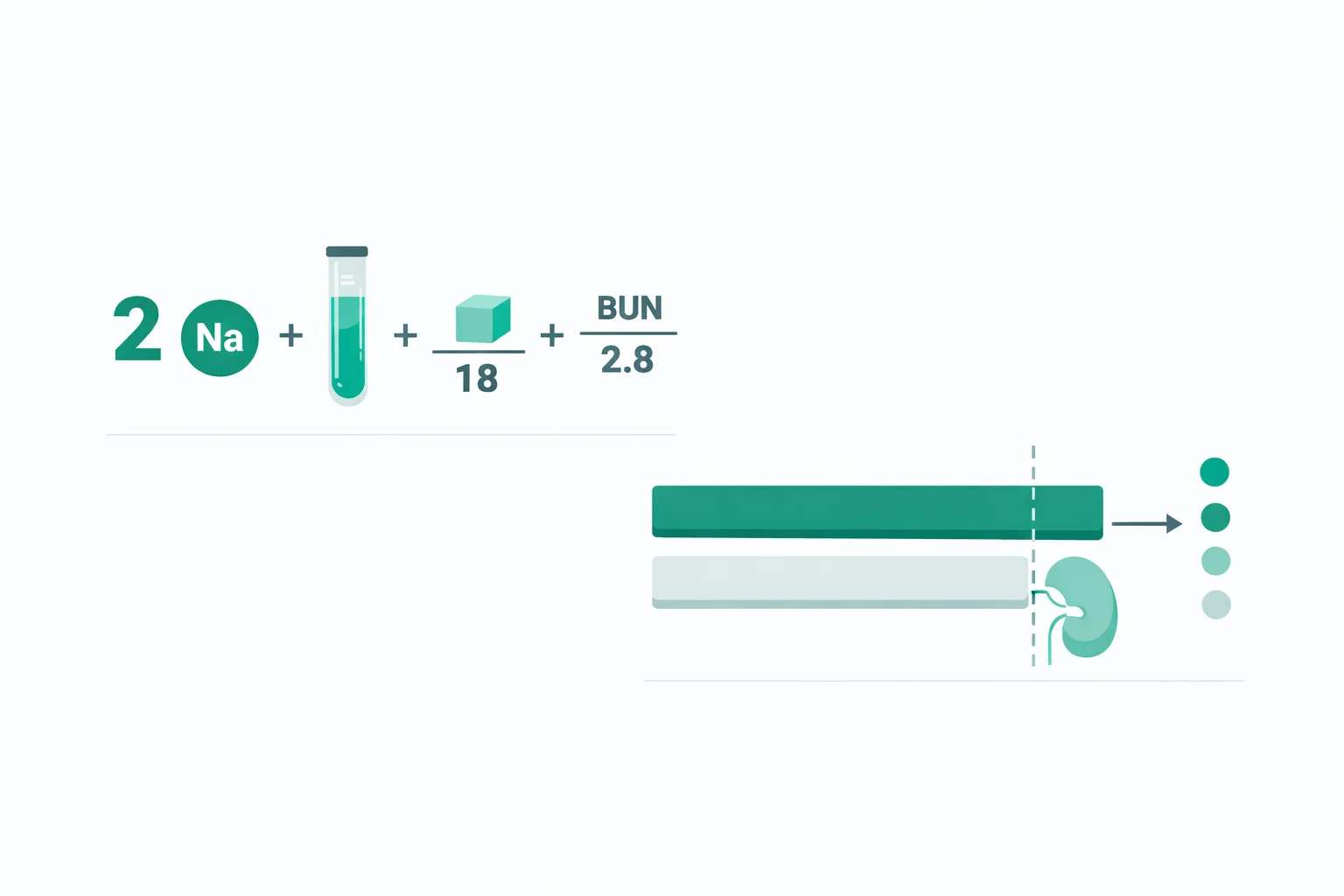
Calculated osmolality = 2 × Na (mmol/L) + glucose (mg/dL) ÷ 18 + BUN (mg/dL) ÷ 2.8. Sodium is doubled because each cation travels with a chloride or bicarbonate anion; the divisors of 18 and 2.8 convert mg/dL to mmol/L using one-tenth of each molecule's weight (glucose 180 g/mol, urea nitrogen 28 g/mol). In SI units, glucose and urea in mmol/L enter directly. When an ethanol level is entered, ethanol (mg/dL) ÷ 3.7 is added — the empiric divisor validated by Purssell and colleagues, which fits real plasma better than the theoretical 4.6. The osmolal gap is the lab-measured osmolality minus this calculated value.
Reference Ranges & Interpretation
Normal serum osmolality runs 275–295 mOsm/kg; values above 320 mOsm/kg are associated with depressed consciousness, and an effective osmolality above 320 is a diagnostic criterion for hyperosmolar hyperglycemic state. A normal osmolal gap is ±10 mOsm/kg. Gaps of 10–20 fit ethanol, ketoacidosis, lactic acidosis, or kidney disease; unexplained gaps above 25–30 raise serious concern for methanol or ethylene glycol, where every 10 mOsm/kg represents roughly 32 or 62 mg/dL of toxin respectively (Kraut & Kurtz, CJASN 2008).
Assumptions & Limitations
The formula carries a baseline scatter of about ±10 mOsm/kg between individuals, so a single "normal" gap cannot exclude a small or late ingestion — after metabolism converts a toxic alcohol to its acids, the osmolal gap falls while the anion gap rises. The gap is only valid against osmolality measured by freezing-point depression; vapor-pressure instruments miss volatile alcohols entirely. This tool supports, but never replaces, confirmatory toxin levels, blood gas analysis, and poison-center guidance.
Complete Guide: Serum Osmolality Calculator
A serum osmolality calculator estimates the total concentration of dissolved particles in blood — normally 275 to 295 mOsm/kg of water — from three values on any basic metabolic panel: sodium, glucose, and BUN. That estimate matters far beyond curiosity. Compare it against the osmolality your lab actually measures and the difference, called the osmolal gap, becomes one of the fastest screening tests in medicine for methanol and ethylene glycol poisoning — hours before a confirmatory alcohol level comes back. This guide walks through the equation term by term, works a real emergency-department case from raw labs to a treatment decision, and covers the two situations where the gap quietly lies to you.
Table of contents
- What a Serum Osmolality Calculator Actually Measures
- The Formula: 2 × Na + Glucose/18 + BUN/2.8
- A Worked Case: The Gap That Found Ethylene Glycol
- What Raises the Osmolal Gap — With Numbers
- Osmolality vs. Osmolarity, and Why the Lab Method Matters
- Why a Normal Gap Doesn't Rule Out Poisoning
- Effective Osmolality: The Tonicity Distinction
- References
The standard sodium, glucose and BUN equation does not classify potassium. If the chemistry panel also reports an abnormal K⁺, the potassium level calculator compares that concentration with its own laboratory limits and adult clinical bands.
What a Serum Osmolality Calculator Actually Measures
Osmolality counts particles, not weight. One millimole of sodium contributes exactly as much osmotic pull as one millimole of glucose, even though a glucose molecule weighs almost eight times more. The body defends this particle count fiercely: a rise of just 1–2% above baseline triggers antidiuretic hormone release, and by roughly 294 mOsm/kg the thirst center switches on. That tight control is why a healthy serum osmolality sits in such a narrow band — 275 to 295 mOsm/kg — while sodium, glucose, and BUN can each wander much more widely on their own.
In practice, clinicians reach for a serum osmolality calculator in three situations: working up hyponatremia (is the low sodium genuinely hypotonic, or an artifact?), assessing severe hyperglycemia (hyperosmolar hyperglycemic state is defined partly by an effective osmolality above 320 mOsm/kg), and screening for toxic alcohol ingestion via the osmolal gap. Each use leans on a different part of the same short equation.
The Formula: 2 × Na + Glucose/18 + BUN/2.8
Out of more than 36 published variants, the most widely validated plasma osmolality formula is also the simplest one that works:
Calculated osmolality = 2 × Na (mmol/L) + glucose (mg/dL) ÷ 18 + BUN (mg/dL) ÷ 2.8
Each term of the osmolality equation has a physical reason for its shape. Sodium is doubled because every sodium cation travels with an anion — chloride or bicarbonate — so 140 mmol/L of sodium really means about 280 mOsm/kg of salt. Glucose is divided by 18 because its molecular weight is 180 g/mol, and dividing mg/dL by one-tenth of the molecular weight converts to mmol/L. BUN is divided by 2.8 for the same reason: the two nitrogen atoms measured in "blood urea nitrogen" weigh 28 g/mol. If your lab reports in SI units, the arithmetic collapses — glucose and urea in mmol/L enter the formula directly with no divisors at all. And when an ethanol level is available, adding ethanol (mg/dL) ÷ 3.7 subtracts alcohol's known contribution from the gap; the empirically derived 3.7 outperforms the theoretical divisor of 4.6 because ethanol doesn't behave as an ideal osmole in plasma.
Notice what the numbers imply about proportions. At a sodium of 140, glucose of 95, and BUN of 14, the sodium term contributes 280 of the total 290.3 mOsm/kg — about 90%. Glucose and urea add roughly 5 mOsm/kg each. That dominance is why osmolality problems are usually sodium problems, and why a BUN that has tripled — say, from a prerenal state your BUN-to-creatinine ratio calculator result already flagged — still only nudges total osmolality by around 10 mOsm/kg.
A Worked Case: The Gap That Found Ethylene Glycol
A 34-year-old arrives confused two hours after drinking an unknown liquid. The chemistry panel: sodium 142 mmol/L, glucose 108 mg/dL, BUN 17 mg/dL, chloride 104, bicarbonate 20. The lab's measured osmolality: 328 mOsm/kg. Run the math step by step:
- Sodium term: 2 × 142 = 284
- Glucose term: 108 ÷ 18 = 6.0
- BUN term: 17 ÷ 2.8 = 6.1
- Calculated osmolality: 284 + 6.0 + 6.1 = 296.1 mOsm/kg
- Osmolal gap: 328 − 296.1 = +31.9 mOsm/kg
A gap of 32 is far outside the ±10 reference band. Ethanol is the first suspect — but the ethanol level comes back at zero, so 32 mOsm/kg of particles remain unexplained. Converting a gap to a candidate concentration uses one relationship: mg/dL = gap × molecular weight ÷ 10. If those particles were ethylene glycol (MW 62), the level would be roughly 32 × 6.2 ≈ 198 mg/dL — ten times the 20 mg/dL threshold at which guidelines recommend starting the antidote fomepizole. Meanwhile the anion gap is 142 − (104 + 20) = 18, already creeping up as ethylene glycol is metabolized to glycolic and oxalic acid. This patient earned fomepizole and a nephrology call on the strength of the osmolal gap alone, hours before any confirmatory level was available. That is the entire point of the tool.
What Raises the Osmolal Gap — With Numbers
Because the gap-to-concentration conversion runs through molecular weight, small molecules move the gap dramatically while big ones barely register. The table below shows how much of each substance it takes to add 10 mOsm/kg — and whether metabolic acidosis travels with it, which is the key branch point in the differential:
| Substance | MW (g/mol) | Amount adding 10 mOsm/kg | Acidosis? | Distinguishing clue |
|---|---|---|---|---|
| Methanol | 32 | 32 mg/dL | Yes, delayed | Visual blurring; formic acid attacks the optic nerve |
| Ethanol | 46 | ~37 mg/dL (empiric) | Only in AKA | Most common cause; measurable, so subtract it |
| Isopropanol | 60 | 60 mg/dL | No | Ketosis with a normal pH; acetone on the breath |
| Ethylene glycol | 62 | 62 mg/dL | Yes, delayed | Calcium oxalate crystals in urine; acute kidney injury |
| Propylene glycol | 76 | 76 mg/dL | Yes (lactate) | Carrier in lorazepam and diazepam infusions |
| Mannitol | 182 | 182 mg/dL | No | Iatrogenic — check the medication list first |
Non-toxin causes cluster at the modest end of the scale. Diabetic and alcoholic ketoacidosis typically add 10–20 mOsm/kg of ketones, acetone, and stress metabolites; lactic acidosis and advanced chronic kidney disease produce similar single-digit to low-double-digit elevations. A gap above 25–30 mOsm/kg with an unexplained story should be treated as a toxic alcohol until a level proves otherwise.
Osmolality vs. Osmolarity, and Why the Lab Method Matters
The two words get swapped constantly, but they are different denominators. Osmolality is particles per kilogram of water and is what the laboratory osmometer measures; osmolarity is particles per liter of solution and is what the formula technically computes. In dilute body fluids the difference is under 1% and clinically ignorable — with one caveat. Plasma is normally 93% water; in severe hyperlipidemia or paraproteinemia the water fraction shrinks, the two quantities diverge, and sodium measured by older indirect methods reads falsely low (pseudohyponatremia). A normal measured osmolality next to an apparently low sodium is exactly how that artifact is caught.
The measurement method matters just as much. Freezing-point depression osmometry — the standard — detects every dissolved particle, because each osmole per kilogram lowers the freezing point of water by 1.86 °C. Vapor-pressure osmometers, by contrast, cannot see volatile solutes: methanol, ethanol, and isopropanol evaporate into the instrument's headspace and vanish from the reading. If the purpose of ordering a measured osmolality is toxic alcohol screening, it must be run by freezing-point depression, or the gap you compute will be falsely reassuring.
Why a Normal Gap Doesn't Rule Out Poisoning
Two failure modes matter. First, timing: the osmolal gap and the anion gap move in opposite directions over the course of a toxic alcohol ingestion. Early on, the intact parent alcohol inflates the osmolal gap while the anion gap is still normal. As the liver converts methanol to formic acid or ethylene glycol to glycolic acid, the osmotically active parent disappears and acidic metabolites accumulate — so the osmolal gap falls toward normal exactly as the anion gap climbs. A patient who presents 12 hours after ingestion can show a nearly normal osmolal gap and a severe high-anion-gap metabolic acidosis. Interpreting either gap alone misses the pattern; together they timestamp the ingestion.
Second, baseline variation: population studies place the "normal" osmolal gap anywhere from −14 to +10 mOsm/kg. Someone whose personal baseline sits at −5 can absorb about 15 mOsm/kg of foreign osmoles — roughly 93 mg/dL of ethylene glycol, over four times the treatment threshold — and still present with a gap of +10 that reads as "normal." This is why every toxicology reference repeats the same warning: a normal osmolal gap lowers suspicion but never excludes ingestion when the history is concerning.
Effective Osmolality: The Tonicity Distinction
Not every osmole pulls water across cell membranes. Urea and ethanol diffuse freely into cells, so they raise measured osmolality without creating a water shift — they are "ineffective" osmoles. Effective osmolality, or tonicity, therefore drops the BUN term: 2 × Na + glucose ÷ 18. The distinction has hard clinical edges. A dialysis patient with a BUN of 100 mg/dL carries 36 extra mOsm/kg of total osmolality yet no cellular dehydration at all. Hyperosmolar hyperglycemic state is diagnosed by an effective osmolality above 320 mOsm/kg — using total osmolality overcalls the diagnosis in anyone with renal impairment.
Glucose is the opposite case: confined to the extracellular space without insulin, it is a fully effective osmole that drags water out of cells and dilutes the serum sodium by roughly 1.6–2.4 mmol/L for every 100 mg/dL of glucose above normal. That translocational effect is why a glucose of 700 mg/dL with a sodium of 128 is not a sodium problem — our sodium correction calculator for hyperglycemia untangles exactly that scenario before anyone reaches for hypertonic saline. Used together — total osmolality for the gap, effective osmolality for tonicity, corrected sodium for the true salt balance — these three numbers turn one chemistry panel into a complete picture of a patient's water physiology.
References
- Rasouli M. Basic concepts and practical equations on osmolality: biochemical approach. Clin Biochem. 2016;49(12):936-941. PubMed
- Kraut JA, Kurtz I. Toxic alcohol ingestions: clinical features, diagnosis, and management. Clin J Am Soc Nephrol. 2008;3(1):208-225. PubMed
- Purssell RA, Pudek M, Brubacher J, Abu-Laban RB. Derivation and validation of a formula to calculate the contribution of ethanol to the osmolal gap. Ann Emerg Med. 2001;38(6):653-659. PubMed

Written by Jurica Šinko
Founder & CEO
Entrepreneur and health information advocate, passionate about making health calculations accessible to everyone through intuitive digital tools.
View full profileFrequently Asked Questions
What is a normal serum osmolality?
Normal serum osmolality is 275 to 295 mOsm/kg of water. The body defends this band tightly — a rise of just 1 to 2 percent triggers antidiuretic hormone release, and thirst switches on near 294 mOsm/kg. Values above 320 mOsm/kg are associated with confusion and warrant urgent clinical evaluation.
How do you calculate serum osmolality from sodium, glucose, and BUN?
Multiply sodium in mmol/L by 2, add glucose in mg/dL divided by 18, then add BUN in mg/dL divided by 2.8. For example, sodium 140, glucose 95, and BUN 14 give 280 + 5.3 + 5.0 = 290.3 mOsm/kg. If your lab reports SI units, glucose and urea in mmol/L are added directly with no divisors.
What osmolal gap suggests toxic alcohol poisoning?
A gap above 10 mOsm/kg is abnormal, and a gap above 25 to 30 with an unexplained history should be treated as methanol or ethylene glycol poisoning until confirmatory levels return. Every 10 mOsm/kg of unexplained gap corresponds to roughly 32 mg/dL of methanol or 62 mg/dL of ethylene glycol.
Can the osmolal gap be normal in ethylene glycol poisoning?
Yes, especially in late presentations. As ethylene glycol is metabolized to glycolic and oxalic acid, the osmolal gap falls while the anion gap rises, so a patient arriving 12 hours after ingestion can show a near-normal osmolal gap with severe acidosis. Baseline gaps also vary from -14 to +10 mOsm/kg between individuals, which can mask a genuine ingestion.
What is the difference between osmolality and osmolarity?
Osmolality counts particles per kilogram of water and is what the lab osmometer measures; osmolarity counts particles per liter of solution and is what the formula computes. In body fluids the difference is under 1 percent, but they diverge in severe hyperlipidemia or paraproteinemia, where the plasma water fraction shrinks below the normal 93 percent.
Does ethanol raise serum osmolality?
Yes — ethanol is the single most common cause of an elevated osmolal gap. Each 100 mg/dL of ethanol adds roughly 27 mOsm/kg using the empirically validated divisor of 3.7, so legal intoxication at 80 mg/dL contributes about 22 mOsm/kg. Entering a measured ethanol level lets the calculator subtract that contribution and expose any residual gap.
What serum osmolality defines hyperosmolar hyperglycemic state (HHS)?
HHS is diagnosed with an effective osmolality above 320 mOsm/kg together with glucose above 600 mg/dL. Effective osmolality is 2 x sodium + glucose/18, deliberately excluding BUN because urea crosses cell membranes freely and does not dehydrate cells. Using total osmolality instead overcalls HHS in patients with kidney impairment.
Why does my calculated osmolality differ from the measured value?
A difference of up to plus or minus 10 mOsm/kg is expected scatter from the formula itself. Larger differences mean unmeasured osmoles: ethanol, ketones (which add 10 to 20 mOsm/kg in ketoacidosis), lactate, retained solutes in kidney disease, or toxic alcohols. Also confirm the lab used freezing-point depression — vapor-pressure osmometers cannot detect volatile alcohols at all.
Related Calculators
A1C Calculator — Convert HbA1c to eAG with Targets
Use our A1C calculator to convert HbA1c to estimated average glucose (eAG). See normal, prediabetes, and diabetes thresholds in mg/dL and mmol/L. Fast results.
Albumin Calculator — Serum Albumin Level Interpretation
Free albumin calculator to interpret serum albumin levels, grade hypoalbuminemia, and compute A/G ratio plus albumin-corrected calcium from your lab results.
Albumin-Corrected Anion Gap Calculator — Hidden Acidosis
Use our albumin-corrected anion gap calculator to raise the anion gap by 2.5 per 1 g/dL of low albumin and reveal a hidden high-gap metabolic acidosis.
ANC Calculator: Absolute Neutrophil Count & Neutropenia
Free ANC calculator to calculate absolute neutrophil count from WBC and differential. Get ANC in cells/uL and x10^9/L with instant neutropenia grading.
Anion Gap Calculator — Metabolic Acidosis Evaluation
Free anion gap calculator finds serum anion gap from sodium, chloride, and bicarbonate, with albumin correction and delta ratio for metabolic acidosis.
AST/ALT Ratio Calculator — Free De Ritis Ratio Tool
Use our free AST/ALT ratio calculator to compute the De Ritis index instantly. Visual ratio chart, enzyme-level assessment, and clinical patterns guide.