Use the BUN/Creatinine Ratio Calculator
Free BUN creatinine ratio calculator to evaluate kidney function from two lab values and tell pre-renal causes like dehydration from intrinsic kidney damage.
Blood urea nitrogen (typical 7–20 mg/dL)
Same blood draw (male range: 0.7–1.3 mg/dL)
Your BUN/Creatinine Ratio
15:1
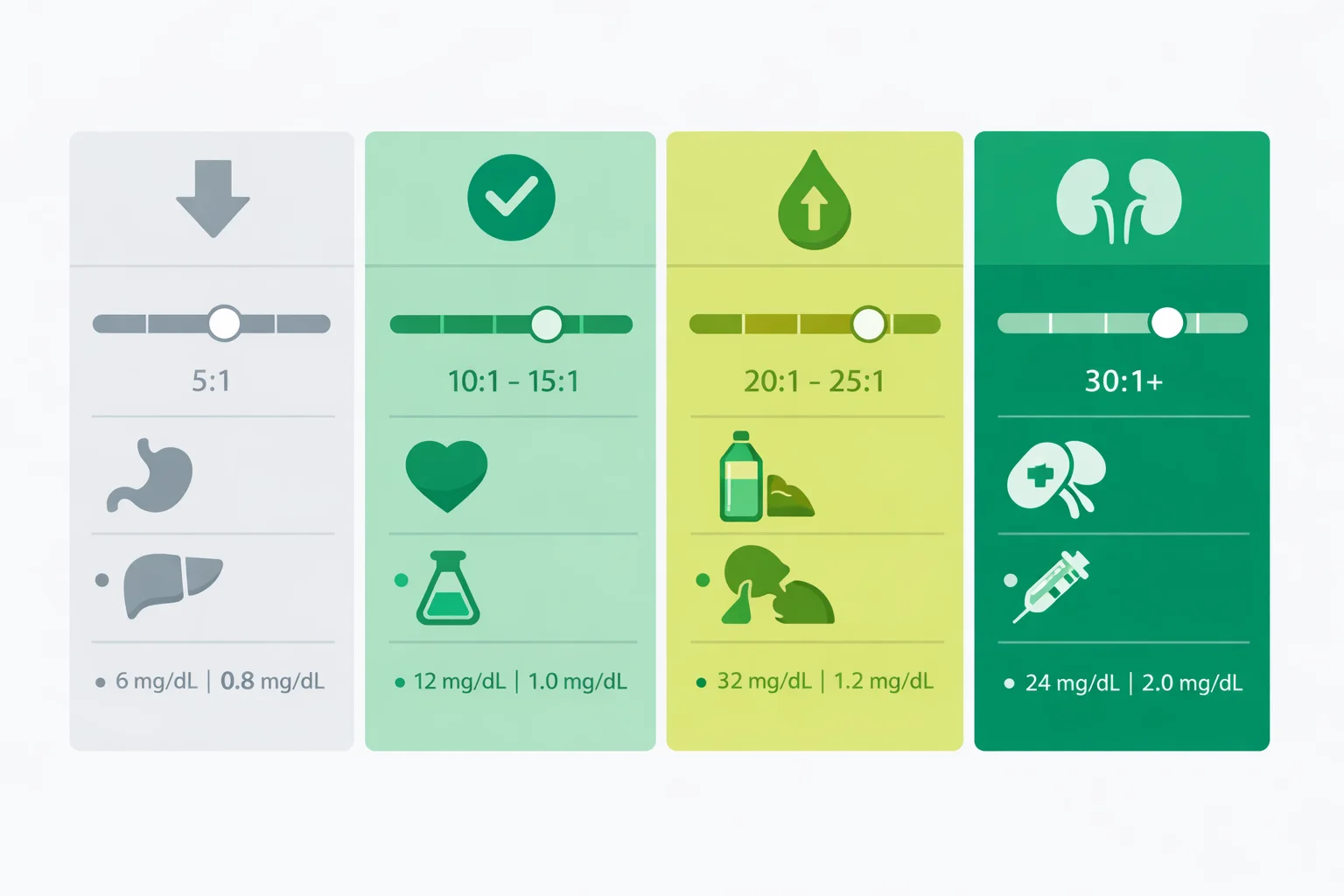
A ratio between 10 and 20 is the expected range for most adults. If both BUN and creatinine are also within their reference ranges, this is reassuring. If both are elevated while the ratio stays normal, it suggests intrinsic renal disease rather than a circulation (pre-renal) problem.
Where your ratio falls
What this combination suggests
Both the ratio and creatinine sit in their usual ranges, which is a reassuring combination.
15 mg/dL
Within range
1.0 mg/dL
Within range
Ratio interpretation guide
| Ratio | Pattern |
|---|---|
| < 10:1 | Low |
| 10:1 – 20:1◀ You | Normal |
| 20:1 – 30:1 | Elevated (pre-renal) |
| > 30:1 | Markedly elevated |
How we calculated this
BUN/Creatinine Ratio = BUN ÷ Creatinine = 15 ÷ 1.0 = 15:1
Both values are converted to mg/dL before dividing. The ratio is unitless and does not account for age, muscle mass, or medications.
Important
The BUN/creatinine ratio is an interpretive clue, not a diagnosis. It should be read alongside the absolute BUN and creatinine values, your hydration status, medications, diet, and symptoms. Always discuss lab results with a qualified healthcare professional.
Educational tool, not medical advice. Check this tool’s method and limitations before interpreting a result. Talk to a qualified healthcare professional before making decisions about medication, diet, exercise, or treatment. See our Terms of Use.
Your rating helps improve BUN/Creatinine Ratio Calculator. We store only an anonymized vote (no personal data).
How to Use BUN/Creatinine Ratio Calculator
Step 1: Select your sex and units
Choose male or female to set the correct creatinine reference range, then pick mg/dL or SI units (mmol/L for urea, µmol/L for creatinine) to match your lab report.
Step 2: Enter your BUN
Type the blood urea nitrogen value from your panel into the BUN/Urea field. SI-unit labs report this as "urea" in mmol/L — the tool converts it for you.
Step 3: Enter your creatinine
Add the serum creatinine value from the same blood draw. The ratio updates instantly as you type, with no Calculate button needed.
Step 4: Read the ratio and pattern
Check your ratio against the 10:1–20:1 normal band and the color-coded gauge to see whether it suggests a pre-renal, intrinsic, or low-ratio pattern.
Step 5: Review the combined interpretation
Read the "What this combination suggests" card, which weighs your ratio together with whether creatinine itself is above range.
Key Features
- Instant ratio from BUN and creatinine
- Supports mg/dL and SI units (mmol/L, µmol/L)
- Flags pre-renal vs. intrinsic kidney patterns
- Sex-specific creatinine reference ranges
- Color-coded interpretation guide and gauge
- Copy-ready result summary
Understanding Results
BUN/Creatinine Ratio Calculator Formula
The BUN/creatinine ratio is a simple division: BUN ÷ serum creatinine, with both values in mg/dL. Because the units cancel, the result is a unitless number expressed as a ratio, such as 15:1. A BUN of 18 mg/dL and a creatinine of 1.2 mg/dL gives 18 ÷ 1.2 = 15:1. If your report uses SI units, the calculator first converts urea (mmol/L × 2.8) and creatinine (µmol/L ÷ 88.4) to mg/dL so the ratio stays comparable to US reference values.
Reference Ranges & Interpretation
The normal BUN/creatinine ratio is roughly 10:1 to 20:1. Above 20:1 suggests a pre-renal cause (dehydration, heart failure, GI bleeding, high-protein intake), and above 30:1 raises concern for upper GI bleeding. Below 10:1 suggests low protein intake, liver disease, overhydration, or rhabdomyolysis. Crucially, the ratio is only meaningful when read alongside the absolute values: normal BUN (7–20 mg/dL) and creatinine (about 0.7–1.3 mg/dL for men, 0.6–1.1 for women). When both are high but the ratio stays normal, intrinsic kidney disease is more likely than a circulation problem.
Assumptions & Limitations
This calculator assumes both values come from the same blood draw and that creatinine is greater than zero. The ratio does not account for age, muscle mass, medications, or pregnancy on its own, and a normal ratio does not rule out kidney disease. Athletes and people with high muscle mass can show a low ratio from elevated creatinine, while a high-protein diet can raise it without any kidney problem. Use the ratio as one clue among several, and confirm any concern with an eGFR trend and a healthcare professional.
Complete Guide: BUN/Creatinine Ratio Calculator
On this page
The BUN/creatinine ratio calculator turns two numbers from your blood panel into a single clue about why a kidney value might be off. Say your report shows a BUN of 28 mg/dL and a creatinine of 1.0 mg/dL. On their own, the BUN looks high and the creatinine looks fine — confusing. Divide them and you get a ratio of 28:1, well above the normal 10:1–20:1 band, which points straight at a circulation or hydration problem rather than damaged kidney tissue. That distinction changes what happens next, and it's the whole reason this ratio exists.
A worked example: reading a real panel
Take three patients who all walk in with a creatinine of 1.4 mg/dL — technically above the normal ceiling of about 1.3 for men. The single creatinine value looks identical, but the BUN tells three different stories:
| Patient | BUN | Creatinine | Ratio | Likely story |
|---|---|---|---|---|
| A — flu, not drinking | 35 | 1.4 | 25:1 | Pre-renal — dehydration |
| B — long-standing CKD | 20 | 1.4 | 14:1 | Intrinsic kidney disease |
| C — vegan, very fit | 11 | 1.4 | 8:1 | Low protein + high muscle mass |
Same creatinine, three ratios, three plans. Patient A needs fluids and a recheck. Patient B needs an eGFR trend and a nephrology conversation. Patient C may not have a kidney problem at all — their creatinine is nudged up by muscle, not failing filtration. The ratio is what separates them. You can sanity-check each scenario by plugging the values into the calculator above.
What BUN and creatinine actually measure
Blood urea nitrogen (BUN) is the nitrogen left over when your liver breaks down protein into urea. Creatinine is a waste product from normal muscle turnover, produced at a fairly steady rate. Both are filtered by the kidneys, so both rise when filtration drops. The trick is that the kidney handles them differently: roughly 40–50% of filtered urea gets reabsorbed back into the blood, especially when you're dry, while creatinine is barely reabsorbed at all. That asymmetry is exactly what makes the ratio informative — urea responds to hydration and blood flow, creatinine mostly responds to filtering capacity.
A note on units. In the United States, BUN is reported in mg/dL and a normal value sits around 7–20 mg/dL. Most other countries report “urea” in mmol/L instead. To convert, multiply urea (mmol/L) by 2.8 to get BUN (mg/dL). Creatinine is mg/dL in the US and µmol/L elsewhere — divide µmol/L by 88.4 to get mg/dL. The calculator above does both conversions for you, so you can enter values straight off a lab report from any country. That same 2.8 divisor is why BUN appears as BUN÷2.8 in the serum osmolality calculator: a BUN of 14 mg/dL contributes only about 5 mOsm/kg of the normal 275–295 total, which is why even a tripled BUN barely moves total osmolality.
Pre-renal vs. intrinsic: why the ratio matters
When kidney function dips, doctors first ask where the problem sits. A pre-renalcause means the kidneys themselves are healthy but aren't getting enough blood — think dehydration, blood loss, or heart failure. In that state the kidney clings to water and drags urea back with it, so BUN climbs faster than creatinine and the ratio rises above 20:1. When the volume loss is mostly pure water rather than blood or salt, serum sodium climbs alongside the ratio, and a free water deficit calculator turns a sodium of 158 mEq/L into the number of liters that need replacing. An intrinsic (renal) cause means the filtering tissue is damaged, as in acute tubular necrosis. Now both urea and creatinine pile up together and the ratio stays inside the normal 10–20 band even though both absolute numbers are high. When the two need separating formally, clinicians add a spot urine sample and compute the fractional excretion of sodium — the FENa calculator classifies the result at the 1% and 2% cutoffs and switches to FEUrea when diuretics make sodium unreliable.
This is why a ratio above 30:1 is a classic flag for upper gastrointestinal bleeding: digested blood is a huge protein meal, so urea production spikes while creatinine doesn't budge. If your numbers point to a kidney concern, it helps to view them alongside an actual filtration estimate. Run your creatinine through the eGFR calculator for a staged kidney-function number, or use the creatinine clearance calculator to estimate clearance the way drug-dosing guidelines do.
What a low ratio (under 10) means
A ratio below 10:1 gets less attention but tells its own story. It usually means urea is unusually low, not that creatinine is high. The biggest drivers are a low-protein or vegetarian diet (less protein means less urea), advanced liver disease (a damaged liver can't make urea efficiently), and overhydration that dilutes the blood. Pregnancy lowers the ratio too, because blood volume expands by roughly 40–50% and the kidneys filter faster. One trap: rhabdomyolysis — severe muscle breakdown — pushes creatinine up sharply while urea barely moves, dropping the ratio even though something serious is happening. A low ratio is rarely an emergency by itself, but it deserves context.
What shifts the ratio besides your kidneys
Several everyday things move BUN without touching kidney health. A high-protein diet or protein supplements can lift BUN by several points within a day. Corticosteroids and tetracycline antibiotics increase protein breakdown and nudge the ratio up. Gastrointestinal bleeding, major surgery, fever, and burns all raise the catabolic load. On the creatinine side, large muscle mass and creatine supplements raise creatinine without any loss of filtration — which is partly why athletes can show a “low” ratio that means nothing worrying. Because creatinine reflects muscle, the same eGFR can correspond to different creatinine values in different bodies; the lean body mass calculator shows how much muscle drives that baseline.
Three mistakes people make reading the ratio
1. Reading the ratio without the absolute numbers. A 22:1 ratio with a BUN of 13 and creatinine of 0.6 is meaningless noise — both values are normal, so the division is just arithmetic. The ratio earns its keep when at least one value is abnormal.
2. Mixing up urea and BUN. A urea of 8 mmol/L is not a BUN of 8. Convert first (8 × 2.8 ≈ 22 mg/dL) or you'll calculate a ratio that's off by nearly three-fold.
3. Treating one snapshot as a trend. A single high ratio after a stomach bug doesn't mean kidney disease. What matters is whether it normalizes after you rehydrate. A recheck in 24–72 hours usually settles the question.
What to do with your number
If your ratio lands between 10 and 20 and both absolute values are normal, there's usually nothing to chase. If the ratio is above 20 and you've been ill, vomiting, or simply not drinking, hydration and a repeat panel come first. A ratio over 30 — especially with dark stools, lightheadedness, or known ulcers — is worth same-day medical attention. And if both BUN and creatinine are elevated with a normal-range ratio, that points toward the kidney tissue itself and is best evaluated with an eGFR trend over time. Whatever your number, treat this ratio as a pointer that helps you ask the right question, not as a diagnosis on its own.
According to the National Institute of Diabetes and Digestive and Kidney Diseases, a BUN test is most useful when read together with creatinine and eGFR rather than in isolation — which is exactly the job this ratio does.
References
- National Institute of Diabetes and Digestive and Kidney Diseases (NIDDK). Blood Urea Nitrogen (BUN) Test.
- MedlinePlus, U.S. National Library of Medicine. BUN (Blood Urea Nitrogen) Test.

Written by Jurica Šinko
Founder & CEO
Entrepreneur and health information advocate, passionate about making health calculations accessible to everyone through intuitive digital tools.
View full profileFrequently Asked Questions
What is a normal BUN to creatinine ratio?
A normal BUN/creatinine ratio is generally 10:1 to 20:1 when both values are in mg/dL. Ratios above 20:1 suggest a pre-renal cause such as dehydration, while ratios below 10:1 often reflect low protein intake, liver disease, or overhydration.
What does a high BUN/creatinine ratio (over 20) mean?
A ratio above 20:1 usually points to a pre-renal problem, meaning the kidneys are healthy but receiving less blood flow. Common causes are dehydration, heart failure, a high-protein diet, and steroid use. A ratio over 30:1 is a classic clue to upper gastrointestinal bleeding.
How do I calculate the BUN/creatinine ratio?
Divide your blood urea nitrogen (BUN) by your serum creatinine, with both in mg/dL. For example, a BUN of 28 mg/dL and creatinine of 1.0 mg/dL gives a ratio of 28:1. If your lab uses SI units, convert urea (mmol/L) by multiplying by 2.8 and creatinine (µmol/L) by dividing by 88.4 first.
What does a low BUN/creatinine ratio under 10 indicate?
A ratio below 10:1 usually means BUN is low rather than creatinine being high. The main causes are a low-protein or vegetarian diet, advanced liver disease, overhydration, pregnancy, and SIADH. Rhabdomyolysis can also lower the ratio by raising creatinine sharply while urea stays flat.
Can the ratio distinguish pre-renal from intrinsic kidney failure?
Yes, that is its main job. A ratio above 20:1 with rising values suggests a pre-renal cause (reduced blood flow), while a normal 10:1–20:1 ratio with both values elevated points to intrinsic kidney damage like acute tubular necrosis. It is a clue, not a definitive test.
Is BUN the same as urea on my lab report?
No. BUN measures only the nitrogen in urea and is reported in mg/dL, mostly in the United States. Many countries report total urea in mmol/L instead. A urea of 8 mmol/L equals a BUN of about 22 mg/dL (8 × 2.8), so converting before calculating matters.
Why is my ratio high if my creatinine is normal?
BUN responds to hydration, diet, and bleeding faster than creatinine does. Early dehydration, a high-protein meal, or a GI bleed can push BUN up while creatinine still sits in range, producing a high ratio. Rechecking after rehydration usually clarifies whether it was meaningful.
Related Calculators

A1C Calculator — Convert HbA1c to eAG with Targets
Use our A1C calculator to convert HbA1c to estimated average glucose (eAG). See normal, prediabetes, and diabetes thresholds in mg/dL and mmol/L. Fast results.

Albumin Calculator — Serum Albumin Level Interpretation
Free albumin calculator to interpret serum albumin levels, grade hypoalbuminemia, and compute A/G ratio plus albumin-corrected calcium from your lab results.
Albumin-Corrected Anion Gap Calculator — Hidden Acidosis
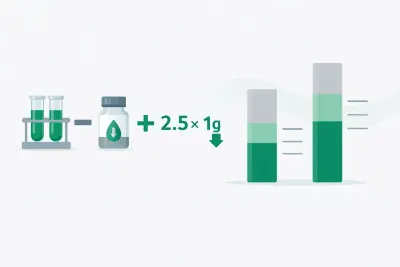
Use our albumin-corrected anion gap calculator to raise the anion gap by 2.5 per 1 g/dL of low albumin and reveal a hidden high-gap metabolic acidosis.
ANC Calculator: Absolute Neutrophil Count & Neutropenia
Free ANC calculator to calculate absolute neutrophil count from WBC and differential. Get ANC in cells/uL and x10^9/L with instant neutropenia grading.

Anion Gap Calculator — Metabolic Acidosis Evaluation
Free anion gap calculator finds serum anion gap from sodium, chloride, and bicarbonate, with albumin correction and delta ratio for metabolic acidosis.
AST/ALT Ratio Calculator — Free De Ritis Ratio Tool
Use our free AST/ALT ratio calculator to compute the De Ritis index instantly. Visual ratio chart, enzyme-level assessment, and clinical patterns guide.