Use the Potassium Level Calculator
Compare an adult blood potassium result with its laboratory range and clinical interpretation bands.
Adult blood results only. The starting value of 4.2 is an example. Use the value and reference limits printed on your laboratory report.
K⁺ 4.2 mmol/L · Usual reference interval
Enter the serum or plasma concentration, not a supplement dose or a urine potassium result.
Use a comparable blood sample. The difference is not a rate of change or a treatment response prediction.
Match your lab reference range
Default: 3.5–5.0. Some labs use 3.7–5.2. Changing these limits only changes the lab comparison; clinical bands and alerts stay fixed.
Blood potassium
4.2 mmol/L
Usual reference interval
Interpret with your lab report and health history
Follow any instructions already given by your laboratory or clinician. A value within a reference interval does not rule out illness.
Equivalent concentration
4.2 mEq/L
Lab comparison
Within lab range
Inside the selected interval
Change from previous result
Add a previous value to compare
A fall or rise alone does not establish improvement.
Concentration scale
Illustrative scale, not a risk percentage. Values outside 2–7 are shown at the nearest end.
| Potassium | Interpretation |
|---|---|
| < 2.5 | Severe hypokalemiaEmergency assessment |
| 2.5 to < 3.0 | Moderate hypokalemiaPrompt clinical assessment |
| 3.0 to < 3.5 | Mild hypokalemiaReview cause and follow-up |
| 3.5 to 5.0 | Usual reference interval← CurrentCheck your own lab limits |
| > 5.0 to < 5.5 | Above usual referenceLab-dependent flag; review context |
| 5.5 to < 6.0 | Mild hyperkalemiaContact clinician for review |
| 6.0 to < 6.5 | Moderate hyperkalemiaUrgent clinical review |
| ≥ 6.5 | Severe hyperkalemiaEmergency assessment |
This educational tool does not diagnose the cause, read an ECG, estimate total-body potassium deficit, or calculate a replacement dose. Children, dialysis care and acute treatment need their own clinical protocols. Do not change medicines or take potassium supplements based on this result.
Educational tool, not medical advice. Check this tool’s method and limitations before interpreting a result. Talk to a qualified healthcare professional before making decisions about medication, diet, exercise, or treatment. See our Terms of Use.
Your rating helps improve Potassium Level Calculator. We store only an anonymized vote (no personal data).
How to Use Potassium Level Calculator
Step 1: Copy the blood result and units
Enter Blood potassium from an adult serum or plasma report. Select mmol/L or mEq/L; potassium has the same numeric value in both units.
Step 2: Match the laboratory limits
Open Match your lab reference range and copy the Lower limit and Upper limit from the report. The default interval is 3.5–5.0. Clinical alert thresholds stay fixed.
Step 3: Add a previous result if available
Enter Previous blood potassium to calculate the difference between two comparable samples. Leave it blank if you have only one result.
Step 4: Check symptoms and sample quality
Select the symptom or hemolysis checkbox if it applies. Severe symptoms need emergency care even if the displayed potassium is within the lab range.
Step 5: Read both interpretations
Review the clinical band, lab comparison and action message. Copy summary saves the text to your clipboard; no replacement dose is calculated.
Key Features
- Adult potassium severity bands with fixed clinical alert thresholds
- Adjustable laboratory reference limits and distance outside the range
- Equivalent potassium concentrations in mmol/L and mEq/L
- Optional comparison with a previous blood result
- Hemolysis context, symptom alerts and a copyable summary
Understanding Results
Formula
Potassium is measured by a laboratory; it cannot be calculated from symptoms. This tool converts units using mEq/L = mmol/L × 1, compares the measured value with your lab limits, and subtracts the previous value from the current value. Distance outside the reference range is lower limit minus result when low, or result minus upper limit when high. These differences are concentrations, not replacement doses.
Reference Ranges & Interpretation
The default interval is 3.5–5.0 mmol/L. Low-potassium bands follow NHS SPS guidance; high-potassium bands start at 5.5 mmol/L under UK Kidney Association guidance. The gap above 5.0 and below 5.5 is labeled separately. Changing your lab limits never changes the clinical bands.
Assumptions & Limitations
Adult serum or plasma results only. This is an educational implementation of published thresholds, not an independently clinically validated diagnostic tool. Symptoms, ECG findings, sample handling, kidney function and the speed of change can outweigh the band label. Pediatric ranges, dialysis protocols, potassium replacement and emergency treatment require clinical assessment. A hemolysis flag cannot make a critical value safe.
Complete Guide: Potassium Level Calculator
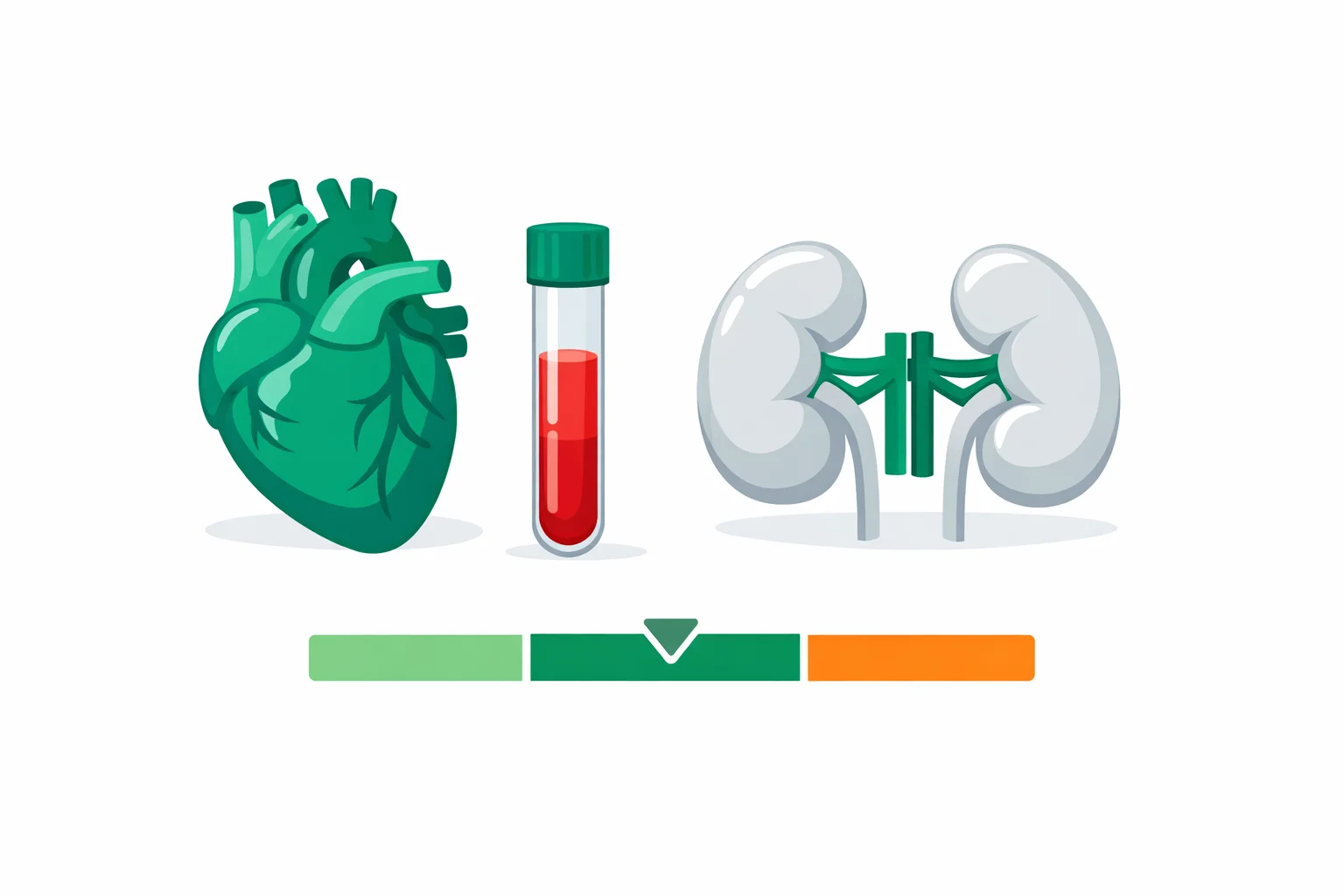
A potassium level calculator can flag 5.1 mmol/L as above one laboratory's range and within another's without making either report wrong. A reference interval describes how that laboratory reports results; a clinical action threshold answers a different question. Mixing the two can make a small lab flag look like an emergency, or make a concerning result seem reassuring. The useful comparison keeps the measured concentration, the lab limits and the clinical circumstances visible together.
In this guide
A lab flag is not an emergency threshold
The usual adult potassium interval used here is 3.5–5.0 mmol/L. MedlinePlus gives another example, 3.7–5.2 mmol/L, and advises using the laboratory's own limits. Those intervals disagree about results such as 3.6 and 5.1, which is why a report should travel with its reference range. Neither interval is a personal treatment target. A result inside the interval does not explain symptoms or replace the clinician's interpretation. [1]
Clinical severity bands serve a separate purpose. UKKA defines hyperkalemia from 5.5 mmol/L; NHS SPS defines hypokalemia below 3.5 mmol/L. The interval above 5.0 and below 5.5 therefore deserves its own label rather than being forced into either “normal” or “mild hyperkalemia.” This page calls it “above usual reference.” The wording identifies a comparison, not a diagnosis. Different organizations may use different definitions; the source of the band must stay attached to it.
A useful reading order is: check for an urgent instruction on the report, check the concentration and units, then compare the lab flag with the clinical band. Symptoms and the circumstances of the blood draw still matter. For example, a current value of 4.2 does not show what happened during an earlier episode of fainting, and it does not establish why that episode occurred.
Potassium level calculator: the math behind the comparison
Potassium is written as K⁺ because each ion carries one positive charge. Millimoles count the amount of substance; milliequivalents account for electrical charge. The conversion is mEq/L = mmol/L × absolute ionic charge. For K⁺, that charge is 1, so 4.2 mmol/L equals 4.2 mEq/L. There is no factor of 18, as there is for glucose in mg/dL and mmol/L, and no factor of 2, as there is for a divalent ion.
For a result below the selected interval, the displayed distance is lower limit − measured potassium. For a result above it, the distance is measured potassium − upper limit. A value of 3.2 compared with a lower limit of 3.5 is 0.3 mmol/L below the interval. That subtraction describes the blood concentration; it does not mean that taking 0.3 mmol of potassium will fix it.
The optional comparison is equally direct: current result − previous result. Moving from 4.6 to 5.4 gives +0.8 mmol/L. Moving from 3.8 to 3.2 gives −0.6 mmol/L. The minus sign is not a “better” sign, and the plus sign is not a “worse” sign in every situation. Without the dates, clinical context and comparable samples, neither difference tells you how quickly potassium changed.
Three reports, three different questions
These examples use invented values to show what the arithmetic can establish. The clinical band remains fixed when the lab interval changes. That makes the comparison reproducible: somebody using the same result and reference limits should obtain the same distance, even if their treatment plan is entirely different.
| Report | Lab comparison | Clinical band |
|---|---|---|
| 3.2; limits 3.5–5.0 | 3.5 − 3.2 = 0.3 below | Mild hypokalemia |
| 5.1; limits 3.7–5.2 | Within this lab interval | Above usual reference |
| 6.5; limits 3.5–5.0 | 6.5 − 5.0 = 1.5 above | Severe hyperkalemia |
The middle row is the important mismatch: 5.1 is inside a 3.7–5.2 interval, but outside the default 3.5–5.0 interval. Changing the upper limit from 5.0 to 5.2 changes the calculated excess from 0.1 to zero. It does not change the blood sample, and it does not change whether 5.1 meets UKKA's 5.5 definition. The last row is different: altering a reference limit cannot remove the 6.5 emergency threshold.
At category boundaries, the tool compares the entered value before rounding its display. A result of 5.99 belongs below 6.0; a result of exactly 6.0 belongs in the next band. The continuous intervals also avoid leaving numbers such as 2.95 unclassified between the rounded labels 2.9 and 3.0. These are arithmetic conventions for implementing the published bands, not extra precision in the laboratory measurement.
Can an ECG tell you the potassium number?
An ECG records the heart's electrical activity, not the concentration of potassium in a blood sample. Hyperkalemia can be associated with peaked T waves, conduction changes and dangerous rhythms, but these changes are not a reliable sequence that every patient follows. Assigning a specific ECG shape to every potassium band would suggest a diagnostic certainty that a concentration-only tool cannot provide.
UKKA recommends an urgent 12-lead ECG for hospitalized patients at 6.0 mmol/L or above. Its guidance also warns that a normal ECG in severe hyperkalemia does not protect against arrhythmias. A tracing and a blood result answer complementary questions. This is why the page gives clinical review messages without predicting what a person's ECG will look like. [2]
Hemolysis: confirm the sample, keep the warning
Most potassium is inside cells. If blood cells break during collection or handling, potassium can enter the sample fluid and produce a misleadingly high laboratory result. A hemolysis comment therefore changes how much confidence to place in the specimen. It does not supply a correction factor: subtracting an arbitrary 0.5 or 1.0 mmol/L would manufacture a new result.
For a hypothetical hemolyzed result of 6.7, two statements can be true together: the sample may overstate circulating potassium, and the reported value needs urgent assessment. The clinician decides how to confirm it while considering symptoms and other findings. Selecting the hemolysis option here adds a reliability note; it never moves 6.7 into a lower band. Pseudohyperkalemia is a possibility to investigate, not a conclusion from a checkbox.
Why a blood concentration is not a replacement dose
A potassium replacement calculator needs more than the difference between 3.0 and 3.5. Potassium can leave the body through renal or gastrointestinal losses, or move between blood and cells. Magnesium depletion can also complicate correction. A serum concentration is a snapshot of one compartment; it is not a measurement of the total potassium missing from the body. NHS SPS emphasizes the underlying cause, symptoms, renal function and repeat monitoring when managing hypokalemia. [3]
The units expose the problem. A gap of 0.5 mmol/L is an amount per liter. A replacement prescription is an amount, with a formulation, route and schedule. Converting the first into the second requires a physiological model and clinical decisions that simple subtraction cannot supply. Even multiplying the gap by an assumed blood volume would leave intracellular distribution, excretion and ongoing losses unresolved.
Related electrolyte tools also have different jobs. The sodium correction calculator addresses sodium relationships; its correction factors should not be transferred to potassium. An anion gap calculator combines electrolytes to help examine acid-base patterns. Neither result determines how much potassium a person should take.
What to bring to a potassium follow-up
Bring the actual report, including the collection date, units, reference interval and any hemolysis comment. A previous 4.4 and current 5.7 are more useful with their dates than as an isolated difference of +1.3. Include the names of prescription medicines, over-the-counter products, supplements and potassium-containing salt substitutes. The clinician needs those details to investigate the cause rather than merely relabel the number.
Kidney function belongs in that conversation because the kidneys regulate potassium excretion. A eGFR calculator can explain a separate kidney estimate, but it does not measure the current potassium concentration or make an abnormal result safe. Ask what follow-up is needed, who will review the next sample, and what symptoms should prompt earlier care. Follow an existing laboratory or clinical instruction even if an online interval looks less concerning.
Sources and implementation notes
- MedlinePlus: Potassium test. Laboratory reference intervals and units.
- UK Kidney Association: Treatment of Acute Hyperkalaemia in Adults. July 2026 update; adult severity bands, assessment and ECG guidance.
- NHS Specialist Pharmacy Service: Treating acute hypokalaemia in adults. Low-potassium bands, management context and monitoring.
- MedlinePlus: Potassium blood test. Potassium distribution, kidney regulation and the purpose of blood testing.
Sources checked September 5, 2026. Worked examples are illustrative calculations, not patient cases. The developer-authored implementation applies published bands and arithmetic comparisons; it has not undergone independent clinical validation. The exact entered number controls the band, and the reference interval never overrides emergency alerts.

Written by Jurica Šinko
Founder & CEO
Entrepreneur and health information advocate, passionate about making health calculations accessible to everyone through intuitive digital tools.
View full profileFrequently Asked Questions
What is the normal potassium range for adults?
A commonly used adult blood potassium interval is 3.5–5.0 mmol/L, but laboratories can use different limits. MedlinePlus gives an example of 3.7–5.2 mmol/L. Use the interval printed on your own report rather than treating one online range as universal.
How do I convert potassium from mmol/L to mEq/L?
Keep the number unchanged: 4.2 mmol/L of potassium equals 4.2 mEq/L. Potassium ions carry one positive charge, so the conversion factor is 1. This applies to blood concentration; a supplement amount in mg is a different measurement.
Is a potassium level of 5.4 high?
A result of 5.4 mmol/L is above many adult lab reference intervals. It is below the UK Kidney Association hyperkalemia threshold of 5.5 mmol/L, which does not make it safe to ignore. Ask the ordering clinician to interpret the sample quality, previous results, kidney function and medicines.
What potassium level needs emergency care?
This tool flags potassium below 2.5 or at least 6.5 mmol/L for emergency assessment. Severe symptoms such as fainting, severe weakness, chest pain or a new irregular heartbeat also need immediate care regardless of the number. Follow any more urgent instructions from your laboratory or clinician.
Is potassium 3.2 considered low?
Yes. A potassium of 3.2 mmol/L falls in the mild hypokalemia band, from 3.0 to below 3.5 mmol/L. Contact your clinician about the cause and follow-up; symptoms, magnesium depletion and kidney function affect management.
Can a hemolyzed blood sample cause high potassium?
Yes. Damaged blood cells can release potassium into the sample and create a falsely high result, called pseudohyperkalemia. There is no reliable correction that this calculator can apply to a single result. A clinician should arrange confirmation without delaying assessment of a critical value.
Can a normal ECG rule out dangerous potassium?
No. Severe hyperkalemia can occur without the expected ECG changes. UKKA recommends an urgent 12-lead ECG for hospitalized patients with potassium at least 6.0 mmol/L, but an ECG cannot replace the blood test or clinical assessment.
Can a potassium replacement calculator work out my dose from one blood test?
A blood potassium result alone cannot determine a safe replacement dose. Kidney function, magnesium, ongoing losses, medicines and movement of potassium between blood and cells all matter. A 0.5 mmol/L gap below a lab limit is a concentration difference, not an amount of potassium to take.
Related Calculators
A1C Calculator — Convert HbA1c to eAG with Targets
Use our A1C calculator to convert HbA1c to estimated average glucose (eAG). See normal, prediabetes, and diabetes thresholds in mg/dL and mmol/L. Fast results.

Albumin Calculator — Serum Albumin Level Interpretation
Free albumin calculator to interpret serum albumin levels, grade hypoalbuminemia, and compute A/G ratio plus albumin-corrected calcium from your lab results.
Albumin-Corrected Anion Gap Calculator — Hidden Acidosis
Use our albumin-corrected anion gap calculator to raise the anion gap by 2.5 per 1 g/dL of low albumin and reveal a hidden high-gap metabolic acidosis.

ANC Calculator: Absolute Neutrophil Count & Neutropenia
Free ANC calculator to calculate absolute neutrophil count from WBC and differential. Get ANC in cells/uL and x10^9/L with instant neutropenia grading.
Anion Gap Calculator — Metabolic Acidosis Evaluation
Free anion gap calculator finds serum anion gap from sodium, chloride, and bicarbonate, with albumin correction and delta ratio for metabolic acidosis.
AST/ALT Ratio Calculator — Free De Ritis Ratio Tool
Use our free AST/ALT ratio calculator to compute the De Ritis index instantly. Visual ratio chart, enzyme-level assessment, and clinical patterns guide.