Use the Fiber Intake Calculator
Free fiber intake calculator estimates your daily grams of dietary fiber from age, sex, and calories, using the 14 g per 1,000 kcal guideline and AI targets.
1. Who the target is for
The DRI changes at 9, 14, 19 and 51.
Men are given a higher flat AI because they eat more calories.
2. How much you eat
Calories drive the target, because fiber is prescribed per 1,000 kcal rather than as a flat number.
Not sure? Pick the nearest chip below, or work it out first with a calorie calculator.
A rough figure is fine. It only sets the size of the gap and the length of the ramp.
Your daily fiber target
Well short of target30.8 g
2,200 kcal ÷ 1,000 × 14 g. Your current 16 g covers 52% of it, leaving 14.8 g to find.
Why your target is not the number on the chart
The flat DRI value was built by multiplying the same 14 g rule by your group's median calorie intake — so it only fits you if you happen to eat that much.
Calorie-matched target (this tool)
30.8 g
Built on your actual 2,200 kcal
DRI Adequate Intake, 19–50 years
38 g
Assumes 2,714 kcal/day
You eat about 514 kcal less than the 2,714 kcal the 38 g figure was modelled on, so that figure asks 7.2 g more of you than the evidence behind it actually requires. Aim for 30.8 g.
Soluble fiber to aim for
7.7 g
About a quarter of the total
Daily shortfall
14.8 g
3 week ramp at +5 g/wk
Your intake as label %DV
57%
Against the 28 g Daily Value
Total water to match
3.7 L
IOM AI, food included
Build today's plan
Tap servings to stack them on top of your current 16 g and watch the total move.
Projected daily total
2 foods · +178 kcal
31.5 g102% of target
Target cleared with 0.7 g to spare.
| Food | Fiber | Servings |
|---|---|---|
| Navy beans½ cup cooked | 9.6 g | 0 |
| Split peas½ cup cooked | 8.1 g | 0 |
| Lentils½ cup cooked | 7.8 g | 0 |
| Black beans½ cup cooked | 7.5 g | 1 |
| Chickpeas½ cup cooked | 6.2 g | 0 |
| Edamame, shelled½ cup | 4 g | 0 |
| Raspberries1 cup | 8 g | 1 |
| Blackberries1 cup | 7.6 g | 0 |
| Prunes½ cup | 6.2 g | 0 |
| Pear, skin on1 medium | 5.5 g | 0 |
| Avocado½ medium | 5 g | 0 |
| Apple, skin on1 medium | 4.4 g | 0 |
| Banana1 medium | 3.1 g | 0 |
| Artichoke1 medium cooked | 6.9 g | 0 |
| Broccoli1 cup cooked | 5.1 g | 0 |
| Green peas½ cup cooked | 4.4 g | 0 |
| Brussels sprouts1 cup cooked | 4.1 g | 0 |
| Sweet potato, skin on1 medium baked | 3.8 g | 0 |
| Carrot, raw1 medium | 1.7 g | 0 |
| Pearl barley1 cup cooked | 6 g | 0 |
| Whole-wheat pasta1 cup cooked | 6.3 g | 0 |
| Quinoa1 cup cooked | 5.2 g | 0 |
| Oatmeal1 cup cooked | 4 g | 0 |
| Air-popped popcorn3 cups | 3.5 g | 0 |
| Brown rice1 cup cooked | 3.5 g | 0 |
| Whole-wheat bread1 slice | 1.9 g | 0 |
| Chia seeds1 oz (2 tbsp) | 9.8 g | 0 |
| Ground flaxseed2 tbsp | 3.8 g | 0 |
| Almonds1 oz (23 nuts) | 3.5 g | 0 |
| Pistachios1 oz | 2.9 g | 0 |
| Psyllium husk1 tbsp | 5 g | 0 |
| Inulin / chicory root1 tbsp | 4.5 g | 0 |
| Wheat bran¼ cup | 6.2 g | 0 |
| Methylcellulose1 tbsp | 3 g | 0 |
Fiber and calorie figures follow USDA FoodData Central for the serving named. Soluble shares are literature approximations — USDA no longer publishes a soluble/insoluble split for most foods.
A ramp your gut will tolerate
Going from 16 g to 30.8 g overnight is the reason most people quit. Adding 5 g a week gives the colonic microbiota time to shift toward the fermenters that handle the extra substrate.
| Week | Daily fiber | Roughly equal to |
|---|---|---|
| Week 1 | 21 g | Add 1 more bean-sized servings than week 0 |
| Week 2 | 26 g | Add 1 more bean-sized servings than week 0 |
| Week 3 | 30.8 g | Target reached — hold here |
DRI Adequate Intake for total fiber
Institute of Medicine, 2005. The final column is each figure divided by 14 g per 1,000 kcal — the calorie intake that value quietly assumes. Your row is highlighted.
| Group | Male | Female | Assumed kcal (M / F) |
|---|---|---|---|
| 1–3 years | 19 g | 19 g | 1,357 / 1,357 |
| 4–8 years | 25 g | 25 g | 1,786 / 1,786 |
| 9–13 years | 31 g | 26 g | 2,214 / 1,857 |
| 14–18 years | 38 g | 26 g | 2,714 / 1,857 |
| 19–50 yearsyou | 38 g | 25 g | 2,714 / 1,786 |
| 51+ years | 30 g | 21 g | 2,143 / 1,500 |
| Pregnancy | — | 28 g | — / 2,000 |
| Breastfeeding | — | 29 g | — / 2,071 |
Fiber has an Adequate Intake, not an RDA. The IOM set an AI precisely because the evidence was not strong enough to fix a Recommended Dietary Allowance, and it never set a Tolerable Upper Intake Level either — so there is no official ceiling, only the point at which your gut objects. If you have Crohn's disease, ulcerative colitis, diverticulitis, gastroparesis, a recent bowel resection or a known stricture, a high-fiber diet can be actively harmful and the target above does not apply to you. Ask your gastroenterologist or dietitian first.
Educational tool, not medical advice. Check this tool’s method and limitations before interpreting a result. Talk to a qualified healthcare professional before making decisions about medication, diet, exercise, or treatment. See our Terms of Use.
Your rating helps improve Fiber Intake Calculator. We store only an anonymized vote (no personal data).
How to Use Fiber Intake Calculator
Step 1: Enter your age and sex
Type your age and select male or female. The DRI Adequate Intake steps at ages 9, 14, 19 and 51, and women aged 12 to 55 also get a pregnancy or breastfeeding option that moves the target to 28 g or 29 g.
Step 2: Set your daily calories
Enter your daily calorie intake or tap one of the preset chips from 1,400 to 3,000 kcal. Calories are what personalise the result, because fiber is prescribed at 14 g per 1,000 kcal rather than as a flat number.
Step 3: Enter the fiber you eat now
Put in your current daily fiber in grams, or tap the 16 g US average chip if you are unsure. This sets the size of your shortfall and the length of the ramp schedule below.
Step 4: Compare the two targets
Read your calorie-matched target against the flat DRI value beside it. The DRI card shows the calorie intake that official figure assumes, so you can see at a glance whether it overshoots or undershoots for you.
Step 5: Build a day in the food picker
Tap the plus buttons to stack servings of legumes, fruit, vegetables, grains or supplements on top of your current intake, and watch the projected total, soluble share and added calories move toward your target.
Step 6: Follow the ramp schedule
If your gap is larger than 5 g, use the week-by-week table to raise intake by 5 g per week instead of all at once, and match it with the daily fluid figure shown in the results cards.
Key Features
- Calorie-matched target built on the 14 g per 1,000 kcal DRI basis
- Side-by-side comparison against the flat DRI Adequate Intake for your group
- Reverse-calculates the calorie intake each official figure quietly assumes
- Interactive food picker with 34 foods and their soluble fiber share
- Week-by-week ramp schedule at 5 g per week to avoid bloating
- Separate soluble fiber target plus pregnancy and breastfeeding AI values
Understanding Results
The Fiber Intake Calculator Formula: 14 g per 1,000 kcal
The recommended fiber intake rests on a single ratio the Institute of Medicine drew from coronary heart disease risk data — 14 grams of fiber for every 1,000 calories eaten:
Daily fiber target (g) = daily calories ÷ 1,000 × 14
Every flat DRI number is that ratio multiplied by a group median calorie intake, which means the arithmetic runs both ways. Divide any published Adequate Intake by 14 and multiply by 1,000 and you recover the calorie level it was built for — 2,714 kcal behind the 38 g figure for men, 1,786 kcal behind the 25 g figure for women:
Assumed calories = Adequate Intake (g) ÷ 14 × 1,000
Two secondary figures follow from the target. The soluble share is estimated at 25% of the total, the typical split in a mixed Western diet. The ramp length is your shortfall divided by 5 g per week, the rate at which the colonic microbiota can adapt without producing gas and bloating.
Reference Ranges & Interpretation
The IOM Adequate Intake for total fiber is 38 g for men aged 19–50 and 30 g from 51 onward; 25 g for women aged 19–50 and 21 g from 51 onward; 28 g in pregnancy and 29 g while breastfeeding. Children run 19 g at ages 1–3, 25 g at 4–8, then 31 g for boys and 26 g for girls aged 9–13. The FDA Daily Value printed on nutrition labels is 28 g, the same ratio at a 2,000 kcal reference diet.
Measured against that, the average US adult eats about 16 g a day, and the Dietary Guidelines report that more than 90% of women and 97% of men fall short. Anything below roughly 60% of your calorie-matched target is a meaningful deficit worth a structured plan rather than a vague intention. At the other end, tolerance rather than toxicity is the limit: most people meet theirs somewhere between 50 g and 60 g a day.
Assumptions & Limitations
Fiber has an Adequate Intake rather than an RDA, which is the IOM signalling that the evidence was not strong enough to fix a firm requirement. No Tolerable Upper Intake Level was ever set either, so there is no official ceiling — only the point at which your gut objects. The calculator inherits both of those uncertainties.
The 25% soluble share is a population average, not a measurement of your diet; a bran-heavy day may run nearer 10% soluble while an oats-and-beans day can exceed 40%. Soluble percentages in the food picker are literature approximations, since USDA no longer publishes a soluble and insoluble split for most foods. Your current intake figure is self-reported and is used only to size the gap and the ramp, so an error there changes the schedule but never the target.
The target does not apply during an active inflammatory bowel disease flare, acute diverticulitis, gastroparesis, a known intestinal stricture, or recovery from bowel surgery, where a low-residue diet may be prescribed instead. Psyllium and other viscous fibers can also interfere with the absorption of some medications if taken at the same time. Speak to a gastroenterologist or registered dietitian before making a large change if any of that applies to you.
Complete Guide: Fiber Intake Calculator
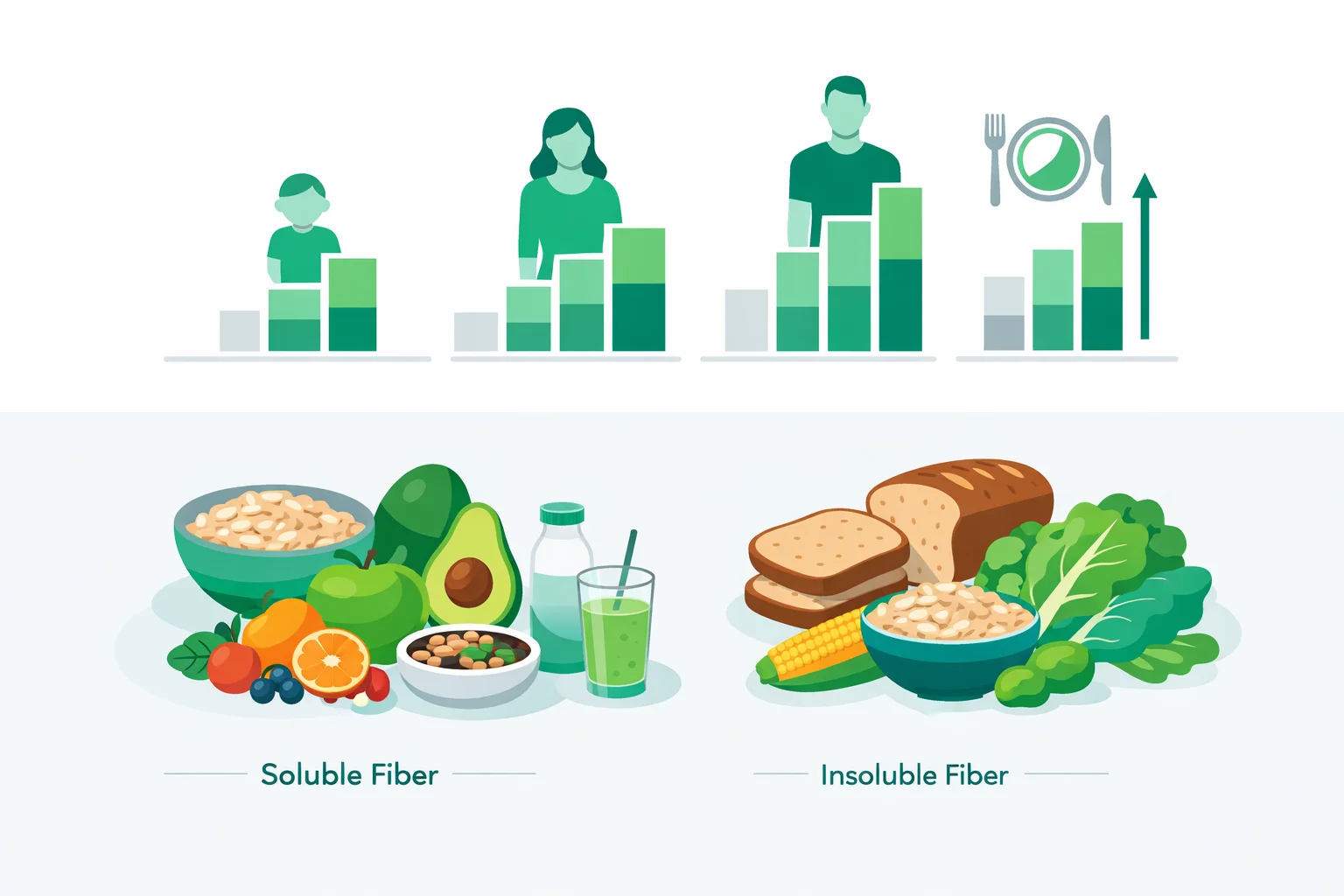
On this page
- Two fiber targets, and only one of them knows what you eat
- Reverse-engineering the 38 g figure
- 1.4 grams per 100 calories: the number that decides everything
- Soluble vs. insoluble: only one of them touches your LDL
- Why the first week is always the worst
- When a supplement beats food
- Can you eat too much fiber?
- References
Any fiber intake calculator has to answer a question the official guidance quietly ducks: 25 grams and 38 grams are the numbers everyone quotes, but neither was ever meant to be a universal target. The federal Dietary Guidelines put the shortfall at more than 90% of women and 97% of men — a miss rate so close to unanimous that it says less about willpower than about the target itself. The average American adult eats roughly 16 g a day.
Here is what almost nobody explains. The 38 g and 25 g figures are not independent measurements. They are one single rule — 14 grams of fiber per 1,000 calories — multiplied by the median calorie intake of each age and sex group. That makes them hand-me-downs. If you eat 1,500 calories or 3,000, the flat number was sewn for somebody else. This guide compares the two standards, shows you how to run the official figure backwards to expose the calorie intake it assumes, and gives you a density table that makes the whole thing solvable at the grocery store.
Two Fiber Targets, and Only One of Them Knows What You Eat
The Institute of Medicine set an Adequate Intake for total fiber in 2005. Not an RDA — an AI, which is the label used when the evidence is too thin to fix a Recommended Dietary Allowance. The committee anchored it to coronary heart disease risk rather than bowel habit, landing on the intake band where cardiovascular events were lowest: 14 g per 1,000 kcal.
Daily fiber target (g) = daily calories ÷ 1,000 × 14
Then, to publish something usable, they multiplied that ratio by each group's median energy intake and printed the products as flat numbers. Men 19–50 got 38 g. Women 19–50 got 25 g. Adults over 50 dropped to 30 g and 21 g, not because ageing changes fiber biology but because calorie intake falls with age.
So the two standards are not rivals. One is the parent, the other is the child, and the child inherited an assumption about your appetite. A 62-year-old woman eating 1,450 kcal and a 26-year-old man eating 3,200 kcal are handed 21 g and 38 g respectively; the density rule gives them 20 g and 45 g. For her the official number is nearly right. For him it is 7 g short every single day, which compounds to about 2.5 kg of missing fiber a year.
This is also why the FDA Daily Value on a nutrition label reads 28 g rather than 25 or 38. The label has no idea who is holding it, so it uses the 2,000 kcal reference diet: 2,000 ÷ 1,000 × 14 = 28. Every “% Daily Value” for fiber you have ever read was computed against a hypothetical 2,000-calorie eater. If you don't know your own intake, our calorie intake calculator gives you the input this whole calculation hinges on.
Reverse-Engineering the 38 g Figure
Because every AI value is a product, you can divide it back out and recover the calorie intake hiding inside it:
Assumed calories = AI grams ÷ 14 × 1,000
Run every published figure through it and the DRI table stops looking like nutrition advice and starts looking like what it is — a calorie table in disguise:
| Group | Published AI | Calorie intake it assumes |
|---|---|---|
| Men 19–50 | 38 g | 2,714 kcal |
| Men 51+ | 30 g | 2,143 kcal |
| Women 19–50 | 25 g | 1,786 kcal |
| Women 51+ | 21 g | 1,500 kcal |
| Pregnancy | 28 g | 2,000 kcal |
| Breastfeeding | 29 g | 2,071 kcal |
Two things fall out of that table. First, a woman dieting on 1,300 kcal is chasing a 25 g target built for someone eating 1,786 — she is being asked for 19 g per 1,000 kcal, a third more density than the guideline itself specifies. Second, the pregnancy figure of 28 g is not a pregnancy adjustment at all. It is the 2,000 kcal reference diet, the same arithmetic as the food label — which matters, because pregnancy raises energy needs by 340 to 452 kcal a day in the second and third trimesters. Work out your actual intake with our pregnancy calorie calculator and the matching fiber target usually lands above 28 g, not on it. The calculator above prints this assumed-calorie column next to your own intake so you can see immediately which side of the mismatch you are on.
1.4 Grams per 100 Calories: the Number That Decides Everything
Fiber gram counts are a bad shopping tool, because a food can be fiber-rich and calorie-rich at the same time. Divide the guideline by ten and it becomes a rule you can apply to a single item: 14 g per 1,000 kcal is 1.4 g per 100 kcal. That is the break-even. Any food above it drags your whole diet toward the target; anything below drags it away.
| Food | Fiber per 100 kcal | Against the 1.4 g break-even |
|---|---|---|
| Psyllium husk | 27.8 g | 20× — practically pure fiber |
| Wheat bran | 20.0 g | 14× |
| Raspberries | 12.5 g | 9× — the best whole fruit there is |
| Artichoke | 10.8 g | 8× |
| Broccoli | 9.3 g | 7× |
| Navy beans | 7.5 g | 5× |
| Lentils | 6.8 g | 5× |
| Pear, skin on | 5.4 g | 4× |
| Avocado | 4.2 g | 3× |
| Air-popped popcorn | 3.8 g | 3× |
| Whole-wheat pasta | 3.6 g | 2.6× |
| Oatmeal | 2.4 g | 1.7× — lower than its reputation |
| Whole-wheat bread | 2.3 g | 1.6× |
| Almonds | 2.1 g | 1.5× — barely clears it |
| Brown rice | 1.6 g | 1.1× — essentially neutral |
| White rice | 0.3 g | Pulls you backwards |
| Meat, fish, eggs, dairy, oil | 0.0 g | Zero, without exception |
The bottom row is the one that reframes the problem. Animal foods and fats contain no fiber whatsoever, so they spend calories without contributing anything to the numerator. If 40% of your calories come from meat, dairy, eggs and oil — which is unremarkable for a Western diet — the remaining 60% has to run at 14 ÷ 0.6 = 23.3 g per 1,000 kcal, or 2.3 g per 100 kcal, just to average out to the guideline.
Look back at the table with that number in mind and oatmeal, whole-wheat bread and almonds all fall below the line you actually need to clear. This is the quiet reason so many careful eaters miss the target: they swapped white bread for whole wheat, brown rice for white, and picked up 1.3 g per 100 kcal for their trouble. Beans, berries, and cruciferous vegetables are the only common foods dense enough to carry the zero-fiber half of a normal diet. The same density logic drives our macro calculator when it splits your carbohydrate allowance between starch and fibrous vegetables.
Soluble vs. Insoluble: Only One of Them Touches Your LDL
No official body sets a separate target for soluble and insoluble fiber, which is unfortunate, because they do completely different jobs and the FDA has authorised health claims for one and not the other.
Soluble, viscous fiber dissolves into a gel that traps bile acids in the small intestine. The liver then pulls LDL cholesterol out of circulation to synthesise replacement bile. The effect is real but modest: the classic meta-analysis of 67 controlled trials put it at roughly 2.2 mg/dL of LDL reduction per gram of soluble fiber added per day. That is why the FDA-authorised claims specify amounts rather than foods — 3 g/day of beta-glucan from oats or barley, or 7 g/day of soluble fiber from psyllium husk. Below those thresholds the claim cannot legally be made, because the effect isn't reliably measurable.
Insoluble fiber does not dissolve and does not move LDL. It increases stool mass and accelerates transit — wheat bran is about 95% insoluble, which is exactly why it works for constipation and exactly why it aggravates IBS in a subset of people.
A mixed Western diet runs about 25% soluble, which is the split the calculator assumes when it prints your soluble target. But if cholesterol is the reason you are here, that quarter is unlikely to reach 7 g on its own — a 2,000 kcal diet at 28 g total yields about 7 g soluble only if you are deliberately choosing oats, barley, beans, apples and citrus over bran and whole wheat. Two tablespoons of psyllium gets you there in one step, which no amount of whole-grain bread will.
Why the First Week Is Always the Worst
People quit high-fiber diets for a reason that has nothing to do with discipline. Fiber is not digested by you — it is fermented by the bacteria in your colon, and that population takes days to weeks to shift toward the species that can handle a larger substrate load. Double your intake on a Monday and you have handed a modest bacterial population far more feedstock than it can process cleanly. The gas, bloating and cramping that follow are the predictable output.
The standard clinical fix is to add about 5 g per day per week. Going from the US average of 16 g to a 32 g target is therefore a four-week project, not a decision. The calculator lays that schedule out week by week once your gap exceeds 5 g.
Fluid is the other half. Soluble fiber works by forming a gel, and a gel needs water to form; psyllium taken with too little fluid can make constipation worse rather than better, and in rare cases has caused oesophageal obstruction. The IOM total water Adequate Intake is 3.7 L a day for men and 2.7 L for women, food included — roughly 20% of that typically arrives in food, so the drinking portion is closer to 3.0 L and 2.2 L. Raise fiber without raising fluid and you have engineered exactly the problem you were trying to solve.
When a Supplement Beats Food
Food first is good advice that occasionally loses to arithmetic. A tablespoon of psyllium husk delivers about 5 g of fiber, roughly 70% of it soluble, for 18 kcal. Reaching the same 3.5 g of soluble fiber from oatmeal costs about 290 kcal. If you are eating 1,400 kcal on a deficit, that is a fifth of your day spent on one nutrient, and the calorie budget simply won't stretch — which is the situation where a supplement stops being a shortcut and starts being the only way the numbers close.
The supplements are not interchangeable, though. Psyllium is viscous and fermented slowly, so it both softens stool and carries the LDL claim. Inulin and chicory root fibre are rapidly fermented, which makes them effective prebiotics and notorious gas producers — they are the reason so many “high fibre” snack bars have a reputation. Wheat bran is almost entirely insoluble bulk with no cholesterol effect. Methylcellulose is synthetic, viscous and non-fermentable, which makes it the gentlest option for anyone whose problem is gas rather than transit.
One labelling trap is worth knowing about. Isomalto-oligosaccharide (IMO) appears on ingredient lists as fiber but is substantially digested and absorbed as glucose, and the FDA never accepted it onto its list of recognised dietary fibers. If you are counting carbohydrate as well as fiber, our net carbs calculator handles which fiber grams may honestly be subtracted from a label total and which may not.
Can You Eat Too Much Fiber?
The IOM set no Tolerable Upper Intake Level for fiber, and that omission is informative — there was no evidence of harm from fiber occurring naturally in food at any intake the committee examined. The practical ceiling is tolerance rather than toxicity, and it sits somewhere around 50–60 g for most people, past which bloating and loose stools become the limiting factor well before anything clinical does.
The mineral-binding worry you may have read about is largely misattributed. Phytate, which travels with fiber in whole grains and legumes rather than being fiber itself, is what chelates iron and zinc. Soaking, sprouting and fermenting reduce phytate substantially, and population-level studies of high-fiber diets have not shown the deficiencies the mechanism predicts. Magnesium runs the other way entirely: the beans, seeds, greens and whole grains carrying the most fiber are also its richest food sources, at 120–157 mg a serving, so closing a fiber gap usually closes a magnesium gap alongside it. The magnesium dosage calculator shows how much of the 310–420 mg RDA those same foods already cover.
The genuine exceptions are clinical, not quantitative. Active Crohn's or ulcerative colitis flares, acute diverticulitis, gastroparesis, a known intestinal stricture, or a recent bowel resection can all turn a high-fiber diet into an obstruction risk, and low-residue diets exist for precisely those situations. The older folk advice that diverticulosis patients must avoid nuts, seeds and popcorn has since been contradicted — a large prospective cohort found no increased risk of diverticulitis in men who ate them, and if anything a lower one.
References
- Institute of Medicine. Dietary Reference Intakes for Energy, Carbohydrate, Fiber, Fat, Fatty Acids, Cholesterol, Protein, and Amino Acids (2005) — the source of the 14 g/1,000 kcal basis and every Adequate Intake value above.
- U.S. Departments of Agriculture and Health and Human Services. Dietary Guidelines for Americans — fiber as a dietary component of public health concern, and the shortfall prevalence figures.
- U.S. Food and Drug Administration. 21 CFR 101.81 — Health claims: soluble fiber from certain foods and coronary heart disease — the 3 g beta-glucan and 7 g psyllium thresholds.

Written by Jurica Šinko
Founder & CEO
Entrepreneur and health information advocate, passionate about making health calculations accessible to everyone through intuitive digital tools.
View full profileFrequently Asked Questions
How much fiber do I need per day?
Take your daily calories, divide by 1,000 and multiply by 14. At 2,000 kcal that is 28 g, which is exactly why the FDA Daily Value on nutrition labels reads 28 g. The flat figures you usually see — 38 g for men aged 19 to 50 and 25 g for women, dropping to 30 g and 21 g after 50 — are that same ratio applied to each group median calorie intake, so they only fit you if you eat that much.
Is 25 grams of fiber a day enough for a woman?
It depends entirely on how much she eats. The 25 g figure was built for a woman consuming about 1,786 kcal a day. On a 1,400 kcal deficit the matching target is 20 g, so 25 g is more than the guideline actually asks of her. Eating 2,400 kcal makes the matching target 34 g, and 25 g leaves her 9 g short every day.
What happens if you suddenly eat a lot of fiber?
Gas, bloating and cramping, usually within 24 to 48 hours. Fiber is fermented by colonic bacteria rather than digested by you, and that population needs days to weeks to shift toward the species that handle a bigger substrate load. Raise intake by about 5 g per day per week and increase fluid at the same time, and most people get through it without symptoms.
Which fiber lowers cholesterol, soluble or insoluble?
Soluble, viscous fiber only. It gels in the small intestine and traps bile acids, forcing the liver to pull LDL from circulation to make more. The effect is about 2.2 mg/dL of LDL reduction per gram of soluble fiber per day. The FDA authorises the heart health claim at 3 g/day of beta-glucan from oats or barley, or 7 g/day of soluble fiber from psyllium. Insoluble fiber such as wheat bran adds stool bulk and speeds transit but does not move LDL.
Why does the nutrition label say 28 g of fiber but the guideline says 38 g?
A food label cannot know who is reading it, so every percent Daily Value is computed against a standard 2,000 kcal reference diet: 2,000 divided by 1,000, times 14, equals 28 g. The 38 g figure is the same calculation run at 2,714 kcal, the median intake for men aged 19 to 50. Neither number is wrong; they assume different eaters.
How much fiber should a child eat?
Paediatricians commonly use the age plus 5 rule as a practical floor, so a 7-year-old aims for 12 g a day and a 12-year-old for 17 g. That is deliberately gentler than the DRI, which asks 25 g of a 4 to 8-year-old and 31 g of a boy aged 9 to 13, because young children rarely eat enough food volume to reach the full DRI without a supplement. Build up toward the DRI as portion sizes grow.
Can too much fiber be harmful?
The Institute of Medicine set no Tolerable Upper Intake Level for fiber, because no harm was demonstrated from fiber occurring naturally in food. In practice tolerance is the ceiling, and most people meet it somewhere around 50 to 60 g a day as bloating and loose stools set in. The real exceptions are clinical rather than numerical: active Crohn disease or ulcerative colitis, acute diverticulitis, gastroparesis, a known stricture or a recent bowel resection can all make a high-fiber diet an obstruction risk.
Does fiber from supplements count toward my daily target?
Recognised fibers do. One tablespoon of psyllium husk supplies about 5 g, roughly 70 percent of it soluble, for only 18 kcal, which is why it wins on a tight calorie budget where 3.5 g of soluble fiber from oatmeal would cost about 290 kcal. Isomalto-oligosaccharide is the exception worth knowing: it is marketed as fiber but is largely digested as glucose, and the FDA never added it to its list of recognised dietary fibers.
Related Calculators

BMR Calculator: Basal Metabolic Rate by Proven Formulas
Use our BMR calculator to estimate your basal metabolic rate using Mifflin–St Jeor or revised Harris–Benedict formulas. Choose metric or US units and see TDEE.
Caffeine Content Calculator — Coffee, Energy Drinks & Tea
Free caffeine content calculator showing how much caffeine is in coffee, espresso, tea, Red Bull, Monster and Celsius, plus your safe daily limit by weight.

Caffeine Half-Life Calculator: How Long Caffeine Lasts
Free caffeine half-life calculator showing how much caffeine is left at bedtime, your personal clearance rate, and the latest safe cutoff time to drink.

Calorie Calculator: Daily TDEE and Intake Estimate
Use our calorie calculator to estimate daily energy needs (TDEE) from age, sex, height, weight, and activity. See maintain, loss, and gain targets instantly.

Calorie Deficit Calculator — Set a Safe Daily Deficit
Use our calorie deficit calculator to set a safe daily calorie target. Estimate TDEE, choose a weekly weight-loss rate, and see deficit, timeline, and guidance.

Calorie Density Calculator: Calories per Gram of Food
Free calorie density calculator that turns calories and grams into kcal per gram, sorts any food into four energy density bands, and compares two foods.