Use the Caffeine Half-Life Calculator
Free caffeine half-life calculator showing how much caffeine is left at bedtime, your personal clearance rate, and the latest safe cutoff time to drink.
1. What did you drink, and when?
Add every caffeinated drink. The calculator stacks them, so a morning coffee still counts against your night.
Not sure of the dose? Use the caffeine content table below the results.
2. When do you want to be asleep?
A bedtime before your last drink rolls to the next day.
Sleep threshold: 50 mg — Most adults — the default threshold.
3. How fast do you clear caffeine?
More than 95% of caffeine is broken down by the liver enzyme CYP1A2. These factors change how fast it works.
Baseline metabolismPopulation average — start here.
Caffeine half-life climbs through pregnancy and can reach 15 hours near term.
Caffeine still in your system at 11:00 PM
May delay sleep onset60 mg
That is 24% of the 255 mg you drank, measured against your 50 mg sleep threshold.
Your half-life
5.0 h
Population average is 5 h
Peak level
196 mg
At 2:30 PM
Total intake
255 mg
64% of the 400 mg guide
Down to trace (10 mg)
11:58 AM (next day)
21 h 28 min after your last drink
Your caffeine cutoff time
12:48 PM
Have your last 160 mg serving by this time and your total lands on 50 mg at 11:00 PM. Right now it is at 2:30 PM. Earlier drinks already claim 11 mg of that budget.
Caffeine decay timeline
Each bar is the total caffeine in your body at that hour. The dashed line is your 50 mg sleep threshold.
When caffeine clears your system
| Milestone | Amount left | Clock time | After last drink |
|---|---|---|---|
| 50% of peak left | 98 mg | 7:30 PM | 5 h |
| 25% of peak left | 49 mg | 12:30 AM (next day) | 10 h |
| Below your sleep threshold | 50 mg | 12:21 AM (next day) | 9 h 51 min |
| Below 10 mg (trace) | 10 mg | 11:58 AM (next day) | 21 h 28 min |
| 97% cleared (5 half-lives) | 6.1 mg | 3:30 PM (next day) | 25 h |
Latest safe time, by drink
If you swapped your final drink for one of these: with a 5.0 h half-life, a 11:00 PM bedtime, and 11 mg still left over from your earlier drinks, this is the last moment each one keeps your total at or under 50 mg.
| Drink | Caffeine | Drink it by |
|---|---|---|
| Green tea | 28 mg | No limit |
| Black tea | 47 mg | 9:38 PM |
| Espresso shot | 63 mg | 7:32 PM |
| Brewed coffee | 95 mg | 4:34 PM |
| Energy drink | 160 mg | 12:48 PM |
| Cold brew | 200 mg | 11:12 AM |
| Pre-workout | 250 mg | 9:35 AM |
Caffeine content reference
Tap any row to add that drink to your timeline. Highlighted rows are already in your list.
| Source | Serving | Caffeine | Add |
|---|---|---|---|
| Brewed coffee | 8 oz / 240 ml | 95 mg | |
| Espresso | 1 oz / 30 ml | 63 mg | |
| Instant coffee | 8 oz / 240 ml | 62 mg | |
| Cold brew | 12 oz / 355 ml | 200 mg | |
| Decaf coffee | 8 oz / 240 ml | 3 mg | |
| Black tea | 8 oz / 240 ml | 47 mg | |
| Green tea | 8 oz / 240 ml | 28 mg | |
| Matcha | 8 oz / 240 ml | 70 mg | |
| Red Bull | 8.4 oz / 250 ml | 80 mg | |
| Monster Energy | 16 oz / 473 ml | 160 mg | |
| Celsius | 12 oz / 355 ml | 200 mg | |
| Cola | 12 oz / 355 ml | 34 mg | |
| Diet Cola | 12 oz / 355 ml | 46 mg | |
| Dark chocolate | 1 oz / 28 g | 12 mg | |
| Pre-workout | 1 scoop | 250 mg | |
| Caffeine tablet | 1 tablet | 200 mg |
Estimate only. This model assumes caffeine is fully absorbed at the moment you drink it and clears at one steady rate. Real absorption peaks 30–60 minutes after your first sip, and individual half-life ranges from about 1.5 to 9.5 hours in healthy adults. Do not use this tool to time medication, and talk to a clinician about caffeine if you are pregnant, have a heart rhythm disorder, or take CYP1A2-affecting drugs.
Educational tool, not medical advice. Check this tool’s method and limitations before interpreting a result. Talk to a qualified healthcare professional before making decisions about medication, diet, exercise, or treatment. See our Terms of Use.
Your rating helps improve Caffeine Half-Life Calculator. We store only an anonymized vote (no personal data).
How to Use Caffeine Half-Life Calculator
Step 1: Log every caffeinated drink
Tap a quick-add chip such as Coffee (95 mg), Energy drink (160 mg), or Cold brew (200 mg), or type milligrams into the Drink field. Set the Time for each one, including this morning's cup.
Step 2: Set your bedtime and sensitivity
Enter your Target bedtime, then pick a Caffeine sensitivity of Low, Typical, or High. That choice sets your sleep threshold to 100 mg, 50 mg, or 25 mg.
Step 3: Tune your clearance rate
Choose a Baseline metabolism of Fast (3.5 h), Typical (5 h), or Slow (7 h), then tick smoking, oral contraceptives, CYP1A2-inhibiting medication, liver disease, or a pregnancy trimester.
Step 4: Read your bedtime level
The headline shows the milligrams still circulating at bedtime and whether that sits below your threshold, above it, or far enough over to disrupt sleep.
Step 5: Act on your cutoff time
The green card gives the latest clock time for your final drink. The "Latest safe time, by drink" table repeats that cutoff for seven common drinks from green tea to pre-workout.
Step 6: Check full clearance
Scroll to the milestones table to see when you fall below your threshold, drop under 10 mg, and hit 97% cleared after five half-lives.
Key Features
- Personal half-life from CYP1A2 factors
- Stacks every drink onto one decay curve
- Caffeine cutoff time for your bedtime
- Hour-by-hour decay chart with sleep threshold
- Clearance milestones as clock times
- Caffeine content table for 16 common sources
Understanding Results
Formula
Caffeine clears by first-order elimination, so a fixed percentage leaves per hour rather than a fixed number of milligrams. Each drink decays as C(t) = C₀ × 0.5(t ÷ t½), where C₀ is the dose in milligrams, t is hours since you drank it, and t½ is your half-life. The calculator sums that curve across every drink you log, so your bedtime figure is the total body burden, not just the last cup.
The cutoff time is the same equation solved backwards: t = t½ × log₂(dose ÷ headroom). Headroom is your sleep threshold minus whatever your earlier drinks still contribute at bedtime, which is why adding a morning coffee moves your afternoon cutoff earlier.
Reference Ranges & Interpretation
Caffeine half-life in healthy adults averages 5 hours with a normal range of about 1.5 to 9.5 hours. Smoking shortens it to roughly 3 hours; oral contraceptives lengthen it to about 8.5 hours; the third trimester of pregnancy can push it to 15 hours. Peak blood concentration arrives 30 to 60 minutes after your first sip, and oral bioavailability is close to 100%.
For the bedtime figure, the tool compares your total against a sleep threshold of 100 mg (low sensitivity), 50 mg (typical), or 25 mg (high). At or below your threshold, caffeine is unlikely to affect sleep onset; between one and two times it, expect a delay; above twice it, expect measurable disruption. The 400 mg daily ceiling shown on the intake card is the FDA guidance for healthy adults, while ACOG advises under 200 mg per day during pregnancy. These are separate questions: you can stay under 400 mg per day and still ruin a night by drinking it late.
Assumptions & Limitations
The model assumes the entire dose enters your bloodstream the instant you drink it and then clears at one steady rate. Real absorption takes 30 to 60 minutes, so the first hour of the curve reads slightly high; by the time bedtime is several hours out, the difference is under a milligram. It also assumes linear kinetics, which holds at dietary doses but not at the gram-level intakes seen in overdose.
Your half-life estimate is a category, not a measurement — only a lab test can give you the real number, and CYP1A2 activity varies with genotype, diet, and medication. The sleep thresholds are practical rules of thumb rather than validated clinical cutoffs. Do not use this tool to time medication doses, and speak with a clinician about caffeine if you are pregnant, have a heart rhythm disorder or liver disease, or take drugs such as fluvoxamine or ciprofloxacin that inhibit CYP1A2.
Complete Guide: Caffeine Half-Life Calculator
On this page
- Half-life vs. how long you actually feel it
- The formula behind every caffeine half-life calculator
- Why your half-life is probably not 5 hours
- Where the "no coffee after 2 p.m." rule comes from
- Front-loading beats rationing: same 255 mg, three nights
- Pregnancy, the pill, and cigarettes
- Four mistakes that wreck your estimate
- What to do with your cutoff time
- References
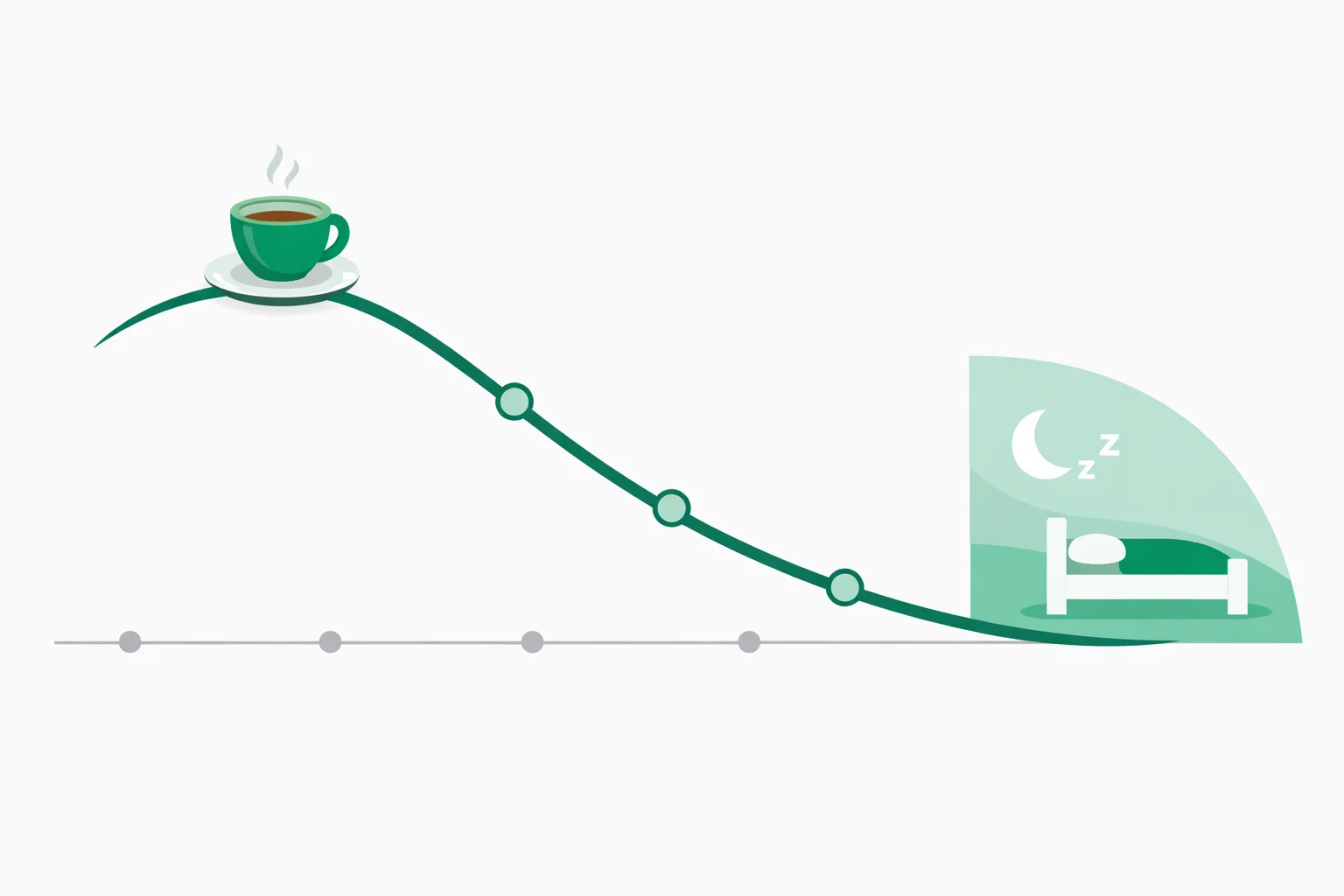
A caffeine half-life calculator converts one number — the time your body needs to clear half a dose — into the two answers you actually want at 3 p.m.: how much caffeine is still circulating at bedtime, and how late you can drink. The math is a single line: C(t) = C₀ × 0.5^(t ÷ t½). Drop a 200 mg cold brew into it at 3 p.m., use the population-average half-life of 5 hours, and 11 p.m. still finds roughly 66 mg in your bloodstream. That is a full shot of espresso, poured directly into the start of your night.
Most advice about caffeine and sleep stops at "don't drink it late." The half-life model is more useful than that, because it gives you a clock time instead of a vibe. This guide walks through the equation, the reason your personal half-life probably isn't 5 hours, and the cases where the whole model quietly falls apart.
Half-Life vs. How Long You Actually Feel It
These are two different clocks, and confusing them is the single most common error. Caffeine reaches peak blood concentration 30 to 60 minutes after your first sip, with near-total oral bioavailability — almost nothing is lost on the way in. The alertness you feel typically fades within 3 to 4 hours. The caffeine does not. At a 5-hour half-life, 4 hours after a 95 mg coffee you still carry 55 mg, more than half the original dose, even though the lift is long gone.
The gap exists because caffeine works by blocking adenosine receptors rather than by stimulating anything directly. Adenosine is the molecule that accumulates across your waking hours and creates sleep pressure. Caffeine occupies its parking spots. Subjective alertness tracks how new that blockade feels; sleep disruption tracks how much caffeine is physically present when you lie down. So the drug can be invisible to you at 8 p.m. and still add 20 minutes to your sleep latency at 11 p.m.
The Formula Behind Every Caffeine Half-Life Calculator
Caffeine follows first-order elimination at normal dietary doses: a fixed percentage leaves per unit time, not a fixed amount. That gives the exponential decay curve every caffeine half-life calculator is built on.
C(t) = C₀ × 0.5(t ÷ t½)
C₀ = the dose in mg · t = hours since you drank it · t½ = your half-life in hours
Worked example, a 160 mg energy drink at 2:30 p.m. with a 5-hour half-life and an 11 p.m. bedtime:
- Elapsed time: 2:30 p.m. to 11:00 p.m. = 8.5 hours
- Half-lives elapsed: 8.5 ÷ 5 = 1.7
- Fraction remaining: 0.51.7 = 0.308
- Caffeine left: 160 × 0.308 = 49 mg
Run the same equation backwards and you get the cutoff time instead: t = t½ × log₂(dose ÷ target). For that 200 mg cold brew, aiming to be under 50 mg at bedtime: log₂(200 ÷ 50) = 2, so 2 × 5 = 10 hours before bed. With an 11 p.m. bedtime, your cutoff is 1 p.m. — a full hour earlier than the folk rule. That inversion is what the calculator above solves for you, including the residue from drinks earlier in the day.
Why Your Half-Life Is Probably Not 5 Hours
Five hours is a population mean, and the spread around it is enormous: healthy adults range from about 1.5 to 9.5 hours. Over 95% of caffeine is broken down by a single liver enzyme, CYP1A2, which converts it mostly into paraxanthine. Anything that induces or inhibits that enzyme moves your entire decay curve. Here is what the documented modifiers do to a 5-hour baseline:
| Factor | Effect on CYP1A2 | Half-life | 200 mg left at 8 h |
|---|---|---|---|
| Heavy smoking | Strong induction | ~3.0 h | 32 mg |
| Healthy adult baseline | — | 5.0 h | 66 mg |
| Pregnancy, 1st trimester | Reduced clearance | ~6.5 h | 85 mg |
| Oral contraceptives / estrogen | Inhibition | ~8.5 h | 104 mg |
| Pregnancy, 2nd trimester | Reduced clearance | ~10 h | 115 mg |
| Pregnancy, 3rd trimester | Reduced clearance | ~15 h | 138 mg |
| Fluvoxamine, ciprofloxacin | Direct inhibition | 12–25 h | 126–160 mg |
| Cirrhosis / severe liver disease | Loss of capacity | 15 h+ | 137 mg+ |
| Newborn, under 1 month | Immature enzyme | ~80 h | 187 mg |
Read the last column as the practical consequence. A smoker and someone on the pill can drink the identical 200 mg at the identical hour and land at bedtime with 32 mg versus 104 mg — a threefold difference from the same cup. That is why a single universal cutoff rule can never be right for both of them, and why a caffeine metabolism calculator is only ever as good as the half-life you feed it — find your row in the table above before you trust any clock time on this page. If you also want your running daily total against the 400 mg guideline, our caffeine intake calculator tracks the day's milligrams rather than the decay curve.
Where the "No Coffee After 2 p.m." Rule Comes From
It traces back to a 2013 study in the Journal of Clinical Sleep Medicine. Drake and colleagues gave healthy sleepers 400 mg of caffeine at three timings — 0, 3, and 6 hours before bed — in a double-blind, placebo-controlled design. All three disrupted sleep. The headline finding was the last one: the dose taken a full six hours before bedtime still cost more than one hour of total sleep time, and the participants did not notice. Subjective sleep quality ratings failed to detect the loss that the objective monitoring recorded.
Six hours before an 11 p.m. bedtime is 5 p.m., not 2 p.m. The stricter folk rule exists because 400 mg is a large dose and the study only tested three timings, so the safety margin got rounded outward. Your actual number depends on three variables the rule ignores: your half-life, your dose, and how much caffeine you already have on board. That last one is where most people go wrong.
Front-Loading Beats Rationing: Same 255 mg, Three Different Nights
Doses stack. The calculator sums every drink's remaining curve, because your liver does too. Hold the total fixed at 255 mg with a 5-hour half-life and an 11 p.m. bedtime, and only the timing changes. (If you are unsure what your drinks actually contain before you stack them, look each one up in the caffeine content calculator — a 16 oz Bang is 300 mg where a Red Bull is 80 mg, and that four-fold gap changes every row below.)
| Schedule (255 mg total) | At 11 p.m. | Verdict |
|---|---|---|
| All 255 mg at 7:30 a.m. | 30 mg | Clear |
| 95 mg at 7:30 a.m. + 160 mg at 2:30 p.m. | 60 mg | Over a 50 mg threshold |
| All 255 mg at 2:30 p.m. | 79 mg | Sleep onset likely delayed |
Identical caffeine, a 2.6x spread in bedtime exposure. Notice the middle row: that morning coffee still contributes 11 mg at 11 p.m., which is 18% of the bedtime total. It is small in isolation, and it is exactly the amount that pushes a borderline night over the line. This is also why cutting your afternoon cup in half often works better than moving it 30 minutes earlier — halving the dose removes one full half-life of exposure, while a 30-minute shift removes a tenth of one. If your nights are already short, pair this with our sleep debt calculator to see what the accumulated shortfall is costing you.
Pregnancy, the Pill, and Cigarettes: The Three Biggest Swings
Pregnancy produces the largest change in any healthy adult. Caffeine clearance falls steadily as estrogen rises, and by the third trimester the half-life can reach 15 hours — triple the baseline. A single 200 mg serving at noon, which a non-pregnant person would have mostly cleared by bedtime, sits at roughly 138 mg at 8 p.m. Combined with the ACOG guidance of under 200 mg per day during pregnancy, this argues for making caffeine a morning-only habit rather than simply a smaller one.
Oral contraceptives and estrogen therapy inhibit CYP1A2 and lengthen caffeine's half-life by roughly 70%. Many people who start the pill report that coffee "stopped agreeing" with them without ever connecting the two. If your 4 p.m. cup became a problem the same month you changed contraception, the mechanism is pharmacological, not psychological.
Smoking runs the other way. Polycyclic aromatic hydrocarbons in smoke are potent CYP1A2 inducers, cutting caffeine's half-life to around 3 hours. The clinically important part is what happens on quitting: within about a week the enzyme induction reverses, effective caffeine exposure roughly doubles at unchanged intake, and the resulting jitteriness and insomnia get misattributed to nicotine withdrawal. Cutting caffeine by a third when you quit smoking is standard advice for exactly this reason.
Four Mistakes That Wreck Your Estimate
1. Treating the half-life as the duration. A 5-hour half-life does not mean caffeine is gone in 5 hours; it means half is gone. Full clearance takes about five half-lives (96.9% eliminated), which is 25 hours at a 5-hour half-life. Drink at 3 p.m. and traces are still measurable the following afternoon.
2. Logging only the last drink. As the table above shows, the morning cup can supply 18% of your bedtime load. Enter every drink, including the one you had before you started paying attention.
3. Trusting the cup size. An 8 oz home-brewed coffee averages 95 mg, but the real range across beans, grind, and brew method is roughly 60 to 200 mg for the same volume. A large chain-shop brewed coffee can exceed 300 mg in one cup. If you are consistently off, your dose estimate is a likelier culprit than your half-life.
4. Counting decaf as zero. Decaffeinated coffee runs about 2 to 15 mg per cup. Three evening decafs can equal a shot of espresso — usually irrelevant, but not for someone with a 10-hour half-life and a 25 mg threshold.
What to Do With Your Cutoff Time
Start by treating the calculated cutoff as a hypothesis, not a verdict. Hold it for seven nights and track how long you take to fall asleep. If sleep onset is still over 30 minutes, your real half-life is longer than the setting you chose — move one step from Typical toward Slow and recalculate. If you fall asleep in under 10 minutes with room to spare, you can move the cutoff later and reclaim your afternoon coffee.
Two adjustments deliver more than shifting the clock. First, move milligrams toward the morning rather than removing them: the 7:30 a.m. schedule in the table above cost 30 mg at bedtime versus 79 mg for the same total at 2:30 p.m. Second, cut the size of the final drink instead of its timing, because dose changes act on the exponential and time changes only act on the exponent. Once you have a cutoff you trust, anchor it to a fixed bedtime with our sleep calculator, which works backwards from your wake time in 90-minute cycles. And if you want the same decay curve for a medication rather than a coffee, the drug half-life calculator runs the identical math for any half-life you enter.
One caveat worth holding onto: this model assumes the full dose enters your blood the instant you drink it, and real absorption takes 30 to 60 minutes. That makes the first hour of the curve slightly pessimistic and the rest of it accurate. For a bedtime eight hours out, the error is under a milligram. For a cup you drank 20 minutes ago, the number on screen is running ahead of your bloodstream.
References
- Drake C, Roehrs T, Shambroom J, Roth T. Caffeine effects on sleep taken 0, 3, or 6 hours before going to bed. Journal of Clinical Sleep Medicine, 2013;9(11):1195–1200.
- U.S. Food and Drug Administration. Spilling the Beans: How Much Caffeine is Too Much? FDA Consumer Updates.
- Nehlig A. Interindividual Differences in Caffeine Metabolism and Factors Driving Caffeine Consumption. Pharmacological Reviews, 2018;70(2):384–411.

Written by Jurica Šinko
Founder & CEO
Entrepreneur and health information advocate, passionate about making health calculations accessible to everyone through intuitive digital tools.
View full profileFrequently Asked Questions
How long does 200mg of caffeine stay in your system?
At the average 5-hour half-life, 200 mg falls to 100 mg after 5 hours, 50 mg after 10 hours, and 25 mg after 15 hours. It drops under 10 mg at about 22 hours, and full clearance takes roughly 25 hours (five half-lives removes 96.9%). If you take oral contraceptives or are pregnant, double or triple every one of those times.
What time should I stop drinking coffee to sleep at 11pm?
Work it out with t = half-life x log2(dose / threshold). For a 95 mg coffee at a 5-hour half-life and a 50 mg bedtime threshold, that is 4.6 hours before bed, so about 6:20 p.m. A 200 mg cold brew needs a full 10 hours, which pushes the cutoff back to 1 p.m. The calculator above also subtracts whatever your earlier drinks leave behind.
Is caffeine half-life 5 or 6 hours?
The most-cited mean in healthy adults is 5 hours, though published means run from about 4 to 6 depending on the sample. The individual spread matters far more than the average: 1.5 to 9.5 hours is normal in healthy adults, and oral contraceptives alone stretch it to roughly 8.5 hours.
Does caffeine affect sleep even if I fall asleep fine?
Yes. In a 2013 double-blind trial published in the Journal of Clinical Sleep Medicine, 400 mg taken six hours before bed cut total sleep time by more than an hour, and the participants own sleep-quality ratings failed to detect the loss. Falling asleep quickly says nothing about sleep depth or total duration.
How long does caffeine stay in your system while pregnant?
Clearance slows every trimester. The half-life climbs from about 5 hours to roughly 6.5 hours in the first trimester, 10 hours in the second, and up to 15 hours near term. A 200 mg dose at noon still leaves about 138 mg at 8 p.m. in the third trimester. ACOG advises staying under 200 mg of caffeine per day during pregnancy.
Why does caffeine not affect me anymore?
Two separate things cause this. Regular intake upregulates adenosine receptors within about a week, so the same dose produces less noticeable alertness. Separately, fast CYP1A2 metabolizers clear caffeine with a half-life near 3 hours instead of 5. Neither means caffeine stopped reaching your brain, and neither protects your sleep.
Does quitting smoking make caffeine stronger?
Yes, and the effect is large. Tobacco smoke induces CYP1A2 and roughly halves caffeine half-life to about 3 hours. Within a week of quitting, that induction reverses and effective caffeine exposure roughly doubles at unchanged intake. Cutting caffeine by about a third when you quit prevents jitteriness and insomnia that get blamed on nicotine withdrawal.
How much caffeine is in a cup of coffee?
An 8 oz brewed coffee averages 95 mg, but the real range is 60 to 200 mg for the same volume depending on bean, grind, and brew time. A large chain-shop brewed coffee can exceed 300 mg on its own. A 1 oz espresso shot is about 63 mg, and decaf still carries 2 to 15 mg per cup.
Related Calculators

BMR Calculator: Basal Metabolic Rate by Proven Formulas
Use our BMR calculator to estimate your basal metabolic rate using Mifflin–St Jeor or revised Harris–Benedict formulas. Choose metric or US units and see TDEE.
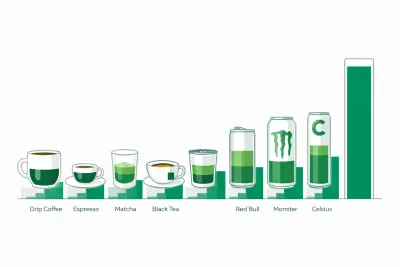
Caffeine Content Calculator — Coffee, Energy Drinks & Tea
Free caffeine content calculator showing how much caffeine is in coffee, espresso, tea, Red Bull, Monster and Celsius, plus your safe daily limit by weight.
Calorie Calculator: Daily TDEE and Intake Estimate
Use our calorie calculator to estimate daily energy needs (TDEE) from age, sex, height, weight, and activity. See maintain, loss, and gain targets instantly.

Calorie Deficit Calculator — Set a Safe Daily Deficit
Use our calorie deficit calculator to set a safe daily calorie target. Estimate TDEE, choose a weekly weight-loss rate, and see deficit, timeline, and guidance.
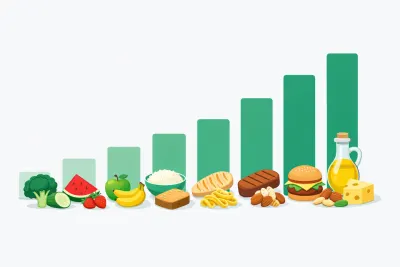
Calorie Density Calculator: Calories per Gram of Food
Free calorie density calculator that turns calories and grams into kcal per gram, sorts any food into four energy density bands, and compares two foods.

Calorie Intake Calculator: Daily Calories for Your Goal
Use our calorie intake calculator to estimate daily calories from your BMR and activity. Choose weight loss, maintenance, or gain and get practical targets.