Use the Calorie Density Calculator
Free calorie density calculator that turns calories and grams into kcal per gram, sorts any food into four energy density bands, and compares two foods.
Choose a food and portion
Typical serving: 1 medium (150 g).
Calorie density
Potato, boiled
Build most meals on these. Reasonable portions stay filling without pushing calories up fast.
Per 100 g
87
kcal
Per ounce
25
kcal
Your portion
131
kcal in 150 g
Per 100 kcal
115 g
of food on the plate
If a whole day ate like this
Adults settle at roughly 1.4 kg of food a day almost regardless of what that food is. A full day at 0.87 kcal/g would total about 1,218 kcal — below most maintenance needs, which is how low-density eating creates a deficit without portion control.
How much fits in a calorie budget?
Density read backwards: instead of calories per gram, grams per calorie allowance.
460 g of potato, boiled
That is 33% of the food weight an average adult eats in a whole day, for 20% of a 2,000 kcal day.
Compare it with another food
Same weight — 150 g
Potato chips costs 6.2x more for an identical plateful.
Same calories — 131 kcal
Equal calories, and far less food on the plate. Stomach stretch receptors respond to volume, not to kilocalories.
Calorie density chart of common foods
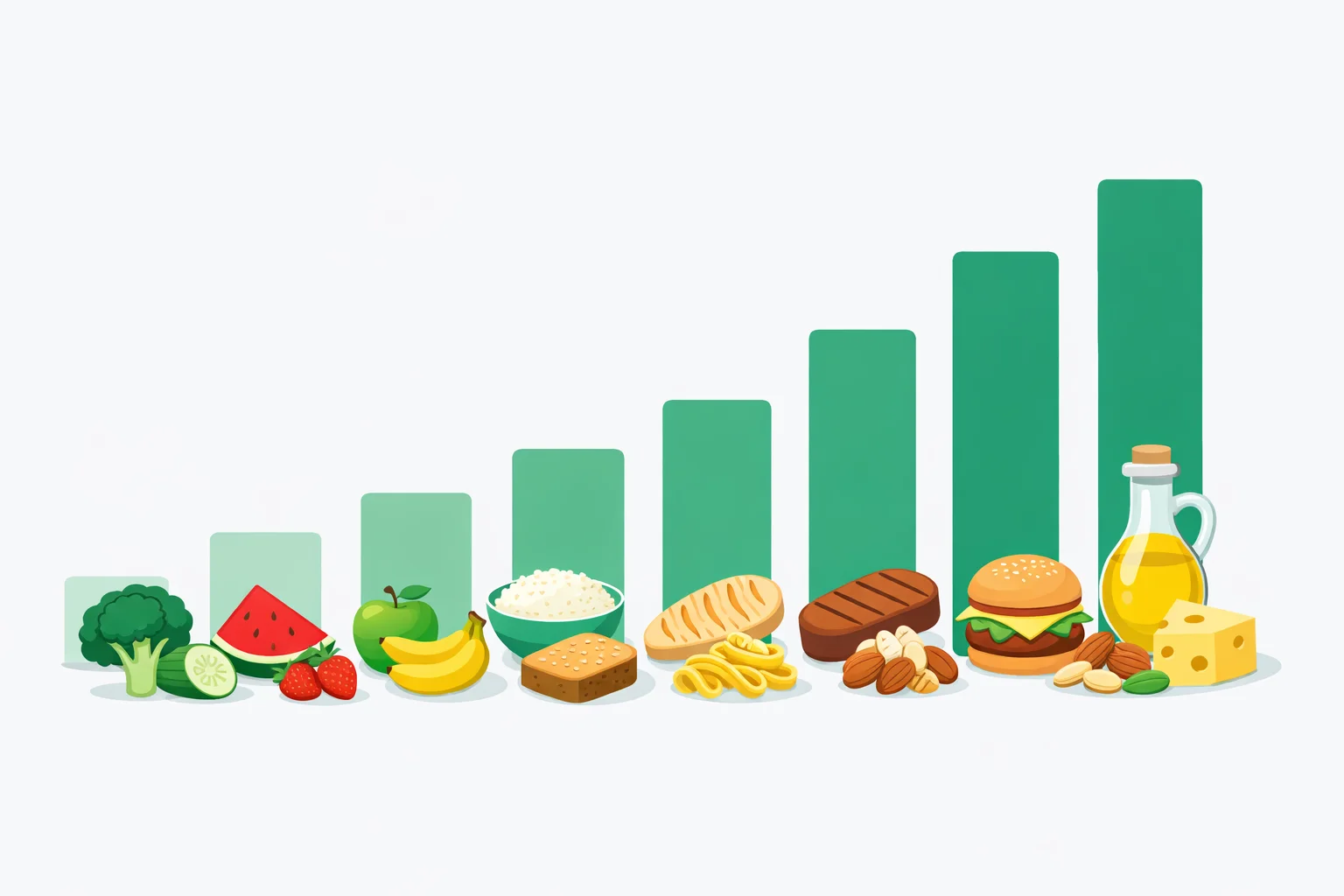
Sorted lowest density first. Water and fibre pull foods down the list; fat and drying push them up.
| Food | kcal/g | Per 100 g | Band | Typical serving |
|---|---|---|---|---|
| Celery, raw | 0.14 | 14 kcal | Very low | 14 kcal · 2 stalks (100 g) |
| Cucumber, raw | 0.15 | 15 kcal | Very low | 23 kcal · half a cucumber (150 g) |
| Vegetable broth soup | 0.3 | 30 kcal | Very low | 74 kcal · 1 cup (245 g) |
| Watermelon | 0.3 | 30 kcal | Very low | 45 kcal · 1 cup diced (150 g) |
| Milk, skim | 0.34 | 34 kcal | Very low | 83 kcal · 1 cup (245 ml) |
| Apple | 0.52 | 52 kcal | Very low | 94 kcal · 1 medium (180 g) |
| Greek yogurt, plain nonfat | 0.59 | 59 kcal | Very low | 100 kcal · 1 pot (170 g) |
| Oatmeal, cooked | 0.71 | 71 kcal | Low | 170 kcal · 1 cup cooked (240 g) |
| Potato, boiled | 0.87 | 87 kcal | Low | 131 kcal · 1 medium (150 g) |
| Banana | 0.89 | 89 kcal | Low | 107 kcal · 1 medium (120 g) |
| Cod, baked | 1.05 | 105 kcal | Low | 158 kcal · 1 fillet (150 g) |
| Rice, white, cooked | 1.3 | 130 kcal | Low | 208 kcal · 1 cup cooked (160 g) |
| Pasta, cooked | 1.58 | 158 kcal | Medium | 221 kcal · 1 cup cooked (140 g) |
| Chicken breast, roasted | 1.65 | 165 kcal | Medium | 198 kcal · 1 small breast (120 g) |
| Ice cream, vanilla | 2.07 | 207 kcal | Medium | 137 kcal · 1 scoop (66 g) |
| Bread, whole wheat | 2.47 | 247 kcal | Medium | 99 kcal · 1 slice (40 g) |
| French fries, fast food | 3.12 | 312 kcal | Medium | 359 kcal · medium serving (115 g) |
| Cheddar cheese | 4.03 | 403 kcal | High | 121 kcal · 1 slice (30 g) |
| Potato chips | 5.36 | 536 kcal | High | 150 kcal · small bag (28 g) |
| Almonds | 5.79 | 579 kcal | High | 162 kcal · about 23 nuts (28 g) |
| Butter | 7.17 | 717 kcal | High | 100 kcal · 1 tbsp (14 g) |
| Olive oil | 8.84 | 884 kcal | High | 124 kcal · 1 tbsp (14 ml) |
Note: Calorie density measures energy per gram, nothing else. Olive oil at 8.84 kcal/g and butter at 7.17 kcal/g are nutritionally very different foods that sit almost side by side on this scale, and a diet chosen on density alone can fall short on protein and essential fats. Values come from USDA FoodData Central for standard preparations — added oil, sauces, and draining change them substantially. Use this for portion planning, not as a substitute for advice from a registered dietitian.
Educational tool, not medical advice. Check this tool’s method and limitations before interpreting a result. Talk to a qualified healthcare professional before making decisions about medication, diet, exercise, or treatment. See our Terms of Use.
Your rating helps improve Calorie Density Calculator. We store only an anonymized vote (no personal data).
How to Use Calorie Density Calculator
Step 1: Pick a food or enter a label
Stay on "Pick a food" and choose from the 72-food database using the category chips, or switch to "Use a label" and type the calories and portion weight printed on the packet. Take both numbers from the same column - either both per serving or both per 100 g.
Step 2: Set the portion weight
Enter the amount you actually eat in the Portion field, in grams or ounces. Tap "Use it" to load the typical serving shown beneath the field. Changing the portion changes the calorie total but never the density.
Step 3: Read the density and its band
The headline figure is calories per gram. The colour band places it as very low (under 0.6), low (0.6 to 1.5), medium (1.5 to 4.0) or high (4.0 and up), and the cards below convert it to kcal per 100 g, kcal per ounce and grams of food per 100 kcal.
Step 4: Test a calorie budget
Type a calorie allowance into the Calorie budget field to see how many grams of that food it buys, shown as a share of the roughly 1,400 g of food an adult eats in a day.
Step 5: Compare a swap
Choose a second food in the "Swap against" menu to see two panels side by side: the calories each food delivers at the same plate weight, and the plate weight each needs to reach the same calories.
Key Features
- Density in kcal/g, per 100 g, per ounce and grams per 100 kcal
- Four-band scale with the 0.6, 1.5 and 4.0 kcal/g cut-offs
- Reverse mode showing how many grams a calorie budget buys
- Same-weight and same-calorie swap comparison between any two foods
- Calorie density chart of 22 common foods, lowest density first
- 72-food USDA database plus nutrition-label entry in grams or ounces
Understanding Results
Formula
Calorie density is calories divided by weight: kcal/g = calories ÷ grams. Both figures must describe the same portion. A 150 g boiled potato holding 131 kcal works out at 131 ÷ 150 = 0.87 kcal/g. Because both sides of the fraction scale together, the answer does not change with serving size — a 300 g portion is 261 kcal and still 0.87 kcal/g. Density is a property of the food itself.
Every gram of a food is water, fibre, protein, carbohydrate, fat, alcohol or ash, and each carries a fixed energy value: water 0 kcal/g, fibre about 2, protein and carbohydrate 4 each, alcohol 7, and fat 9. Those constants set the boundaries. No food can fall below 0 or rise above 9 kcal/g, and where a food lands between them is decided almost entirely by its water and fat content.
Reference Ranges & Interpretation
Energy-density research, including the Volumetrics work from Penn State, sorts foods into four bands:
- Very low — under 0.6 kcal/g: non-starchy vegetables, most fruit, broth soups, skim milk. Cucumber sits at 0.15, watermelon 0.30, apple 0.52. Portion control is not needed here.
- Low — 0.6 to 1.5 kcal/g: cooked grains, starchy vegetables, legumes, lean white fish, low-fat dairy. Oatmeal 0.71, potato 0.87, cod 1.05, lentils 1.16. These belong at the base of most meals.
- Medium — 1.5 to 4.0 kcal/g: cooked pasta 1.58, chicken breast 1.65, salmon 2.08, bread 2.47, raisins 2.99, table sugar 3.87. Serve these deliberately rather than freely.
- High — 4.0 kcal/g and above: cheddar 4.03, potato chips 5.36, almonds 5.79, peanut butter 5.88, butter 7.17, olive oil 8.84. Worth weighing rather than eyeballing.
The number that matters most is your daily average, not any single food. Adults eat a fairly fixed weight of food per day — roughly 1,400 g — so the average density effectively sets the calorie total. At 0.70 kcal/g that day comes to 975 kcal; at 1.95 kcal/g the same weight of food delivers 2,730.
Assumptions & Limitations
Database values are USDA FoodData Central figures for standard preparations of the edible portion. Cooking oil, sauces, dressings and marinades are not included and change results sharply — 200 g of vegetables at 0.35 kcal/g becomes 0.91 kcal/g after a tablespoon of oil hits the pan. Enter the weight of food in the state you eat it: dry pasta is 3.71 kcal/g against 1.58 cooked, so using packet weight overstates density by about 2.3 times.
Two categories break the scale's usual logic. Caloric drinks compute as very low density — cola is 0.41 kcal/g — yet produce little of the fullness that solid food of the same density would, because the satiety response depends on chewing, gastric distension and transit time. Aerated foods do the reverse: air-popped popcorn is a medium 3.87 kcal/g but three cups weigh just 24 g, so volume and density disagree.
Calorie density says nothing about nutritional quality. Almonds, olive oil and oily fish are high or medium density and among the most protective foods in the evidence base, while a sugary drink scores very low. Low density is also the wrong target for endurance athletes, underweight adults, older people with poor appetite, toddlers, and anyone with restricted gastric capacity — those groups need density raised, not lowered. Use this as a portion-planning tool alongside a nutrient check, and speak to a registered dietitian before making large dietary changes.
Complete Guide: Calorie Density Calculator
On this page
- Two days, the same weight of food, 1,633 calories apart
- Calories divided by grams — and why the portion cancels out
- The four bands: 0.6, 1.5 and 4.0 kcal/g
- Water does the work, fat sets the ceiling
- Four swaps worth 737 calories a day
- When eating low-density is the wrong advice
- Four ways a calorie density calculator result gets misread
- References
Every calorie density calculator rests on one uncomfortable finding: adults eat a roughly fixed weight of food each day — about 1.4 kg, or three pounds — and that weight barely budges whether the food is celery or cheesecake. Barbara Rolls' group at Penn State demonstrated this repeatedly across controlled feeding studies. Hand people meals secretly diluted with water and vegetables and they eat the same grams, take in hundreds fewer calories, and report feeling just as full. Your stomach counts volume. Only your fat cells count kilocalories. Calorie density — kilocalories per gram — is the exchange rate between the two, and it is the single number that decides whether 1.4 kg of food costs you 900 calories or 2,900.
Two Days, the Same Weight of Food, 1,633 Calories Apart
Abstractions do not persuade anyone. Two real days do. Both of these are ordinary menus, nobody is starving on either, and the plates are the same size — the second day actually contains 64 g less food.
| Day A — 0.70 kcal/g | Grams | kcal |
|---|---|---|
| Oatmeal, blueberries, skim milk | 500 | 304 |
| Lentils, broccoli, red pepper | 450 | 316 |
| Baked cod, boiled potato, cauliflower | 450 | 355 |
| Total | 1,400 g | 975 kcal |
| Day B — 1.95 kcal/g | Grams | kcal |
|---|---|---|
| Granola with whole milk | 340 | 577 |
| Bagel, peanut butter, cola | 487 | 591 |
| Pasta, ground beef, olive oil, cheddar | 424 | 965 |
| Almonds and milk chocolate | 85 | 475 |
| Total | 1,336 g | 2,608 kcal |
Day B contains 64 g less food and 1,633 more calories. Nobody counted anything on either day. No food was forbidden on Day B — pasta, beef, chocolate and peanut butter all appear. The entire gap comes from the density column: 0.70 against 1.95 kcal/g. That is why weight regain is so common after calorie counting stops and why people who never count can still hold a stable weight for decades. They landed on a menu whose average density happens to sit in the right place. If you want the calorie totals behind any single item on these menus, the food calorie calculator looks them up by serving or by 100 g.
Calories Divided by Grams — and Why the Portion Cancels Out
The arithmetic is trivial. The implication is not.
Calorie density (kcal/g) = calories in the portion ÷ weight of that portion in grams
Both numbers must come from the same column of the label — either both per serving or both per 100 g. Reading calories from the "per serving" column and weight from "per 100 g" is the most common way people get a wrong answer.
Worked example 1 — a boiled potato. A 150 g medium potato holds 131 kcal. Divide: 131 ÷ 150 = 0.87 kcal/g. Low band. Eat a 300 g double portion and you take in 261 kcal, but the density is still 0.87. That is the property people miss — density describes the food, not your serving of it, so it stays useful even before you decide how much to put on the plate.
Worked example 2 — the same potato, fried. A 28 g bag of potato chips carries 150 kcal: 150 ÷ 28 = 5.36 kcal/g. Identical vegetable, 6.2 times the density. Frying strips a raw potato from roughly 77% water down to about 2% and replaces the loss with oil at 8.84 kcal/g. To match the 131 calories in that boiled potato you would eat 24 g of chips — nine or ten crisps. Same calories, one sixth the food, and one of the two options empties a bag while the other fills a plate.
The Four Bands: 0.6, 1.5 and 4.0 kcal/g
Nutrition research sorts foods into four bands, and the cut-offs are worth memorising because they map cleanly onto how you should treat a food at the table.
| Band | Range | Typical members | How to treat it |
|---|---|---|---|
| Very low | under 0.6 | Cucumber 0.15, broth soup 0.30, strawberries 0.32, skim milk 0.34, apple 0.52 | No limit needed |
| Low | 0.6 – 1.5 | Oatmeal 0.71, potato 0.87, banana 0.89, cod 1.05, lentils 1.16, white rice 1.30 | Base of most meals |
| Medium | 1.5 – 4.0 | Pasta 1.58, chicken breast 1.65, salmon 2.08, bread 2.47, raisins 2.99, table sugar 3.87 | Portion on purpose |
| High | 4.0 and up | Cheddar 4.03, potato chips 5.36, almonds 5.79, butter 7.17, olive oil 8.84 | Weigh or measure |
Look at where table sugar lands. At 3.87 kcal/g pure sucrose is only medium density — below cheddar cheese, well below almonds, and less than half of olive oil. That result offends most people's intuition, and it is the fastest way to understand what this scale actually measures. Density is not a verdict on how healthy a food is. It measures how much energy is packed into each bite, and fat packs more than sugar ever can.
Water Does the Work, Fat Sets the Ceiling
Only a handful of things contribute weight to food, and each has a fixed energy value per gram. Once you know these six numbers you can predict any food's density before you look it up:
- Water: 0 kcal/g. The only ingredient that adds weight for free.
- Fibre: about 2 kcal/g. Partially fermented in the colon, so it is discounted.
- Protein and carbohydrate: 4 kcal/g each.
- Alcohol: 7 kcal/g. Nearly as dense as fat, which is why drinks distort a day quietly.
- Fat: 9 kcal/g. The hard ceiling — nothing edible exceeds it.
That gives you exactly three levers. Add water and density falls; cucumber is 96% water and lands at 0.15 kcal/g, watermelon at 91% water sits at 0.30. Add fat and density climbs toward 9; olive oil at 8.84 is essentially the ceiling, and butter's 7.17 is lower only because roughly 16% of a butter pat is water. Take water away and density rises without a single ingredient changing: grapes at 0.69 kcal/g become raisins at 2.99, a 4.3-fold jump produced entirely by dehydration. This is also why almost every processing step — drying, frying, milling, juicing — pushes a food up the scale. Processing is mostly water removal.
Four Swaps Worth 737 Calories a Day
Density is only useful if it changes what you do at breakfast. These four changes keep plate weight the same or larger, and the arithmetic is checkable:
- Granola bowl to oatmeal bowl — saves 373 kcal. 90 g of granola with 250 g of whole milk is 577 kcal in a 340 g bowl. The same 340 g as 240 g cooked oatmeal plus 100 g of skim milk is 204 kcal. Identical bowl, identical weight, 0.60 kcal/g instead of 1.70. This is the largest single-meal swap most people have available.
- Measure the cooking oil — saves 204 kcal. Two tablespoons of olive oil poured into a pan is 28 g and 248 kcal that never appears on any plate you can see. One teaspoon (5 g, 44 kcal) browns the same vegetables. Plate weight moves by 23 g; the calorie count moves by 204.
- Halve the pasta, double the vegetables — saves 144 kcal and adds food. 250 g of cooked pasta is 395 kcal. Drop to 125 g and add 150 g of broccoli: 251 kcal on a plate that now weighs 275 g instead of 250 g. More food, less energy, no willpower involved.
- Dried fruit to fresh — saves 16 kcal and quadruples the volume. A 40 g box of raisins is 120 kcal; 150 g of grapes is 104 kcal. The calorie saving is trivial and that is exactly the point — the win is 110 extra grams of food and several minutes more chewing for the same energy.
Together those come to roughly 737 kcal a day. Sustained, that is the difference between slow gain and steady loss for most adults, and not one of them requires eating less food by weight. To see how a saving of that size maps onto a weekly rate of loss, run it through the calorie deficit calculator.
When Eating Low-Density Is the Wrong Advice
Low density is a weight-management tool, not a universal virtue, and for several groups it actively causes harm. A cyclist burning 4,000 kcal on a training day would have to eat 5.7 kg of food to get there at 0.70 kcal/g — physically unpleasant and practically impossible before a race. Older adults with reduced appetite, people recovering from surgery or illness, and anyone underweight face the same wall from the other side: they need density, and 30 ml of olive oil stirred into a soup delivers 265 kcal in almost no volume. Toddlers have small stomachs relative to their energy needs, which is why paediatric guidance warns against filling them with bulky, very-low-density foods.
There is also a nutrient trap. Almonds (5.79 kcal/g), olive oil (8.84) and salmon (2.08) all sit in the medium or high bands, and all three are among the most consistently protective foods in the literature. Chase a low average density hard enough and you can end up short on protein, essential fatty acids and fat-soluble vitamins while technically succeeding. Density belongs next to a nutrient check, not instead of one — the food nutrition calculator breaks out the macro and micronutrient profile that this scale deliberately ignores.
Four Ways a Calorie Density Calculator Result Gets Misread
- Dry weight instead of cooked weight. Dry pasta is 3.71 kcal/g; cooked, it is 1.58 — the same food, having absorbed its own weight in water. Dry rice runs 3.60 against 1.30 cooked, a 2.8-fold gap. Take the number off a packet and apply it to what is on your plate and you will overstate density by roughly two and a half times. Weigh food in the state you eat it.
- Drinks break the rule. Cola is 0.41 kcal/g, which files it in the very low band alongside strawberries. But density predicts fullness only for food you chew; liquid calories bypass most of that response. A 355 ml can is 146 kcal that registers almost nowhere. Treat every caloric drink as if its density were far higher than the arithmetic says.
- Air is not water. Air-popped popcorn is 3.87 kcal/g — medium band, identical to table sugar — yet three cups weigh 24 g and cost 93 kcal. Bulk density (how much space a gram occupies) and energy density (how many calories a gram carries) are separate axes, and popcorn wins on the first while losing on the second. Aerated foods are the one place where the density band alone will mislead you.
- The oil you cook in is invisible. A 200 g portion of mixed vegetables at 0.35 kcal/g is 70 kcal. Sauté it in one tablespoon of oil and the dish becomes 194 kcal at 214 g — 0.91 kcal/g. The vegetables did not change band; the pan did. Sauces, dressings and butter finishes work the same way, which is why restaurant versions of "light" dishes so often are not.
Track any of these for a week and the pattern becomes obvious quickly. Most people find their average daily density sits between 1.6 and 2.2 kcal/g. Moving it to 1.2 without changing how much food you eat is worth roughly 500 kcal a day, and it is a far more durable change than trying to eat less.
References
- Rolls BJ. The relationship between dietary energy density and energy intake. Physiology & Behavior, 2009 — the review behind the fixed daily food-weight finding.
- Bell EA, Castellanos VH, Pelkman CL, Thorwart ML, Rolls BJ. Energy density of foods affects energy intake in normal-weight women. The American Journal of Clinical Nutrition, 1998.
- US Department of Agriculture. FoodData Central — the per-100 g energy values used throughout this calculator and article.

Written by Jurica Šinko
Founder & CEO
Entrepreneur and health information advocate, passionate about making health calculations accessible to everyone through intuitive digital tools.
View full profileFrequently Asked Questions
What is a good calorie density to aim for?
For weight loss, most guidance points at a daily average under 1.5 kcal/g, with meals built mainly from foods below 1.0. Typical Western eating averages 1.6 to 2.2 kcal/g. Moving from 1.9 to 1.2 without eating any less food by weight cuts roughly 1,000 kcal from a 1,400 g day, which is why the average matters far more than any single food.
How do I calculate calorie density from a nutrition label?
Divide the calories by the weight in grams of the exact same portion. A 55 g granola serving listed at 259 kcal is 259 divided by 55, or 4.71 kcal/g. If the label shows a per 100 g column, the shortcut is simpler still: move the decimal two places left, so 259 kcal per 100 g becomes 2.59 kcal/g. Never mix the per-serving and per-100 g columns.
Is calorie density the same as calories per 100g?
They are the same measurement on different scales. Calories per 100 g divided by 100 gives calories per gram, so 87 kcal per 100 g of boiled potato is 0.87 kcal/g. Europe and the UK label per 100 g, the US labels per serving, and research uses kcal/g. The four density bands at 0.6, 1.5 and 4.0 kcal/g correspond to 60, 150 and 400 kcal per 100 g.
What food has the highest calorie density?
Pure fats top the scale. Olive oil and other cooking oils reach 8.84 kcal/g, just under the 9 kcal/g theoretical ceiling for pure fat. Butter is lower at 7.17 kcal/g only because about 16 percent of it is water. Nothing edible exceeds 9 kcal/g, because fat is the most energy-dense substance the body can absorb and no food is 100 percent fat.
Why is table sugar only medium calorie density?
Sucrose is 3.87 kcal/g, which places it in the medium band, below cheddar cheese at 4.03 and well below almonds at 5.79. Carbohydrate carries 4 kcal per gram while fat carries 9, so a pure sugar cannot exceed about 4 kcal/g. Density measures energy per gram, not nutritional quality, and fatty foods will always outrank sugary ones on this particular scale.
Can I use calorie density to gain weight instead?
Yes, and it is often more effective than trying to eat more. If you need 4,000 kcal a day, doing it at 0.7 kcal/g means eating 5.7 kg of food, which is unrealistic. Shifting the average to 2.5 kcal/g brings the same 4,000 kcal down to 1.6 kg. Adding 30 ml of olive oil to a meal contributes 265 kcal with almost no extra volume.
Does cooking change the calorie density of food?
Substantially, in both directions. Dry pasta is 3.71 kcal/g and drops to 1.58 once boiled, because it absorbs roughly its own weight in water. Dry rice falls from 3.60 to 1.30. Frying does the opposite: a boiled potato at 0.87 kcal/g becomes potato chips at 5.36 as water is driven off and oil takes its place. Always weigh food in the state you eat it.
Is popcorn a low calorie density food?
No, and this is the clearest exception to the whole scale. Air-popped popcorn is 3.87 kcal/g, identical to table sugar and squarely in the medium band. It feels light because it is full of air, so three cups weigh only 24 g and cost 93 kcal. Bulk density and energy density are different things, and aerated foods are where reading the band alone will mislead you.
Related Calculators

BMR Calculator: Basal Metabolic Rate by Proven Formulas
Use our BMR calculator to estimate your basal metabolic rate using Mifflin–St Jeor or revised Harris–Benedict formulas. Choose metric or US units and see TDEE.
Caffeine Content Calculator — Coffee, Energy Drinks & Tea
Free caffeine content calculator showing how much caffeine is in coffee, espresso, tea, Red Bull, Monster and Celsius, plus your safe daily limit by weight.
Caffeine Half-Life Calculator: How Long Caffeine Lasts
Free caffeine half-life calculator showing how much caffeine is left at bedtime, your personal clearance rate, and the latest safe cutoff time to drink.
Calorie Calculator: Daily TDEE and Intake Estimate
Use our calorie calculator to estimate daily energy needs (TDEE) from age, sex, height, weight, and activity. See maintain, loss, and gain targets instantly.
Calorie Deficit Calculator — Set a Safe Daily Deficit
Use our calorie deficit calculator to set a safe daily calorie target. Estimate TDEE, choose a weekly weight-loss rate, and see deficit, timeline, and guidance.

Calorie Intake Calculator: Daily Calories for Your Goal
Use our calorie intake calculator to estimate daily calories from your BMR and activity. Choose weight loss, maintenance, or gain and get practical targets.