Use the Caffeine Content Calculator
Free caffeine content calculator showing how much caffeine is in coffee, espresso, tea, Red Bull, Monster and Celsius, plus your safe daily limit by weight.
1. Which drink do you want to look up?
65 coffees, teas, energy drinks, sodas and caffeinated foods, each with its published range.
65 matches. Pick one to load it into the calculator.
2. How big is your serving?
Caffeine scales linearly with volume. The label serving for brewed / drip coffee is 8 fl oz / 237 ml.
Currently the standard label serving.
3. What is your own daily ceiling?
The famous 400 mg figure is a flat number for an average-sized adult. Body weight narrows it.
Leave blank to fall back on the flat guideline figure.
FDA 400 mg/day, narrowed to 5.7 mg per kg of body weight (EFSA).
Caffeine in brewed / drip coffee
Comfortably under95 mg
Published range 70–140 mg — a 2.0× spread depending on preparation and batch.
That is 24% of your 399 mg daily ceiling (from 70 kg of body weight).
Caffeine density
11.9 mg/oz
The benchmark other drinks are judged against
Coffee-cup equivalent
1.0
Cups of 8 oz drip coffee
Servings to your ceiling
4.2
Before 399 mg
Single-dose guide
210 mg
This serving is within it
How your drink compares
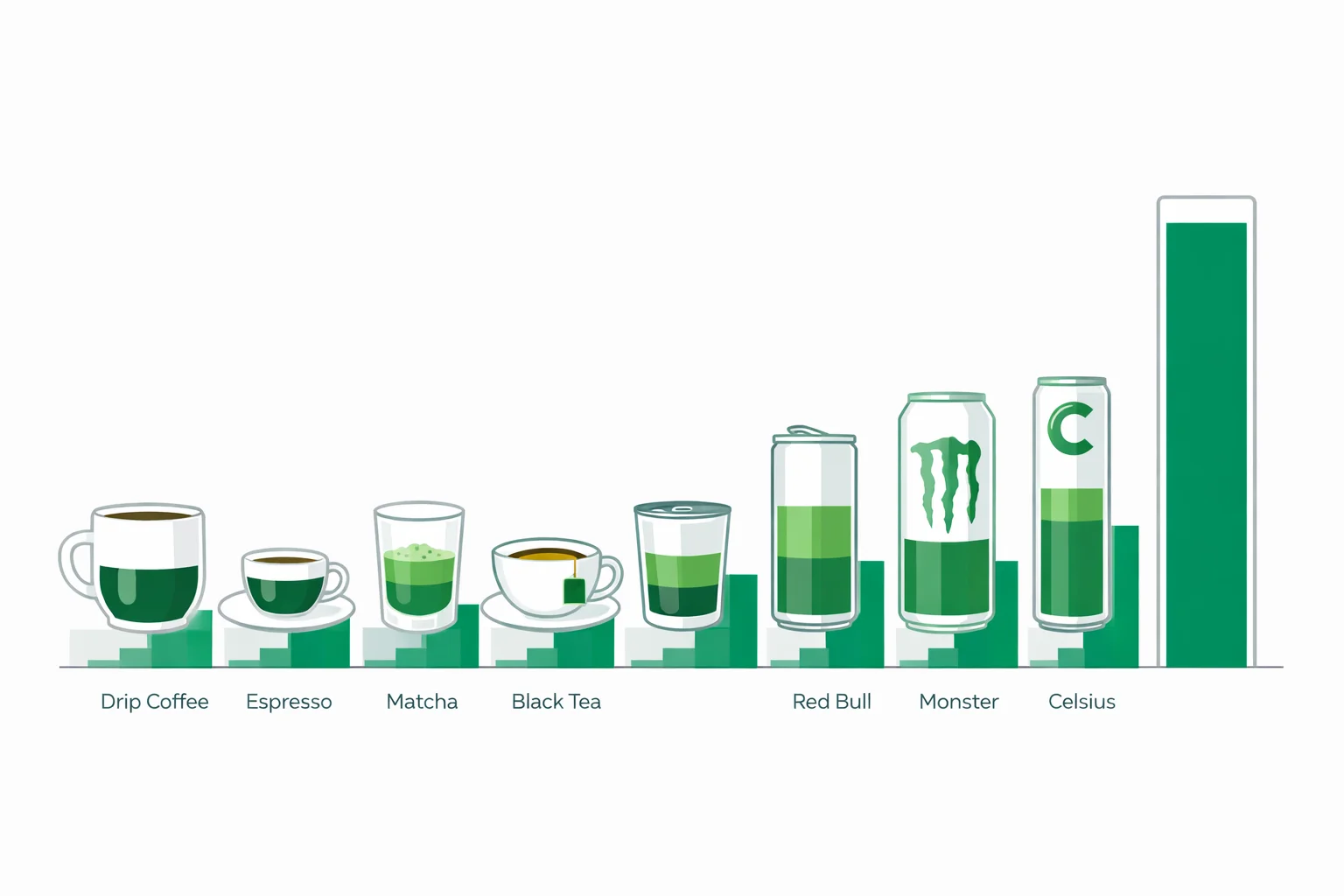
Every bar is one standard serving of that product. Yours is highlighted; the dashed line is your 399 mg ceiling.
Worth knowing about brewed / drip coffee
The reference cup. Grind, dose and contact time move it more than the bean does.
Caffeine content chart
Showing 65 of 65 entries. Tap any row to load it above. Density is what makes an espresso shot feel stronger than a mug of coffee that actually contains more.
| Drink | Serving | Caffeine | Range | Per fl oz |
|---|---|---|---|---|
| Brewed / drip coffee | 8 fl oz / 237 ml | 95 mg | 70–140 | 11.9 mg |
| Espresso (single shot) | 1 fl oz / 30 ml | 63 mg | 47–75 | 63.0 mg |
| Double espresso (doppio) | 2 fl oz / 59 ml | 126 mg | 94–150 | 63.0 mg |
| Instant coffee | 8 fl oz / 237 ml | 62 mg | 27–90 | 7.8 mg |
| French press coffee | 8 fl oz / 237 ml | 107 mg | 80–135 | 13.4 mg |
| Moka pot (stovetop) | 2 fl oz / 59 ml | 105 mg | 80–130 | 52.5 mg |
| Cold brew coffee | 12 fl oz / 355 ml | 205 mg | 150–260 | 17.1 mg |
| Nitro cold brew | 16 fl oz / 473 ml | 280 mg | 240–330 | 17.5 mg |
| Latte or cappuccino (2 shots) | 12 fl oz / 355 ml | 126 mg | 94–150 | 10.5 mg |
| Americano (3 shots) | 16 fl oz / 473 ml | 189 mg | 141–225 | 11.8 mg |
| Turkish coffee | 2 fl oz / 59 ml | 50 mg | 40–65 | 25.0 mg |
| K-Cup pod coffee | 8 fl oz / 237 ml | 100 mg | 75–150 | 12.5 mg |
| Decaf brewed coffee | 8 fl oz / 237 ml | 2 mg | 2–15 | 0.3 mg |
| Decaf espresso | 1 fl oz / 30 ml | 3 mg | 3–16 | 3.0 mg |
| Starbucks brewed coffee (Tall, 12 oz) | 12 fl oz / 355 ml | 235 mg | 210–260 | 19.6 mg |
| Starbucks brewed coffee (Grande, 16 oz) | 16 fl oz / 473 ml | 310 mg | 280–340 | 19.4 mg |
| Starbucks brewed coffee (Venti, 20 oz) | 20 fl oz / 591 ml | 410 mg | 375–445 | 20.5 mg |
| Starbucks Blonde Roast (Grande, 16 oz) | 16 fl oz / 473 ml | 360 mg | 330–390 | 22.5 mg |
| Dunkin' original blend (Medium, 14 oz) | 14 fl oz / 414 ml | 210 mg | 190–230 | 15.0 mg |
| McDonald's brewed coffee (Large, 16 oz) | 16 fl oz / 473 ml | 145 mg | 130–165 | 9.1 mg |
| Black tea | 8 fl oz / 237 ml | 47 mg | 25–90 | 5.9 mg |
| Green tea | 8 fl oz / 237 ml | 28 mg | 20–50 | 3.5 mg |
| Matcha (1 tsp whisked) | 8 fl oz / 237 ml | 70 mg | 38–88 | 8.8 mg |
| Oolong tea | 8 fl oz / 237 ml | 38 mg | 30–55 | 4.8 mg |
| White tea | 8 fl oz / 237 ml | 15 mg | 6–60 | 1.9 mg |
| Yerba mate | 8 fl oz / 237 ml | 85 mg | 65–130 | 10.6 mg |
| Chai latte (Grande, 16 oz) | 16 fl oz / 473 ml | 95 mg | 70–120 | 5.9 mg |
| Bottled iced tea (16.9 oz) | 16.9 fl oz / 500 ml | 30 mg | 15–60 | 1.8 mg |
| Arizona green tea (16 oz) | 16 fl oz / 473 ml | 15 mg | 12–20 | 0.9 mg |
| Decaf black tea | 8 fl oz / 237 ml | 2 mg | 1–5 | 0.3 mg |
| Herbal tea (chamomile, peppermint, rooibos) | 8 fl oz / 237 ml | 0 mg | fixed | 0.0 mg |
| Red Bull (8.4 oz can) | 8.4 fl oz / 248 ml | 80 mg | fixed | 9.5 mg |
| Red Bull (12 oz can) | 12 fl oz / 355 ml | 114 mg | fixed | 9.5 mg |
| Monster Energy (16 oz can) | 16 fl oz / 473 ml | 160 mg | fixed | 10.0 mg |
| Monster Ultra (16 oz can) | 16 fl oz / 473 ml | 150 mg | fixed | 9.4 mg |
| Celsius (12 oz can) | 12 fl oz / 355 ml | 200 mg | fixed | 16.7 mg |
| Celsius Essentials (16 oz can) | 16 fl oz / 473 ml | 270 mg | fixed | 16.9 mg |
| Bang Energy (16 oz can) | 16 fl oz / 473 ml | 300 mg | fixed | 18.8 mg |
| Reign Total Body Fuel (16 oz) | 16 fl oz / 473 ml | 300 mg | fixed | 18.8 mg |
| Alani Nu (12 oz can) | 12 fl oz / 355 ml | 200 mg | fixed | 16.7 mg |
| Prime Energy (12 oz can) | 12 fl oz / 355 ml | 200 mg | fixed | 16.7 mg |
| Ghost Energy (16 oz can) | 16 fl oz / 473 ml | 200 mg | fixed | 12.5 mg |
| C4 Energy (16 oz can) | 16 fl oz / 473 ml | 200 mg | fixed | 12.5 mg |
| Rockstar (16 oz can) | 16 fl oz / 473 ml | 160 mg | fixed | 10.0 mg |
| NOS Energy (16 oz can) | 16 fl oz / 473 ml | 160 mg | fixed | 10.0 mg |
| 5-hour Energy (1.93 oz shot) | 1.93 fl oz / 57 ml | 200 mg | fixed | 103.6 mg |
| 5-hour Energy Extra Strength (1.93 oz) | 1.93 fl oz / 57 ml | 230 mg | fixed | 119.2 mg |
| Pre-workout powder (1 scoop) | 1 serving | 250 mg | 150–400 | — |
| Coca-Cola Classic (12 oz) | 12 fl oz / 355 ml | 34 mg | fixed | 2.8 mg |
| Diet Coke (12 oz) | 12 fl oz / 355 ml | 46 mg | fixed | 3.8 mg |
| Coke Zero Sugar (12 oz) | 12 fl oz / 355 ml | 34 mg | fixed | 2.8 mg |
| Pepsi (12 oz) | 12 fl oz / 355 ml | 38 mg | fixed | 3.2 mg |
| Pepsi Zero Sugar (12 oz) | 12 fl oz / 355 ml | 69 mg | fixed | 5.8 mg |
| Mountain Dew (12 oz) | 12 fl oz / 355 ml | 54 mg | fixed | 4.5 mg |
| Dr Pepper (12 oz) | 12 fl oz / 355 ml | 41 mg | fixed | 3.4 mg |
| Barq's Root Beer (12 oz) | 12 fl oz / 355 ml | 22 mg | fixed | 1.8 mg |
| Sunkist Orange (12 oz) | 12 fl oz / 355 ml | 19 mg | fixed | 1.6 mg |
| Sprite, 7Up, ginger ale (12 oz) | 12 fl oz / 355 ml | 0 mg | fixed | 0.0 mg |
| Dark chocolate 70-85% (1 oz) | 1 serving | 23 mg | 12–35 | — |
| Milk chocolate (1 oz) | 1 serving | 6 mg | 3–9 | — |
| Hot chocolate (8 oz) | 8 fl oz / 237 ml | 5 mg | 3–13 | 0.6 mg |
| Coffee ice cream (1/2 cup) | 1 serving | 30 mg | 15–45 | — |
| Caffeine tablet (NoDoz, Vivarin) | 1 serving | 200 mg | 100–200 | — |
| Excedrin (2 tablets) | 1 serving | 130 mg | fixed | — |
| Caffeine gum (1 piece) | 1 serving | 100 mg | 40–100 | — |
Figures are typical values, not guarantees. Brewed coffee and tea are measured averages and a single cup legitimately varies by a factor of two; canned and bottled products use the manufacturer's declared amount, which can change with reformulation. Caffeine-sensitive people, anyone with a heart rhythm disorder or uncontrolled hypertension, and anyone taking CYP1A2-affecting medication should talk to a clinician rather than rely on a general ceiling. Caffeine is not recommended for children under 12.
Educational tool, not medical advice. Check this tool’s method and limitations before interpreting a result. Talk to a qualified healthcare professional before making decisions about medication, diet, exercise, or treatment. See our Terms of Use.
Your rating helps improve Caffeine Content Calculator. We store only an anonymized vote (no personal data).
How to Use Caffeine Content Calculator
Step 1: Find your drink
Type a brand into the search box — Monster, Celsius, Diet Coke, matcha, espresso — or filter with the Coffee, Tea, Energy, Soda and Food category pills, then tap a result to load it.
Step 2: Set your serving size
Enter the volume in the Serving field and toggle between fl oz and ml, or tap a quick size such as 12 or 16 oz. Caffeine scales linearly from the product label serving.
Step 3: Enter body weight and profile
Add your weight in kg or lb and choose healthy adult, pregnant, or age 12 to 18. The tool converts that into a personal daily ceiling instead of the flat 400 mg figure.
Step 4: Read the milligrams and the range
The headline number is caffeine at your serving size. The line beneath gives the published low-to-high range, which is wide for brewed drinks and fixed for canned ones.
Step 5: Check density and cup equivalents
The four cards show mg per fluid ounce, how many 8 oz cups of drip coffee this equals, how many servings reach your ceiling, and the single-dose guideline.
Step 6: Compare against benchmarks
The comparison chart places your drink among nine common products at their standard servings, with a dashed line marking your personal daily ceiling.
Key Features
- Caffeine lookup for 65 named drinks, brands and foods
- Serving-size scaling in fluid ounces or millilitres
- Caffeine density in mg per fl oz, not just mg per serving
- Published low-to-high range for every brewed drink
- Daily ceiling from body weight, pregnancy or age 12-18
- Side-by-side comparison against nine benchmark drinks
Understanding Results
Formula
Three short calculations sit behind the results. Caffeine scales linearly with volume, so your serving is simply the label value stretched or shrunk:
Caffeine (mg) = label mg × (your serving ÷ label serving)
Density (mg per fl oz) = caffeine mg ÷ serving in fl oz
Daily ceiling (adult) = min(400 mg, 5.7 mg/kg × body weight)
Worked example: a 20 fl oz Starbucks drip coffee against a 16 fl oz label serving of 310 mg gives 310 × (20 ÷ 16) = 388 mg, at a density of 388 ÷ 20 = 19.4 mg per fl oz. For a 68 kg adult the ceiling is 5.7 × 68 = 388 mg, so that one cup is 100% of the day. The single-dose guideline is a separate figure at 3 mg/kg, which for the same person is 204 mg — meaning the cup exceeds the single-serving guidance twice over. Pregnancy uses a flat 200 mg per day and ages 12 to 18 use 2.5 mg/kg capped at 100 mg; neither scales the way the adult formula does.
Reference Ranges & Interpretation
The badge on the result grades one serving against your own ceiling rather than against the flat 400 mg figure: under 25% is comfortably under, 25 to 50% is a quarter to half of your day, 50 to 100% means one serving spends most of it, and above 100% means a single container has passed the ceiling on its own. A 20 oz Venti drip (410 mg) and a 16 oz Bang (300 mg) both land in the top two bands for an average adult.
Common anchors for calibration: 8 oz drip coffee 95 mg, 1 oz espresso 63 mg, 8 oz black tea 47 mg, 8 oz green tea 28 mg, 8 oz matcha 70 mg, 12 oz Coca-Cola 34 mg, 8.4 oz Red Bull 80 mg, 16 oz Monster 160 mg, 12 oz Celsius 200 mg. The FDA sets 400 mg per day for healthy adults; EFSA sets 5.7 mg/kg daily and 3 mg/kg per single dose; ACOG sets 200 mg in pregnancy; the AAP sets 100 mg for ages 12 to 18 and advises none under 12.
Assumptions & Limitations
Scaling assumes a drink is homogeneous, which holds for a poured beverage but not for a milk-based one: a larger latte contains the same two shots and therefore the same 126 mg, so change the shot count rather than the cup size. Brewed values are population averages and a single cup legitimately varies twofold, which is why every entry carries a published range — plan against the high end when your intake is mostly coffee and tea. Canned and bottled figures come from declared formulas and change only when a product is reformulated. This page reports what is in a serving; it does not model absorption or clearance, so use the caffeine half-life calculator for how long it stays in your system. Anyone pregnant, under 18, taking CYP1A2-affecting medication, or living with a heart rhythm disorder or uncontrolled hypertension should treat these ceilings as a starting point for a conversation with a clinician, not as a personal allowance.
Complete Guide: Caffeine Content Calculator
On this page
- Espresso is stronger than coffee, and also weaker
- Your "one cup" may be 310 mg, not 95
- The dark roast myth, settled by weight
- Energy drinks are not the villains people assume
- Decaf is not caffeine-free
- Why this caffeine content calculator shows a range
- 400 mg is a flat number for a non-flat population
- When the label refuses to tell you
- References
Nearly everyone who opens a caffeine content calculator arrives believing one thing that is half wrong: that espresso is the strongest coffee drink there is. A single shot contains 63 mg of caffeine. A plain 8 fl oz mug of drip coffee contains 95 mg. The espresso loses by half again — and yet the belief persists, because on the measure people actually feel, espresso wins by a landslide. This guide works through that contradiction and the four other misconceptions that make published caffeine charts so hard to use, then shows you what the numbers mean for your own daily ceiling.
Espresso is stronger than coffee, and also weaker
Both statements are true because they measure different things. Total dose is caffeine per serving. Density is caffeine per fluid ounce. Espresso wins one and loses the other, and almost every argument about coffee strength is really two people quoting different metrics at each other.
The arithmetic is short. A 1 fl oz espresso shot at 63 mg works out to 63 mg per fl oz. An 8 fl oz drip coffee at 95 mg works out to 95 ÷ 8 = 11.9 mg per fl oz. Espresso is 5.3 times denser, delivered in one-eighth the volume. You swallow it in four seconds instead of twenty minutes, so the plasma concentration curve rises far more sharply even though the area under it is smaller. That sharp rise is what people mean by "strong".
This matters practically the moment milk enters the picture. A 12 fl oz latte and a 16 fl oz latte both contain two shots, so both contain roughly 126 mg. The bigger cup is not stronger — it is the same caffeine, diluted. Ordering a large latte to get more of a lift buys you eight more ounces of milk and zero extra milligrams. Order a third shot instead. The calculator above reports density alongside dose for exactly this reason: it is the number that settles the argument.
Your "one cup" may be 310 mg, not 95
The 95 mg figure everyone quotes belongs to a specific object: 8 fluid ounces of home-brewed drip coffee. Almost nobody drinks that. A standard mug holds 11 to 12 oz. A Starbucks Grande holds 16 oz, and because Starbucks brews at a higher dose than a home machine, a Grande Pike Place carries about 310 mg — not the 190 mg you would get by simply doubling the reference cup. A Venti drip lands near 410 mg, which by itself exceeds the entire adult daily ceiling before you have eaten breakfast.
Two variables are stacking here and people usually adjust for only one. Volume is the obvious one. Brew strength is the hidden one: Starbucks drip runs near 19 mg per fl oz against roughly 12 mg per fl oz for a typical home machine. Multiply a 60% higher density by double the volume and you get more than triple the caffeine. That is why the calculator scales from each product's own label serving rather than from a generic per-ounce constant.
Anyone counting a day's total should count containers, not cups. If you track several drinks across a day, the caffeine calculator adds them into a running daily total against the 400 mg limit, which is a different job from looking up what is in one product.
The dark roast myth, settled by weight
Dark roast tastes more intense, so it must contain more caffeine. It does not. Caffeine is remarkably heat-stable — it sublimes around 178 °C, above most roasting temperatures — so roasting destroys very little of it. What roasting does destroy is water and mass. Beans lose 12 to 20% of their weight as they darken and swell, which means a dark roast bean is physically larger and lighter than a light roast bean.
The consequence depends entirely on how you measure your coffee. Scoop by volume and the light roast gives you more caffeine, because more dense beans fit in the scoop. Weigh your dose on a scale and the two roasts land within a few percent of each other. Starbucks publishes the cleanest real-world example: a Grande Blonde Roast contains about 360 mg against roughly 310 mg for the darker Pike Place — the lighter roast is ahead by 16%. Anyone switching to dark roast in the evening to sleep better has changed the flavour and nothing else.
Energy drinks are not the villains people assume
A standard 8.4 oz Red Bull contains 80 mg of caffeine. That is less than a mug of drip coffee and roughly the same as a strong cup of yerba mate. A 16 oz Monster contains 160 mg, about what you would get from a 12 oz cup of ordinary coffee at a diner. On dose alone, the mainstream energy drinks are unremarkable.
Three things make them behave differently anyway. First, the outliers are genuinely large: Bang and Reign both carry 300 mg in one can, and Celsius Essentials reaches 270 mg — that is three-quarters of an adult daily ceiling in a single container. Second, they are cold, carbonated and sweet, so people drink 16 oz in ten minutes in a way nobody drinks hot coffee. Third, the caffeine density runs high in the concentrated formats: a 1.93 oz 5-hour Energy shot packs 200 mg, which is 104 mg per fl oz — denser than espresso by 65%, and the highest of any ready-to-drink product on a supermarket shelf.
The sodas hide a smaller surprise of the same kind. Diet Coke contains 46 mg per 12 oz can against 34 mg for Coca-Cola Classic — the diet version has 35% more, not less. Pepsi Zero Sugar carries 69 mg, nearly double a regular Pepsi. Sprite, 7Up and most ginger ales contain none at all.
Decaf is not caffeine-free
United States regulation requires decaffeinated coffee to have at least 97% of its caffeine removed; the EU threshold is 99.9% of dry mass. Neither is zero. A cup of decaf drip typically holds 2 mg, but measured samples run as high as 15 mg, and decaf espresso has been recorded up to 16 mg per shot. Someone drinking five decafs through an afternoon can accumulate 10 to 75 mg — comparable to a cup of green tea, which is enough to matter if you are on the sensitive end.
Herbal infusions are the genuine zero. Chamomile, peppermint and rooibos contain no Camellia sinensis leaf and therefore no caffeine at all. If the goal is a hot drink after 6 pm with no pharmacology attached, that is the category to move to. If you want to know whether an earlier drink is still working against you at bedtime, the caffeine half-life calculator models the decay curve and returns a cutoff time.
Why this caffeine content calculator shows a range
Every caffeine chart online publishes a single number per drink. That is fine for a can and misleading for a cup. Brewed products are the output of a process you control; canned products are the output of a factory recipe. The first varies by a factor of two, the second does not vary at all. This caffeine content calculator reports both the typical value and the published spread so you can tell which kind of number you are looking at.
| Drink | Typical | Measured range | What moves it |
|---|---|---|---|
| Drip coffee, 8 oz | 95 mg | 70–140 mg | Grind size, dose, contact time |
| Black tea, 8 oz | 47 mg | 25–90 mg | Steep time — 5 minutes nearly doubles 2 minutes |
| Instant coffee, 8 oz | 62 mg | 27–90 mg | Heaped or level spoon |
| Espresso, 1 oz | 63 mg | 47–75 mg | Basket dose, ristretto versus lungo |
| Matcha, 8 oz | 70 mg | 38–88 mg | Grams of powder whisked in |
| Decaf coffee, 8 oz | 2 mg | 2–15 mg | Decaffeination method and bean |
| Red Bull, 8.4 oz | 80 mg | Fixed | Nothing — declared formula |
| Monster Energy, 16 oz | 160 mg | Fixed | Nothing — declared formula |
Read the right-hand column before you trust the left. If you are trying to stay under a ceiling and your intake is mostly brewed coffee and tea, plan against the high end of the range rather than the typical value — a three-mug day that looks like 285 mg on paper can genuinely be 420 mg in the cup. If your intake is mostly cans, the declared number is the number.
400 mg is a flat number for a non-flat population
The FDA cites 400 mg per day as the point at which healthy adults generally do not experience negative effects. It is a useful headline and a blunt instrument, because it is the same figure for a 50 kg adult and a 100 kg one. The European Food Safety Authority did the work in body-weight terms instead: habitual intakes up to 5.7 mg per kg per day, and single doses up to 3 mg per kg, are not a safety concern for healthy non-pregnant adults.
Run those numbers and the flat guideline starts to look generous at the low end. A 55 kg adult gets 5.7 × 55 = 314 mg per day, not 400. That person can have one Grande drip coffee and nothing else. A 90 kg adult calculates to 513 mg, which the calculator caps back at 400 because the FDA figure functions as a ceiling on top of the weight formula. Single-dose guidance is tighter still: 3 mg/kg puts a 55 kg adult at 165 mg, meaning one 200 mg Celsius exceeds the single-serving guidance even though it sits at only 64% of the daily one.
Two groups get different numbers entirely. ACOG advises pregnant women to stay under 200 mg per day, and that cap does not scale with weight — caffeine half-life roughly triples by the third trimester, so the same dose lingers far longer. The American Academy of Pediatrics advises no more than 100 mg per day for ages 12 to 18 and no caffeine at all for children under 12. A 45 kg fourteen-year-old drinking one Celsius takes in 200 mg, double the adolescent ceiling and about 4.4 mg per kg — more, relative to body size, than a large adult drinking two Grande coffees.
When the label refuses to tell you
Caffeine disclosure is voluntary in the United States for most products, and the gaps cluster in predictable places. Pre-workout powders are the worst offenders: the range across popular products runs from 150 to 400 mg per scoop, and many list caffeine inside a proprietary blend where only the blend total is declared. Guarana, yerba mate extract and green tea extract all contribute caffeine under names that do not include the word.
A practical rule: 1 gram of guarana seed extract contributes roughly 40 to 80 mg of caffeine, about twice the concentration of coffee beans by weight. If a supplement lists guarana high in a proprietary blend and declares no caffeine figure, assume it is meaningful rather than zero. The same applies to combination headache tablets — Excedrin contains 65 mg per tablet, so the standard two-tablet dose is 130 mg, roughly a strong cup of coffee that most people never count.
Timing is the other half of the picture. Caffeine reaches peak plasma concentration 30 to 60 minutes after you drink it and has a median half-life near 5 hours, so a 200 mg afternoon can still leave roughly 50 mg circulating at midnight. If an evening drink is the question, check what time you can still have it with the bedtime calculator, and remember that caffeine is a mild diuretic — habitual drinkers develop tolerance to that effect, but a sudden 400 mg day in someone who normally drinks none will move fluid balance enough to notice.
References
- U.S. Food and Drug Administration. Spilling the Beans: How Much Caffeine is Too Much? — the source of the 400 mg per day figure for healthy adults.
- European Food Safety Authority. Scientific Opinion on the Safety of Caffeine (EFSA Journal, 2015) — the 3 mg/kg single-dose and 5.7 mg/kg daily body-weight thresholds.
- U.S. Department of Agriculture, FoodData Central — measured caffeine values for brewed coffee, tea and commercially prepared beverages.
- American College of Obstetricians and Gynecologists, Committee Opinion 462 — moderate caffeine consumption during pregnancy (under 200 mg per day).

Written by Jurica Šinko
Founder & CEO
Entrepreneur and health information advocate, passionate about making health calculations accessible to everyone through intuitive digital tools.
View full profileFrequently Asked Questions
How much caffeine is in a cup of coffee?
A standard 8 fl oz cup of brewed drip coffee contains about 95 mg of caffeine, with measured samples running from 70 to 140 mg depending on grind, dose and brew time. Most people drink more than 8 oz: a 12 oz mug is closer to 142 mg, and a 16 oz Starbucks Grande brewed coffee reaches roughly 310 mg because the chain brews at a higher dose than a home machine.
Does espresso have more caffeine than regular coffee?
Per serving, no. A 1 fl oz espresso shot holds about 63 mg against 95 mg in an 8 oz drip coffee. Per fluid ounce, espresso wins by a wide margin: 63 mg per oz versus 11.9 mg per oz, which is 5.3 times denser. That density, plus swallowing it in seconds rather than over twenty minutes, is why espresso feels stronger despite the smaller total dose.
How much caffeine is in a Monster, Red Bull or Celsius?
A 16 oz Monster Energy has 160 mg, an 8.4 oz Red Bull has 80 mg, and a 12 oz Celsius has 200 mg. Red Bull actually sits below an ordinary mug of coffee. The genuine outliers are Bang and Reign at 300 mg per 16 oz can and Celsius Essentials at 270 mg, which is roughly three-quarters of an adult daily ceiling in one container.
How much caffeine is too much in one day?
The FDA cites 400 mg per day as the level at which healthy adults generally see no negative effects. EFSA states it in body-weight terms instead: up to 5.7 mg per kg daily, and 3 mg per kg in a single dose. A 55 kg adult therefore calculates to 314 mg per day, not 400. Pregnancy is capped at 200 mg by ACOG, and ages 12 to 18 at 100 mg by the AAP.
Does dark roast coffee have more caffeine than light roast?
No, it is the other way round when you measure by scoop. Roasting barely destroys caffeine but does burn off 12 to 20 percent of the bean mass, so dark roast beans are larger and lighter and fewer of them fit in a scoop. Starbucks publishes the clearest example: a Grande Blonde Roast is about 360 mg against roughly 310 mg for the darker Pike Place. Weigh your dose on a scale and the two roasts land within a few percent.
How much caffeine is in decaf coffee?
About 2 mg in an 8 oz cup, but measured samples reach 15 mg, and decaf espresso has been recorded up to 16 mg per shot. US rules require at least 97 percent of the caffeine to be removed, not 100 percent. Five decafs across an afternoon can add 10 to 75 mg, comparable to a cup of green tea. Herbal infusions such as chamomile, peppermint and rooibos are the genuine zero.
Which has more caffeine, Coke or Diet Coke?
Diet Coke has more: 46 mg per 12 oz can against 34 mg for Coca-Cola Classic, about 35 percent higher. Pepsi Zero Sugar is higher still at 69 mg, nearly double a regular Pepsi at 38 mg. Mountain Dew sits at 54 mg. Sprite, 7Up and most ginger ales contain no caffeine at all.
Does matcha have more caffeine than green tea?
Yes, roughly 2.5 times more. An 8 oz serving of matcha whisked from one teaspoon of powder carries about 70 mg against 28 mg for brewed green tea. The difference is not the plant but the method: with matcha you swallow the entire ground leaf rather than an infusion drawn out of it, so you get the whole caffeine content rather than the fraction that dissolves.
Related Calculators

BMR Calculator: Basal Metabolic Rate by Proven Formulas
Use our BMR calculator to estimate your basal metabolic rate using Mifflin–St Jeor or revised Harris–Benedict formulas. Choose metric or US units and see TDEE.
Caffeine Half-Life Calculator: How Long Caffeine Lasts
Free caffeine half-life calculator showing how much caffeine is left at bedtime, your personal clearance rate, and the latest safe cutoff time to drink.
Calorie Calculator: Daily TDEE and Intake Estimate
Use our calorie calculator to estimate daily energy needs (TDEE) from age, sex, height, weight, and activity. See maintain, loss, and gain targets instantly.
Calorie Deficit Calculator — Set a Safe Daily Deficit
Use our calorie deficit calculator to set a safe daily calorie target. Estimate TDEE, choose a weekly weight-loss rate, and see deficit, timeline, and guidance.
Calorie Density Calculator: Calories per Gram of Food
Free calorie density calculator that turns calories and grams into kcal per gram, sorts any food into four energy density bands, and compares two foods.

Calorie Intake Calculator: Daily Calories for Your Goal
Use our calorie intake calculator to estimate daily calories from your BMR and activity. Choose weight loss, maintenance, or gain and get practical targets.