Use the Mentzer Index Calculator
Use our Mentzer index calculator to divide MCV by red cell count and tell iron deficiency anemia apart from beta thalassemia trait using a routine CBC result.
Mentzer index
11.6
From your CBC — microcytic means below 80 fL; the index is meant for that range
Same number as million cells/µL — a count above 5.0 with a low MCV already leans thalassemia
Optional — unlock five more discrimination indices
Hemoglobin enables England–Fraser, RDW enables Green & King and the RDW index, MCH enables Shine & Lal and Srivastava. Clear a field to drop the indices that depend on it.
If your lab reports g/L, divide by 10
Mean corpuscular hemoglobin — normal 27–33 pg
Red cell distribution width — normal 11.5–14.5%
Mentzer index (MCV ÷ RBC)
11.6
65 ÷ 5.6 = 11.6. Below 13 the marrow is making many small cells — the β-thalassemia trait pattern. Confirm with hemoglobin electrophoresis: an HbA2 above 3.5% clinches it.
Where 11.6 falls against the 13 cutoff
Cross-check: 7 discrimination indices
7 of 7 favor β-thalassemia trait| Index | Formula | Value | Thal if | Points to |
|---|---|---|---|---|
| Mentzer index | MCV ÷ RBC | 11.6 | < 13 | β-thalassemia trait |
| Ehsani index | MCV − (10 × RBC) | 9 | < 15 | β-thalassemia trait |
| England–Fraser | MCV − RBC − (5 × Hb) − 3.4 | -1.5 | < 0 | β-thalassemia trait |
| Green & King | MCV² × RDW ÷ (Hb × 100) | 49.6 | < 65 | β-thalassemia trait |
| Shine & Lal | MCV² × MCH ÷ 100 | 887 | < 1530 | β-thalassemia trait |
| RDW index | MCV × RDW ÷ RBC | 157 | < 220 | β-thalassemia trait |
| Srivastava index | MCH ÷ RBC | 3.75 | < 3.8 | β-thalassemia trait |
No single index is definitive — agreement across several strengthens the pattern, but disagreement is itself a finding (think combined iron deficiency plus trait).
Distance from cutoff
−1.4
Comfortably clear of the 13 threshold
RBC count signal
5.6 ×10¹²/L
Above 5.0 with microcytosis — classic thalassemia-trait erythrocytosis
Index agreement
7/7
Unanimous — a consistent pattern across every computed index
Iron deficiency vs β-thalassemia trait — the full CBC pattern
| Marker | Iron deficiency | β-thalassemia trait |
|---|---|---|
| RBC count (×10¹²/L) | Low — often < 4.5 | Normal or high — often > 5.0 |
| MCV (fL) | Falls with severity (72–79 mild) | Disproportionately low (60–75) |
| RDW (%) | Elevated — usually > 14.5 | Normal — uniform small cells |
| Mentzer index | > 13 | < 13 |
| Ferritin (ng/mL) | < 30 (< 15 is diagnostic) | Normal or raised |
| HbA2 on electrophoresis | Normal (≤ 3.5%) | > 3.5% confirms β-trait |
This tool is a screening aid, not a diagnosis. Every discrimination index misclassifies some patients — the Mentzer index reaches roughly 74–98% sensitivity depending on the population studied, and none of them work reliably in pregnancy, combined deficiencies, α-thalassemia, or after a recent transfusion. Iron studies (ferritin, transferrin saturation) and hemoglobin electrophoresis with HbA2 quantification are the tests that actually settle the question — bring this result to a clinician rather than acting on it, and never start or stop iron supplements based on a ratio alone.
Educational tool, not medical advice. Check this tool’s method and limitations before interpreting a result. Talk to a qualified healthcare professional before making decisions about medication, diet, exercise, or treatment. See our Terms of Use.
Your rating helps improve Mentzer Index Calculator. We store only an anonymized vote (no personal data).
How to Use Mentzer Index Calculator
Step 1: Enter your MCV
Type the mean corpuscular volume from your CBC report into the MCV field, in femtoliters (fL). The index is designed for microcytic results below 80 fL.
Step 2: Enter your RBC count
Enter the red blood cell count in ×10¹²/L — the same number your lab may print as million cells/µL. This is the denominator that separates the two diagnoses.
Step 3: Add optional CBC values
Fill in hemoglobin, MCH, and RDW if your report shows them. Each one unlocks additional discrimination indices like England–Fraser, Green & King, and Shine & Lal.
Step 4: Read the Mentzer index against 13
A result below 13 suggests beta thalassemia trait; above 13 suggests iron deficiency anemia. Values between 12 and 14 sit in the gray zone and count as indeterminate.
Step 5: Check the cross-check panel
Review the vote tally across all computed indices and the confirmatory-test guidance — ferritin for iron deficiency, hemoglobin electrophoresis with HbA2 for thalassemia trait.
Key Features
- Instant Mentzer index (MCV ÷ RBC) with the 13 cutoff applied
- Cross-checks up to 7 discrimination indices including Green & King and Ehsani
- Visual gauge showing your distance from the 13 threshold
- Vote tally across all computed indices with gray-zone warnings
- Side-by-side iron deficiency vs beta thalassemia trait CBC reference table
- Copy-ready summary with confirmatory test guidance
Understanding Results
Formula
The Mentzer index divides the mean corpuscular volume (MCV, in femtoliters) by the red blood cell count (in ×10¹²/L, identical to million cells/µL): Mentzer index = MCV ÷ RBC. Proposed by William Mentzer in a 1973 Lancet letter, it exploits a production difference — beta thalassemia trait marrow makes many small cells (high RBC, very low MCV, so a low quotient), while iron-deficient marrow makes few small cells (low RBC, so a high quotient). The optional hemoglobin, MCH, and RDW inputs let the calculator also compute the Ehsani, England–Fraser, Shine & Lal, Green & King, RDW, and Srivastava indices as a cross-check.
Reference Ranges & Interpretation
A Mentzer index below 13 suggests beta thalassemia trait; above 13 suggests iron deficiency anemia; values between roughly 12 and 14 are indeterminate. Supporting patterns: thalassemia trait typically shows RBC above 5.0 ×10¹²/L, MCV of 60–75 fL, a normal RDW (below 14.5%), and hemoglobin rarely under 10 g/dL, while iron deficiency shows a falling RBC count, an elevated RDW, and ferritin under 30 ng/mL (under 15 ng/mL is diagnostic per WHO criteria). Confirmation comes from ferritin for iron deficiency and hemoglobin electrophoresis for beta trait, where HbA2 above 3.5% is diagnostic.
Assumptions & Limitations
The index assumes a microcytic sample (MCV below 80 fL) and a single underlying cause. It fails predictably with combined iron deficiency plus thalassemia trait, in pregnancy, after recent transfusion, and in alpha thalassemia, where electrophoresis is also normal and DNA testing is needed. Pooled studies report Mentzer sensitivity of roughly 74–98% with specificity of 63–82% — good screening performance, but never a substitute for iron studies and electrophoresis. Results are for education and screening triage; interpretation of any abnormal CBC belongs with your clinician.
Complete Guide: Mentzer Index Calculator
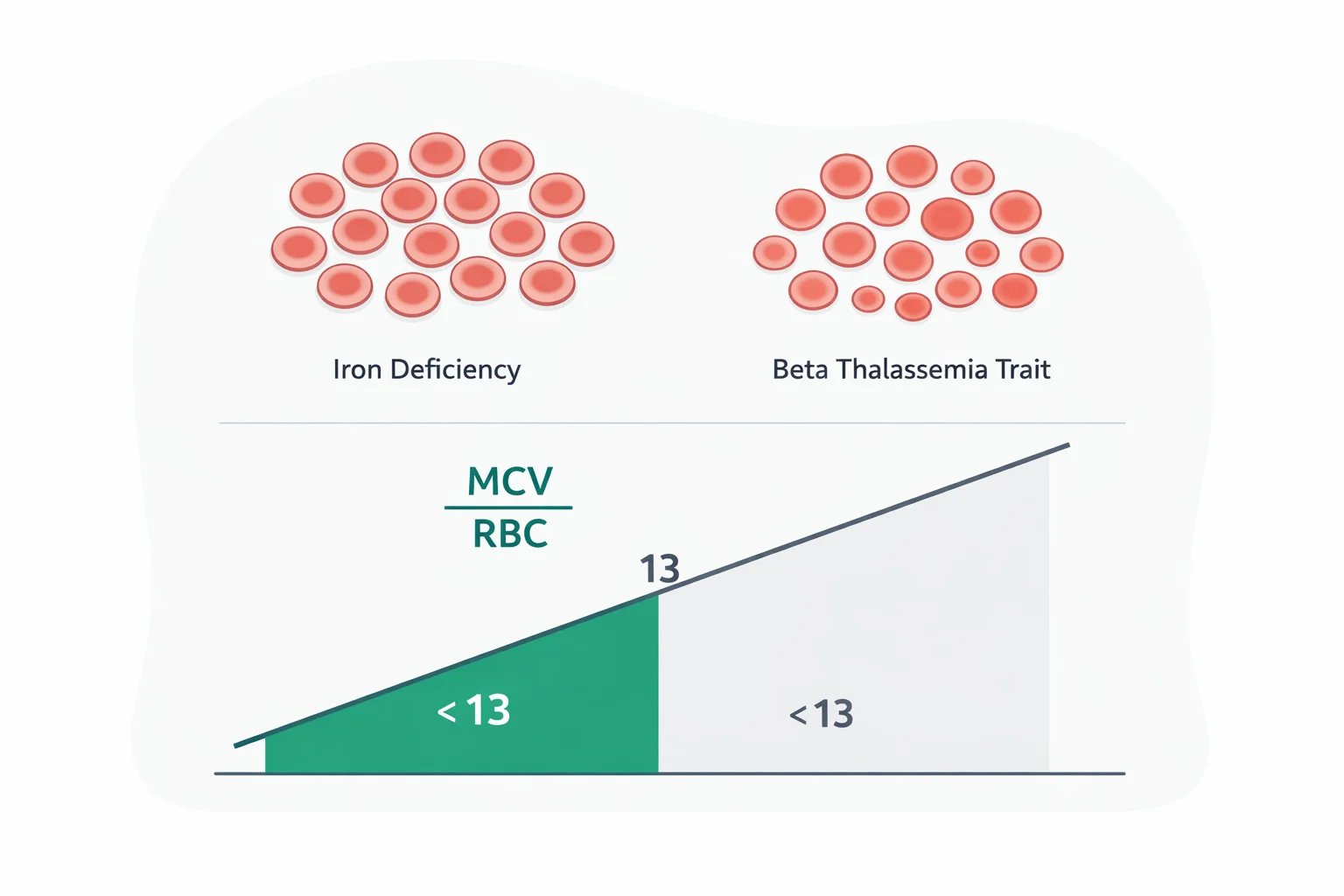
A Mentzer index calculator settles a question that two nearly identical lab reports can't. Picture two patients: both have a hemoglobin of 10.9 g/dL and an MCV of 64 fL. Same anemia, same small red cells, same fatigue. One needs months of iron therapy. The other needs no iron at all — giving it would be useless and, over years, potentially harmful. The only number on the CBC that separates them is one most people skip right past: the red blood cell count. Divide MCV by that count and you get the Mentzer index — below 13 points to β-thalassemia trait, above 13 points to iron deficiency. This guide walks through why that one-line division works, how the Mentzer index stacks up against six rival discrimination indices, where all of them fail, and which two confirmatory tests actually close the case.
Table of contents
Iron Deficiency vs. β-Thalassemia Trait: Two Diseases, One Disguise
Both conditions shrink red blood cells below the 80 fL microcytosis line, but for opposite reasons. Iron deficiency is a supply problem: hemoglobin synthesis stalls because the raw material is missing, so the marrow produces fewer cells and each one is undersized and pale. β-thalassemia trait is a manufacturing-instruction problem: one of the two β-globin genes is faulty, so every cell carries less hemoglobin — but iron is plentiful and the marrow compensates by producing more cells, not fewer. A thalassemia-trait CBC often shows an RBC count above 5.0 ×10¹²/L alongside an MCV in the 60s, a combination iron deficiency almost never produces.
Getting the two confused has real costs in both directions. Iron given to a thalassemia-trait patient treats nothing and adds to iron stores that are already normal or high — some trait carriers accumulate excess iron even without supplements. Missing the trait matters even more for family planning: when both partners carry β-thalassemia trait, each pregnancy has a 25% chance of producing a child with transfusion-dependent thalassemia major. That's why a cheap screening ratio computed from a routine CBC has survived for five decades in clinical practice.
MCV ÷ RBC: The Arithmetic Behind the 13 Cutoff
William Mentzer proposed the index in a 1973 letter to The Lancet, and the formula hasn't changed since: divide the MCV in femtoliters by the RBC count in millions per microliter (the same number as ×10¹²/L). The logic follows directly from the biology above. In thalassemia trait, the denominator is large (many cells) while the numerator is small (very low MCV), so the quotient lands low — under 13. In iron deficiency, cell production falls roughly in step with cell size, so the denominator shrinks faster than the numerator and the quotient lands high — over 13.
Run the two patients from the opening through it. Patient one: MCV 64 ÷ RBC 5.9 = 10.8. Below 13 — the marrow is pumping out huge numbers of small cells, the thalassemia-trait signature. Patient two: MCV 64 ÷ RBC 3.6 = 17.8. Well above 13 — few cells, small cells, the iron-starved marrow's signature. Identical hemoglobin, identical MCV, and the index splits them cleanly. One caution: values between roughly 12 and 14 misclassify most often, so a result of 12.7 or 13.4 deserves to be called indeterminate rather than forced into a category.
Mentzer vs. Six Rival Indices
The Mentzer index was neither the first nor the last attempt to squeeze a diagnosis out of the CBC — England and Fraser published theirs the same year, and at least a dozen more followed. They differ in which red-cell parameters they recruit and where they draw the line. Our calculator computes all seven of these when you supply the optional inputs:
| Index | Formula | Thal trait if | Extra inputs |
|---|---|---|---|
| Mentzer (1973) | MCV ÷ RBC | < 13 | None |
| Ehsani (2005) | MCV − (10 × RBC) | < 15 | None |
| England–Fraser (1973) | MCV − RBC − (5 × Hb) − 3.4 | < 0 | Hemoglobin |
| Shine & Lal (1977) | MCV² × MCH ÷ 100 | < 1530 | MCH |
| Green & King (1989) | MCV² × RDW ÷ (Hb × 100) | < 65 | RDW, Hb |
| RDW index (1999) | MCV × RDW ÷ RBC | < 220 | RDW |
| Srivastava (1973) | MCH ÷ RBC | < 3.8 | MCH |
Which one wins? A 2015 meta-analysis in Clinical Chemistry and Laboratory Medicine pooled dozens of validation studies and reached two conclusions that matter here. First, the Mentzer and Green & King indices consistently rank at or near the top — reported sensitivities for the Mentzer index run from about 74% up to 98.7% depending on the population, with specificity typically in the 63–82% range. Second, and more important: no index performed well enough to replace definitive testing. The smart way to use them is the way our calculator does — as a panel. Seven indices agreeing is a strong pattern; a 4-to-3 split is a flag that something atypical (often a combined deficiency) is going on.
Where the Mentzer Index Calculator Gets It Wrong
Every discrimination index assumes the patient has exactly one thing wrong, and that assumption breaks surprisingly often. The classic trap is combined disease: a thalassemia-trait carrier who also becomes iron deficient — common in pregnancy, where iron demands rise by roughly 1,000 mg — loses the high RBC count that makes the index work. The falling cell count pushes the ratio up toward or past 13, and the trait disappears from view. Anyone with a low ferritin should have iron corrected first and the CBC rechecked before any conclusion about thalassemia is drawn.
α-thalassemia trait is the second blind spot. It produces the same low-MCV, high-RBC pattern — so the Mentzer index will read below 13 — but hemoglobin electrophoresis comes back completely normal, because HbA2 rises only in β-trait. Confirming α-trait requires DNA testing. A recent blood transfusion also scrambles the math, since the donor's normal-sized cells blend into every red-cell parameter for up to three months. And the whole approach only applies when the MCV is actually below 80 fL: platelet abnormalities can hint at the cause too — iron deficiency commonly drives a reactive thrombocytosis above 400 ×10⁹/L, which you can put in context with our platelet count calculator.
Ferritin and HbA2: The Two Tests That Actually Decide
The index tells you which door to knock on; two lab tests open it. Ferritin settles the iron question: the WHO threshold of below 15 ng/mL is diagnostic of depleted iron stores in adults, and most clinicians treat anything under 30 ng/mL as probable iron deficiency (ferritin rises with inflammation, so a "normal" 60 ng/mL in someone with rheumatoid arthritis can still hide empty stores). Hemoglobin electrophoresis settles the β-thalassemia question: an HbA2 fraction above 3.5% confirms the trait. There's an interaction worth knowing — severe iron deficiency suppresses HbA2 and can pull a true trait carrier back under the 3.5% line, which is the second reason to replete iron before ordering electrophoresis.
Reading the rest of the CBC alongside the index sharpens the call. RDW below 14.5% means the small cells are uniformly small — typical of trait, where every cell shares the same genetic handicap. An elevated RDW means a mixed population of old normal cells and new starved ones — typical of evolving iron deficiency. Your absolute hemoglobin level helps too: β-thalassemia trait rarely drags hemoglobin below 10 g/dL, so deeper anemia should make you doubt a pure-trait explanation and look harder for iron loss, while your hematocrit normally tracks at roughly three times the hemoglobin in either condition.
What to Do With Your Result
If your Mentzer index is below 13: don't start iron on autopilot. Ask for ferritin plus hemoglobin electrophoresis with HbA2 quantification. If β-trait is confirmed, the practical consequences are modest but permanent — no iron unless a deficiency is separately proven, a note in your record so future mild microcytosis doesn't trigger repeated workups, and partner screening before pregnancy given the 25% per-pregnancy risk when both parents carry the trait.
If it's above 13: the job becomes finding the iron leak, not just plugging it. Menstrual loss and dietary shortfall explain most cases in younger patients, but new iron deficiency in men or postmenopausal women warrants a gastrointestinal evaluation, because occult GI bleeding is the leading cause in those groups. On oral iron, expect hemoglobin to climb about 1 g/dL every two to three weeks; the MCV lags and can take two to three months to normalize. If it's between 12 and 14: treat the index as abstaining. Order both confirmatory tests and let them vote instead — a few dollars of lab work beats a misread ratio every time.
A Mentzer index above 13 does not by itself justify iron replacement. After confirmatory testing establishes iron deficiency, the iron deficit calculator can show the Ganzoni estimate from weight, measured Hb and clinician-selected assumptions; it does not choose an iron product or schedule.
References
- Mentzer WC. Differentiation of iron deficiency from thalassaemia trait. Lancet. 1973;1(7808):882
- Hoffmann JJ, Urrechaga E, Aguirre U. Discriminant indices for distinguishing thalassemia and iron deficiency in patients with microcytic anemia: a meta-analysis. Clin Chem Lab Med. 2015;53(12):1883-1894
- World Health Organization. WHO guideline on use of ferritin concentrations to assess iron status in individuals and populations. Geneva: WHO; 2020

Written by Jurica Šinko
Founder & CEO
Entrepreneur and health information advocate, passionate about making health calculations accessible to everyone through intuitive digital tools.
View full profileFrequently Asked Questions
What does a Mentzer index below 13 mean?
A Mentzer index under 13 means your MCV is low relative to a preserved or elevated red cell count — the pattern of beta thalassemia trait, where the marrow produces many small cells. It is a screening signal, not a diagnosis: hemoglobin electrophoresis showing HbA2 above 3.5% is what confirms the trait.
How do I calculate the Mentzer index from my CBC?
Divide the MCV in femtoliters by the RBC count in millions per microliter (the same figure as ×10¹²/L). For example, an MCV of 64 fL with an RBC of 5.9 gives 64 ÷ 5.9 = 10.8. No unit conversion is needed — both numbers appear on every standard CBC report.
Is a Mentzer index of exactly 13 iron deficiency or thalassemia?
Neither — 13 is the indeterminate point, and in practice anything between about 12 and 14 misclassifies too often to trust. In that gray zone, skip the index and go straight to ferritin (below 30 ng/mL suggests iron deficiency) and hemoglobin electrophoresis with HbA2 quantification.
Does the Mentzer index work for alpha thalassemia?
Partially. Alpha thalassemia trait produces the same low-MCV, high-RBC pattern, so the index often reads below 13 — but electrophoresis comes back normal because HbA2 rises only in beta trait. Confirming alpha thalassemia requires DNA-based globin gene testing, which is worth pursuing when the index says thalassemia but HbA2 is 3.5% or less.
Can the Mentzer index be wrong if I have both iron deficiency and thalassemia trait?
Yes — combined disease is its biggest blind spot. Iron deficiency lowers the RBC count that normally keeps a trait carrier below 13, pushing the ratio up and hiding the trait. Iron deficiency also suppresses HbA2 on electrophoresis. Correct the iron first, then recheck both the CBC and electrophoresis about three months later.
What RBC count suggests thalassemia trait instead of iron deficiency?
An RBC count above 5.0 ×10¹²/L combined with an MCV below 80 fL strongly favors thalassemia trait — iron deficiency almost never produces that pairing, because an iron-starved marrow cannot maintain a high cell count. In iron deficiency the RBC count typically falls below 4.5 as the anemia deepens.
What is the difference between the Mentzer index and the Green and King index?
The Mentzer index uses only MCV ÷ RBC with a cutoff of 13, while Green & King uses MCV² × RDW ÷ (Hb × 100) with a cutoff of 65, adding red cell size variability and anemia depth to the equation. Meta-analysis data rank both among the most reliable discrimination indices, and when they disagree, confirmatory testing matters more than either score.
Why is my MCV low but my ferritin normal?
Thalassemia trait is the most common explanation — small cells with full iron stores, usually with an RDW under 14.5% because the cells are uniformly small. Less common causes include anemia of chronic disease and sideroblastic anemia. A Mentzer index below 13 plus a normal ferritin is exactly the combination that warrants hemoglobin electrophoresis.
Related Calculators

A1C Calculator — Convert HbA1c to eAG with Targets
Use our A1C calculator to convert HbA1c to estimated average glucose (eAG). See normal, prediabetes, and diabetes thresholds in mg/dL and mmol/L. Fast results.
Albumin Calculator — Serum Albumin Level Interpretation
Free albumin calculator to interpret serum albumin levels, grade hypoalbuminemia, and compute A/G ratio plus albumin-corrected calcium from your lab results.
Albumin-Corrected Anion Gap Calculator — Hidden Acidosis
Use our albumin-corrected anion gap calculator to raise the anion gap by 2.5 per 1 g/dL of low albumin and reveal a hidden high-gap metabolic acidosis.
ANC Calculator: Absolute Neutrophil Count & Neutropenia
Free ANC calculator to calculate absolute neutrophil count from WBC and differential. Get ANC in cells/uL and x10^9/L with instant neutropenia grading.
Anion Gap Calculator — Metabolic Acidosis Evaluation
Free anion gap calculator finds serum anion gap from sodium, chloride, and bicarbonate, with albumin correction and delta ratio for metabolic acidosis.
AST/ALT Ratio Calculator — Free De Ritis Ratio Tool
Use our free AST/ALT ratio calculator to compute the De Ritis index instantly. Visual ratio chart, enzyme-level assessment, and clinical patterns guide.