Use the Platelet Count Calculator
Free platelet count calculator to interpret your CBC result, grade thrombocytopenia or thrombocytosis severity, bleeding risk, and corrected count increment.
What do you want to do?
Units on your report
250 ×10⁹/L, 250 K/µL, and 250,000 /µL are the same count — only the units differ.
Normal adults: 150–450 ×10⁹/L. The result updates as you type.
Platelet interpretation
= 245,000 platelets/µL · 245 K/µL
At 100 ×10⁹/L or above, platelet-related bleeding risk is minimal, including for high-stakes procedures such as neurosurgery.
Classification
Normal platelet count
Tier range
150–450 ×10⁹/L
Normal reference
150–450 ×10⁹/L
Platelet count classification
| Classification | Count (×10⁹/L) |
|---|---|
| Severe thrombocytopenia | < 50 |
| Moderate thrombocytopenia | 50–99 |
| Mild thrombocytopenia | 100–149 |
| Normal platelet count | 150–450 |
| Mild thrombocytosis | 451–700 |
| Marked thrombocytosis | 701–1,000 |
| Extreme thrombocytosis | > 1,000 |
Reference intervals vary slightly by lab. Your report's stated range is the final authority.
This tool interprets platelet numbers for general education only. Transfusion thresholds and CCI cutoffs vary by protocol and clinical context. It does not diagnose any condition or replace your hematologist's judgment.
Educational tool, not medical advice. Check this tool’s method and limitations before interpreting a result. Talk to a qualified healthcare professional before making decisions about medication, diet, exercise, or treatment. See our Terms of Use.
Your rating helps improve Platelet Count Calculator. We store only an anonymized vote (no personal data).
How to Use Platelet Count Calculator
Step 1: Choose a mode
Pick "Interpret a count" to classify a single platelet result, or "Corrected count (CCI)" to grade how well a platelet transfusion worked.
Step 2: Match your units
Set the unit toggle to ×10⁹/L (K/µL) or raw /µL so the number matches your CBC printout. 250 ×10⁹/L equals 250,000 /µL.
Step 3: Enter the platelet count
Type your platelet value, e.g. 245. The severity tier and bleeding-risk band update instantly as you type.
Step 4: Read the classification
See whether the count is normal (150–450), thrombocytopenic, or thrombocytotic, plus the bleeding-risk note keyed to the 50, 20, and 10 thresholds.
Step 5: Run a CCI (optional)
In CCI mode, enter pre- and post-transfusion counts, the dose (×10¹¹), height, and weight to compute the corrected count increment and refractoriness check.
Step 6: Copy or reset
Tap Copy summary to save the result for your records, or Reset to clear the fields and start over.
Key Features
- Classifies counts into normal, mild, moderate, and severe thrombocytopenia
- Flags mild, marked, and extreme thrombocytosis above 450 ×10⁹/L
- Bleeding-risk read-out tied to transfusion thresholds (50, 20, 10)
- Unit toggle: ×10⁹/L, K/µL, and raw /µL with instant conversion
- Corrected count increment (CCI) mode for platelet transfusion response
- Copy-summary button and visual normal-range gauge
Understanding Your Platelet Count Results
How the platelet count calculator classifies your number
A platelet count is a direct measurement from your complete blood count (CBC), not a derived formula, so the platelet count calculator's job is interpretation. It normalizes whatever unit you enter to ×10⁹/L (where ×10⁹/L = K/µL, and raw /µL ÷ 1,000 = ×10⁹/L), then maps the value onto seven tiers: severe thrombocytopenia (< 50), moderate (50–99), mild (100–149), normal (150–450), mild thrombocytosis (451–700), marked (701–1,000), and extreme (> 1,000). Alongside the tier, it reports a bleeding-risk band keyed to the count, because hemostatic risk does not change at the same boundaries as the severity labels.
The corrected count increment (CCI) mode does use a formula: CCI = (post − pre count in /µL) × body surface area (m²) ÷ platelets transfused (×10¹¹). Body surface area is computed with the Mosteller equation, √(height × weight ÷ 3600). The CCI exists because a fixed platelet dose raises a small person's count more than a large person's, so the raw increment alone can't tell you whether a transfusion truly worked.
Reference ranges & bleeding-risk thresholds
The normal adult platelet range is 150–450 ×10⁹/L, and it is broadly similar across sex and age, with only minor variation by lab method. What matters clinically are the bleeding thresholds: above 100, hemostasis is normal even for neurosurgery; 50–99 supports most surgery; 20–49 carries procedural risk; 10–19 brings rising spontaneous bleeding; and below 10 is the usual prophylactic-transfusion threshold. For transfusion response, a one-hour CCI ≥ 7,500 is adequate, while a 20-hour CCI ≥ 4,500 confirms a durable rise. These cutoffs come from transfusion-medicine guidance such as the AABB platelet transfusion recommendations.
Assumptions & limitations
This tool assumes the entered count is a valid analyzer result. It cannot detect pseudothrombocytopenia from EDTA-induced platelet clumping, which can falsely report counts in the 20s–30s and needs a citrate-tube redraw and blood-film review to exclude. The CCI assumes accurate timing and an actual transfused dose in ×10¹¹; estimating the dose from "one unit" introduces error. Thresholds are population guides, not individual promises — bleeding also depends on platelet function, medications such as aspirin, and coagulation status. Always interpret a single value against prior counts and symptoms, and review abnormal or falling results with a clinician.
Complete Guide: Platelet Count Calculator
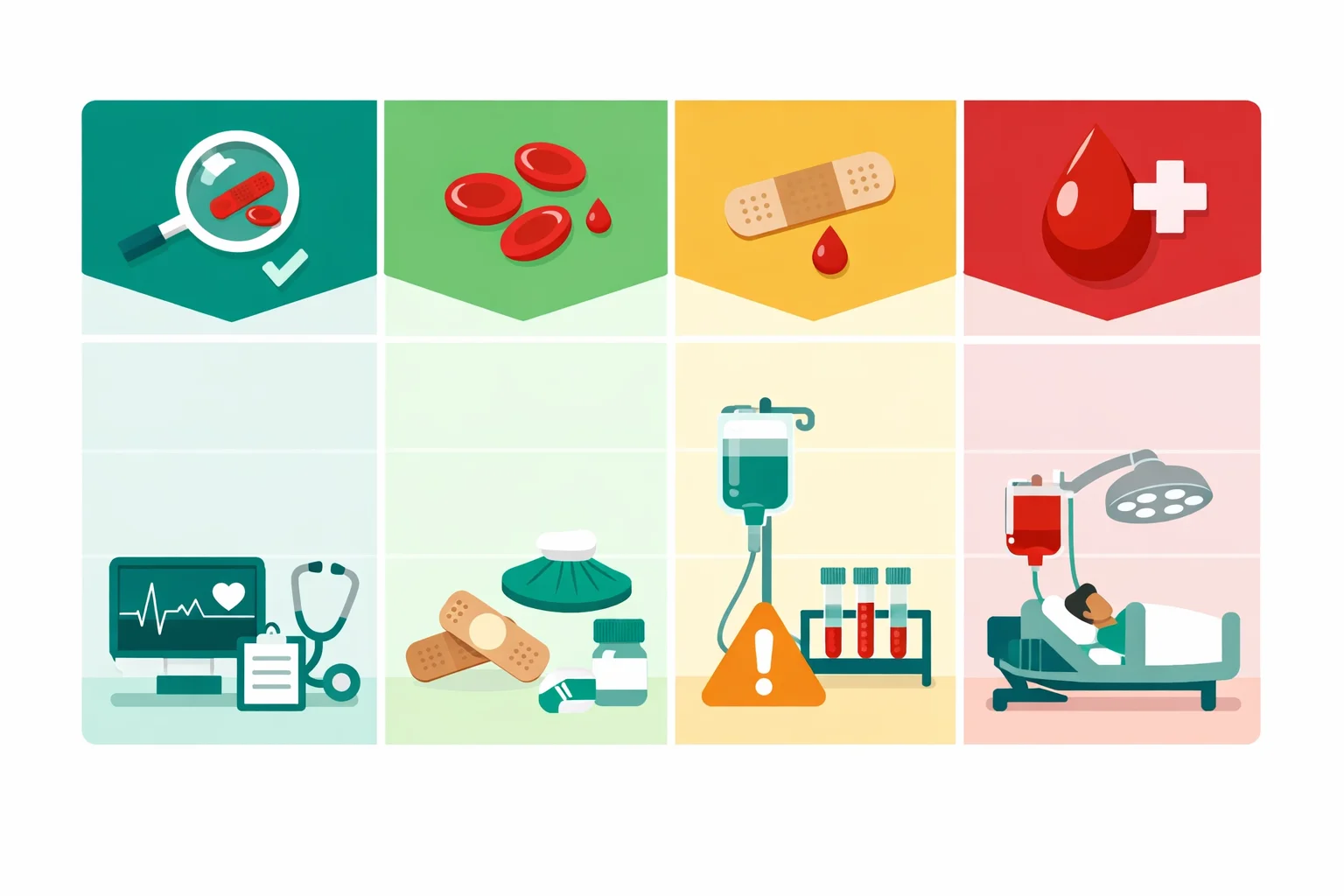
You open your lab portal, this platelet count calculator in one tab and your CBC in the other, and there it is: "Platelets 96." Is 96 dangerous? Does it mean a transfusion? The number sits between a normal 150–450 ×10⁹/L and the scary single digits, and the report rarely explains what that gap means for you. This guide turns the raw number into a clear answer — what tier it falls in, what bleeding risk it carries, and when the count actually changes a decision.
Platelets (thrombocytes) are the tiny cell fragments that plug damaged blood vessels and start the clotting cascade. A healthy adult makes roughly 100 billion of them every day, and they survive about 8–10 days in circulation. Because production, storage in the spleen, and destruction all influence the count, a single value is a snapshot of a moving system — which is exactly why interpretation, not just the digit, matters.
Start with a worked example
Take that count of 96 ×10⁹/L. Enter it in the platelet count calculator and you land in the moderate thrombocytopenia tier (96 falls in the 50–99 band, just below the 100–149 mild band — a reminder that tier edges are not cliffs). The bleeding-risk panel reads "adequate for most surgery" because 96 is comfortably above 50, the usual surgical floor. Practically, a count of 96 in an otherwise-well person is rarely an emergency — it's a number to recheck and trend, not to panic over.
Now drop the count to 18 ×10⁹/L. The tier flips to severe thrombocytopenia and the bleeding panel turns red: "elevated bleeding risk." Below 20, spontaneous bruising and mucosal bleeding (gums, nose) become realistic, and many inpatient protocols transfuse below 20 in the presence of fever or sepsis. Same lab test, same units — but a fivefold difference in clinical weight. The calculator's job is to make that jump obvious at a glance.
×10⁹/L, K/µL, and /µL: the unit trap
More platelet panic comes from units than from biology. Labs report the same count three ways: 250 ×10⁹/L (SI units, common outside the US), 250 K/µL (thousands per microliter, common on US printouts), and 250,000 /µL (the raw count). The first two are numerically identical; the third is the same value written out with three extra zeros. So a person reading "250" and a person reading "250,000" have the exact same platelet count. The calculator's unit toggle exists precisely so you don't misread a healthy 250 as a catastrophic-looking number — or vice versa.
The conversion is trivial once you see it: divide a raw /µL count by 1,000 to get ×10⁹/L. 245,000 /µL ÷ 1,000 = 245 ×10⁹/L. If your report shows a number like 245 with a normal flag, it's already in ×10⁹/L. If it shows 245,000, it's the raw count. Switching the toggle keeps the interpretation identical and just changes how the input is labeled.
What each count means for bleeding
The clinically useful question isn't "is this normal?" but "at what count does bleeding actually change?" Decades of transfusion data give surprisingly consistent thresholds. The table below pairs each platelet band with its real-world hemostatic meaning — these numbers, not the normal range alone, drive transfusion and procedure decisions.
| Count (×10⁹/L) | Hemostatic meaning |
|---|---|
| ≥ 100 | Normal hemostasis |
| 50–99 | Adequate for most surgery |
| 20–49 | Procedural bleeding risk |
| 10–19 | Spontaneous bleeding rises |
| < 10 | High spontaneous risk |
Notice that the steepest change in risk happens between 50 and 10 — a span the "normal vs. low" framing completely flattens. A patient at 80 ×10⁹/L and a patient at 12 ×10⁹/L are both "low," yet one can have surgery and the other may need platelets before getting out of bed. That granularity is the entire point of interpreting the count rather than reading a single flag.
Low platelets: causes by cell size
Used as a thrombocytopenia calculator, the tool grades any low result into mild, moderate, or severe — but the count alone doesn't reveal the cause. Thrombocytopenia has three mechanisms — the platelets aren't being made, they're being destroyed, or they're being pooled in an enlarged spleen. A useful clinical shortcut is the mean platelet volume (MPV), which behaves like the platelet version of MCV. A high MPV with a low count suggests rapid turnover and young, large platelets — typical of immune thrombocytopenia (ITP) where the marrow is compensating. A normal or low MPV with a low count points toward production failure: chemotherapy, marrow infiltration, B12 or folate deficiency, or aplastic anemia.
Liver disease deserves special mention because it lowers platelets through two routes at once: a cirrhotic spleen sequesters them, and a damaged liver makes less thrombopoietin, the hormone that drives platelet production. That's why platelet count is a core variable in fibrosis scoring. Our FIB-4 calculator divides by the platelet count specifically because a falling platelet level tracks worsening liver scarring, and the liver function calculator helps place that finding in the wider hepatic picture.
High platelets: reactive vs. clonal
A count above 450 ×10⁹/L is thrombocytosis, and the first fork is whether it's reactive or clonal. Reactive (secondary) thrombocytosis accounts for roughly 80–90% of high counts and is the body responding to something else — iron deficiency, infection, inflammation, recent surgery, or the rebound after the spleen is removed. These counts usually sit between 450 and 700 and drift back down once the trigger resolves. Iron deficiency is worth singling out: high platelets alongside small red cells is a common pairing, and the Mentzer index calculator can screen whether that low MCV reflects iron deficiency or thalassemia trait before iron studies come back. Clonal thrombocytosis, by contrast, comes from a bone-marrow disorder such as essential thrombocythemia, often pushing counts past 700 or even 1,000.
Counterintuitively, extreme thrombocytosis above 1,000 ×10⁹/L can cause bleeding rather than clotting. The enormous platelet mass mops up large von Willebrand factor multimers, producing an acquired von Willebrand syndrome. So the gauge runs in both directions: too few platelets and too many can each impair hemostasis, just by different mechanisms. The calculator flags marked (701–1,000) and extreme (> 1,000) tiers separately because the workup and urgency differ.
Corrected count increment (CCI): did the transfusion work?
When someone receives a platelet transfusion, the raw post-transfusion rise is misleading — a small adult and a large adult given the same unit will show different increments simply because of blood volume. The corrected count increment fixes that by adjusting the rise for body surface area and the dose transfused. The formula is:
CCI = (post − pre count, /µL) × BSA (m²) ÷ platelets transfused (×10¹¹)
A one-hour CCI of 7,500 or more means the transfusion did its job. Two consecutive one-hour values below 7,500 define platelet refractoriness — most often immune, from HLA antibodies in someone who has had many transfusions or pregnancies. There's also a time dimension: a good one-hour CCI that collapses by 18–24 hours (below 4,500) points away from antibodies and toward consumption — sepsis, fever, an enlarged spleen, disseminated intravascular coagulation, or active bleeding. The mode switch in the calculator lets you set the timing so the right threshold is applied automatically.
A worked CCI calculation
Suppose a 170 cm, 70 kg patient has a pre-transfusion count of 14 ×10⁹/L and rises to 42 ×10⁹/L one hour after a single apheresis unit of 4 ×10¹¹ platelets. First, BSA by the Mosteller formula: √(170 × 70 ÷ 3600) = √3.31 ≈ 1.82 m². The increment is 42 − 14 = 28 ×10⁹/L, which is 28,000 /µL. Plug in: CCI = 28,000 × 1.82 ÷ 4 = 12,740. That comfortably clears 7,500, so the transfusion worked as expected.
Change one thing — the patient only rises to 19 ×10⁹/L. Now the increment is 5 ×10⁹/L (5,000 /µL), and CCI = 5,000 × 1.82 ÷ 4 = 2,275, far below 7,500. A single low value can be a fluke, but a second one like it confirms refractoriness and triggers a hunt for HLA antibodies and a switch to matched or crossmatched platelets. This is the kind of decision the raw "19" alone can't support — the correction for size and dose is what makes the number actionable.
Mistakes that distort the count
Before acting on a surprising platelet number, rule out artifacts. Pseudothrombocytopenia is the classic trap: in some people, the EDTA anticoagulant in the purple-top tube causes platelets to clump, and the analyzer counts the clumps as single cells, reporting a falsely low value that can read in the 20s or 30s while the true count is normal. The fix is a repeat draw in a citrate (blue-top) tube and a blood-film review for clumping. Anyone with an unexpectedly low count and no bleeding should have this excluded first.
Other distortions: giant platelets can be miscounted as red or white cells, lowering the reported number; very high white-cell counts or fragmented red cells (schistocytes) can be miscounted as platelets, raising it. Timing matters too — counts dip transiently after heavy alcohol use or a viral illness and rebound afterward. As with hematocrit, a trend across two or three draws beats a single value, and pairing the platelet result with the rest of the CBC, like the hematocrit calculator and hemoglobin calculator, tells a fuller story.
What to do with your result
As a low platelet count calculator, this tool tells you which tier you're in, but the next move depends on the size of the change. If your count is mildly off (say, 120–149 or 451–600) and you feel well, the sensible move is a recheck in a few weeks and a look at the trend — most mild changes are transient or reactive. If you're below 50, or above 700, or you have symptoms such as easy bruising, petechiae (pinpoint red spots), nosebleeds, or unusual bleeding, that warrants prompt medical review rather than watchful waiting. Bring the actual numbers and units with you; "my platelets were a bit low" is far less useful to a clinician than "96 ×10⁹/L, down from 180 three months ago."
Because platelets fall in advanced liver disease, a persistently low count alongside abnormal liver tests may prompt fibrosis and prognosis scoring. The MELD score calculator and Child-Pugh calculator use related markers to stage liver disease, and reading them together with your platelet trend gives a far more complete picture than any single number.
In adult critical care, platelet count also contributes to the original SOFA score calculator. A count of 90 ×10⁹/L contributes 2 coagulation points, but that subscore does not diagnose sepsis or set a platelet transfusion threshold.
Related lab calculators
- FIB-4 calculator — uses your platelet count to estimate liver fibrosis.
- Hematocrit calculator — the red-cell half of your CBC.
- Hemoglobin calculator — oxygen-carrying capacity and anemia context.
- Liver function calculator — where low platelets and liver disease meet.
- Neutrophil to lymphocyte ratio calculator — feeds your platelet count into the PLR and SII inflammation indices alongside the NLR.
References and further reading
Authoritative, patient-accessible resources:
- MedlinePlus — Platelet tests
- NHLBI — Thrombocytopenia
- American Society of Hematology — Blood disorders
This article is informational and does not provide medical advice. Discuss any abnormal or persistent platelet result with your healthcare provider.

Written by Jurica Šinko
Founder & CEO
Entrepreneur and health information advocate, passionate about making health calculations accessible to everyone through intuitive digital tools.
View full profileFrequently Asked Questions
Is a platelet count of 100 dangerous?
A count of 100 ×10⁹/L is mild thrombocytopenia and rarely dangerous on its own. It is above 50, the usual floor for most surgery, and well above 20, where spontaneous bleeding starts to rise. In a person with no bleeding symptoms it is usually a number to recheck and trend rather than treat.
What platelet level requires a transfusion?
For a stable patient, prophylactic platelet transfusion is commonly given below 10 ×10⁹/L. The threshold rises to about 20 with fever or sepsis, 50 before most invasive procedures or major surgery, and 100 before neurosurgery or epidural anesthesia. Active bleeding can raise these targets.
What is the difference between thrombocytopenia and thrombocytosis?
Thrombocytopenia means a low platelet count, below 150 ×10⁹/L, and is graded mild (100–149), moderate (50–99), or severe (under 50). Thrombocytosis means a high count, above 450 ×10⁹/L, split into mild, marked (701–1,000), and extreme (over 1,000). Both can impair clotting by different mechanisms.
How do I convert a platelet count from /µL to ×10⁹/L?
Divide the raw count in /µL by 1,000. For example, 245,000 /µL is 245 ×10⁹/L, which is the same as 245 K/µL. The values ×10⁹/L and K/µL are numerically identical, so a report showing 245 is already in the standard unit.
What does the corrected count increment (CCI) tell you?
The CCI shows whether a platelet transfusion raised the count as expected, after adjusting for body size and dose. A one-hour CCI of 7,500 or more is a good response; two values below 7,500 indicate refractoriness, usually from HLA antibodies. A good one-hour but poor 20-hour CCI (under 4,500) suggests consumption such as sepsis or splenomegaly.
Can a low platelet count be a lab error?
Yes. Pseudothrombocytopenia happens when EDTA in the purple-top tube makes platelets clump, so the analyzer undercounts them and may report a value in the 20s or 30s while the true count is normal. A repeat draw in a citrate (blue-top) tube and a blood-film review for clumping rule this out, especially when there is no bleeding.
What platelet count is considered too high?
Counts above 450 ×10⁹/L are thrombocytosis. Most cases between 450 and 700 are reactive — driven by iron deficiency, infection, or inflammation — and settle once the cause resolves. Counts above 1,000 raise concern for a marrow disorder and can paradoxically cause bleeding through acquired von Willebrand syndrome.
Why are my platelets low if I have liver disease?
Cirrhosis lowers platelets two ways: an enlarged spleen traps them, and the damaged liver makes less thrombopoietin, the hormone driving platelet production. This is why a falling platelet count is built into liver fibrosis scores like FIB-4, where a lower count pushes the score toward advanced scarring.
Related Calculators
A1C Calculator — Convert HbA1c to eAG with Targets
Use our A1C calculator to convert HbA1c to estimated average glucose (eAG). See normal, prediabetes, and diabetes thresholds in mg/dL and mmol/L. Fast results.
Albumin Calculator — Serum Albumin Level Interpretation
Free albumin calculator to interpret serum albumin levels, grade hypoalbuminemia, and compute A/G ratio plus albumin-corrected calcium from your lab results.
Albumin-Corrected Anion Gap Calculator — Hidden Acidosis
Use our albumin-corrected anion gap calculator to raise the anion gap by 2.5 per 1 g/dL of low albumin and reveal a hidden high-gap metabolic acidosis.

ANC Calculator: Absolute Neutrophil Count & Neutropenia
Free ANC calculator to calculate absolute neutrophil count from WBC and differential. Get ANC in cells/uL and x10^9/L with instant neutropenia grading.
Anion Gap Calculator — Metabolic Acidosis Evaluation
Free anion gap calculator finds serum anion gap from sodium, chloride, and bicarbonate, with albumin correction and delta ratio for metabolic acidosis.
AST/ALT Ratio Calculator — Free De Ritis Ratio Tool
Use our free AST/ALT ratio calculator to compute the De Ritis index instantly. Visual ratio chart, enzyme-level assessment, and clinical patterns guide.