Use the Iron Deficit Calculator
Estimate the iron needed for a selected hemoglobin increase and a separate iron-store allowance. Start with the 70 kg, 10 g/dL example, then review the assumptions for your calculation.
Estimated total iron need
1,340 mg not a single dose
For education and clinician cross-checking after iron deficiency has been confirmed. This estimates total elemental iron need; it does not choose a medicine, oral dose, infusion volume, or treatment schedule.
Enter numbers without thousands separators. Decimal commas are accepted; for three decimal places, use a point to avoid ambiguity.
At least 35 kg: target 15 g/dL and stores 500 mg. Below 35 kg: target 13 g/dL and stores 15 mg/kg. These are formula assumptions, not universal treatment targets.
Estimated total iron deficit
1,340 mg
Elemental iron across the whole replacement course, if clinically indicated.
Standard assumptions
Hb correction
840 mg
Assumed iron stores
500 mg
Hemoglobin gap
5.0 g/dL
Total per kg
19.1 mg/kg
Not a per-dose limit
Where the estimate comes from
Emerald: Hb correction · Blue: iron stores
Calculation in g/dL
70.00 × (15.00 − 10.00) × 2.4 + 500.0 = 1,340.0 mg
A 1 g/dL change in target changes this estimate by 168.0 mg, with weight and stores fixed.
Standard formula assumptions by weight
| Weight | Target Hb | Stores |
|---|---|---|
| Below 35 kg | 13 g/dL | 15 mg/kg |
| 35 kg or more | 15 g/dL | 500 mg |
Source: Venofer UK prescribing information, section 4.2. Displayed totals are rounded; arithmetic uses unrounded values.
Low hemoglobin alone does not prove iron deficiency. Ferritin, transferrin saturation, symptoms and the cause of anemia need review. Active bleeding, recent transfusion or iron treatment, kidney disease, pregnancy and altered body composition need individual assessment. IV iron must be prescribed and administered by qualified clinicians.
Educational tool, not medical advice. Check this tool’s method and limitations before interpreting a result. Talk to a qualified healthcare professional before making decisions about medication, diet, exercise, or treatment. See our Terms of Use.
Your rating helps improve Iron Deficit Calculator. We store only an anonymized vote (no personal data).
How to Use Iron Deficit Calculator
Step 1: Choose the calculation weight
Enter Body weight used in formula in kg or lb. Use the weight basis specified by the treating clinician, especially in obesity or pregnancy.
Step 2: Enter laboratory hemoglobin
Enter Current hemoglobin and select g/dL or g/L to match the lab report. Unit buttons convert existing values; 10 g/dL equals 100 g/L.
Step 3: Review target and store assumptions
Choose Standard Ganzoni assumptions or Custom clinician-selected values under Target and iron stores. Custom mode lets you enter Target hemoglobin and Iron-store allowance.
Step 4: Review the total and its components
Read the total iron deficit, Hb correction, assumed iron stores and calculation. Copy summary includes the assumptions. A clinician must determine any actual treatment dose and schedule.
Key Features
- Total elemental iron estimate using the Ganzoni equation
- Weight conversion between kg and lb; hemoglobin in g/dL or g/L
- Separate hemoglobin correction and iron-store allowance
- Standard weight-based assumptions or custom clinician-selected values
- Visible formula, target sensitivity and copyable result summary
Understanding Results
Formula
Total iron deficit (mg) = calculation weight (kg) × [target Hb − current Hb] (g/dL) × 2.4 + iron stores (mg). With Hb expressed in g/L, use 0.24 instead. The Venofer prescribing information documents this Ganzoni equation and its weight-based assumptions.
Reference Ranges & Interpretation
There is no universal normal range for total iron deficit. The result depends on the chosen target and store allowance, as well as weight and measured Hb. A 1,340 mg estimate means 840 mg for a hemoglobin increase plus 500 mg assumed stores in the default example; it is neither an anemia severity score nor an authorized infusion amount.
Assumptions & Limitations
The formula assumes that iron deficiency explains the hemoglobin shortfall. It does not diagnose deficiency, account for continuing losses or predict response. Target Hb and calculation weight require clinical judgment: the Monofer prescribing information, for example, specifies ideal weight in obesity and pre-pregnancy weight in pregnancy. The calculator does not choose these values or provide product-specific dosing.
Complete Guide: Iron Deficit Calculator
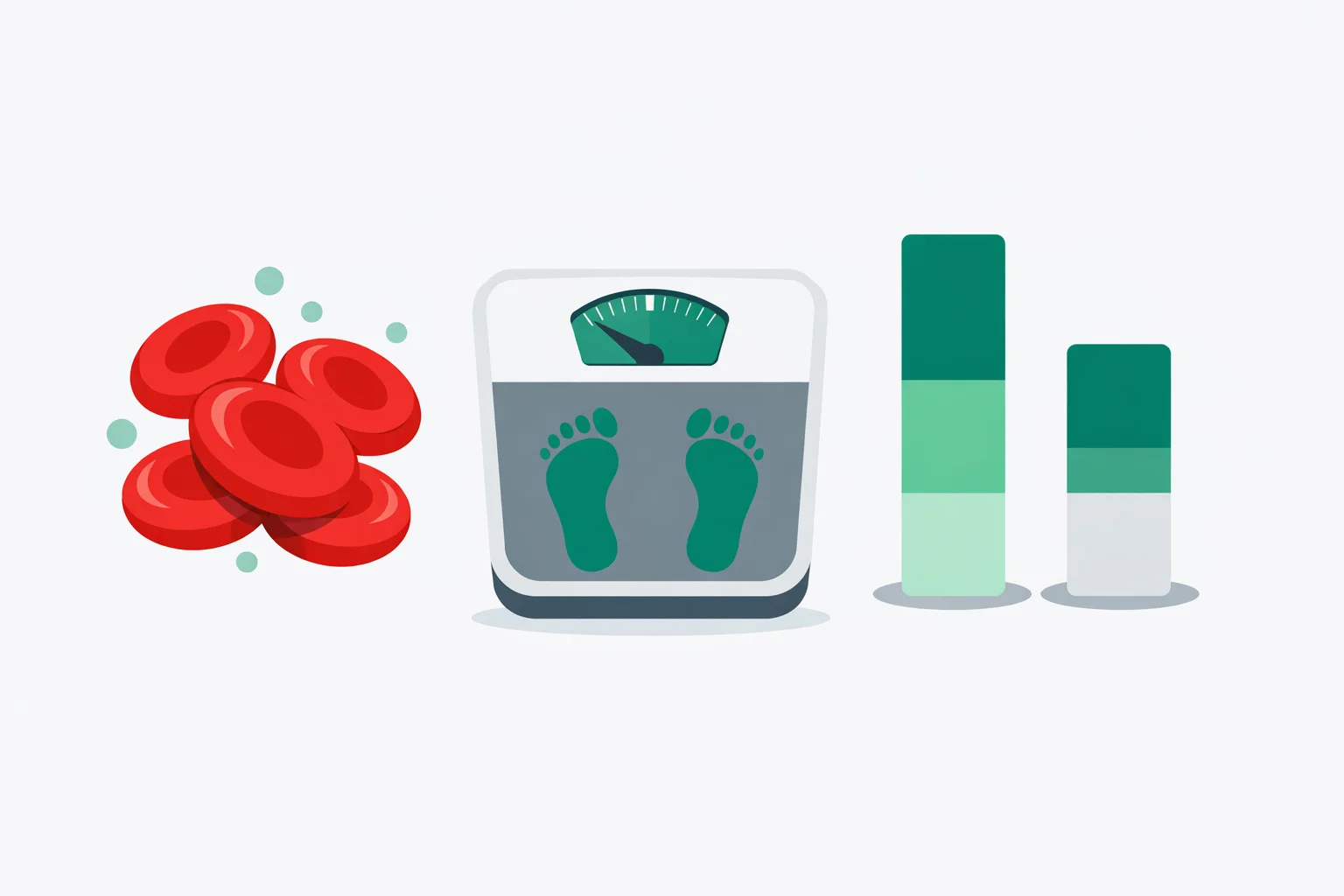
An iron deficit calculator estimates a total iron requirement, which is easy to mistake for the amount to give in one infusion. A result of 1,340 mg is an arithmetic estimate built from body weight, a hemoglobin gap and an allowance for stores. It does not specify a product, infusion speed or number of appointments. Understanding those separate decisions makes the Ganzoni equation more useful than memorizing its multiplier.
In this guide
An iron deficit calculator does not prescribe an infusion
Consider the default example: calculation weight 70 kg, current Hb 10 g/dL, target Hb 15 g/dL and iron stores of 500 mg. The hemoglobin gap is 5 g/dL. Multiplying 70 × 5 × 2.4 gives 840 mg for the modeled increase in hemoglobin. Adding the store allowance brings the total to 1,340 mg. The two components answer different questions: how much iron the modeled Hb rise requires, and how much extra iron the calculation reserves for stores.
In that example, approximately 63% of the total is the hemoglobin component and 37% is the store allowance. Neither percentage measures how much iron is presently in the blood or liver. These are proportions of an estimate. Calling the result a measured body iron level would give the arithmetic more meaning than its inputs can support.
The distinction also explains why a total requirement and a prescribed course may look different on paper. Product selection and administration limits are additional decisions. The National Blood Authority publishes a separate guide to iron product choice and dose calculation with preparation-specific comparisons. A generic total iron deficit calculator cannot substitute for those instructions.
Why 2.4 becomes 0.24 when the Hb unit changes
The Ganzoni formula in g/dL is weight × Hb gap × 2.4 + stores. Its coefficient approximates the iron content of hemoglobin and a blood volume proportional to weight. The Venofer prescribing reference gives the underlying assumptions as 0.34% iron in hemoglobin and blood volume equivalent to 7% of body weight. These population assumptions explain why an exact calculation is still only a physiological estimate.
A unit check can catch a much larger error than rounding. A hemoglobin gap of 5 g/dL equals 50 g/L. Therefore, 70 × 5 × 2.4 and 70 × 50 × 0.24 both equal 840 mg. If someone pairs 50 g/L with 2.4, the hemoglobin component becomes 8,400 mg and the total becomes 8,900 mg after adding stores. Only the Hb component increased tenfold; the fixed 500 mg allowance did not.
The reverse mistake understates the result: 70 × 5 × 0.24 + 500 is only 584 mg. Keep units beside every number when checking a calculation. Our hemoglobin calculator provides a separate way to interpret and convert an Hb result. Hematocrit is a percentage, so it cannot be substituted directly for either 10 g/dL or 100 g/L.
What does changing the target from 13 to 15 actually do?
The target is a powerful assumption because it appears inside the hemoglobin gap. Hold measured Hb at 10 g/dL and stores at 500 mg, and compare the following calculated scenarios. These are arithmetic examples, not recommended targets for the weights shown. Every entry uses the same equation, so the differences isolate the effect of weight and target selection.
| Weight | Target 13 | Target 14 | Target 15 g/dL |
|---|---|---|---|
| 50 kg | 860 | 980 | 1,100 |
| 70 kg | 1,004 | 1,172 | 1,340 |
| 90 kg | 1,148 | 1,364 | 1,580 |
For 70 kg, each 1 g/dL added to the target adds 168 mg: 70 × 1 × 2.4. Moving from 13 to 15 g/dL therefore adds 336 mg, even though the measured hemoglobin never changes. At 50 kg that same two-point change adds 240 mg; at 90 kg it adds 432 mg. The target should come from the clinical context, rather than whichever value produces the most convenient total.
This sensitivity works in the opposite direction for measured Hb. At 70 kg, an Hb measurement 0.5 g/dL higher reduces the calculated hemoglobin component by 84 mg if the target stays fixed. That comparison does not mean someone has gained exactly 84 mg of body iron. It shows how one changed input moves the model, which is especially relevant when comparing results calculated from different blood samples.
The 500 mg allowance is an assumption, not a ferritin result
The standard convention used here assigns 500 mg for stores at 35 kg or above. It adds that amount to the hemoglobin component; it does not estimate stores from a ferritin test. Below 35 kg, the convention uses 15 mg/kg. Both assumptions are documented alongside the formula in the Venofer reference. A custom allowance needs its own clinical justification.
You can see the effect without changing any Hb values. For the 70 kg example, the hemoglobin component remains 840 mg. A store allowance of 0 mg makes the total 840 mg, an allowance of 500 mg makes it 1,340 mg, and 1,000 mg makes it 1,840 mg. Each additional milligram assigned to stores adds one milligram to the total. These examples demonstrate the equation; they are not three interchangeable treatment options.
Ferritin has different units and a different role. A laboratory result of 20 micrograms/L cannot be entered as 20 mg of missing iron. Nor does a store allowance of 500 mg imply a desired ferritin of 500. Keeping those quantities separate avoids an attractive but invalid shortcut between a laboratory concentration and a whole-body replacement estimate.
The 35 kg boundary deserves a second look
Below 35 kg, this implementation changes the standard target to 13 g/dL as well as using the weight-based store allowance. With a calculation weight of 30 kg and current Hb 9 g/dL, the gap is 4 g/dL: 30 × 4 × 2.4 = 288 mg. Stores contribute 30 × 15 = 450 mg, making the total 738 mg. This is the low-weight formula convention, not proof of eligibility for a particular medicine.
There is a real discontinuity in these conventions. At 34.9 kg and Hb 10 g/dL, the total is 774.78 mg: 251.28 mg for hemoglobin plus 523.5 mg for stores. At exactly 35 kg, the target becomes 15 g/dL and stores become 500 mg, giving 920 mg. That jump of 145.22 mg is caused by switching assumptions, not by a sudden biological change over 100 grams of body weight.
This is why the weight basis belongs beside the result. Entering 35 kg approximately as 77 lb gives 34.9266 kg, which lies just below the threshold. The kg/lb buttons preserve the entered weight through conversion rather than rounding it to a whole pound. For children, a specialist must also establish age and product suitability; the National Blood Authority pediatric guide addresses that separate clinical setting.
Low hemoglobin: confirm the cause before replacing iron
The Ganzoni equation has no input for the cause of anemia. It produces the same number for identical weight and hemoglobin inputs whether the underlying problem is iron deficiency, a hemoglobin disorder or another process. That is a mathematical limitation, not a diagnostic finding. The Mentzer index calculator explores one screening distinction between iron deficiency and thalassemia trait, but screening indices cannot confirm that iron treatment is appropriate.
The British Society of Gastroenterology guideline describes ferritin below 15 micrograms/L as indicating absent stores and below 30 micrograms/L as generally indicating low stores. Ferritin can rise with inflammation, so a value within a laboratory interval does not always exclude iron deficiency. Transferrin saturation and the wider clinical picture help resolve that uncertainty.
A low hematocrit also needs context. The hematocrit calculator explains relationships between red-cell volume and other blood-count measurements. An estimated Hb derived from hematocrit introduces another assumption into the iron calculation. When measured hemoglobin is available, using that laboratory value avoids stacking one approximation on top of another.
Why two iron replacement estimates can disagree
Before comparing totals, compare calculation weight, measured Hb, target Hb, store allowance and units. Two estimates of 1,004 mg and 1,340 mg can both be mathematically correct for the same 70 kg person with Hb 10 g/dL: the first uses a target of 13, the second 15. A difference in the target alone explains the entire 336 mg gap.
Prescribing methods can differ as well. The Monofer reference includes simplified methods alongside Ganzoni and notes circumstances requiring adjustments to weight or target. Results generated under different product instructions therefore need not match. A total from this equation should not override a product-specific table just because it contains more decimal places.
Rounding adds a smaller discrepancy. The 30 kg example gives 738 mg before any treatment rounding. A display rounded to the nearest whole milligram preserves that number, while an administration plan may use available presentations and different limits. The calculator leaves that decision open: it shows the unrounded arithmetic to one decimal place and does not round upward to a vial, bag or appointment count.
Bring the calculation assumptions, not just the total
A useful calculation record reads: weight 70 kg, Hb 10 g/dL, target 15 g/dL, stores 500 mg, total 1,340 mg by Ganzoni. The standalone number 1,340 mg cannot tell the next reader which assumptions produced it. Include the laboratory sampling date and whether the weight is measured, ideal or pre-pregnancy weight when discussing the result with a clinician.
Recent iron treatment or transfusion and continuing blood loss complicate a before-and-after comparison. Re-entering the latest Hb and automatically adding another 500 mg for stores is not a way to calculate a repeat course. The cause of deficiency also needs attention: the BSG guideline emphasizes investigation alongside replacement, because correcting anemia does not by itself explain why iron was lost.
If current Hb is equal to or higher than the selected target, this page deliberately withholds a total rather than letting a negative Hb term cancel part of the stores. An Hb of 15 g/dL with a target of 15 is outside this anemia-correction calculation, even though iron deficiency without anemia can exist. The next decision is a review of iron status, not a new target chosen merely to make the formula return a positive number.
References and calculation provenance
- Venofer UK SmPC, section 4.2: Ganzoni equation and weight conventions.
- Monofer UK SmPC: assessment of iron need and dosing assumptions.
- British Society of Gastroenterology, 2021: iron deficiency anemia in adults.
- National Blood Authority: adult iron product and dose resources.
- National Blood Authority: pediatric and neonatal iron deficiency resources.
Sources checked September 6, 2026. Worked examples and sensitivity tables are calculations from the stated equation, not patient observations. Formula checks do not constitute independent medical review or clinical validation.

Written by Jurica Šinko
Founder & CEO
Entrepreneur and health information advocate, passionate about making health calculations accessible to everyone through intuitive digital tools.
View full profileFrequently Asked Questions
How do you calculate total iron deficit with the Ganzoni equation?
Multiply calculation weight in kg by the target-minus-current hemoglobin gap in g/dL and by 2.4, then add the iron-store allowance in mg. For 70 kg, Hb 10 g/dL, target 15 g/dL and stores 500 mg, the estimate is 1,340 mg of elemental iron. This is a total requirement estimate, not a single infusion dose.
What does the 500 mg in the Ganzoni formula mean?
It is an assumed allowance for replenishing iron stores, separate from the iron needed for the hemoglobin increase. The standard convention used here adds 500 mg at weights of 35 kg or more. It is not a measured ferritin value or a daily supplement recommendation.
Do I use 2.4 or 0.24 when hemoglobin is in g/L?
Use 0.24 with a hemoglobin gap in g/L and 2.4 with a gap in g/dL. A gap of 50 g/L is the same as 5 g/dL. This calculator converts g/L to g/dL internally so both unit choices give the same result.
Is 15 g/dL the right target hemoglobin for everyone?
No. The 15 g/dL value is a conventional Ganzoni calculation target at weights of at least 35 kg, not a universal treatment goal or anemia cutoff. Pregnancy, kidney disease and local protocols may use different assumptions; use custom values only with clinician guidance.
What changes in the Ganzoni formula below 35 kg?
The convention implemented here uses a target of 13 g/dL and stores of 15 mg/kg below 35 kg. At 30 kg and Hb 9 g/dL, that gives 288 mg for hemoglobin plus 450 mg for stores, or 738 mg total. This arithmetic does not establish whether an IV iron product is appropriate for a child.
Can I turn a 1,340 mg iron deficit into a tablet schedule?
No. A total body iron estimate cannot be divided by the iron printed on a tablet to determine treatment duration, because oral absorption is incomplete and variable. The same 1,340 mg estimate also does not authorize one IV dose; product limits, diagnosis and monitoring determine treatment.
Can ferritin replace hemoglobin in an iron deficit calculator?
No. Ferritin reflects iron stores and is commonly reported in micrograms/L or ng/mL, whereas Ganzoni uses the hemoglobin gap in g/dL or g/L. Entering ferritin of 10 as Hb of 10 g/dL would create a meaningless estimate. A clinician interprets ferritin and transferrin saturation separately to confirm iron deficiency.
Why is no estimate shown when my hemoglobin reaches the target?
This tool stops when current hemoglobin is at or above the selected target instead of producing a negative correction or an automatic store-only dose. For example, Hb 15 g/dL with a target of 15 g/dL needs a separate assessment of iron stores. Iron deficiency can still be present without anemia.
Related Calculators
A1C Calculator — Convert HbA1c to eAG with Targets
Use our A1C calculator to convert HbA1c to estimated average glucose (eAG). See normal, prediabetes, and diabetes thresholds in mg/dL and mmol/L. Fast results.
Albumin Calculator — Serum Albumin Level Interpretation
Free albumin calculator to interpret serum albumin levels, grade hypoalbuminemia, and compute A/G ratio plus albumin-corrected calcium from your lab results.
Albumin-Corrected Anion Gap Calculator — Hidden Acidosis
Use our albumin-corrected anion gap calculator to raise the anion gap by 2.5 per 1 g/dL of low albumin and reveal a hidden high-gap metabolic acidosis.

ANC Calculator: Absolute Neutrophil Count & Neutropenia
Free ANC calculator to calculate absolute neutrophil count from WBC and differential. Get ANC in cells/uL and x10^9/L with instant neutropenia grading.
Anion Gap Calculator — Metabolic Acidosis Evaluation
Free anion gap calculator finds serum anion gap from sodium, chloride, and bicarbonate, with albumin correction and delta ratio for metabolic acidosis.
AST/ALT Ratio Calculator — Free De Ritis Ratio Tool
Use our free AST/ALT ratio calculator to compute the De Ritis index instantly. Visual ratio chart, enzyme-level assessment, and clinical patterns guide.