Use the FENa Calculator
Free FENa calculator to find the fractional excretion of sodium from urine and serum sodium and creatinine — separate prerenal AKI from ATN, with FEUrea mode.
FENa
0.6%
Lab units
From the basic metabolic panel (mEq/L and mmol/L are identical for sodium)
Spot (random) urine sample — collect before fluids or diuretics if possible
The current (AKI) value, not the baseline
From the same spot urine as the urine sodium
Fractional excretion of sodium
0.6%
The tubules are holding on to sodium — consistent with reduced kidney perfusion (volume depletion, heart failure, cirrhosis). Confirm with history, volume exam, and urinalysis before giving fluid.
Where your value falls (0–5% scale)
Urine sodium
25 mmol/L
Intermediate
Urine/serum creatinine
30:1
Intermediate (20–40:1)
Filtered sodium reclaimed
99.4%
Healthy tubules reabsorb ≥ 99% of filtered sodium
FENa interpretation in oliguric AKI — your row is highlighted
| FENa | Pattern | Mechanism |
|---|---|---|
| < 1% ● | Prerenal pattern | Intact tubules reabsorb > 99% of filtered sodium under aldosterone and angiotensin II drive |
| 1–2% | Indeterminate zone | Overlap zone — early ATN, partial treatment, or mixed physiology |
| > 2% | Intrinsic (ATN) pattern | Injured tubules cannot reclaim filtered sodium; it spills into the urine |
FENa < 1% that is NOT prerenal
- Contrast-induced nephropathy
- Rhabdomyolysis / pigment nephropathy
- Acute glomerulonephritis
- Hepatorenal syndrome
- Early sepsis-associated AKI
FENa > 2% that is NOT ATN
- Loop or thiazide diuretic within 24–48 h
- Chronic kidney disease at baseline
- Bicarbonaturia (vomiting, metabolic alkalosis)
- Adrenal insufficiency / salt-wasting states
This tool is for education and clinical decision support only. The 1% and 2% FENa cutoffs were validated in oliguric acute kidney injury without diuretics or baseline CKD — outside that setting the number misleads more often than it helps. FENa never replaces history, volume examination, urine microscopy, and clinical judgment. Always interpret results with the treating clinician.
Educational tool, not medical advice. Check this tool’s method and limitations before interpreting a result. Talk to a qualified healthcare professional before making decisions about medication, diet, exercise, or treatment. See our Terms of Use.
Your rating helps improve FENa Calculator. We store only an anonymized vote (no personal data).
How to Use FENa Calculator
Step 1: Enter serum values
Type the serum sodium and serum creatinine from the chemistry panel, using the current AKI creatinine rather than the patient’s baseline.
Step 2: Enter spot urine values
Add urine sodium and urine creatinine from the same spot urine sample, ideally collected before fluids or diuretics were given.
Step 3: Pick your lab units
Choose US (mg/dL) or SI (µmol/L serum, mmol/L urine) — the calculator converts creatinine automatically so the ratio stays valid.
Step 4: Flag diuretic use
Check the loop diuretic box if furosemide or similar was given in the last 24–48 hours, then enter BUN and urine urea to compute FEUrea instead.
Step 5: Read the classification
FENa under 1% suggests a prerenal pattern and over 2% suggests ATN — review the false-low and false-high pitfalls panel before acting on it.
Key Features
- FENa from spot urine and serum sodium and creatinine
- Instant classification at the 1% and 2% AKI cutoffs
- FEUrea mode for patients on loop diuretics (35%/50% cutoffs)
- US and SI units with automatic creatinine conversion
- Supportive indices: urine/serum creatinine and BUN:creatinine ratios
- Built-in false-low and false-high pitfall reference
Understanding Results
Formula
FENa = (urine sodium × serum creatinine) ÷ (serum sodium × urine creatinine) × 100. It is the ratio of sodium clearance to creatinine clearance, expressed as the percentage of filtered sodium that ends up in the urine. The creatinine terms cancel out water reabsorption, which is why FENa beats a raw urine sodium. In diuretic mode the tool applies the same structure to urea: FEUrea = (urine urea × serum creatinine) ÷ (serum urea × urine creatinine) × 100.
Reference Ranges & Interpretation
In oliguric AKI, FENa below 1% indicates a prerenal pattern (intact, sodium-avid tubules), 1–2% is indeterminate, and above 2% indicates intrinsic injury, classically acute tubular necrosis — thresholds from Espinel's original JAMA 1976 validation. On loop diuretics, use FEUrea instead: below 35% suggests prerenal azotemia and above 50% suggests ATN, with 85% sensitivity and 92% specificity in the Carvounis 2002 series of 102 patients.
Assumptions & Limitations
The cutoffs assume oliguric AKI, no diuretics within 24–48 hours, and previously normal kidneys. FENa reads falsely low (under 1% despite intrinsic injury) in contrast nephropathy, rhabdomyolysis, acute glomerulonephritis, hepatorenal syndrome, and early sepsis; it reads falsely high in CKD, bicarbonaturia from vomiting, and adrenal insufficiency. This is a clinical decision-support and education tool — interpretation and treatment belong with the treating clinician.
Complete Guide: FENa Calculator
On this page
Every FENa calculator in clinical use is built on a study of exactly 17 patients. Carlos Espinel published the fractional excretion of sodium test in JAMA in 1976, and in his small oliguric cohort it separated prerenal azotemia from acute tubular necrosis almost perfectly: below 1% meant the kidneys were underperfused but intact, above 3% meant the tubules themselves were damaged. Fifty years later, that cutoff gets applied to patients Espinel deliberately excluded — people on furosemide, people with CKD, people making plenty of urine — and that's where FENa earns its reputation as the most misused number in nephrology. This guide works the formula, shows how one diuretic dose flips the result, and maps every major false positive and false negative so you know exactly when the percentage means what it claims to mean.
The 1% rule rests on 17 patients
Espinel's original series enrolled 17 oliguric patients — urine output under 500 mL/day — with a clear clinical diagnosis of either prerenal failure or acute tubular necrosis. Nobody was on diuretics. Nobody had chronic kidney disease. In that narrow population the separation was striking: every prerenal patient had FENa under 1%, every ATN patient over 3%. Miller and colleagues confirmed the pattern two years later in a 102-patient series, and the test entered textbooks as near-gospel.
The catch is selection. Modern AKI rarely arrives that cleanly — roughly half of hospital-acquired cases involve diuretics, sepsis, contrast exposure, or pre-existing CKD, and each of those breaks one of Espinel's entry criteria. The number still works, but only inside the box it was validated in: oliguric AKI, no diuretics, previously normal kidneys. Outside the box it doesn't degrade gracefully — it points confidently in the wrong direction.
What does a FENa calculator actually measure?
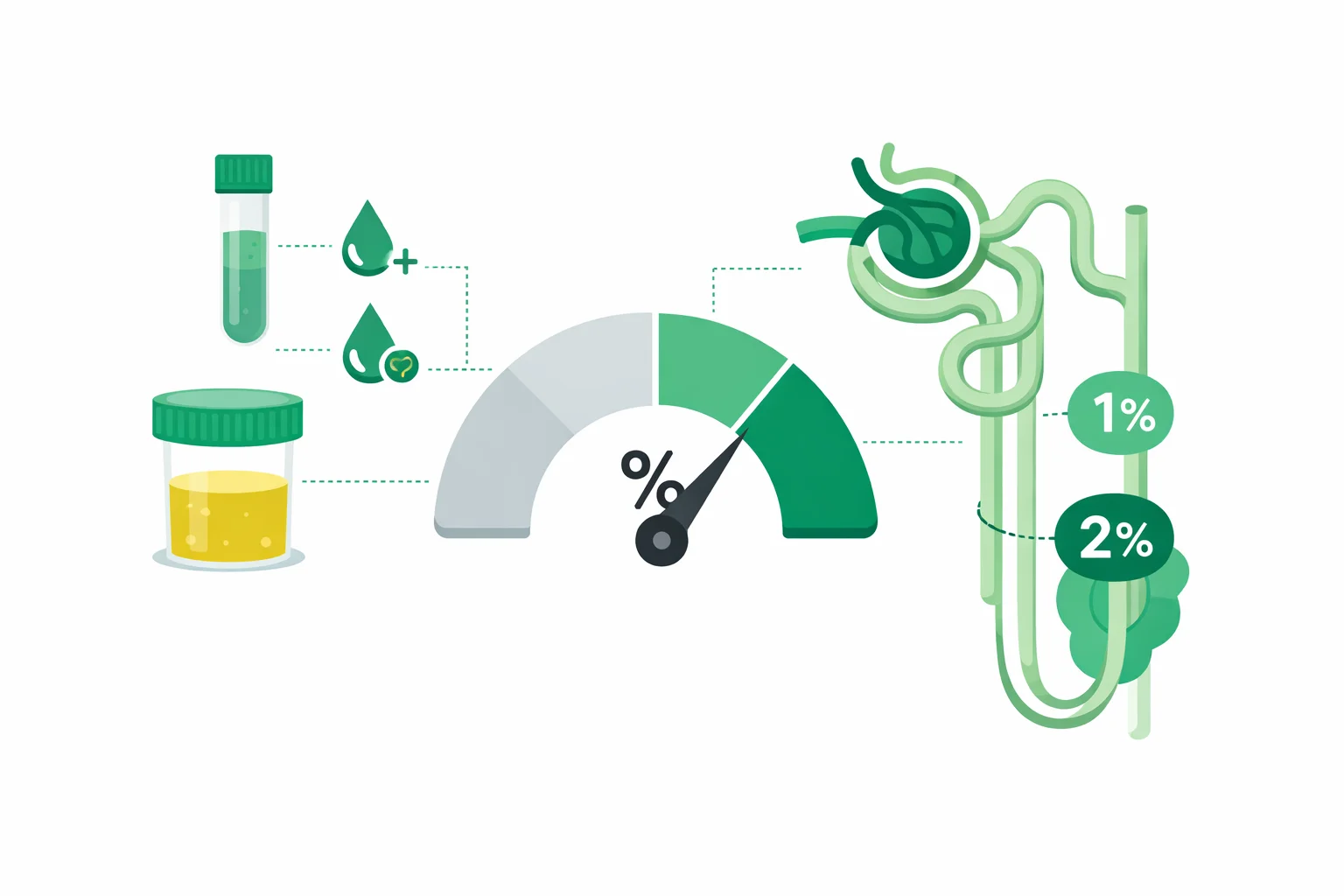
FENa answers one physiologic question: of all the sodium the glomeruli filter, what percentage escapes into the final urine? A healthy adult filters roughly 25,000 mmol of sodium a day and excretes 100–200 mmol of it — a fractional excretion of about 0.5–1%. The tubules reclaim more than 99% of the filtered load, and how hard they work at it is under direct hormonal control. When perfusion drops — hemorrhage, vomiting, heart failure — angiotensin II and aldosterone push reabsorption even harder, and FENa falls below 1%. When the tubular cells themselves are injured, they physically cannot reclaim sodium, and FENa climbs above 2% no matter what the hormones demand.
The formula is a ratio of two clearances: FENa = (urine Na × serum creatinine) ÷ (serum Na × urine creatinine) × 100. The creatinine terms are the clever part. A raw urine sodium of 25 mmol/L could mean sodium-avid kidneys making concentrated urine or leaky tubules making dilute urine — you can't tell from the sodium alone. Dividing by the urine-to-serum creatinine ratio corrects for how much water the kidney reabsorbed, which is why FENa outperforms urine sodium read in isolation. It also makes the test immune to units: because everything enters as a ratio, the result is identical whether your lab reports creatinine in mg/dL or µmol/L, so long as serum and urine use consistent units — our calculator handles that conversion automatically.
One dose of furosemide, two different answers
Here's the sensitivity problem in numbers. A 68-year-old arrives after three days of vomiting. Creatinine has risen from a baseline of 1.0 to 2.4 mg/dL, serum sodium is 134 mmol/L, spot urine sodium is 12 mmol/L, urine creatinine is 88 mg/dL:
FENa = (12 × 2.4) ÷ (134 × 88) × 100 = 28.8 ÷ 11,792 × 100 = 0.24%
Textbook prerenal physiology — sodium-avid tubules doing their job.
Now suppose the admitting team gave 80 mg of IV furosemide an hour before the urine was collected. Furosemide blocks the Na-K-2Cl transporter in the loop of Henle, forcing sodium out regardless of volume status. Urine sodium jumps to 65 mmol/L and urine creatinine falls to 45 mg/dL as the urine dilutes:
FENa = (65 × 2.4) ÷ (134 × 45) × 100 = 156 ÷ 6,030 × 100 = 2.59%
Same patient, same volume-depleted kidneys — now wearing an "ATN" label.
Nothing about the kidneys changed between those two calculations. One drug dose moved the result from 0.24% to 2.59% — a tenfold shift across both diagnostic thresholds. This is why the calculator asks about loop diuretics up front, and why FEUrea exists as the fallback: in the same scenario, a BUN of 42 mg/dL and urine urea nitrogen of 260 mg/dL give FEUrea = (260 × 2.4) ÷ (42 × 45) × 100 = 33% — still correctly under the 35% prerenal cutoff, because furosemide doesn't touch urea handling.
Five conditions that fake a prerenal FENa
A FENa under 1% is routinely read as "give fluid," but several intrinsic kidney diseases produce exactly the same number. The common thread is intense renal vasoconstriction or an intact-tubule injury pattern — the sodium-retaining machinery still runs even though the kidney is genuinely damaged. Up to 15% of ATN cases, particularly non-oliguric ones, present with FENa below 1%.
| Condition | Why FENa stays low | Clue it isn't simple prerenal |
|---|---|---|
| Contrast-induced nephropathy | Early intense afferent vasoconstriction preserves tubular sodium handling | Creatinine peaks 3–5 days after contrast exposure |
| Rhabdomyolysis / pigment nephropathy | Myoglobin scavenges nitric oxide, constricting renal vessels | CK typically > 5,000 U/L; dark urine, positive blood on dipstick without RBCs |
| Acute glomerulonephritis | Injury is glomerular — tubules downstream are intact and sodium-avid | Dysmorphic RBCs and red-cell casts on microscopy |
| Hepatorenal syndrome | Extreme splanchnic vasodilation triggers maximal sodium retention | FENa often < 0.1%; no response to 1 g/kg albumin over 48 h |
| Early sepsis-associated AKI | Initial phase can be vasoconstrictive with preserved tubular function | FENa may cross 1% only as tubular injury evolves over 24–48 h |
The practical consequence: a low FENa in a patient with a compatible story — recent angiography, a CK in the tens of thousands, an active urine sediment, decompensated cirrhosis — should never close the case. In hepatorenal syndrome especially, chasing a FENa of 0.1% with saline delays the albumin challenge and vasoconstrictor therapy the patient actually needs.
Four ways FENa reads high without tubular injury
The reverse error matters just as much, because a "high" FENa can talk a team out of fluid a dry patient needs. Diuretics are the classic culprit — the effect lingers 24–48 hours after the last dose. Chronic kidney disease is subtler. A person with a GFR of 20 mL/min has lost 80% of their nephrons but eats the same 100–200 mmol of sodium daily; each surviving nephron must excrete five times its usual share, so the baseline FENa in advanced CKD often sits above 2% before anything acute happens. Staging that baseline properly is what our CKD calculator is for — and it's why FENa thresholds simply don't transfer to acute-on-chronic kidney injury.
Two rarer offenders round out the list. Bicarbonaturia — typically from vomiting with metabolic alkalosis — forces sodium into the urine as the obligate cation accompanying bicarbonate, so a genuinely volume-depleted vomiting patient can post a FENa above 2%. (Urine chloride under 20 mmol/L gives the game away, and if that same patient is hyponatremic, correct the sodium slowly — our sodium correction calculator walks through the rate limits.) Adrenal insufficiency does it hormonally: without aldosterone, the distal nephron can't conserve sodium regardless of volume status.
FENa vs. FEUrea: which index when?
FEUrea applies the same fractional-excretion logic to urea: (urine urea × serum creatinine) ÷ (serum urea × urine creatinine) × 100. Urea is reabsorbed mainly in the proximal tubule — upstream of the thick ascending limb where loop diuretics act — so furosemide leaves it largely untouched. In the Carvounis series of 102 ICU patients, FEUrea below 35% identified prerenal azotemia with 85% sensitivity and 92% specificity, and it kept discriminating in the diuretic-treated group where FENa failed outright.
| FENa | FEUrea | |
|---|---|---|
| Prerenal cutoff | < 1% | < 35% |
| Intrinsic (ATN) cutoff | > 2% | > 50% |
| Valid on loop diuretics | No — falsely elevated for 24–48 h | Yes — urea handling is proximal |
| Weak spots | CKD, bicarbonaturia, vasoconstrictive AKI | Osmotic diuresis, high protein load, elderly with low muscle mass |
| Extra lab needed | None beyond spot urine Na + creatinine | Urine urea — must be ordered separately |
Neither index is a tiebreaker for the other — they fail in different places. FEUrea misleads during osmotic diuresis (uncontrolled hyperglycemia, mannitol) and in patients on high-protein feeds, where urea delivery overwhelms reabsorption. When the two disagree, the answer is almost never "average them" — it's to go back to the urine sediment and the volume exam.
When to trust the number — and when to ignore it
A usable bedside rule: FENa deserves weight only when all four of Espinel's conditions still hold. First, true AKI by KDIGO criteria — a creatinine rise of at least 0.3 mg/dL within 48 hours or 1.5× baseline within 7 days. Second, oliguria — the cutoffs were never validated in patients making 2 L of urine a day. Third, no diuretic within 48 hours (otherwise switch to FEUrea). Fourth, no significant baseline CKD. Check those boxes and a FENa of 0.3% or 4% is genuinely informative; miss two of them and the number is closer to noise.
Even inside the box, FENa is one vote among several. Muddy brown granular casts on microscopy push hard toward ATN whatever the percentage says. A urine-to-serum creatinine ratio above 40:1 supports prerenal physiology; below 20:1 supports tubular injury. And the response to a 500 mL crystalloid challenge over 30–60 minutes remains the most honest test of volume responsiveness ever devised. In practice, most nephrologists treat FENa as a way to quantify suspicion, not settle it.
What to do with the result
A prerenal pattern earns a perfusion fix: hold diuretics and nephrotoxins (NSAIDs, ACE inhibitors, ARBs), give measured fluid, and expect creatinine to start falling within 24–72 hours if the read was right. An ATN pattern shifts the goal to protection — strict avoidance of further insults, daily weights and electrolytes, and renal dosing of every cleared drug. That last step is where the companion tools come in: dose adjustments key off estimated clearance, so run the numbers through our creatinine clearance calculator — remembering that during unsteady-state AKI, any equation based on a single creatinine (including the CKD-EPI formula behind our eGFR calculator) overestimates true function while creatinine is still climbing.
Most ATN recovers: tubular cells regenerate over 1–3 weeks if the kidney is kept out of harm's way. The number to watch isn't the FENa trending back down — it's urine output climbing and creatinine turning the corner. If neither happens within a week, or potassium and acidosis become unmanageable, that's the point where dialysis conversations start, and a percentage from a spot urine no longer has anything to add.
References
- Espinel CH. The FENa test: use in the differential diagnosis of acute renal failure. JAMA. 1976;236(6):579–581
- Carvounis CP, Nisar S, Guro-Razuman S. Significance of the fractional excretion of urea in the differential diagnosis of acute renal failure. Kidney Int. 2002;62(6):2223–2229
- Kidney Disease: Improving Global Outcomes (KDIGO). Clinical Practice Guideline for Acute Kidney Injury. Kidney Int Suppl. 2012;2(1):1–138
- Miller TR, Anderson RJ, Linas SL, et al. Urinary diagnostic indices in acute renal failure: a prospective study. Ann Intern Med. 1978;89(1):47–50

Written by Jurica Šinko
Founder & CEO
Entrepreneur and health information advocate, passionate about making health calculations accessible to everyone through intuitive digital tools.
View full profileFrequently Asked Questions
What does a FENa of less than 1% mean?
A FENa below 1% means the tubules are reabsorbing more than 99% of filtered sodium — the classic prerenal pattern seen with volume depletion, heart failure, or cirrhosis. It is not proof, though: contrast nephropathy, rhabdomyolysis, acute glomerulonephritis, and hepatorenal syndrome all produce FENa under 1% despite real kidney injury. Match the number against history, volume exam, and urine microscopy before giving fluid.
Is FENa reliable if the patient is on furosemide or other diuretics?
No. Loop diuretics force sodium into the urine directly, so FENa reads falsely high for 24–48 hours after a dose — a volume-depleted patient can post a FENa above 2%. Use the fractional excretion of urea instead: FEUrea below 35% suggests prerenal azotemia and above 50% suggests ATN, because urea is reabsorbed in the proximal tubule where loop diuretics have no effect.
How do you calculate FENa from labs?
FENa = (urine sodium × serum creatinine) ÷ (serum sodium × urine creatinine) × 100. For example, urine sodium 12 mmol/L, serum creatinine 2.4 mg/dL, serum sodium 134 mmol/L, and urine creatinine 88 mg/dL give (12 × 2.4) ÷ (134 × 88) × 100 = 0.24%. Because it is a ratio, the result is the same in any creatinine unit as long as serum and urine values are expressed consistently.
What FENa value indicates acute tubular necrosis?
A FENa above 2% in oliguric AKI points to ATN — injured tubules cannot reclaim filtered sodium. In Espinel’s original validation every ATN patient ran above 3%. Values between 1% and 2% are indeterminate, and up to 15% of ATN cases — especially non-oliguric, contrast, or pigment injury — run below 1%, so a low value never fully excludes tubular damage.
Does FENa work in chronic kidney disease?
No — the 1% and 2% cutoffs assume previously normal kidneys. In CKD each surviving nephron must excrete a larger share of the daily sodium load, so baseline FENa rises as GFR falls; near a GFR of 20 mL/min it often sits above 2% with no acute injury at all. In acute-on-chronic kidney injury, follow the creatinine trend and urine output instead of the FENa percentage.
What is the difference between FENa and FEUrea?
Both compare a solute’s clearance to creatinine clearance, but FENa tracks sodium (cutoffs 1% and 2%) while FEUrea tracks urea (cutoffs 35% and 50%). FEUrea stays valid on loop diuretics; FENa does not. FEUrea in turn misleads during osmotic diuresis or high protein intake. In the Carvounis study of 102 patients, FEUrea under 35% detected prerenal azotemia with 85% sensitivity and 92% specificity.
Why is urine creatinine needed for FENa instead of just urine sodium?
The creatinine ratio corrects for water reabsorption. A urine sodium of 25 mmol/L could come from sodium-avid kidneys concentrating urine or from damaged tubules diluting it — the raw value cannot tell them apart. Dividing by the urine-to-serum creatinine ratio expresses sodium loss as a fraction of the filtered load, which is why FENa outperforms a spot urine sodium read on its own.
How much urine do you need for a FENa test?
Only a few milliliters from a single spot (random) urine sample — no 24-hour collection is required. Order urine sodium and urine creatinine on the same sample, drawn as close in time as possible to the serum chemistry, and ideally before fluids or diuretics are given. Adding urine urea to the same order enables FEUrea if a loop diuretic has already been dosed.
Related Calculators
A1C Calculator — Convert HbA1c to eAG with Targets
Use our A1C calculator to convert HbA1c to estimated average glucose (eAG). See normal, prediabetes, and diabetes thresholds in mg/dL and mmol/L. Fast results.

Albumin Calculator — Serum Albumin Level Interpretation
Free albumin calculator to interpret serum albumin levels, grade hypoalbuminemia, and compute A/G ratio plus albumin-corrected calcium from your lab results.
Albumin-Corrected Anion Gap Calculator — Hidden Acidosis
Use our albumin-corrected anion gap calculator to raise the anion gap by 2.5 per 1 g/dL of low albumin and reveal a hidden high-gap metabolic acidosis.
ANC Calculator: Absolute Neutrophil Count & Neutropenia
Free ANC calculator to calculate absolute neutrophil count from WBC and differential. Get ANC in cells/uL and x10^9/L with instant neutropenia grading.
Anion Gap Calculator — Metabolic Acidosis Evaluation
Free anion gap calculator finds serum anion gap from sodium, chloride, and bicarbonate, with albumin correction and delta ratio for metabolic acidosis.
AST/ALT Ratio Calculator — Free De Ritis Ratio Tool
Use our free AST/ALT ratio calculator to compute the De Ritis index instantly. Visual ratio chart, enzyme-level assessment, and clinical patterns guide.