Use the CKD Calculator
Use our CKD calculator to stage chronic kidney disease from your eGFR and urine albumin (ACR) into KDIGO G1-G5 and A1-A3 risk categories for monitoring.
KDIGO stage
G3a A2
eGFR input
From your lab report — usually listed next to creatinine
Spot urine test; 1 mg/mmol ≈ 8.84 mg/g. No ACR yet? A1 is below 30 mg/g.
KDIGO CKD stage
G3a · A2
Orange zone. Progression risk is real: guideline care typically means 2+ checks per year, ACE inhibitor/ARB if albuminuric, and consideration of an SGLT2 inhibitor.
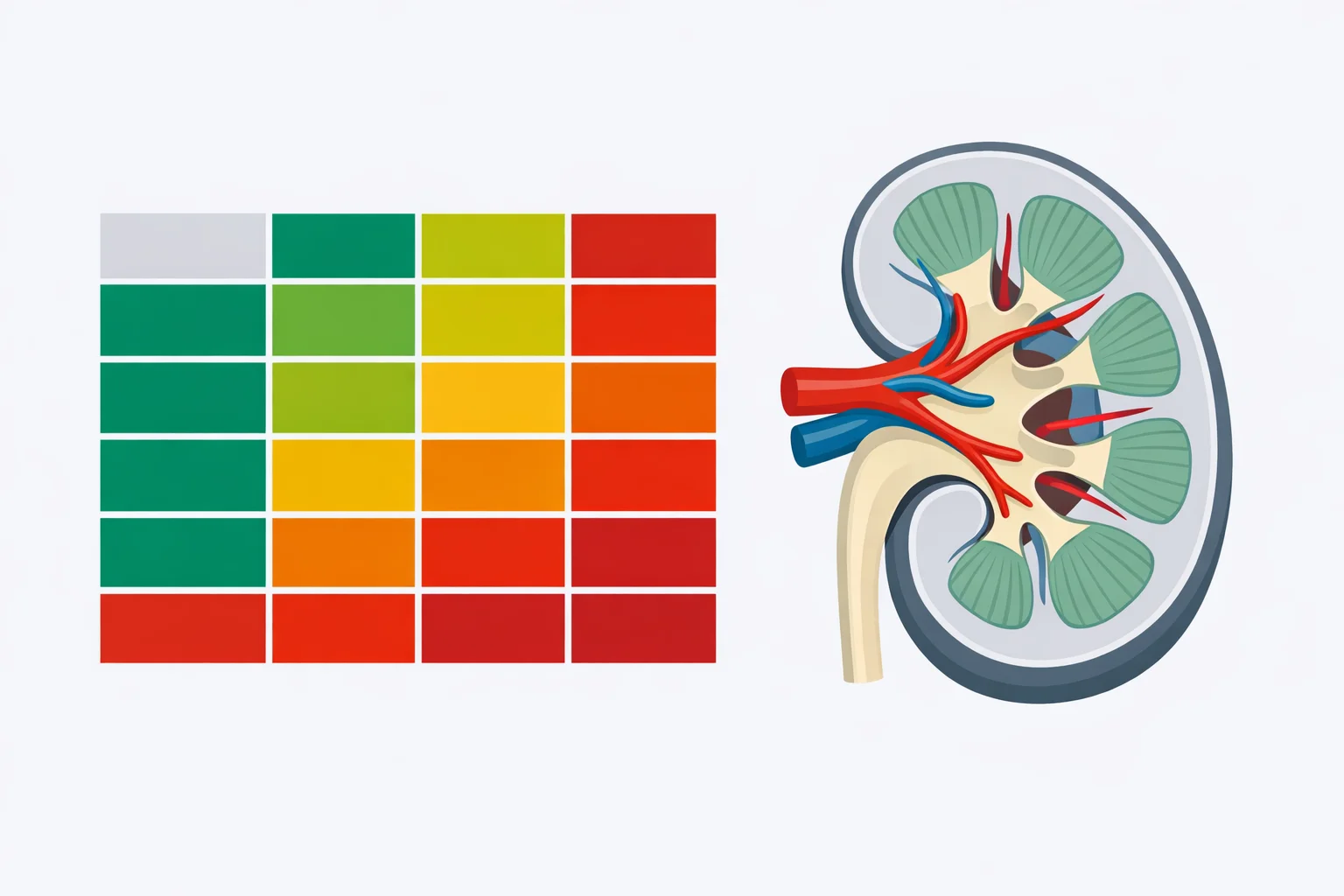
KDIGO risk heat map — your cell is outlined
eGFR
52
mL/min/1.73 m² → Mild–moderately decreased
Urine ACR
40 mg/g
Moderately increased
Suggested monitoring
2× / year
eGFR + ACR checks (KDIGO)
Nephrology referral
Not triggered
By stage alone; progression still matters
This tool stages kidney function for education only — it cannot diagnose CKD. A diagnosis requires abnormalities that persist for more than 3 months, so a single reading is never enough. The CKD-EPI equation assumes stable creatinine: it is not valid in acute kidney injury, pregnancy, under age 18, or at extremes of muscle mass. Review results with your clinician.
Educational tool, not medical advice. Check this tool’s method and limitations before interpreting a result. Talk to a qualified healthcare professional before making decisions about medication, diet, exercise, or treatment. See our Terms of Use.
Your rating helps improve CKD Calculator. We store only an anonymized vote (no personal data).
How to Use CKD Calculator
Step 1: Choose your eGFR input mode
Pick "I know my eGFR" to type the value straight from your lab report, or "Calculate from creatinine" to derive it with the CKD-EPI 2021 equation.
Step 2: Enter your kidney values
Type your eGFR in mL/min/1.73 m², or enter age, sex, and serum creatinine with the mg/dL or µmol/L unit toggle.
Step 3: Enter your urine ACR
Add your urine albumin-to-creatinine ratio and select mg/g or mg/mmol — 1 mg/mmol equals about 8.84 mg/g.
Step 4: Read your KDIGO cell
The calculator shows your G stage (G1–G5), A category (A1–A3), and highlights your exact cell on the color-coded KDIGO risk heat map.
Step 5: Check monitoring and referral guidance
Review the suggested eGFR/ACR checks per year for your cell and whether KDIGO nephrology referral criteria (eGFR below 30 or ACR above 300 mg/g) are met.
Key Features
- Full 18-cell KDIGO heat map with your risk cell highlighted
- Stages eGFR into G1–G5 and urine ACR into A1–A3
- Built-in CKD-EPI 2021 eGFR from creatinine, age, and sex
- ACR unit toggle between mg/g and mg/mmol
- KDIGO monitoring frequency and nephrology referral flags
Understanding Results
Formula
Staging uses two independent axes. The G stage comes from eGFR: either the value on your lab report, or one computed here with the CKD-EPI 2021 race-free equation — eGFR = 142 × min(Scr/κ, 1)^α × max(Scr/κ, 1)^−1.2 × 0.9938^age × 1.012 if female, where Scr is serum creatinine in mg/dL, κ is 0.7 (female) or 0.9 (male), and α is −0.241 (female) or −0.302 (male). The A category comes from the urine albumin-to-creatinine ratio (ACR); values entered in mg/mmol are multiplied by 8.84 to convert to mg/g. The G row and A column together select one of 18 cells on the KDIGO risk grid, which maps to a risk color and a suggested monitoring frequency.
Reference Ranges & Interpretation
GFR categories (mL/min/1.73 m²): G1 ≥ 90, G2 60–89, G3a 45–59, G3b 30–44, G4 15–29, G5 < 15. Albuminuria categories: A1 < 30 mg/g, A2 30–300 mg/g, A3 > 300 mg/g. KDIGO combines them into four risk bands — low (green: G1–G2 with A1), moderately increased (yellow: G1–G2 with A2, or G3a with A1), high (orange: G1–G2 with A3, G3a with A2, or G3b with A1), and very high (red: everything else, including all of G4 and G5). Green cells are not CKD unless another marker of kidney damage persists beyond 3 months.
Assumptions & Limitations
CKD is defined by abnormalities lasting more than 3 months — a single result never diagnoses it. The CKD-EPI equation assumes stable creatinine and adult, non-pregnant physiology: it is invalid in acute kidney injury, under age 18 (use Schwartz), in pregnancy, and it drifts at muscle-mass extremes (athletes read falsely low eGFR, sarcopenic patients falsely high). Spot ACR rises transiently with exercise, fever, and urinary infection, so A2/A3 need confirmation in 2 of 3 early-morning samples. Discuss any abnormal staging with your clinician; borderline G3a A1 results often deserve a cystatin C recheck.
Complete Guide: CKD Calculator
On this page
A CKD calculator answers a question a single eGFR number can't: how worried should you actually be? Picture two 61-year-olds leaving the same lab with identical results — eGFR 52 mL/min/1.73 m². Maria's urine albumin-to-creatinine ratio (ACR) is 12 mg/g; David's is 610 mg/g. On the KDIGO staging grid, Maria lands in the yellow “moderately increased risk” zone and needs one check-up a year. David lands deep in the red “very high risk” zone: three visits a year, a nephrology referral, and medication changes. Same eGFR, completely different diseases. That two-axis logic — eGFR row plus albuminuria column — is exactly what this CKD staging calculator maps, and this guide explains every cell of it.
Two Patients, One eGFR of 52
Why does David's albumin matter so much? Because albumin in the urine isn't just a symptom — it marks active glomerular damage that predicts how fast filtration will keep falling. In the CKD Prognosis Consortium's pooled cohorts (over a million participants), moving from ACR under 30 to ACR over 300 mg/g at the same eGFR multiplied the risk of progressing to kidney failure several-fold — a bigger jump than dropping an entire eGFR stage. That's why KDIGO abandoned eGFR-only staging in 2012: an eGFR of 52 with clean urine behaves more like early CKD, while the same eGFR with heavy albuminuria behaves like advanced disease.
The scale of the blind spot is striking. The CDC estimates roughly 35.5 million US adults — about 1 in 7 — have chronic kidney disease, and as many as 9 in 10 don't know it. Most of the undiagnosed sit in exactly the territory Maria and David occupy: creatinine looks “borderline,” nobody ordered the urine test, and the two-axis stage never gets assigned.
The KDIGO Heat Map: Six eGFR Rows, Three Albuminuria Columns
KDIGO (Kidney Disease: Improving Global Outcomes) stages CKD on an 18-cell grid. The rows are GFR categories: G1 (eGFR 90 or higher), G2 (60–89), G3a (45–59), G3b (30–44), G4 (15–29), and G5 (below 15, kidney failure). The columns are albuminuria categories from a spot urine ACR: A1 (under 30 mg/g), A2 (30–300 mg/g), and A3 (over 300 mg/g). Each cell carries one of four colors — green (low risk), yellow (moderately increased), orange (high), red (very high) — and the color, not either number alone, drives monitoring frequency, medication choices, and referral. The numbers inside each cell below are KDIGO's suggested eGFR/ACR checks per year:
| eGFR (mL/min/1.73 m²) | A1 (< 30 mg/g) | A2 (30–300 mg/g) | A3 (> 300 mg/g) |
|---|---|---|---|
| G1 (≥ 90) | 1×/yr | 1×/yr | 2×/yr |
| G2 (60–89) | 1×/yr | 1×/yr | 2×/yr |
| G3a (45–59) | 1×/yr | 2×/yr | 3×/yr |
| G3b (30–44) | 2×/yr | 3×/yr | 3×/yr |
| G4 (15–29) | 3×/yr | 3×/yr | 4+×/yr |
| G5 (< 15) | 4+×/yr | 4+×/yr | 4+×/yr |
Two quirks trip people up. First, the green cells (G1–G2 with A1) aren't CKD at all unless some other marker of kidney damage — a structural abnormality on imaging, persistent blood in the urine, a biopsy finding — lasts more than 3 months. A healthy eGFR of 95 with an ACR of 8 mg/g is just a healthy kidney. Second, chronicity is part of the definition: every abnormal value must persist for over 3 months before it counts. A creatinine spike during a hospital stay for dehydration is acute kidney injury, not CKD, and staging it on this grid is a category error.
How Is Your G Stage Assigned?
The G row — your eGFR CKD stage — comes from estimated GFR, and since 2021 the standard equation is CKD-EPI 2021 — the race-free revision. It takes serum creatinine, age, and sex: eGFR = 142 × min(Scr/κ, 1)α × max(Scr/κ, 1)−1.2 × 0.9938age × 1.012 (if female), where κ is 0.7 for women and 0.9 for men. Worked through for a 61-year-old woman with creatinine 1.30 mg/dL: the ratio 1.30/0.7 = 1.86 is above 1, so the max term is 1.86−1.2 ≈ 0.476; the age term 0.993861 ≈ 0.684; multiply 142 × 0.476 × 0.684 × 1.012 and you get roughly 47 — squarely in G3a. Our calculator runs this equation for you, or you can type in the eGFR printed on your lab report; for eGFR alone with body-surface-area adjustment, the dedicated eGFR calculator goes deeper.
One refinement worth knowing: KDIGO 2024 recommends confirming borderline results with cystatin C, a filtration marker that ignores muscle mass. This matters most in the G3a/A1 cell — the single most common CKD stage — where a muscular creatinine or age-related drift can overcall disease. In studies of the combined creatinine-cystatin equation, roughly a third of people initially labeled G3a A1 by creatinine alone reclassified to G2, out of CKD entirely.
ACR: The Number Most Lab Slips Bury
The albumin-to-creatinine ratio divides urine albumin by urine creatinine to cancel out how dilute the sample happens to be. US labs report it in mg/g; UK, European, and Australian labs use mg/mmol — multiply mg/mmol by 8.84 to convert (so the UK referral threshold of 70 mg/mmol is about 620 mg/g). The category cutoffs are A1 below 30 mg/g (below 3 mg/mmol), A2 from 30 to 300 mg/g (3–30 mg/mmol), and A3 above 300 mg/g (above 30 mg/mmol) — the old terms were microalbuminuria and macroalbuminuria for A2 and A3.
Spot ACR is noisy, and the noise runs in one direction: up. Vigorous exercise within 24 hours, fever, a urinary tract infection, menstrual contamination, and even prolonged standing can each push a normal ACR past 30 mg/g. That's why guidelines want an early-morning sample and require 2 abnormal results out of 3 collections over 3 months before assigning A2 or A3. The reverse error matters too: a standard urine dipstick only turns positive around 300 mg/g of albumin — by the time “protein: 1+” appears, the entire A2 range has already been missed. If diabetes, hypertension, or an eGFR under 60 is in play, the ACR has to be ordered by name.
What Each Color Changes: Monitoring, Medication, Referral
The heat map isn't decorative — each color band maps to concrete actions. Yellow means yearly eGFR and ACR checks plus blood pressure control. Orange typically doubles the monitoring and triggers medication review. Red means nephrology involvement and 3–4+ visits a year. On the drug side, the evidence is unusually strong: ACE inhibitors or ARBs are first-line once ACR passes 300 mg/g (and in diabetes, 30 mg/g), and the SGLT2 inhibitor trials changed practice across almost the whole grid — DAPA-CKD cut the combined risk of kidney failure, eGFR halving, or kidney/cardiovascular death by 39% in patients with eGFR down to the mid-20s, with or without diabetes.
When does a nephrologist need to be involved? KDIGO's referral framework is checkable at home: eGFR below 30 (any A category); ACR above 300 mg/g, or above roughly 2,200 mg/g for urgent review of nephrotic-range proteinuria; a sustained eGFR drop of 25% or more from baseline, or a decline faster than 5 mL/min/1.73 m² per year; any red cell on the grid; hematuria plus albuminuria together; or CKD with resistant hypertension on 4+ drugs. Many health systems now add a computed threshold — a 5-year kidney failure risk above 3–5% on the Kidney Failure Risk Equation, which combines age, sex, eGFR, and ACR — the same four inputs this page's staging uses.
When a CKD Calculator Misleads: AKI, Pregnancy, and Muscle Extremes
The grid assumes a stable, adult, non-pregnant patient — take away any of those and it misleads. In acute kidney injury, creatinine is still rising toward its true level, so a calculated eGFR overestimates function precisely when it matters most. In pregnancy, filtration physiologically climbs 40–50%, and a “normal” creatinine of 1.0 mg/dL can hide real impairment. Children need the height-based Schwartz equation, not CKD-EPI. Muscle extremes distort in both directions: a bodybuilder's creatinine of 1.4 may come with perfectly normal filtration, while a frail 80-year-old's 0.9 can mask a genuine G3b — a broader kidney function calculator that cross-checks multiple markers helps flag these mismatches.
One more boundary: drug dosing. Renal dose adjustments in most pharmacy references were validated against creatinine clearance, not indexed eGFR, so pharmacists still reach for the Cockcroft-Gault calculator when adjusting medications like direct oral anticoagulants. Your KDIGO stage tells you where you stand and where you're heading; it isn't the number to dose gentamicin against.
What to Do Next, Stage by Stage
In the green and yellow zones, the goal is to stop the slide before it starts: blood pressure treated toward the KDIGO systolic target of under 120 mmHg (measured with standardized technique), HbA1c near 7% in diabetes, no routine NSAIDs — ibuprofen and naproxen are the most common avoidable nephrotoxins in G3 — and a repeat eGFR plus ACR every 12 months. In orange, add the medication conversation: is an ACE inhibitor/ARB indicated, does an SGLT2 inhibitor fit, are statins on board (KDIGO recommends them for essentially everyone over 50 with CKD)? Metformin needs review too — it continues at full dose to eGFR 45, gets halved between 30 and 45, and stops below 30.
In the red zone, planning horizons shift. G4 (eGFR 15–29) is when nephrologists start education about transplant listing and dialysis access — a fistula needs 2–3 months to mature, and preemptive transplant referral typically begins once eGFR falls below 20. Hepatitis B vaccination, avoiding subclavian lines to protect future fistula sites, and correcting anemia and mineral-bone markers all belong to this stage. None of that starts on time if the stage was never assigned — which is the practical case for running your numbers through the grid today and rechecking at the frequency your cell prescribes.
References
- Kidney Disease: Improving Global Outcomes (KDIGO) CKD Work Group. KDIGO 2024 Clinical Practice Guideline for the Evaluation and Management of Chronic Kidney Disease. Kidney International, 2024.
- Centers for Disease Control and Prevention. Chronic Kidney Disease in the United States. CDC, 2023.
- Tangri N, et al. Multinational Assessment of Accuracy of Equations for Predicting Risk of Kidney Failure. JAMA, 2016.

Written by Jurica Šinko
Founder & CEO
Entrepreneur and health information advocate, passionate about making health calculations accessible to everyone through intuitive digital tools.
View full profileFrequently Asked Questions
What does CKD stage G3a A2 mean on the KDIGO grid?
G3a means your eGFR sits between 45 and 59 mL/min/1.73 m² (mild-moderately decreased filtration), and A2 means your urine albumin-to-creatinine ratio is 30-300 mg/g (moderately increased). Combined, KDIGO classifies G3a A2 as high risk — the orange zone — which typically means eGFR and ACR checks twice a year plus a review of blood pressure medication, usually an ACE inhibitor or ARB.
Can I have chronic kidney disease with a normal eGFR of 95?
Yes. An eGFR of 95 is G1 (normal filtration), but if your urine ACR stays at 30 mg/g or higher for more than 3 months, you have CKD stage G1 A2. Albuminuria alone is a marker of kidney damage, which is why guidelines require both tests — filtration and albumin — before ruling CKD out.
Is stage 3 kidney disease without albumin in the urine serious?
G3a with A1 (ACR under 30 mg/g) is the lowest-risk form of stage 3 — KDIGO rates it moderately increased risk (yellow) with yearly monitoring. It is also the stage most often overcalled: when borderline G3a A1 results are rechecked with cystatin C, roughly a third reclassify to G2 and out of CKD entirely. Confirmation matters before the label sticks.
What ACR level is considered macroalbuminuria or A3?
An ACR above 300 mg/g (above 30 mg/mmol) is category A3, historically called macroalbuminuria. A3 at any eGFR is at least high risk on the KDIGO grid and is a standing nephrology referral criterion. Above roughly 2,200 mg/g, proteinuria reaches nephrotic range and warrants urgent specialist review.
How often should CKD stage G3b A2 be monitored?
KDIGO suggests 3 eGFR and ACR checks per year for G3b A2, which sits in the very high risk (red) zone. G3b A1 drops to twice a year, while anything in G4 runs 3 or more visits annually. The color of your cell, not eGFR alone, sets the schedule.
When does CKD need a nephrologist referral?
KDIGO criteria include: eGFR below 30 mL/min/1.73 m², ACR above 300 mg/g, a sustained eGFR fall of 25% or more from baseline, decline faster than 5 mL/min/1.73 m² per year, any red cell on the risk grid, combined hematuria and albuminuria, or resistant hypertension on 4 or more drugs. Meeting any one criterion is enough.
How do I convert ACR from mg/mmol to mg/g?
Multiply by 8.84. A UK-style result of 5 mg/mmol is about 44 mg/g, which is category A2, and the common UK referral threshold of 70 mg/mmol equals roughly 620 mg/g, well into A3. The calculator handles the conversion with its unit toggle.
Is an eGFR of 55 in an 80-year-old normal aging or CKD?
Technically it stages as G3a, but eGFR drifts down about 1 mL/min/1.73 m² per year after age 40, so 55 at 80 is near the expected curve. With A1 albuminuria the absolute risk is low and many nephrologists manage it as age-related decline; with A2 or A3 it behaves like true disease. A cystatin C-based recheck is the cleanest tiebreaker.
Related Calculators

A1C Calculator — Convert HbA1c to eAG with Targets
Use our A1C calculator to convert HbA1c to estimated average glucose (eAG). See normal, prediabetes, and diabetes thresholds in mg/dL and mmol/L. Fast results.

Albumin Calculator — Serum Albumin Level Interpretation
Free albumin calculator to interpret serum albumin levels, grade hypoalbuminemia, and compute A/G ratio plus albumin-corrected calcium from your lab results.
Albumin-Corrected Anion Gap Calculator — Hidden Acidosis
Use our albumin-corrected anion gap calculator to raise the anion gap by 2.5 per 1 g/dL of low albumin and reveal a hidden high-gap metabolic acidosis.

ANC Calculator: Absolute Neutrophil Count & Neutropenia
Free ANC calculator to calculate absolute neutrophil count from WBC and differential. Get ANC in cells/uL and x10^9/L with instant neutropenia grading.

Anion Gap Calculator — Metabolic Acidosis Evaluation
Free anion gap calculator finds serum anion gap from sodium, chloride, and bicarbonate, with albumin correction and delta ratio for metabolic acidosis.
AST/ALT Ratio Calculator — Free De Ritis Ratio Tool
Use our free AST/ALT ratio calculator to compute the De Ritis index instantly. Visual ratio chart, enzyme-level assessment, and clinical patterns guide.