Use the Rowing Pace Calculator
Free rowing pace calculator converts your 500m split, distance, and time on the erg, predicting 2k, 5k, and 10k rowing times for race pacing and training.
500 m split
1:45.0
Power
302 W
What do you want to work out?
The 2,000 m test is the sport-wide benchmark. 500 m is a sprint; 6k is the standard winter test.
Type it as it reads on the monitor: 7:00, 21:30.4, or 1:12:05 for long pieces.
The number in the top-left of the Concept2 monitor: seconds to cover 500 m at this speed.
Steady state usually sits at 18–22 spm, a 2k race at 30–36. This sets metres and joules per stroke, not your split.
Used only for the Concept2 weight-adjusted score, which compares you against a 270 lb reference rower.
500 m split
1:45.0 /500 m
2,000 m in 7:00.0 · 17.1 km/h
Average power
302 watts
2k equivalent 7:00 · Strong recreationalEvery rower is ranked on the 2,000 m test, so this piece is projected onto it: 7:00 at 1:45.0, which is strong recreational territory for men. Drop your split by one second and average power rises to 311 W — a 2.9% jump, because power scales with the cube of speed.
Speed
17.1
km/h · 4.76 m/s
Monitor calories
156
kcal · 1,341/hr
Metres per stroke
11.9
at 24 spm
Work per stroke
756
joules
Strokes in the piece
168
total pulls
Total work
127
kilojoules
Projection model:
Projected from 2,000 m in 7:00.0
| Distance | Split | Time | Watts |
|---|---|---|---|
| 500 m | 1:35.0 | 1:35 | 408 |
| 1,000 m | 1:40.0 | 3:20 | 350 |
| 2,000 m — your piece | 1:45.0 | 7:00 | 302 |
| 5,000 m | 1:51.6 | 18:36 | 252 |
| 6,000 m | 1:52.9 | 22:35 | 243 |
| 10,000 m | 1:56.6 | 38:52 | 221 |
| Half marathon (21,097 m) | 2:02.0 | 1:25:47 | 193 |
| Marathon (42,195 m) | 2:07.0 | 2:58:37 | 171 |
| 30 minutes (fixed time) | 1:54.9 | 7,836 m | 231 |
| 60 minutes (fixed time) | 1:59.6 | 15,055 m | 205 |
Paul's Law adds five seconds to your split every time the distance doubles — Concept2's own rule of thumb, and the one most coaches use. The two disagree by 0.7 s per 500 m at 5,000 m, which is a fair error bar on any projection made from a single piece.
Weight-adjusted score
6:16.7
1:34.2 /500 m · factor 0.897
Concept2 multiplies your raw time by (weight in lb ÷ 270)0.222. At 165 lb that turns 7:00 into 6:17 — the handicap lightweight rowers are given because the erg never has to move their body mass.
2k standards
- World classunder 5:50
- National levelunder 6:10
- Elite clubunder 6:30
- Competitive clubunder 6:50
- Strong recreationalunder 7:20
- Recreationalunder 7:50
- Beginnerslower than 7:50
Trains on the erg most weeks. Open-weight world records: 5:35.8 men, 6:21.1 women.
Split ↔ watts ↔ speed conversion table
| 500 m split | Watts | km/h | 2,000 m | 5,000 m |
|---|---|---|---|---|
| 1:20.0 | 684 | 22.5 | 5:20 | 13:20 |
| 1:25.0 | 570 | 21.2 | 5:40 | 14:10 |
| 1:30.0 | 480 | 20.0 | 6:00 | 15:00 |
| 1:35.0 | 408 | 18.9 | 6:20 | 15:50 |
| 1:40.0 | 350 | 18.0 | 6:40 | 16:40 |
| 1:45.0 | 302 | 17.1 | 7:00 | 17:30 |
| 1:50.0 | 263 | 16.4 | 7:20 | 18:20 |
| 1:55.0 | 230 | 15.7 | 7:40 | 19:10 |
| 2:00.0 | 203 | 15.0 | 8:00 | 20:00 |
| 2:05.0 | 179 | 14.4 | 8:20 | 20:50 |
| 2:10.0 | 159 | 13.8 | 8:40 | 21:40 |
| 2:15.0 | 142 | 13.3 | 9:00 | 22:30 |
| 2:20.0 | 128 | 12.9 | 9:20 | 23:20 |
| 2:25.0 | 115 | 12.4 | 9:40 | 24:10 |
| 2:30.0 | 104 | 12.0 | 10:00 | 25:00 |
Distance times here assume you hold the split the whole way, so they are conversions rather than predictions. A 200 W pull is 2:00.0 on any Concept2 at any damper setting — the monitor measures work done on the flywheel, not how heavy the handle feels.
Pace, power and calorie figures follow Concept2's published monitor formulas and apply to indoor rowing ergometers; on-water speed depends on boat, crew and conditions and will not match. Projections to other distances are estimates from a single piece, not a training prescription. Maximal erg tests are hard efforts — get medical clearance first if you have a cardiac or respiratory condition or are returning from illness. This tool is general information, not medical advice.
Educational tool, not medical advice. Check this tool’s method and limitations before interpreting a result. Talk to a qualified healthcare professional before making decisions about medication, diet, exercise, or treatment. See our Terms of Use.
Your rating helps improve Rowing Pace Calculator. We store only an anonymized vote (no personal data).
How to Use Rowing Pace Calculator
Step 1: Choose what to work out
Pick "My split" to turn a completed piece into a 500m pace, "My finish time" to see what a target split delivers, or "My distance" to find how far a given split carries you in a set time.
Step 2: Set the distance
Type the distance in metres or tap a preset: 500m, 1k, 2k, 5k, 6k, 10k, half marathon or marathon. The 2,000m test is the benchmark every rower is ranked on.
Step 3: Enter your time or split
Type the total time exactly as the monitor shows it (7:00, 21:30.4, or 1:12:05 for long pieces), or enter the 500m split you want to hold, such as 1:45.0.
Step 4: Add stroke rate and body weight
Drag the stroke rate slider to the rate you rowed (18-22 spm for steady state, 30-36 for a 2k race) and enter body weight in kg or lb to unlock the Concept2 weight-adjusted score.
Step 5: Compare the two projection models
Switch between Paul's Law and Riegel to see projected splits, times and watts from 500m to the marathon, plus the distance you would cover in 30-minute and 60-minute pieces.
Step 6: Check your 2k standard
Read the 2k standards panel to see which band your 2,000m equivalent falls into, switching between the men and women reference tables as needed.
Key Features
- Solves for 500m split, finish time, or distance from any two of the three
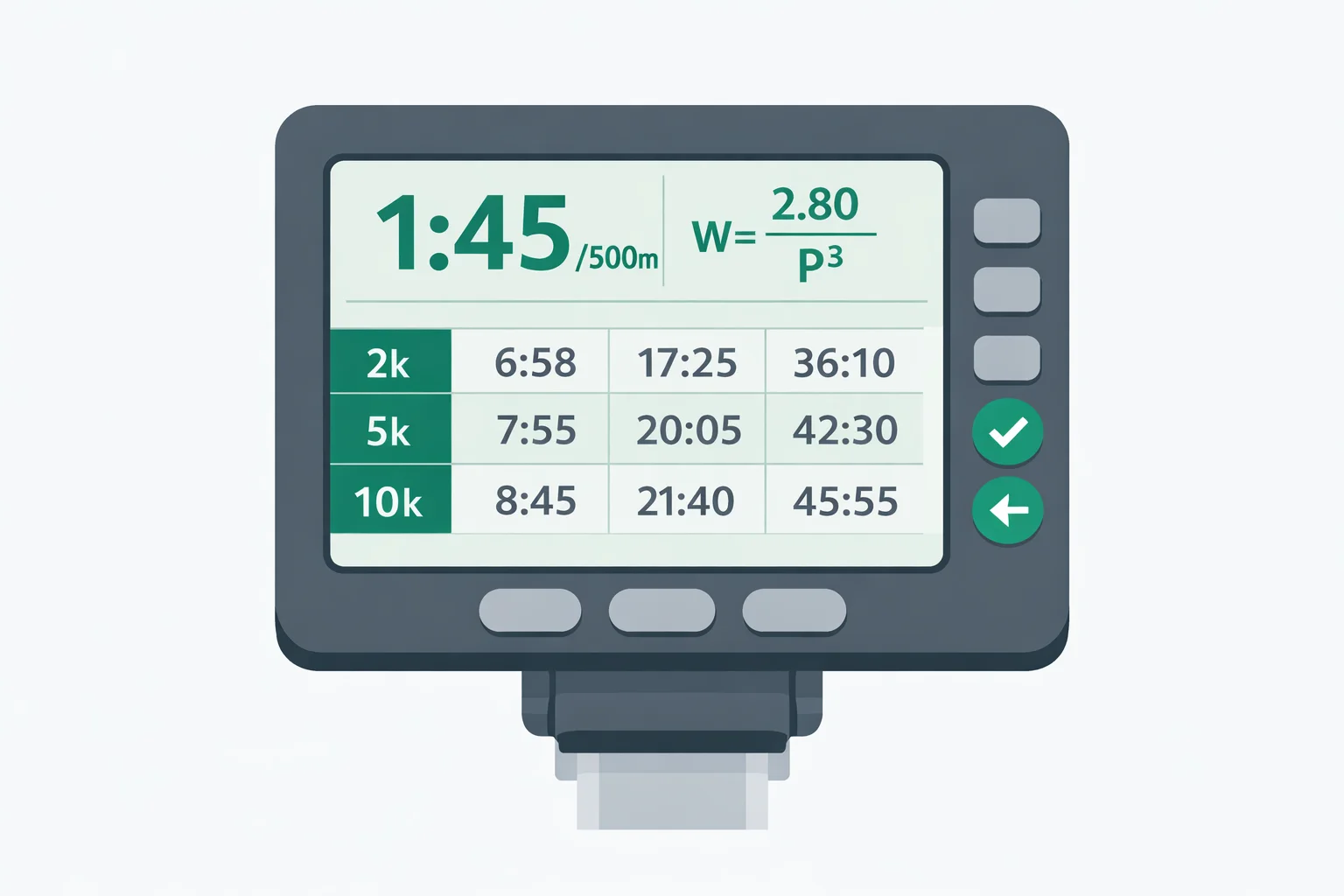
- Converts pace to watts with the Concept2 formula, watts = 2.80 / pace cubed
- Projects 500m to marathon times using Paul's Law or the Riegel 1.06 exponent
- Shows distance covered in fixed 30-minute and 60-minute pieces
- Concept2 weight-adjusted score plus 2,000m standards for men and women
- Metres and joules per stroke at your chosen stroke rate
Understanding Results
The Rowing Pace Calculator Formula
Pace itself is simple arithmetic: split = total time ÷ (distance ÷ 500). Row 2,000 m in 7:00 and you covered four 500 m units, so the split is 420 ÷ 4 = 105 seconds, displayed as 1:45.0. The calculator rearranges the same identity to solve for time (split × distance ÷ 500) or for distance (500 × time ÷ split).
Power comes from Concept2's published flywheel relationship, watts = 2.80 ÷ pace³, with pace in seconds per metre. Folding the 500 into the constant gives a one-step version: watts = 350,000,000 ÷ split³. A 2:00 split is 202.5 W, a 1:45 split is 302 W, and a 1:30 split is 480 W. Calories follow the monitor's own formula, kcal/hr = (4 × watts × 0.8604) + 300, where the 4 assumes 25% gross mechanical efficiency and the +300 is a fixed baseline.
Projections to other distances use one of two rules. Paul's Law adds five seconds to the split for every doubling of distance (continuously: split + 5 × log₂ of the distance ratio). Riegel scales pace by the distance ratio raised to 0.06, the split-form of the 1.06 endurance exponent used in running. Stroke metrics are geometric: metres per stroke = 30,000 ÷ (split × stroke rate), and joules per stroke = watts × 60 ÷ stroke rate. The weight-adjusted score multiplies your raw time by (body weight in lb ÷ 270)0.222.
Reference Ranges: Splits, Watts and 2k Standards
The 2,000 m test is the sport-wide yardstick, which is why every result on this page is projected onto it. For men, 7:00 sits in strong recreational territory, 6:50 marks competitive club, 6:30 elite club, 6:10 national level, and anything under 5:50 is world class — the open-weight record is 5:35.8. For women the same bands fall at roughly 7:40, 7:15, 6:55 and 6:30, against a record of 6:21.1. Adults new to the machine typically test between 7:50 and 8:45.
Useful anchors elsewhere: drag factor for training normally sits at 120–135 for heavyweight men and 110–125 for lightweights and women, well below what damper 10 produces on a clean machine. Steady-state stroke rates run 18–22 spm and 2k race rates 30–36 spm. At a 1:45 split those two ends of the range mean 11.9 versus 8.9 metres per stroke — the same speed bought two very different ways.
Assumptions and Limitations
Every figure here describes an indoor rowing ergometer. On-water speed depends on boat class, crew, wind and stream, so erg splits will not transfer to a hull. Projections are extrapolated from a single piece and assume you are equally trained across all distances, which is rarely true — the gap between the two models is the honest error bar, and both drift furthest at the extremes. The calorie readout carries a fixed +300 kcal/hr baseline and overstates exercise energy expenditure by roughly 210–230 kcal per hour. The weight adjustment was fitted to 2,000 m performance and assumes extra mass is useful muscle, so applying it to a marathon piece stretches it past its intended range. Maximal erg tests are hard maximal efforts: get medical clearance before testing if you have a cardiac or respiratory condition, are new to intense exercise, or are returning from illness. This tool provides general information, not medical advice.
Complete Guide: Rowing Pace Calculator
On this page
- Ten seconds off your split demands 30% more power
- The damper is not resistance — drag factor is
- Paul's Law: five seconds per doubling
- Paul's Law vs. Riegel: where the projections part company
- The monitor adds 300 calories an hour you never burned
- How should you pace a 2k?
- Why a 270-pound rower is the reference point
- Rate is not intensity: metres and joules per stroke
Open any rowing pace calculator and the first thing it does is turn your piece into one number: the 500 m split. That number is not a speed dial. Pulling a 1:50 split instead of a 2:00 does not cost you 8% more effort — it costs you 30% more power, because on a Concept2 the relationship between pace and watts is cubic. Almost every mistake rowers make with their splits traces back to treating that curve as if it were a straight line: the fly-and-die 2k, the damper cranked to 10, the belief that a 5k split should sit two seconds off a 2k split. This guide takes the four biggest of those myths apart with the actual arithmetic.
Ten Seconds Off Your Split Demands 30% More Power
Concept2 publishes the equation the monitor runs on, and it is short: watts = 2.80 ÷ pace³, where pace is seconds per metre. Feed it a 2:00 split — 120 seconds for 500 m, so 0.24 s/m — and you get 2.80 ÷ 0.24³ = 202.5 watts. That is where the familiar “two minutes is roughly 200 watts” rule comes from, and it is exact rather than approximate. Because the equation is published rather than proprietary, any Concept2 pace calculator that gets the cube right agrees with the machine to the decimal — if a tool disagrees with your monitor, it is using a linear approximation somewhere.
The cube is the part that matters. Because power scales with the cube of speed, every second you shave off a split costs progressively more, and the cost compounds fast:
| 500 m split | Watts | Power vs. 2:00 | 2,000 m time |
|---|---|---|---|
| 2:10.0 | 159 W | −21% | 8:40 |
| 2:00.0 | 203 W | baseline | 8:00 |
| 1:50.0 | 263 W | +30% | 7:20 |
| 1:40.0 | 350 W | +73% | 6:40 |
| 1:30.0 | 480 W | +137% | 6:00 |
Read the last two rows again. Moving from a 6:40 2k to a 6:00 2k — forty seconds, which sounds like a season of work — means holding 130 extra watts, an increase of 37% on an already large number. This is why erg progress stalls so visibly near the top: the same ten-second improvement that took a beginner six weeks takes an elite rower years, and no amount of training changes the exponent. It is also why watts, not splits, are the honest currency when you compare a rowing session against a cycling one. A rower holding 263 W and a cyclist holding 263 W at their functional threshold power are doing the same mechanical work, even though one number reads as 1:50 and the other reads as a number on a head unit.
The Damper Is Not Resistance — Drag Factor Is
Here is the myth that costs beginners the most: that damper 10 is “harder” and therefore better training. The damper lever controls how much air enters the flywheel housing, which changes how quickly the wheel decelerates between strokes. It does not change what the monitor rewards. Pull 200 watts at damper 3 and pull 200 watts at damper 10, and both read 2:00.0. The monitor measures work done on the flywheel, then divides. There is no setting that makes a split cheaper.
What the damper does change is the shape of the stroke. High drag means a heavy, slow catch and a load profile closer to a deadlift; low drag means a lighter handle that has to be moved faster. Drag factor — the number under Display Drag Factor, not the lever position — is the actual measurement, and it drifts with altitude, air temperature and how much dust is in the flywheel cage. That is why a damper setting of 4 can read a drag factor of 110 on one machine and 130 on another. Most national-team crews train at a drag factor of 120–135 for heavyweight men and 110–125 for lightweights and women; setting the drag factor rather than the damper is the only way to make two machines comparable.
The practical consequence: if you have been testing on damper 10 because it felt more serious, you have been recruiting more strength and less aerobic capacity for the same split, and you have almost certainly been slower over 2,000 m than you would have been at 125. High drag also loads the lumbar spine harder at the catch, which is where most erg injuries originate.
Paul's Law: Five Seconds Per Doubling
Rowing has its own endurance rule of thumb, and unlike most gym folklore it holds up. Paul's Law — named for Concept2's Paul Smith — says that every time you double the distance, your split slows by about five seconds. Halve the distance and it drops by five. It is the erg equivalent of a power law, but stated in a form you can do in your head between strokes.
Take a 7:00 2k, which is a 1:45.0 split. Double to 4,000 m and the rule predicts 1:50.0. Double again to 8,000 m and it predicts 1:55.0. Go the other way and a 1,000 m piece should come in at 1:40.0, a 500 m sprint at 1:35.0. For distances that are not clean doublings, the rowing split calculator above uses the continuous version, adding five seconds per log₂ of the distance ratio, which is how it produces 1:51.6 for a 5k and 1:56.6 for a 10k from that same 2k.
The rule earns its keep as a session planner rather than a race predictor. If your 2k split is 1:45, a set of 6 × 500 m with full recovery should sit near 1:35 and steady-state work belongs around 1:56–2:00 — the 10k-to-half-marathon end of the table, not two seconds off race pace. Rowers who train everything at “2k pace minus a bit” are the ones who plateau, because the entire session lands in the same physiological band.
Paul's Law vs. Riegel: Where the Projections Part Company
Running has its own version of this arithmetic: Peter Riegel's 1981 endurance formula, where time scales with distance to the power 1.06 — which in split terms means pace scales with distance0.06. The two rules are built on completely different reasoning, so it is worth seeing how far apart they actually land. Same 7:00 2k in both:
| Distance | Paul's Law | Riegel 1.06 | Disagreement |
|---|---|---|---|
| 500 m | 1:35.0 | 1:36.6 | 1.6 s |
| 1,000 m | 1:40.0 | 1:40.7 | 0.7 s |
| 5,000 m | 1:51.6 | 1:50.9 | 0.7 s |
| 10,000 m | 1:56.6 | 1:55.6 | 1.0 s |
| Marathon (42,195 m) | 2:07.0 | 2:06.1 | 0.9 s |
They never disagree by more than about 1.6 seconds per 500 m, which is quietly remarkable for two rules derived eighty years and one sport apart. The pattern in the disagreement is the useful bit: Paul's Law is more optimistic at short distances and more pessimistic at long ones, because a fixed five-second step is a bigger proportional change over a 500 m sprint than over a marathon. If you have a strong sprint background, Riegel will usually describe your short pieces better; if you are a diesel who fades late, Paul's Law tends to be kinder about your 10k. Treat the gap between them as the error bar, and never plan a race off a projection that came from a single piece. An erg pace calculator that prints one confident projection is hiding an uncertainty it cannot actually resolve, which is why the tool above shows you both. The same caution applies when you convert erg splits into the min/km and min/mile world; a pace converter calculator will handle the units, but it cannot make a rowing split and a running pace physiologically equivalent.
The Monitor Adds 300 Calories an Hour You Never Burned
Concept2's calorie readout is the most misread number on the machine, and again the formula is published: kcal/hr = (4 × watts × 0.8604) + 300. Three things are hiding in there. The 0.8604 converts watt-hours into kilocalories. The 4 assumes 25% gross mechanical efficiency, which is a fair average for rowing. And the flat +300 is a baseline the monitor adds whether you are pulling hard, pulling gently, or sitting still with the handle in the hooks.
A typical adult at rest burns roughly 70–90 kcal per hour, not 300. So the monitor is crediting you with something like 210–230 kcal per hour that has nothing to do with rowing. Over a 30-minute session that is 105–115 phantom calories; over a 60-minute steady state it is more than 200. Someone rowing an hour at 200 watts sees 995 kcal on the screen and has actually spent closer to 690 kcal of exercise energy above baseline. If you are eating back what the monitor says, that gap is a third of a meal a day. For anything that feeds into a deficit, use a calories burned calculator that works from body mass and duration instead, and treat the erg figure as a session-to-session comparison only.
One genuinely useful thing about the readout: because it is a fixed function of watts, calories per hour is a legitimate way to compare intervals with different stroke rates. The number is inflated, but it is inflated by exactly the same amount every time.
How Should You Pace a 2k?
Badly, if you go by what happens on most test days. The classic failure is the fly-and-die: 1:38 for the first 500, 1:44 for the second, 1:47 for the third, and a desperate 1:46 sprint that still leaves the average at 1:43.75 — a 6:55. The same rower holding an even 1:43.5 the whole way finishes in 6:54 having suffered considerably less, and the cube law explains why. Those opening strokes at 1:38 cost 372 watts against the 316 watts an even pace needs — 56 extra watts, 18% more power, sustained for 98 seconds to buy back a single second at the finish. The anaerobic debt is then repaid with interest in the third 500.
A pacing plan that survives contact with a real test looks like this. Take your target split from the calculator. Row the first 500 no more than 1.5 seconds faster than target — enough to get the flywheel up without burning matches. Hold target through the second 500. Accept that the third 500 is where the test is won or lost and simply refuse to let the split drift more than a second. Then spend everything from 500 m to go. The third 500 is the one nobody trains for, which is why race-pace work in blocks of 750–1,000 m transfers better than short intervals.
The 2,000 m test earns its status because it sits almost exactly at the duration where aerobic and anaerobic systems contribute most evenly — roughly 70–80% aerobic for a six-to-eight-minute effort. That is also why erg scores correlate so tightly with laboratory oxygen uptake in trained rowers, and why a 2k time is a decent cross-check on a VO2 max calculator estimate derived from running or cycling.
Why a 270-Pound Rower Is the Reference Point
On the water, a heavier crew has to push a deeper, slower hull; on an erg, the flywheel does not care what you weigh. That makes the machine structurally unfair to light rowers, and Concept2 corrects for it with a published handicap: adjusted time = actual time × (body weight in lb ÷ 270)0.222. The 270 lb anchor is not a typical rower — it is deliberately heavier than almost everyone, so that virtually every adjustment pulls a time faster rather than slower.
Run the numbers on two rowers who both pull 7:00. A 200 lb heavyweight gets a factor of 0.936 and an adjusted time of 6:33. A 130 lb lightweight gets 0.850 and an adjusted 5:57 — a 36-second gap opened purely by mass. That is the scale of the advantage raw erg scores hand to bigger athletes, and it is why lightweight categories exist at all. Two caveats worth keeping in mind: the adjustment assumes the extra mass is useful muscle rather than fat, and it was fitted to 2,000 m performance, so applying it to a marathon piece stretches it past what it was built for.
Rate Is Not Intensity: Metres and Joules Per Stroke
Two rowers hold 1:45. One sits at 22 strokes per minute, the other at 32. The monitor shows the same split, but they are doing profoundly different work. Distance per stroke is simply 30,000 ÷ (split × rate): at 24 spm a 1:45 split covers 11.9 metres per stroke; at 32 spm it covers 8.9. Work per stroke follows the same logic in reverse — 302 watts at 24 spm is 755 joules of work in every pull, against 566 joules at 32 spm.
This is the single most useful diagnostic the erg gives you for free. If your split only improves when your rate climbs, you are buying speed with cadence rather than with force, and that ceiling arrives early — nobody wins a 2k at 42 spm. Coaches build rate-capped sessions for exactly this reason: 4 × 2,000 m capped at 20 spm forces every extra metre to come from a harder leg drive. Watch metres per stroke rise across a block at a fixed rate and you are watching genuine improvement, in a way a split alone cannot show you. If you row alongside running or cycling, an endurance calculator will keep the pace-time-distance relationship consistent across all three so a week's training compares like for like.
One last number to leave with. Because power is cubic in speed, the athletes who improve their splits most reliably are the ones who spend the majority of their metres nowhere near race pace — 70–80% of volume at splits ten to fifteen seconds slower than 2k pace, with a small, deliberate dose of work at or under it. The rowing pace calculator above will tell you exactly what those splits are for you. Whether you actually row them slowly enough is the harder problem.
References
- Concept2. Watts Calculator — the published pace-to-power relationship (watts = 2.80 / pace³).
- Concept2. Calorie Calculator — source of the (4 × watts × 0.8604) + 300 monitor formula.
- Concept2. Weight Adjustment Calculator — the (lb / 270)^0.222 handicap.
- Concept2. Drag Factor — why the damper lever and the drag factor are different quantities.
- Riegel PS. Athletic records and human endurance. American Scientist, 1981;69(3):285–290 — origin of the 1.06 endurance exponent used as the alternative projection model.
- Ingham SA, Whyte GP, Jones K, Nevill AM. Determinants of 2,000 m rowing ergometer performance in elite rowers. European Journal of Applied Physiology — PubMed.

Written by Jurica Šinko
Founder & CEO
Entrepreneur and health information advocate, passionate about making health calculations accessible to everyone through intuitive digital tools.
View full profileFrequently Asked Questions
What does the 500m split on a rowing machine mean?
The split is how long it would take you to cover 500 metres at your current speed, shown as minutes:seconds. A 1:45 split means 105 seconds per 500m, so a 2,000m piece at that pace finishes in 7:00. It is a pace, not a distance, so it stays on screen even during a 10k.
How do I convert a 500m split into watts?
Concept2 uses watts = 2.80 divided by pace cubed, where pace is seconds per metre. A 2:00 split is 120 seconds over 500m, or 0.24 s/m, which gives 2.80 / 0.24 cubed = 202.5 watts. A 1:45 split works out at 302 watts and a 1:30 split at 480 watts.
What is a good 2k row time?
For men, breaking 7:00 is a strong recreational standard, 6:50 marks competitive club level, 6:30 elite club, and anything under 5:50 is world class; the open-weight record is 5:35.8. For women the same rungs fall near 7:40, 7:15 and 6:30, against a record of 6:21.1. Adults new to the machine usually test between 7:50 and 8:45 depending on sex and body size.
What is the difference between the damper setting and drag factor?
The damper lever controls airflow into the flywheel cage; drag factor is the deceleration the monitor actually measures, typically 90 to 135 on a Model D. The same damper number gives different drag factors on different machines depending on dust, altitude and air temperature. Neither changes your split for a given power output: 200 watts reads 2:00 at damper 3 and damper 10.
How much slower should my 5k split be than my 2k split?
Paul's Law says your split slows by about 5 seconds every time the distance doubles, so a 1:45 2k split projects to roughly 1:51-1:52 over 5,000m and 1:56-1:57 over 10,000m. The Riegel power law used in running gives answers within about one second per 500m, which is a fair error bar on any projection made from a single piece.
Why does my rowing machine say I burned so many calories?
The Concept2 formula is (4 x watts x 0.8604) + 300, and that flat +300 kcal per hour is added whether you are pulling or resting. A typical adult burns 70-90 kcal an hour at rest, so the monitor credits you with roughly 210-230 phantom calories every hour. An hour at 200 watts reads 995 kcal when the work itself accounts for about 690.
What stroke rate should I use for steady state rowing?
Most steady state work sits at 18-22 strokes per minute, with 2k racing at 30-36. Rate is not intensity: at a 1:45 split, 24 spm covers 11.9 metres per stroke while 32 spm covers only 8.9. If your split only improves when your rate climbs, you are buying speed with cadence instead of leg drive.
Does my erg split match my speed on the water?
No. The ergometer never has to move your body mass or overcome hull drag, so erg splits are typically faster than boat splits and the gap widens with crew size, boat class, wind and stream. Use the erg score for fitness testing and selection, and time trials in the boat for on-water pace. Concept2 weight adjustment exists precisely because the machine ignores the mass penalty a real hull imposes.
Related Calculators

5K Pace Calculator — Splits, Finish Time & Pace Zones
Train smarter with the 5K pace calculator: convert goal time to precise per-km and per-mile pace and split targets. Get fast, accurate results instantly.

Agility Calculator for T‑Test and Pro Agility (5‑10‑5)
Use our agility calculator to time T‑Test and pro agility shuttles, compare attempts, track change‑of‑direction speed, check asymmetry, and monitor progress.
Speed, Agility & Power — Athletic Performance Calculator
Analyze running pace, race predictions, strength 1RM, and jump power in one athletic performance calculator. Mobile‑first with quick inputs and clear results.
Bench Press Calculator — 1RM, Strength Level & Training
Free bench press calculator to estimate your one-rep max (1RM), compare strength standards by body weight and sex, and get percentage-based training loads.

Bench Press Calculator — 1RM Max, Sets & Plate Math
Use our bench press calculator to estimate your 1RM from reps and weight, auto‑build working sets, warm‑up ladder, and plate math in kg/lb. Mobile‑friendly.
Body Recomposition Calculator — Recomp Fat Loss & Muscle
Free body recomposition calculator projects fat loss and muscle gain month by month from your calories, protein, body fat and training age. Plan a real recomp.