Use the Pace Converter Calculator
Pace /mi
8:00
Pace /km
4:58
Speed
7.5 mph
Convert from
e.g. 08:00 = 8-minute mile
min/mile
8:00
min/km
4:58
mph
7.5
km/h
12.1
Race Finish Time Estimates
| Distance | Finish Time |
|---|---|
| 1 mile | 8:00 |
| 5K | 24:51 |
| 10K | 49:43 |
| Half Marathon | 1:44:53 |
| Marathon | 3:29:45 |
Common Pace Reference
| Level | min/mi | min/km | mph | km/h |
|---|---|---|---|---|
| Elite marathon | 4:45 | 2:57 | 12.6 | 20.3 |
| Sub-3h marathon | 6:53 | 4:17 | 8.7 | 14.0 |
| Fast 5K | 6:30 | 4:02 | 9.2 | 14.9 |
| Recreational | 9:30 | 5:54 | 6.3 | 10.2 |
| Brisk walk | 15:00 | 9:19 | 4.0 | 6.4 |
Disclaimer
Conversions assume steady pace on flat terrain. Real-world times vary with elevation, wind, temperature, and fatigue. Use these estimates for planning, not as guarantees. This tool provides general fitness information, not medical advice.
Educational tool, not medical advice. Check this tool’s method and limitations before interpreting a result. Talk to a qualified healthcare professional before making decisions about medication, diet, exercise, or treatment. See our Terms of Use.
Your rating helps improve Pace Converter Calculator. We store only an anonymized vote (no personal data).
How to Use Pace Converter Calculator
Step 1: Choose your input format
Select min/mi, min/km, mph, or km/h under "Convert from" depending on the pace or speed value you already know.
Step 2: Enter your pace or speed
Type your value into the input field. Pace inputs use separate minute and second boxes; speed inputs accept decimals like 7.5.
Step 3: Read the converted results
All four equivalents (min/mi, min/km, mph, km/h) update instantly in the emerald result card along with a pace category badge.
Step 4: Check race finish estimates
Scroll to the Race Finish Time Estimates table to see projected times for 1 mile, 5K, 10K, half marathon, and marathon.
Step 5: Copy or reset
Tap Copy Summary to save all conversions and race times to your clipboard, or tap Reset to start over with default values.
Key Features
- Instant 4-way conversion: min/mi, min/km, mph, km/h
- Race finish time estimates for 5K through marathon
- Common pace reference table with active-row highlight
- Pace category classification with visual progress bar
- One-tap copy summary for sharing or logging
- Mobile sticky result bar for on-the-go use
Understanding Your Converted Pace
Conversion Formulas
Two constants power every conversion: 60 (to toggle between pace and speed) and 1.609344 (the mile-to-km ratio). Speed to pace: divide 60 by your speed. At 7.5 mph, one mile takes 60 ÷ 7.5 = 8.0 minutes. Mile pace to km pace: divide seconds-per-mile by 1.609344. So 480 seconds/mi becomes 298 seconds/km (4:58/km). Going the other direction, multiply seconds/km by 1.609344 to get seconds/mi.
Finish time equals pace × distance. At 4:58/km, a 5K takes 5 × 298 = 1,490 seconds ≈ 24:50. A marathon at that pace: 42.195 × 298 = 12,574 seconds ≈ 3:29:34. The calculator computes these automatically for five standard race distances.
Pace Categories and What They Mean
The calculator classifies your pace into five categories. Elite (under 5:00/mi / 3:06/km) represents world-class and sub-elite runners. Competitive (5:00–7:00/mi) covers serious club runners and Boston qualifiers. Intermediate (7:00–9:00/mi) is the sweet spot for trained recreational runners. Recreational (9:00–12:00/mi) encompasses most regular joggers. Walking (above 12:00/mi) includes power walkers and walk/run programs. These bands align with ACSM activity intensity guidelines.
Assumptions & Limitations
All conversions assume flat terrain, still air, and a perfectly calibrated device. In practice, elevation gain of 100 feet per mile adds 15–20 seconds to your pace at the same heart rate. Wind, heat (above 55 °F), and altitude (above 4,000 ft) also shift the relationship between speed and perceived effort. Use converted numbers as targets and adjust by feel, heart rate, or perceived exertion. Race time estimates assume even pacing throughout — realistic for 5K–10K but optimistic for marathons where most runners slow 5–10% over the final third.
Complete Guide: Pace Converter Calculator
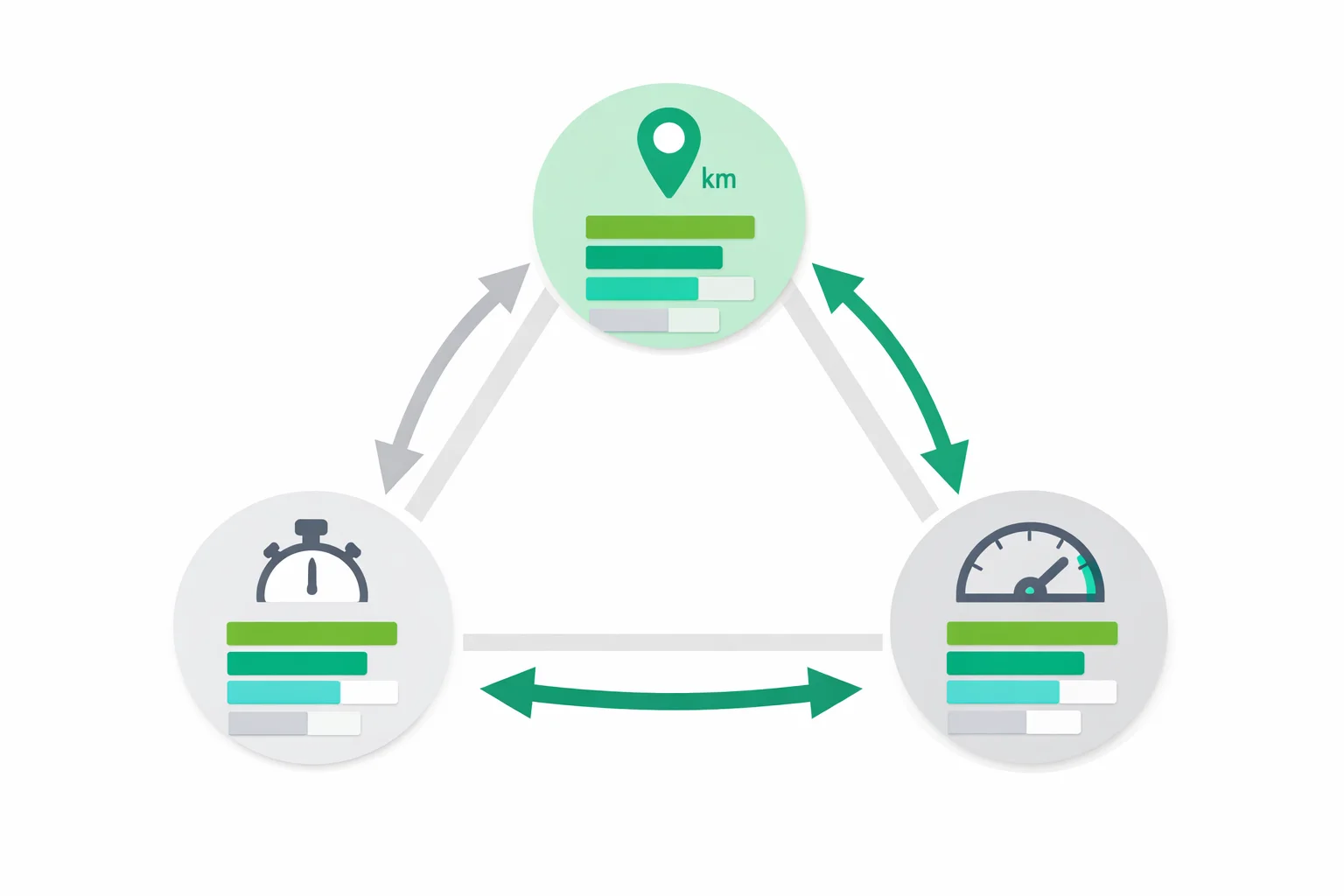
On this page
A pace converter calculator solves a frustration that hits runners mid-workout: your training plan says 4:58/km, the treadmill displays 7.5 mph, and your GPS watch flashes 8:00/mi. Three numbers, same speed, zero clarity until you can translate between them. Whether you need to convert min per mile to min per km or figure out how to convert min/km to mph for a treadmill session, the arithmetic is the same — divide 60 by speed, or multiply by 1.609344 — but doing it in your head while oxygen-deprived on rep five of an interval set isn't realistic. This running pace converter guide breaks down the exact formulas, walks through concrete examples, and gives you a running pace conversion chart you can bookmark for race day.
The Math Behind Pace Conversion
Pace and speed are reciprocals. If you run at S miles per hour, one mile takes 60 ÷ S minutes. That gives you min/mi. Flip it: if your pace is P min/mi, your speed is 60 ÷ P mph. The kilometer versions work identically but the constant shifts because 1 mile = 1.609344 km.
Here are the four core conversions that every runner should internalize:
- mph → min/mi: pace = 60 ÷ mph
- min/mi → min/km: divide by 1.609344 (since each km is shorter, the per-km number is smaller)
- min/km → km/h: speed = 60 ÷ min/km
- km/h → mph: divide by 1.609344
Notice the pattern: 60 toggles between pace and speed, and 1.609344 toggles between mile-based and km-based units. That's really just two operations applied in sequence — which is why a pace conversion calculator (or pace to speed calculator, depending on your starting point) only needs a single input to fill in the other three values. Our mph calculator handles the speed half of this equation if you want a dedicated speed-first tool.
Worked Example: the 8-Minute Mile
An 8:00/mi pace is a common benchmark for recreational runners, so let's trace it through every unit:
- Start: 8:00 per mile = 480 seconds per mile.
- min/km: 480 ÷ 1.609344 = 298.3 seconds ≈ 4:58/km.
- mph: 60 ÷ 8 = 7.5 mph.
- km/h: 7.5 × 1.609344 = 12.07 km/h.
So 8:00/mi, 4:58/km, 7.5 mph, and 12.1 km/h are all the same effort on flat ground. At that pace, a 5K takes about 24:51, a 10K lands near 49:42, and a half marathon clocks in around 1:44:53. These estimates assume you hold the same pace — realistic for shorter races, optimistic for a marathon where cardiac drift and glycogen depletion slow most runners by 5–10% over the final 10K.
Try a second scenario: you see 6.0 on a hotel treadmill (km/h). That's 6.0 ÷ 1.609 = 3.73 mph — a brisk walk, not a run. If you meant 6.0 mph, set the treadmill to 9.66 km/h. Misreading the unit label is one of the most common treadmill mistakes, and it can throw off an entire workout.
min/mile vs. min/km: Why the Gap Is Exactly 1.609
A mile is 1.609344 times longer than a kilometer. That fixed ratio means your min/mi pace will always be about 61% larger than your min/km pace. Said differently, min/km is roughly 62% of min/mi. This is handy for mental math: take your mile pace, chop off about 38%, and you've got a decent km estimate. For example, 10:00/mi × 0.621 ≈ 6:13/km (actual: 6:13). Close enough for mid-run decisions.
The confusion spikes for runners who train with both systems. European race results post km splits while U.S. events mark mile markers. If you qualified for Boston with 3:30:00 splits in km and then switch to a mile-marked course, you need to know that your 4:59/km translates to 8:01/mi so you can pace off the correct markers without drifting fast early.
Our running pace calculator can generate full split tables in either unit once you've nailed down your target pace here.
Treadmill Dial vs. GPS Watch Readout
Treadmills display speed (mph or km/h). GPS watches usually display pace (min/mi or min/km). This disconnect is the #1 reason runners Google “pace converter.” The fix is straightforward: convert once before you step on, or tape a small cheat sheet to the treadmill console.
But there's a subtlety. Treadmill speed represents belt speed, which your footstrike pacing should match. GPS pace represents ground speed, which factors in horizontal displacement but not vertical oscillation or belt calibration error. Studies from the Journal of Sports Sciences have shown treadmill belt speed can deviate 1–4% from the displayed value, depending on age and maintenance. At 7.5 mph, a 3% error means you're actually running somewhere between 7.28 and 7.73 mph — a swing of about 15 seconds per mile.
Takeaway: use converted numbers as targets, not gospel. If your heart rate at “8:00/mi on the treadmill” feels like a 7:30 effort, the belt might be slightly fast. Pair pace conversion with heart rate data from a target heart rate calculator to stay in the right zone regardless of what the screen says.
Pace Converter Calculator Reference Table (5:00/mi to 15:00/mi)
Bookmark this table or screenshot it for race-day reference. Every row is pre-calculated so you don't have to reach for a calculator mid-stride.
| min/mi | min/km | mph | km/h | 5K Time | Marathon |
|---|---|---|---|---|---|
| 5:00 | 3:06 | 12.0 | 19.3 | 15:33 | 2:11:06 |
| 6:00 | 3:44 | 10.0 | 16.1 | 18:38 | 2:37:19 |
| 7:00 | 4:21 | 8.6 | 13.8 | 21:45 | 3:03:33 |
| 8:00 | 4:58 | 7.5 | 12.1 | 24:51 | 3:29:45 |
| 9:00 | 5:35 | 6.7 | 10.7 | 27:57 | 3:55:58 |
| 10:00 | 6:13 | 6.0 | 9.7 | 31:04 | 4:22:12 |
| 11:00 | 6:50 | 5.5 | 8.8 | 34:10 | 4:48:25 |
| 12:00 | 7:27 | 5.0 | 8.0 | 37:17 | 5:14:39 |
| 13:00 | 8:05 | 4.6 | 7.4 | 40:23 | 5:40:52 |
| 15:00 | 9:19 | 4.0 | 6.4 | 46:35 | 6:33:19 |
All marathon times above assume even pacing — no positive or negative split. Real marathons almost always have some drift. The 2023 Chicago Marathon median finish was 4:34:00, which lands between the 10:00/mi and 11:00/mi rows. If you're targeting sub-4:00, you need to hold roughly 9:09/mi (5:41/km) throughout.
Race Pacing from Converted Numbers
Knowing your converted pace is step one. Executing it is step two. Here's a practical framework: take your goal pace in the unit your race markers use, and build a checkpoint card.
For a sub-25-minute 5K (target: 8:03/mi or 5:00/km), your checkpoints look like: Mile 1 at 8:03, Mile 2 at 16:06, Mile 3 at 24:09, then a 0.11-mile kick to the finish. In km: 1 km at 5:00, 2 km at 10:00, 3 km at 15:00, 4 km at 20:00, 5 km at 25:00. Same race, same effort, different markers — and converting between them before the gun goes off means you won't panic when you pass a mile marker 30 seconds “ahead” of your km-based plan.
For half marathon or marathon planning with full split tables, pair this converter with our race pace calculator or dedicated marathon pace calculator. Those tools generate per-mile and per-km checkpoints automatically once you plug in your target finish time.
Edge Cases Where Conversion Misleads
Pace conversion assumes flat ground and steady effort. Real running breaks both assumptions regularly. Here are specific scenarios where the numbers lie:
- Uphill segments: A 6% grade adds roughly 30–45 seconds per mile at the same heart rate effort. Your converted pace says 8:00/mi, but the hill makes it feel — and measure — like 8:35/mi. Effort-based pacing (heart rate or perceived exertion) is more honest on climbs.
- Wind resistance: A 15 mph headwind can add 12–15 seconds per mile. A tailwind of the same magnitude saves about half that, because aerodynamic drag scales with velocity squared.
- Heat: For every 10°F above 55°F, expect pace to drift 1.5–3% slower at the same effort. A 7:30/mi effort in cool weather becomes 7:44–7:53/mi when it's 85°F.
- Altitude: VO2max drops about 3% per 1,000 feet above 4,000 ft. If you trained at sea level and race in Denver (5,280 ft), your 8:00/mi pace will require more effort than expected.
- Treadmill calibration: Belt slip and motor inaccuracy mean a displayed 7.5 mph might actually be 7.2–7.7 mph. Older gym machines are the worst offenders.
None of these invalidate pace conversion — they just mean you should layer environmental awareness on top of your converted numbers. Train with both pace and heart rate data so you can adjust on the fly. The 5K pace calculator and VO2 max calculator can help you calibrate expected effort levels for different conditions. One more unit trap worth naming: indoor rowing does not use min/mile or min/km at all — it reports a 500 m split, and the pace-to-power relationship there is cubic rather than linear, so a rowing pace calculator is the right tool for erg numbers. Swimming has the strangest unit of all: pace is quoted per 100, and because 100 yards is exactly 91.44 metres, the identical swimming speed reads about 8.6% faster in a yard pool than a metre pool — a swim pace calculator handles that plus the 25 m, 50 m and short-course-yard conversions no running unit needs.
References
- Jones, A.M. & Doust, J.H. (1996). “A 1% treadmill grade most accurately reflects the energetic cost of outdoor running.” Journal of Sports Sciences, 14(4), 321–327. PubMed
- American College of Sports Medicine. ACSM Physical Activity Guidelines — running intensity benchmarks mapped to pace zones.

Written by Jurica Šinko
Founder & CEO
Entrepreneur and health information advocate, passionate about making health calculations accessible to everyone through intuitive digital tools.
View full profileFrequently Asked Questions
How do I convert 8:00 per mile to min per km?
Divide 480 seconds (8 minutes) by 1.609344. The result is 298 seconds, which is 4:58 per km. An 8-minute mile always equals roughly 4:58/km because 1 mile is 1.609 km.
What is a 10 min/mile pace in km/h?
10:00 per mile equals 6.0 mph. Multiply 6.0 by 1.609344 to get 9.66 km/h. In per-km terms, that is about 6:13/km.
Why does my treadmill pace feel different from my outdoor pace?
Treadmill belt speed can deviate 1-4% from the display due to calibration and belt slip. A displayed 7.5 mph may actually be 7.2-7.7 mph. Heat, wind, and terrain also shift outdoor effort independently of the converted number.
What pace per km do I need for a sub-2-hour half marathon?
A sub-2:00 half marathon (21.1 km) requires holding about 5:41/km or 9:09/mi. In speed terms, that is roughly 10.6 km/h or 6.55 mph held steadily for 13.1 miles.
Is 5:00 per km a fast running pace?
5:00/km equals 8:03/mi or 12.0 km/h. For most recreational runners this is moderate to fast. Competitive club runners typically sustain 3:30-4:30/km, while beginners often start around 6:00-7:00/km.
How do I convert km/h on a treadmill to min per mile?
First convert km/h to mph by dividing by 1.609344. Then divide 60 by that mph value. For example, 10 km/h is 6.21 mph, and 60 divided by 6.21 is 9:39 per mile.
Does altitude affect the accuracy of pace conversion?
The math stays the same at any altitude, but your ability to sustain a given pace changes. VO2max drops about 3% per 1,000 feet above 4,000 ft, so a pace that feels easy at sea level will feel harder in Denver at 5,280 ft.
What is the difference between pace and speed?
Pace measures time per distance (e.g., 8:00 per mile), while speed measures distance per time (e.g., 7.5 mph). They are reciprocals: as speed increases, pace decreases. Runners use pace for training plans; treadmills display speed.
Related Calculators

5K Pace Calculator — Splits, Finish Time & Pace Zones
Train smarter with the 5K pace calculator: convert goal time to precise per-km and per-mile pace and split targets. Get fast, accurate results instantly.

Agility Calculator for T‑Test and Pro Agility (5‑10‑5)
Use our agility calculator to time T‑Test and pro agility shuttles, compare attempts, track change‑of‑direction speed, check asymmetry, and monitor progress.

Speed, Agility & Power — Athletic Performance Calculator
Analyze running pace, race predictions, strength 1RM, and jump power in one athletic performance calculator. Mobile‑first with quick inputs and clear results.
Bench Press Calculator — 1RM, Strength Level & Training
Free bench press calculator to estimate your one-rep max (1RM), compare strength standards by body weight and sex, and get percentage-based training loads.

Bench Press Calculator — 1RM Max, Sets & Plate Math
Use our bench press calculator to estimate your 1RM from reps and weight, auto‑build working sets, warm‑up ladder, and plate math in kg/lb. Mobile‑friendly.
Body Recomposition Calculator — Recomp Fat Loss & Muscle
Free body recomposition calculator projects fat loss and muscle gain month by month from your calories, protein, body fat and training age. Plan a real recomp.