Use the Bench Press Calculator
Free bench press calculator to estimate your one-rep max (1RM), compare strength standards by body weight and sex, and get percentage-based training loads.
Est. 1RM
82.5 kg
Units
Sex
3\u20138 reps is most accurate
Estimated Bench Press 1RM
82.5 kg
1.02× bodyweight
+17.5 kg to Advanced
Beginner
40.0 kg
0.5× BW
Novice
60.0 kg
0.75× BW
Intermediate
80.0 kg
1× BW
Advanced
100.0 kg
1.25× BW
Elite
120.0 kg
1.5× BW
Training Percentage Chart
| % of 1RM | Weight | Rep range | Training goal |
|---|---|---|---|
| 95% | 77.5 kg | 1–2 | Peaking / Max strength |
| 90% | 72.5 kg | 1–3 | Strength (heavy singles/doubles) |
| 85% | 70.0 kg | 3–5 | Strength (core sets) |
| 80% | 65.0 kg | 4–6 | Strength–Hypertrophy |
| 75% | 62.5 kg | 5–8 | Hypertrophy / Volume |
| 70% | 57.5 kg | 8–10 | Hypertrophy / Endurance |
| 65% | 52.5 kg | 10–12 | Muscular endurance |
Progressive Overload Starting Weights
5×5 Linear
62.5 kg
Start: 5×5 @ 75%
+2.5 kg / +5 lb per week
Texas Method
65.0 kg
Start: 5×5 → 1×5 heavy @ 80%
+2.5 kg on Friday PR set
5/3/1 Wendler
52.5 kg
Start: 3 working sets (65–95%) @ 65%
+2.5 kg / +5 lb per cycle (3 wk)
Bench Press Strength Standards (Male)
1RM targets by body weight, in kg
| BW (kg) | Beginner | Novice | Intermediate | Advanced | Elite |
|---|---|---|---|---|---|
| 60 | 30 | 45 | 60 | 75 | 90 |
| 70 | 35 | 52.5 | 70 | 87.5 | 105 |
| 80 | 40 | 60 | 80 | 100 | 120 |
| 90 | 45 | 67.5 | 90 | 112.5 | 135 |
| 100 | 50 | 75 | 100 | 125 | 150 |
| 110 | 55 | 82.5 | 110 | 137.5 | 165 |
| 120 | 60 | 90 | 120 | 150 | 180 |
Disclaimer
Estimates use the Epley formula and published strength standards. Your true 1RM may differ based on technique, fatigue, and training history. Always use a spotter for heavy bench press attempts. This tool is for training guidance, not medical advice.
Educational tool, not medical advice. Check this tool’s method and limitations before interpreting a result. Talk to a qualified healthcare professional before making decisions about medication, diet, exercise, or treatment. See our Terms of Use.
Your rating helps improve Bench Press Calculator. We store only an anonymized vote (no personal data).
How to Use Bench Press Calculator
Step 1: Select units and sex
Toggle between kg/lb and male/female to set the strength standard thresholds that match your profile.
Step 2: Enter your bodyweight
Type your current body weight in the Bodyweight field. This is used to calculate your strength-to-bodyweight ratio and classify your level.
Step 3: Enter weight lifted and reps
Enter the weight you benched and the number of reps completed in a recent set taken close to failure. Sets of 3–8 reps produce the most accurate estimate.
Step 4: Read your estimated 1RM and strength level
Your estimated one-rep max appears instantly along with a classification from Beginner to Elite and a progress bar showing how close you are to the next level.
Step 5: Use the training tables
Scroll down to the Training Percentage Chart for sets and reps at every intensity, and the Progressive Overload section for ready-made program starting weights.
Key Features
- Epley-based 1RM estimation from any rep count
- Strength classification (Beginner to Elite) by sex and body weight
- Training percentage chart with rep ranges and goals
- Progressive overload starting weights for 5x5, Texas Method, and 5/3/1
- Full body-weight strength standards reference table
- Metric and imperial unit toggle with automatic conversion
Understanding Your Bench Press Results
The Epley Formula
This calculator estimates your one-rep max using the Epley equation:
1RM = weight × (1 + reps ÷ 30)
For example, pressing 80 kg for 6 reps gives 80 × 1.20 = 96 kg. The result is then divided by your bodyweight to produce a strength-to-bodyweight ratio, which is compared against published standards for your sex.
Strength Level Classification
Your 1RM-to-bodyweight ratio determines your level. Male thresholds: Beginner (< 0.5×), Novice (0.5–0.75×), Intermediate (0.75–1.0×), Advanced (1.0–1.25×), Elite (≥ 1.5×). Female thresholds: Beginner (< 0.25×), Novice (0.25–0.4×), Intermediate (0.4–0.6×), Advanced (0.6–0.8×), Elite (≥ 1.0×).
Standards are drawn from ExRx, Symmetric Strength, and NSCA research. They reflect drug-tested, recreational-to-competitive lifters and apply to barbell flat bench press with a full range of motion.
Assumptions & Limitations
The Epley formula is most reliable between 3 and 10 reps. Above 12 reps, predicted 1RM tends to overshoot by 5–8%. The formula assumes controlled reps without a pause command, bounce, or spotter assistance. Strength standards are population averages and may not account for limb length, age, or training history. Always use a spotter or safeties when attempting loads above 85% of your estimated max.
Complete Guide: Bench Press Calculator
On this page
A bench press calculator turns a single working set into a full training roadmap—estimated 1RM, strength classification, percentage-based loading, and progressive overload targets all in one place. According to a 2020 analysis of 47,000 drug-tested powerlifters published in Sports Medicine, the average competitive male benches roughly 1.2× bodyweight while the average female competitor reaches about 0.7× BW. Where do you fall on that spectrum, and more importantly, what weight should you put on the bar next Monday? That's what this guide answers.
Below you'll find a complete worked example, a comparison of the most-cited 1RM formulas, a body-weight strength standards table, and three plug-and-play programs that start from your estimated max. Everything ties directly back to the calculator above.
A Worked Example: 80 kg Male, 5 Reps at 70 kg
Take a lifter who weighs 80 kg and completes 5 clean reps with 70 kg on the bench. Using the Epley equation—1RM = weight × (1 + reps / 30)—the math looks like this:
1RM = 70 × (1 + 5 / 30) = 70 × 1.167 = 81.7 kg → rounded to 82.5 kg
The strength-to-bodyweight ratio is 82.5 / 80 = 1.03× BW. Against published male standards, that sits right at the Intermediate threshold (1.0× BW), meaning this lifter has moved past beginner gains and is building real base strength. His 5×5 working weight would be 75% of 82.5 = 61.9 → 62.5 kg, and a 3×3 strength block would use 85% = 70.1 → 70 kg.
Contrast this with a 60 kg female who presses 42.5 kg for 5 reps. Her Epley 1RM is 49.6 kg (rounded to 50 kg), giving a ratio of 0.83× BW—solidly in the Advanced band for women (0.8×+). Same formula, very different context, because standards are sex-specific. That's why the calculator asks for both bodyweight and sex before classifying your level.
Bench Press Strength Standards by Body Weight
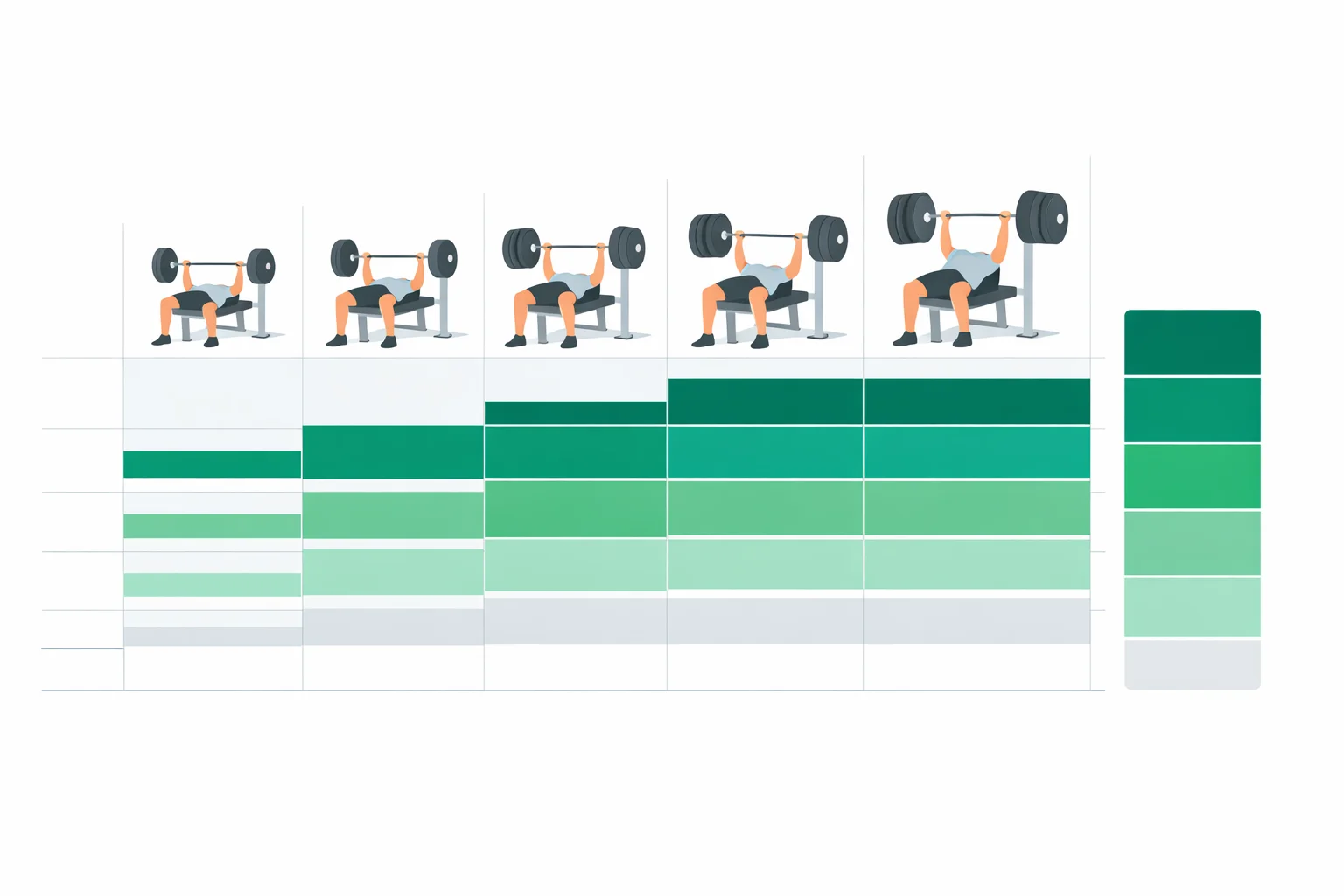
Standards compile data from thousands of competitive and recreational lifters. The table below shows 1RM thresholds expressed as a multiple of bodyweight, drawn from ExRx, Symmetric Strength, and NSCA research. They aren't pass/fail grades—they're waypoints that help you set realistic short-term targets.
| Level | Male (1RM/BW) | Female (1RM/BW) | Typical timeline |
|---|---|---|---|
| Beginner | < 0.5× | < 0.25× | 0–3 months |
| Novice | 0.5–0.75× | 0.25–0.4× | 3–6 months |
| Intermediate | 0.75–1.0× | 0.4–0.6× | 6–18 months |
| Advanced | 1.0–1.25× | 0.6–0.8× | 1.5–3 years |
| Elite | ≥ 1.5× | ≥ 1.0× | 3–5+ years |
An 80 kg male benching 100 kg sits at exactly 1.25× BW—the upper edge of Advanced. To hit Elite (1.5×) he'd need 120 kg, which typically takes another 1–2 years of structured training. For context, the calculator's progress bar shows exactly how far you are between your current level and the next threshold, down to the kilogram.
Epley vs. Brzycki vs. Wathan: Which 1RM Formula Wins?
Our bench press max calculator shows five formulas side by side and takes the median. This broader bench press calculator uses the Epley equation alone—intentionally. Here's why. A 2017 meta-analysis in the Journal of Strength and Conditioning Research found that Epley's predictions fell within ±4% of true 1RM for sets of 3–10 reps across upper-body lifts. Brzycki tends to underpredict above 10 reps, and Wathan overestimates at lower rep counts.
| Formula | 70 kg × 5 reps | Best accuracy range | Tendency |
|---|---|---|---|
| Epley | 81.7 kg | 3–10 reps | Balanced |
| Brzycki | 78.8 kg | 1–10 reps | Conservative |
| Wathan | 83.9 kg | 1–6 reps | Aggressive |
| Lombardi | 82.6 kg | 3–8 reps | Slightly high |
The practical spread is about 5 kg between Brzycki and Wathan on a 70 kg × 5 input—roughly the width of one small plate. For percentage-based training, that difference rarely changes your loading. If you want the five-formula median for a second opinion, use the max bench calculator. If you need a broader multi-lift assessment including squat and deadlift, the strength level calculator ranks all four main lifts, and our squat calculator applies the same strength-standards framework to the lower body with depth normalization built in.
Translating Your 1RM Into Weekly Training Weights
A one-rep max is only useful if you do something with it. Percentage-based training prescribes loads as a fraction of your estimated 1RM, and decades of coaching data back the following zones:
- 90–95% 1RM (1–3 reps) — Peaking and neuromuscular efficiency. Use sparingly: 1–2 sets, once a week at most.
- 80–85% 1RM (3–6 reps) — The core strength zone. Most intermediate and advanced programs spend the majority of heavy-day volume here.
- 70–75% 1RM (5–10 reps) — Hypertrophy with meaningful mechanical tension. Good for back-off sets or higher-volume phases.
- 60–65% 1RM (10–15 reps) — Muscular endurance, technique refinement, or deload intensity.
The calculator auto-generates a training percentage table so you don't have to do the arithmetic yourself. Round each load to the nearest available plate increment—2.5 kg or 5 lb—since the bar doesn't care about decimal precision. A 1–2% rounding error has zero measurable effect on strength adaptation over a training cycle.
Three Proven Progressive Overload Programs
Progressive overload—adding weight, reps, or sets over time—is the single most validated driver of strength. Here are three programs that plug directly into the starting weights the calculator provides:
5×5 Linear Progression (best for beginners and early intermediates). Start at 75% of your estimated 1RM. Perform 5 sets of 5 reps, three times per week. Add 2.5 kg (or 5 lb) every session. When you fail a weight twice in a row, deload by 10% and build back up. A lifter starting at 62.5 kg can realistically reach 80+ kg in 8–10 weeks before the first deload is needed.
Texas Method (intermediates who've stalled on linear gains). Monday: volume day (5×5 at 80%). Wednesday: light recovery (3×5 at 70%). Friday: intensity day (1×5 PR attempt at 85–90%). Add 2.5 kg to Friday's top set each week. This weekly periodization extends linear gains by another 3–6 months.
5/3/1 Wendler (advanced lifters). Four-week cycles: week 1 is 3×5 at 65/75/85%, week 2 is 3×3 at 70/80/90%, week 3 is 5/3/1 at 75/85/95%, and week 4 is a deload. Add 2.5 kg to your training max every cycle. Progress is slower—about 10 kg per year on bench—but sustainable for lifters already pressing 1.25×+ BW. Pair with the one-rep max calculator to track your training max separately from your true max.
Where Lifters Stall and How to Break Through
Bench press plateaus tend to cluster at two spots on the bar path. Off-the-chest stalls (the first 5–10 cm) indicate weak pecs and poor leg drive. Fixes: paused reps with a 2-second hold, wide-grip dumbbell presses, and conscious foot pressure into the floor. Lockout stalls (the final 10–15 cm) point to underdeveloped triceps. Fixes: close-grip bench (index fingers on the smooth ring), floor presses, and heavy triceps extensions.
A third, often-overlooked cause is simply insufficient volume. Research by Schoenfeld et al. (2019) found that 10+ weekly sets targeting the chest produced significantly more hypertrophy than 5 sets in intermediate trainees. If you're doing flat bench and nothing else, adding 2–3 sets of incline dumbbell work or dips can supply the extra stimulus without overloading the exact same movement pattern.
The Setup Cues That Add 5–10% to Your Press
Technique changes don't just protect joints—they directly increase load capacity. A 2016 biomechanics study at the University of Padova found that scapular retraction and a modest thoracic arch reduced the range of motion by 2–4 cm while increasing pectoral activation by 12%. Here are the cues that matter most:
- Squeeze shoulder blades together and down before unracking. Your upper back is the platform the bar presses from.
- Plant feet flat, knees tracking over ankles, and drive the floor away as you press. Leg drive contributes roughly 5–8% of bench output.
- Grip width at 1.5× biacromion (shoulder) width balances pec stretch with triceps contribution. A grip that's too narrow shifts load to triceps; too wide and shoulder stress climbs.
- Touch the bar at the lower sternum, roughly nipple line, and press back toward the rack in a slight J-curve. Straight-line pressing increases shoulder impingement risk at the bottom.
Film a set from the side with your phone. Compare your bar path to the J-curve. If the bar drifts toward your face off the chest, your grip may be too wide or your elbows are flaring. Small corrections at 70% translate into real kilos at 95%.
Protein, Calories, and Sleep: The Other Half of Strength
Strength adaptation occurs during recovery, not during the set. A 2022 meta-analysis in the British Journal of Sports Medicine confirmed that 1.6–2.2 g of protein per kg of bodyweight per day maximizes muscle protein synthesis for resistance trainees. For our 80 kg lifter, that's 128–176 g daily. Use the protein intake for muscle gain calculator to dial in your specific target based on age, training frequency, and goal.
Calorie intake matters too. Gaining strength on a deficit is possible for beginners, but intermediates and above usually need at least maintenance calories to make weekly jumps on the bar. The TDEE calculator estimates your daily expenditure so you can set a small surplus of 200–300 kcal on training days without unnecessary fat gain.
Sleep is the free performance enhancer nobody wants to prioritize. A Stanford study on college athletes showed that extending sleep to 9–10 hours improved reaction time and sprint speed; similar findings apply to strength. Aim for 7–9 hours of actual sleep (not just time in bed), and keep your heaviest bench session at least 4 hours after waking so core temperature and neural readiness are at their peak.
The bench press rewards consistency over intensity. Estimate your max, pick a program, show up three times a week, and add the smallest plate you can find. In six months, look back at your first entry in the bench press calculator and enjoy the gap.
References
- LeSuer DA, McCormick JH, Mayhew JL, Wasserstein RL, Arnold MD. The accuracy of prediction equations for estimating 1-RM performance in the bench press, squat, and deadlift. J Strength Cond Res. 1997;11(4):211–213.
- Schoenfeld BJ, Grgic J, Van Every DW, Plotkin DL. Loading recommendations for muscle strength, hypertrophy, and local endurance. Int J Environ Res Public Health. 2021;18(15):7927.
- Stokes T, Hector AJ, Morton RW, et al. Recent perspectives regarding the role of dietary protein for the promotion of muscle hypertrophy with resistance exercise training. Nutrients. 2018;10(2):180.

Written by Jurica Šinko
Founder & CEO
Entrepreneur and health information advocate, passionate about making health calculations accessible to everyone through intuitive digital tools.
View full profileFrequently Asked Questions
What is a good bench press for my body weight?
For men, pressing 1.0x your bodyweight for a single rep puts you at the Intermediate level, which most lifters reach after 6-18 months of consistent training. Pressing 1.5x bodyweight is considered Elite. For women, 0.6x bodyweight is Intermediate and 1.0x is Elite. The calculator classifies your exact level based on your inputs.
How does the Epley formula estimate my bench press 1RM?
The Epley equation is 1RM = weight x (1 + reps / 30). For example, benching 80 kg for 5 reps gives 80 x 1.167 = 93.3 kg. The formula is most accurate between 3 and 10 reps. Below 3 reps it tends to underpredict, and above 10 it can overpredict by 5-8%.
Is benching 225 lb (100 kg) considered strong?
A 225 lb (102 kg) bench press is Advanced-level for a man weighing about 180 lb (82 kg), since the ratio is roughly 1.25x bodyweight. For a lighter lifter at 150 lb it would be Elite at 1.5x BW. Context matters: always compare against your own body weight rather than using a single number as a benchmark.
How often should I retest my bench press max?
Every 4-6 weeks is a good cadence. Use a clean set of 3-5 reps at a challenging weight and let the calculator estimate your 1RM. Avoid grinding a true one-rep max test more than once every 8-12 weeks, as heavy singles are fatiguing and carry higher injury risk.
What percentage of my 1RM should I use for 5x5?
Most programs prescribe 5x5 at 72-77% of your estimated 1RM, with 75% being the standard starting point. For a lifter with an estimated max of 100 kg, that means working sets at 75 kg. Add 2.5 kg each session until you stall, then deload by 10%.
Why is my bench press stuck at the same weight?
The most common causes are insufficient weekly volume (fewer than 10 chest sets per week), inadequate protein intake (under 1.6 g per kg bodyweight), and not enough sleep. Technique issues like poor leg drive or inconsistent bar path also limit progress. Try adding 2-3 accessory sets and increasing protein before changing your program.
Does body weight affect how much I can bench press?
Yes, heavily. Heavier lifters carry more muscle mass and have shorter effective moment arms at a given height. A 100 kg man at the Intermediate level (1.0x BW) benches 100 kg, while a 70 kg man at the same level benches 70 kg. That is why strength standards are expressed as a ratio rather than an absolute number.
Should I use a bench press calculator or test a real 1RM?
Estimated 1RM from a calculator is safer and more practical for weekly programming. True max testing requires a spotter, full warm-up protocol, and 48-72 hours of recovery. Use estimates for training loads and save real max tests for peaking blocks or competition prep, roughly once every 2-3 months.
Related Calculators

5K Pace Calculator — Splits, Finish Time & Pace Zones
Train smarter with the 5K pace calculator: convert goal time to precise per-km and per-mile pace and split targets. Get fast, accurate results instantly.

Agility Calculator for T‑Test and Pro Agility (5‑10‑5)
Use our agility calculator to time T‑Test and pro agility shuttles, compare attempts, track change‑of‑direction speed, check asymmetry, and monitor progress.
Speed, Agility & Power — Athletic Performance Calculator
Analyze running pace, race predictions, strength 1RM, and jump power in one athletic performance calculator. Mobile‑first with quick inputs and clear results.

Bench Press Calculator — 1RM Max, Sets & Plate Math
Use our bench press calculator to estimate your 1RM from reps and weight, auto‑build working sets, warm‑up ladder, and plate math in kg/lb. Mobile‑friendly.
Body Recomposition Calculator — Recomp Fat Loss & Muscle
Free body recomposition calculator projects fat loss and muscle gain month by month from your calories, protein, body fat and training age. Plan a real recomp.

Calorie Burn Calculator for Exercise and Activities
Estimate calories with the calorie burn calculator (calories burned calculator). Uses MET values with weight and duration, summarizing totals clearly.