Use the QTc Calculator
Free QTc calculator to correct the QT interval using Bazett, Fridericia, Framingham, and Hodges formulas. Enter QT and heart rate to flag prolongation.
QTc (Bazett)
416 ms
Measure Q onset to T end in lead II or V5. At 25 mm/s paper speed, 1 small square = 40 ms.
Use the rate from the same strip where you measured QT.
Sex (sets prolongation thresholds)
QTc — Bazett (standard report value)
416 ms
Bazett
416 ms
QT / √RR
Fridericia
404 ms
QT / ∛RR
Framingham
406 ms
QT + 154(1−RR)
Hodges
401 ms
QT + 1.75(HR−60)
At 72 bpm all four formulas agree closely. Bazett is the value most ECG machines print.
Uncorrected QT
380 ms
RR interval
833 ms
Formula spread
15 ms
QTc classification by sex (ms)
| Category | Men | Women | Meaning |
|---|---|---|---|
| Short QT | < 360 | < 360 | Values under 340 ms warrant short QT syndrome evaluation |
| Normal(you) | 360–430 | 360–440 | No action needed on the interval itself |
| Borderline | 431–450 | 441–460 | Repeat ECG; review QT-prolonging drugs |
| Prolonged | 451–499 | 461–499 | Correct electrolytes; reassess drug list |
| High risk | ≥ 500 | ≥ 500 | Marked torsades risk — urgent clinical review |
Educational tool only. QTc correction formulas are unreliable in atrial fibrillation, bundle branch block, and paced rhythms, and no calculator replaces over-reading the ECG. A QTc of 500 ms or more, or an increase of 60 ms or more from baseline, needs prompt clinical review — do not adjust any medication based on this tool alone.
Educational tool, not medical advice. Check this tool’s method and limitations before interpreting a result. Talk to a qualified healthcare professional before making decisions about medication, diet, exercise, or treatment. See our Terms of Use.
Your rating helps improve QTc Calculator. We store only an anonymized vote (no personal data).
How to Use QTc Calculator
Step 1: Enter the QT interval
Measure from Q-wave onset to T-wave end in lead II or V5 and type it into the QT interval field. Toggle to small squares if you prefer counting boxes — 1 small square equals 40 ms at 25 mm/s paper speed.
Step 2: Enter heart rate or RR interval
Type the heart rate in bpm from the same strip, or switch the toggle to RR (ms) and enter the distance between two consecutive R waves. The calculator converts between them automatically.
Step 3: Select sex
Choose male or female to set the prolongation thresholds — above 450 ms flags prolonged for men, above 460 ms for women.
Step 4: Compare the four QTc values
Read Bazett, Fridericia, Framingham, and Hodges side by side. If the disagreement alert appears, follow the formula guidance — Bazett is reliable at 60-100 bpm, Fridericia outside that range.
Step 5: Check the classification
Find your highlighted row in the reference table. Any QTc of 500 ms or more, or a rise of 60 ms from baseline, needs prompt clinical review.
Key Features
- Four correction formulas side by side: Bazett, Fridericia, Framingham, Hodges
- Sex-specific thresholds: prolonged above 450 ms (men) and 460 ms (women)
- QT input in milliseconds or ECG small squares (1 square = 40 ms at 25 mm/s)
- Heart rate (bpm) or RR interval (ms) input modes
- Formula disagreement alert with guidance on which correction to trust
- Color-coded QTc scale with 500 ms high-risk line
Understanding Results
Formula
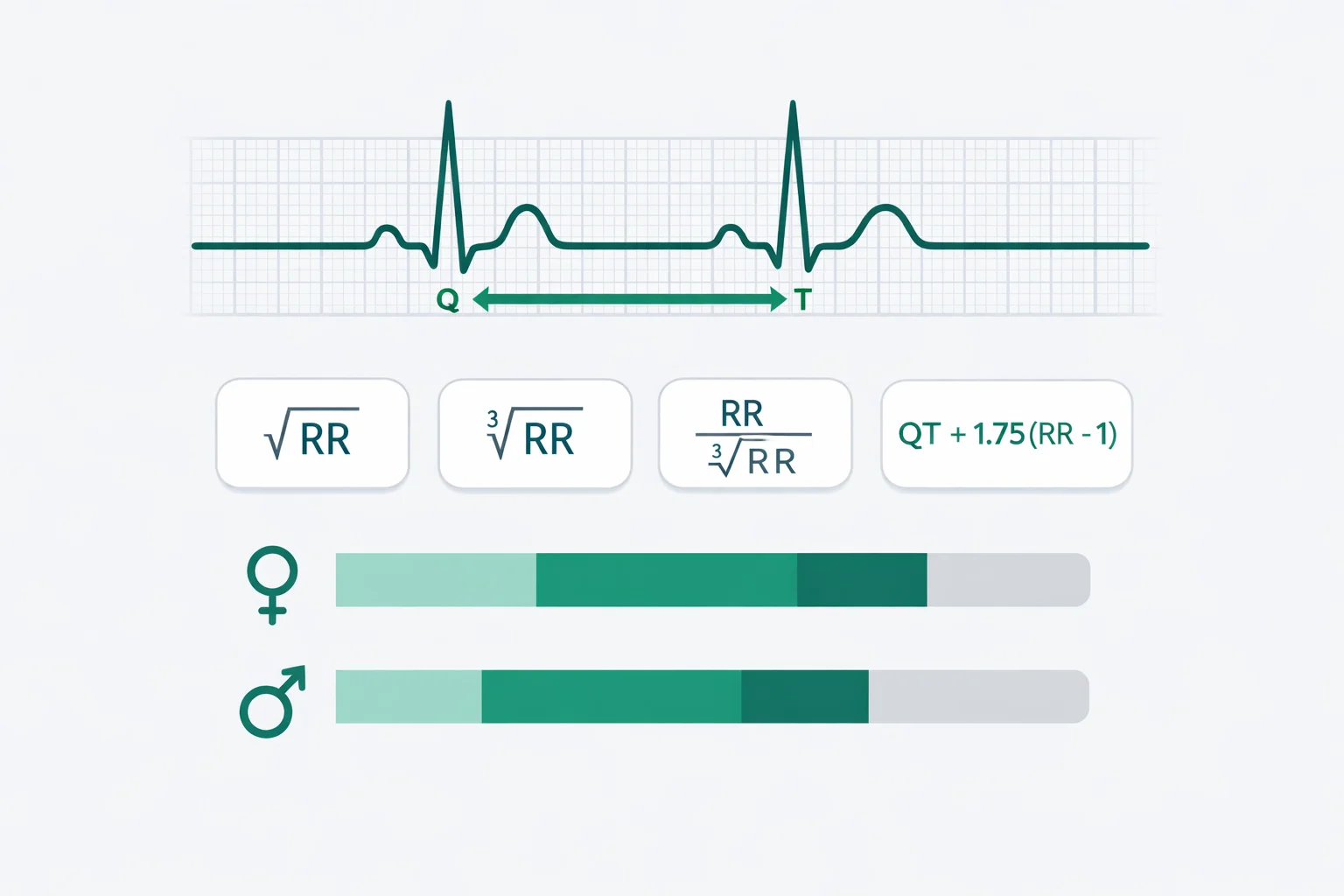
The corrected QT calculator normalizes your measured QT interval to a heart rate of 60 bpm (RR = 1 second) using four formulas at once. Bazett divides QT by the square root of the RR interval in seconds (QTc = QT ÷ √RR); Fridericia uses the cube root (QTc = QT ÷ ∛RR); Framingham adds a linear term (QTc = QT + 154 × (1 − RR)); and Hodges adjusts by heart rate directly (QTc = QT + 1.75 × (HR − 60)). All four collapse to the raw QT at exactly 60 bpm and diverge as the rate moves away from it — Bazett fastest of all.
Reference Ranges & Interpretation
Per the AHA/ACCF scientific statement on torsade de pointes prevention, QTc is prolonged above 450 ms in men and 460 ms in women, with 431–450 ms (men) and 441–460 ms (women) considered borderline. A QTc of 500 ms or more — or a rise of 60 ms or more from baseline after starting a drug — marks high torsades risk and warrants urgent review. Values below 360 ms are unusually short, and below 340 ms raise the question of short QT syndrome.
Assumptions & Limitations
Every correction assumes a single representative RR interval, so results are unreliable in atrial fibrillation unless QT and RR are averaged over about 10 beats. Wide-QRS rhythms (bundle branch block, ventricular pacing) inflate the measured QT and need a QRS adjustment before correction. Bazett over-corrects above 100 bpm and under-corrects below 60 bpm — the FDA E14 guidance prefers Fridericia for that reason. This tool is educational: medication decisions based on QTc belong to the treating clinician with the full ECG in hand.
Complete Guide: QTc Calculator
On this page
A QTc calculator exists because the raw QT interval lies. A measured QT of 400 ms is completely normal at 60 bpm and genuinely alarming at 110 bpm — same number, opposite meanings — because the QT physiologically shortens as the heart speeds up. Correction formulas normalize every measurement to what the QT would be at 60 bpm (an RR interval of exactly 1 second), which is the only way two ECGs taken at different heart rates can be compared, and the only way a drug-monitoring threshold like 500 ms can mean anything at all.
The catch: there are at least four correction formulas in routine use, and away from 60 bpm they disagree — by more than 70 ms at 120 bpm, which is the difference between “continue the antibiotic” and “call cardiology.” This guide works through all four, the sex-specific thresholds that define prolongation, how to measure the QT correctly in the first place, and the rhythms and drugs that complicate the picture.
What a QTc Calculator Actually Corrects For
The QT interval spans ventricular depolarization and repolarization — Q-wave onset to T-wave end. It's the repolarization half that matters for risk: when repolarization stretches out, a premature beat can land in the vulnerable window and trigger torsades de pointes, a polymorphic ventricular tachycardia that degenerates to ventricular fibrillation in a minority of episodes. But raw QT tracks heart rate tightly. A healthy QT runs roughly 420 ms at 55 bpm and 320 ms at 100 bpm, so without rate correction you can't tell physiologic shortening from pathologic prolongation.
Every correction formula therefore asks the same question: given this QT at this RR interval, what would the QT be at RR = 1 s? Where they differ is the assumed mathematical shape of the QT–RR relationship — square root, cube root, or linear — and that modelling choice, invisible on the printout, is why the same strip can produce four different QTc values. If you're working from a pulse count rather than the strip itself, verify the rate first with our heart rate calculator, because every formula inherits whatever error the rate carries in.
Bazett vs. Fridericia vs. Framingham vs. Hodges: One QT, Four Answers
Bazett (1920) divides QT by the square root of RR; Fridericia (1920) uses the cube root; Framingham (1992) and Hodges (1983) apply linear adjustments. All four coincide exactly at 60 bpm, where RR = 1 and every correction collapses to the measured QT. That's worth internalizing: at 60 bpm there is nothing to argue about.
Bazett: QTc = QT / √RR
Fridericia: QTc = QT / ∛RR
Framingham: QTc = QT + 154 × (1 − RR)
Hodges: QTc = QT + 1.75 × (HR − 60)
QT in ms, RR in seconds (RR = 60 ÷ heart rate), HR in bpm.
Away from 60 bpm the formulas fan out, and Bazett fans out fastest. The table below holds the measured QT fixed at 360 ms and only changes the heart rate. Watch what happens to the “same” patient:
| Heart rate | Bazett | Fridericia | Framingham | Hodges | Spread |
|---|---|---|---|---|---|
| 60 bpm | 360 | 360 | 360 | 360 | 0 ms |
| 80 bpm | 416 | 396 | 399 | 395 | 21 ms |
| 100 bpm | 465 | 427 | 422 | 430 | 43 ms |
| 120 bpm | 509 | 454 | 437 | 465 | 72 ms |
At 120 bpm, Bazett reports 509 ms — above the drug-stopping line — while Framingham reads 437 ms, normal for a man. Neither is fabricated; they simply model the QT–RR curve differently, and Bazett's square root is known to over-correct at fast rates and under-correct below 60 bpm. This is why the FDA's E14 guidance for thorough QT studies names Fridericia as the preferred correction, and why a febrile, tachycardic patient should never have a drug decision made on a Bazett value alone. In practice: trust Bazett between 60 and 100 bpm, and reach for Fridericia (or Framingham) outside that window.
The 450, 460, and 500 ms Lines
Population QTc distributions differ by sex — adult men centre near 410 ms, women near 420 ms — so the cut-offs differ too. The convention used by the AHA/ACCF and most hospital protocols: prolonged means QTc above 450 ms in men and above 460 ms in women, with 431–450 ms (men) and 441–460 ms (women) treated as borderline. The line everyone agrees on is 500 ms: beyond it, torsades risk climbs steeply regardless of sex, and drug-safety data suggest each additional 10 ms of QTc adds roughly 5–7% to the arrhythmic risk.
Two numbers matter as much as the absolute value. First, the change from baseline: an increase of 60 ms or more after starting a drug is an action threshold even if the absolute QTc still sits below 500 ms. Second, the short end: a QTc under 360 ms is unusual, and under 340 ms raises the question of short QT syndrome, a rare (<1 in 100,000) but genuinely dangerous channelopathy. A prolonged QTc is one input among several in cardiovascular assessment — our cardiac risk calculator covers the broader picture that a single interval can't. An ECG and a biomarker also look at different things: the QT interval reports electrical repolarisation, while a rise between two blood samples on our troponin calculator reports muscle cell damage, and a normal QTc says nothing about whether that damage is happening.
Measuring QT: Tangent Method, Small Squares, and the U-Wave Trap
Garbage in, garbage out: a 40 ms measurement error dwarfs the difference between any two formulas. Standard technique uses lead II or V5 at 25 mm/s paper speed, where one small square equals 40 ms and one large square 200 ms. Measure from the first deflection of the QRS to the end of the T wave, defined by the tangent method: draw a line down the steepest slope of the T wave's descending limb, and the QT ends where that tangent crosses the isoelectric baseline. Take the longest QT from 3–5 consecutive beats rather than a single cycle.
The classic error is sweeping the U wave into the measurement. A prominent U wave — common in hypokalemia and bradycardia — sits just after the T wave and adds 40–80 ms if included, easily converting a normal interval into a false positive. The tangent method exists precisely to cut the U wave off. Automated machine measurements handle clean tracings well but over-read flat, notched, or biphasic T waves; treat any automated QTc that would change management as unverified until you've re-measured it by hand.
When Correction Breaks: Atrial Fibrillation, Wide QRS, and Paced Rhythms
Every formula assumes one representative RR interval, and atrial fibrillation refuses to supply one — beat-to-beat RR can swing by 400 ms within a single strip. The pragmatic approach: measure QT and RR across 10 consecutive beats and average them, or at minimum average the QTc from the shortest-RR and longest-RR beats. A QTc computed from one lucky beat in AF can be off by 60 ms in either direction.
Wide-QRS rhythms break correction differently: a left bundle branch block stretches depolarization, inflating the QT with time that has nothing to do with repolarization. For LBBB, the Bogossian formula subtracts 48.5% of the QRS duration from the measured QT before correcting — with a 160 ms QRS, that's a 78 ms deduction, which is the difference between a false alarm and a fair reading. Ventricular-paced rhythms behave like LBBB and need the same adjustment. An alternative for any QRS over 120 ms is the JT interval (QT − QRS), which isolates repolarization entirely.
Which Drugs Move the QTc, and by How Much?
More than 200 marketed drugs prolong the QT, and CredibleMeds maintains the definitive risk-tiered list. The magnitudes vary enormously. Citalopram at 60 mg/day adds a mean 18.5 ms — the finding behind the FDA's 40 mg cap (20 mg over age 60). Sotalol prolongs QTc dose-dependently with a torsades incidence up to 2% at higher doses. Methadone, haloperidol, ondansetron, macrolides, and fluoroquinolones each add roughly 5–20 ms on average, but the danger is stacking: two QT-prolonging drugs plus hypokalemia (potassium below 3.5 mEq/L) or hypomagnesemia multiplies risk far beyond any single agent.
A worked case shows why formula choice matters here. A 66-year-old woman on citalopram has QT 400 ms at 88 bpm. Bazett reads 484 ms — prolonged for a woman — while Fridericia gives 455 ms and Framingham 449 ms, both borderline. Acting on Bazett alone means stopping an effective antidepressant; the defensible move is a repeat ECG, electrolyte check, and a Fridericia-based trend. And when a culprit drug is withdrawn, the QTc doesn't normalize until the drug clears — roughly five half-lives, which our drug half-life calculator converts into an actual re-check date. For methadone's 24–55 hour half-life, that's 5–11 days, not the next morning.
Four Errors That Shift the Answer by 40 ms or More
- Trusting Bazett in tachycardia. At 120 bpm, Bazett runs 40–70 ms above Fridericia on the same strip. Fever, sepsis, and anxiety all push heart rate up — re-correct with Fridericia before escalating.
- Including the U wave. Adds 40–80 ms, most often in the hypokalemic patients who are already at highest torsades risk — a double-counting error, since the electrolyte itself is the problem to fix.
- Accepting the machine's QT with an abnormal T wave. Automated algorithms mis-place the T-wave end on flat or notched morphology; hand-measure with the tangent method whenever the printed value would change a decision.
- Correcting a single beat in an irregular rhythm. In AF or marked sinus arrhythmia, one beat is a sample of one. Average 10 beats, or bracket with the shortest and longest RR.
The pattern behind all four: the formula is the precise part of the process, and the measurement is the sloppy part. A QTc calculator removes the arithmetic error — the remaining 40–80 ms of potential error lives entirely in how the QT and RR were read off the strip, which is why serial QTcs should always come from the same lead, the same method, and ideally the same reader.
References
- Drew BJ, Ackerman MJ, Funk M, et al. Prevention of torsade de pointes in hospital settings: a scientific statement from the American Heart Association and the American College of Cardiology Foundation. Circulation. 2010;121(8):1047–1060.
- U.S. Food and Drug Administration. E14 Clinical Evaluation of QT/QTc Interval Prolongation and Proarrhythmic Potential for Non-Antiarrhythmic Drugs — Guidance for Industry. FDA Guidance Documents.
- Woosley RL, Heise CW, Romero KA. QTdrugs List — risk-tiered database of QT-prolonging medications. CredibleMeds.org.

Written by Jurica Šinko
Founder & CEO
Entrepreneur and health information advocate, passionate about making health calculations accessible to everyone through intuitive digital tools.
View full profileFrequently Asked Questions
Is a QTc of 470 ms dangerous?
A QTc of 470 ms is prolonged for both sexes — the thresholds are 450 ms for men and 460 ms for women — but it sits below the 500 ms line where torsades de pointes risk climbs steeply. The right response is a repeat ECG, checking potassium and magnesium, and reviewing the medication list rather than panic. Each additional 10 ms of QTc adds roughly 5-7% to arrhythmic risk, so the trend matters as much as the single value.
Should I use Bazett or Fridericia for QTc?
Use Bazett between 60 and 100 bpm, where all formulas agree closely and Bazett matches what most ECG machines print. Outside that range Bazett distorts — it over-corrects in tachycardia by 40-70 ms at 120 bpm and under-corrects in bradycardia. Fridericia stays accurate across a wider rate range, which is why the FDA E14 guidance uses it for drug safety studies.
How do I measure the QT interval on an ECG?
Measure in lead II or V5 at 25 mm/s paper speed, where one small square equals 40 ms. Start at the first deflection of the QRS and end where a tangent drawn down the steepest slope of the T wave crosses the baseline — this tangent method deliberately excludes the U wave. Take the longest QT from 3-5 consecutive beats, not a single cycle.
What QTc level requires stopping a medication?
Most hospital protocols act at a QTc of 500 ms or more, or an increase of 60 ms or more from the pre-drug baseline. At that point the usual sequence is to hold or substitute the QT-prolonging drug, correct potassium to above 4.0 mEq/L and magnesium to above 2.0 mg/dL, and repeat the ECG. The decision always belongs to the treating clinician — one borderline reading is grounds for a recheck, not automatic discontinuation.
Why is my QTc different with each formula?
The four formulas model the QT-heart rate relationship with different math — square root (Bazett), cube root (Fridericia), or linear terms (Framingham, Hodges). They agree exactly at 60 bpm and fan apart as the rate moves away from it: with a QT of 360 ms at 120 bpm, Bazett reads 509 ms while Framingham reads 437 ms, a 72 ms spread. The disagreement is a property of the correction, not a measurement error.
Can you calculate QTc in atrial fibrillation?
Yes, but never from a single beat — RR intervals in atrial fibrillation can vary by 400 ms within one strip, and one beat can skew the QTc by 60 ms either way. Measure QT and RR across 10 consecutive beats and average them, or at minimum average the QTc from the shortest-RR and longest-RR beats. Treat any single-beat QTc in AF as an estimate, not a value to act on.
What is a normal QTc for a woman?
For adult women, 360-440 ms is normal, 441-460 ms is borderline, and above 460 ms is prolonged. Women run about 10-20 ms longer than men on average and carry roughly twice the risk of drug-induced torsades, which is why the female threshold sits 10 ms higher. Below 360 ms is unusually short and below 340 ms warrants evaluation for short QT syndrome.
Does a wide QRS or bundle branch block affect QTc?
Yes — a left bundle branch block or ventricular pacing stretches depolarization, inflating the measured QT with time unrelated to repolarization risk. For LBBB, the Bogossian formula subtracts 48.5% of the QRS duration before correcting: with a 160 ms QRS that removes 78 ms. An alternative for any QRS over 120 ms is the JT interval (QT minus QRS), which isolates repolarization entirely.
Related Calculators
A1C Calculator — Convert HbA1c to eAG with Targets
Use our A1C calculator to convert HbA1c to estimated average glucose (eAG). See normal, prediabetes, and diabetes thresholds in mg/dL and mmol/L. Fast results.

Albumin Calculator — Serum Albumin Level Interpretation
Free albumin calculator to interpret serum albumin levels, grade hypoalbuminemia, and compute A/G ratio plus albumin-corrected calcium from your lab results.
Albumin-Corrected Anion Gap Calculator — Hidden Acidosis
Use our albumin-corrected anion gap calculator to raise the anion gap by 2.5 per 1 g/dL of low albumin and reveal a hidden high-gap metabolic acidosis.

ANC Calculator: Absolute Neutrophil Count & Neutropenia
Free ANC calculator to calculate absolute neutrophil count from WBC and differential. Get ANC in cells/uL and x10^9/L with instant neutropenia grading.

Anion Gap Calculator — Metabolic Acidosis Evaluation
Free anion gap calculator finds serum anion gap from sodium, chloride, and bicarbonate, with albumin correction and delta ratio for metabolic acidosis.

AST/ALT Ratio Calculator — Free De Ritis Ratio Tool
Use our free AST/ALT ratio calculator to compute the De Ritis index instantly. Visual ratio chart, enzyme-level assessment, and clinical patterns guide.