Use the PCL-5 Calculator
Free PCL-5 calculator scoring the 20-item PTSD Checklist for DSM-5, with symptom cluster subscores and the 31 to 33 provisional diagnosis cutoff explained.
Answered 0 of 20 items
0 of 80 points — provisional cutoff at 31–33
Below is a list of problems that people sometimes have in response to a very stressful experience. Keeping your worst event in mind, indicate how much you have been bothered by each problem in the past month.
Criterion B: Intrusion (re-experiencing)
Items 1–5 · subscore 0–20
Criterion C: Avoidance
Items 6–7 · subscore 0–8
Criterion D: Negative cognitions & mood
Items 8–14 · subscore 0–28
Criterion E: Arousal & reactivity
Items 15–20 · subscore 0–24
Your PCL-5 results
Total severity
—
out of 80
Cutoff method (31–33)
—
answer all 20 items
DSM-5 criterion rule
—
items rated 2+ per cluster
DSM-5 symptom cluster breakdown
An item is “endorsed” at a rating of 2 (Moderately) or higher. The criterion rule needs 1+ intrusion, 1+ avoidance, 2+ cognition/mood, and 2+ arousal items.
| Scoring method | Threshold | Your result |
|---|---|---|
| Total severity cutoff | 31–33 of 80 | — |
| DSM-5 criterion rule | 1 B + 1 C + 2 D + 2 E items at 2+ | — |
Answer all 20 items to see your total severity score, the cutoff comparison, the DSM-5 criterion rule result, and your four cluster subscores.
The PCL-5 is a screening and monitoring instrument, not a diagnostic test — it does not verify Criterion A (exposure to a qualifying traumatic event), and a positive result means a structured clinical interview such as the CAPS-5 is warranted. If you are in crisis, call or text 988 in the US (veterans: press 1) or contact local emergency services immediately.
Educational tool, not medical advice. Check this tool’s method and limitations before interpreting a result. Talk to a qualified healthcare professional before making decisions about medication, diet, exercise, or treatment. See our Terms of Use.
Your rating helps improve PCL-5 Calculator. We store only an anonymized vote (no personal data).
How to Use PCL-5 Calculator
Step 1: Rate all 20 items
For each statement, pick from Not at all (0) to Extremely (4) based on how much it bothered you in the past month, keeping your single worst event in mind.
Step 2: Watch the cluster subscores
The four DSM-5 cluster bars — intrusion, avoidance, negative cognitions and mood, and arousal — fill in as you answer, with endorsed-item counts shown for each.
Step 3: Read the total against the cutoff
Your 0–80 severity score is compared to the validated 31–33 provisional PTSD threshold, with borderline scores of 31–32 flagged separately.
Step 4: Check the DSM-5 criterion rule
The calculator counts every item rated 2 (Moderately) or higher and tests the required pattern: 1+ intrusion, 1+ avoidance, 2+ cognition/mood, and 2+ arousal symptoms.
Step 5: Copy or print your summary
Use the Copy summary or Print buttons to capture the item-level breakdown and bring it to a clinician for a structured diagnostic interview.
Key Features
- All 20 official PTSD Checklist items on the 0–4 scale
- Four DSM-5 symptom cluster subscores with progress bars
- Dual scoring: 31–33 cutoff plus the DSM-5 criterion rule
- Reliable-change guidance (5-point and 10-point thresholds)
- Copyable and printable summary for clinical visits
Understanding Results
Formula
PCL-5 total = the sum of all 20 item ratings, each scored 0 (Not at all) through 4 (Extremely) for the past month, giving a 0–80 range with no weighting or reverse scoring. The four DSM-5 cluster subscores are partial sums: Criterion B intrusion = items 1–5 (0–20), Criterion C avoidance = items 6–7 (0–8), Criterion D negative cognitions and mood = items 8–14 (0–28), and Criterion E arousal and reactivity = items 15–20 (0–24). The parallel criterion-rule method counts any item rated 2 or higher as an endorsed symptom and requires at least 1 B, 1 C, 2 D, and 2 E symptoms.
Reference Ranges & Interpretation
A total of 33 or above is the most widely validated provisional PTSD threshold (Blevins et al., 2015), and research in US veterans supports cut-points from 31 to 33 (Bovin et al., 2016) — so 31–32 is best read as a borderline positive. The National Center for PTSD publishes no official severity bands; interpretation rests on the cutoff comparison, the criterion-rule pattern, and change over time, where a 5-point shift is the minimum reliable change and a 10-point drop is clinically meaningful improvement.
Assumptions & Limitations
The PCL-5 assumes a single index trauma held in mind for all 20 answers and a past-month time window — it cannot verify Criterion A (exposure to a qualifying traumatic event), which clinicians assess separately with the Life Events Checklist. Several arousal and mood items overlap with depression, anxiety, and chronic stress, so an elevated score is a screening signal, not a diagnosis; confirmation requires a structured interview such as the CAPS-5. Within the first month after a trauma the checklist measures acute stress reactions, not PTSD, which requires symptoms persisting beyond one month.
Complete Guide: PCL-5 Calculator
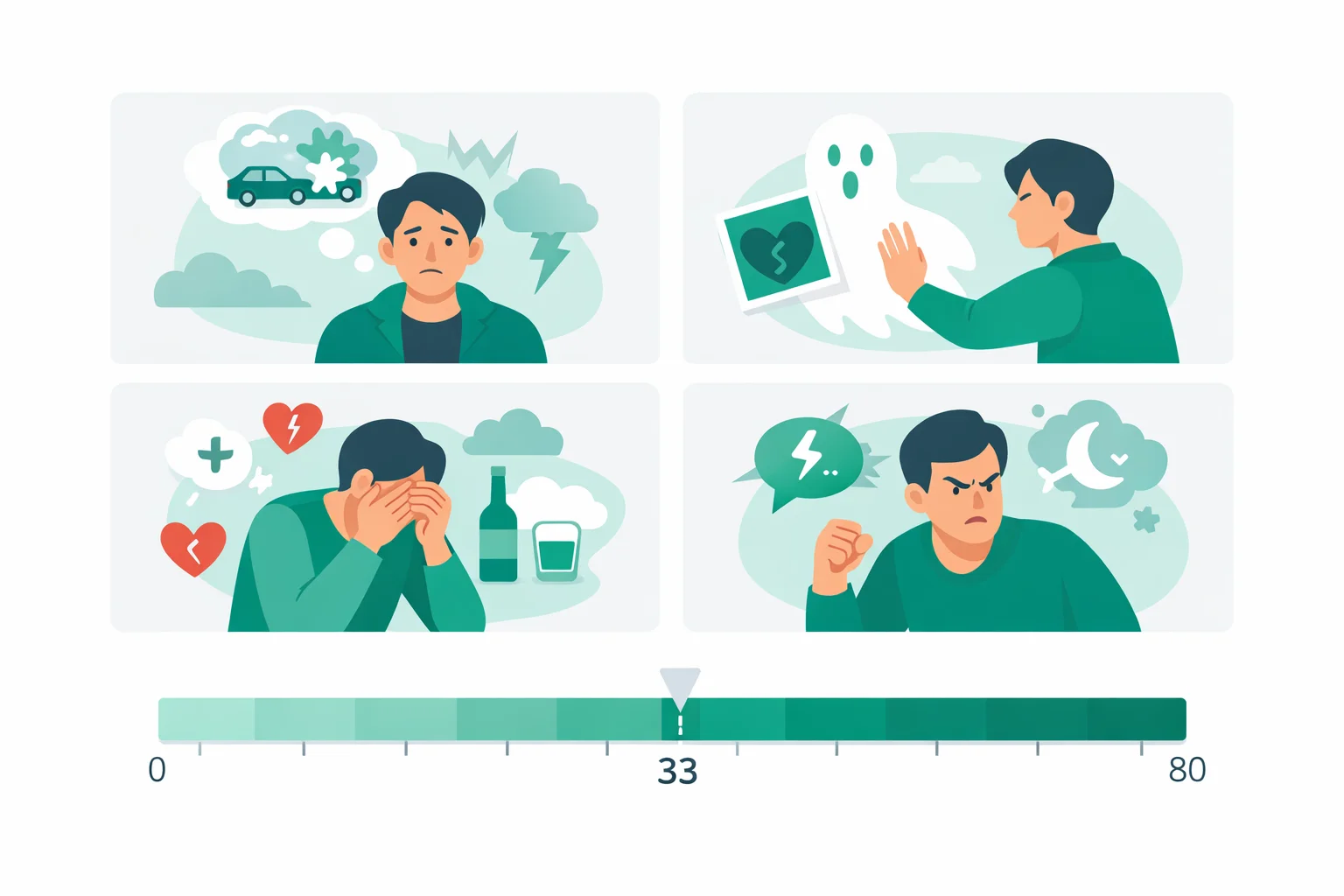
A PCL-5 calculator scores the PTSD Checklist for DSM-5 — a 20-item self-report questionnaire developed by the US National Center for PTSD that measures how much the symptoms of post-traumatic stress disorder have bothered you over the past month. Each item is rated 0 to 4, the total runs from 0 to 80, and a score of 31 to 33 or higher is the research-backed threshold for a provisional PTSD indication. That single sentence hides a surprising amount of nuance: there are actually two independent ways to score the same 20 answers, the cutoff moves depending on the population, and a score from the older 17-item PCL can't be compared to a PCL-5 result at all. This guide walks through all of it — the item-by-item math, a fully worked 42-point example, and what to do with the number you get.
Table of contents
- What the PCL-5 Actually Measures
- How PCL-5 Scoring Works: 20 Items, 0 to 80 Points
- A Worked Example: How a 42-Point Profile Adds Up
- Where the 33-Point Cutoff Comes From — and When 31 Applies
- The Second Scoring Method Most People Miss
- PCL-5 vs PCL-C: Why Old Scores Don't Transfer
- Common Mistakes When Reading a PCL-5 Calculator Result
- Tracking Change: The 5-Point and 10-Point Rules
- References
What the PCL-5 Actually Measures
The PTSD checklist maps one-to-one onto the DSM-5 diagnostic criteria for post-traumatic stress disorder. Its 20 items are split across four symptom clusters: Criterion B, intrusion (items 1–5 — unwanted memories, nightmares, flashbacks, emotional and physical reactivity to reminders); Criterion C, avoidance (items 6–7 — avoiding internal reminders like thoughts and external ones like places or people); Criterion D, negative alterations in cognitions and mood (items 8–14 — trauma-related amnesia, distorted blame, persistent negative beliefs, detachment, inability to feel positive emotions); and Criterion E, arousal and reactivity (items 15–20 — irritability, recklessness, hypervigilance, exaggerated startle, poor concentration, disturbed sleep).
What the checklist deliberately does not measure is Criterion A — whether you were actually exposed to a qualifying traumatic event involving actual or threatened death, serious injury, or sexual violence. In clinical settings the PCL-5 is usually paired with the Life Events Checklist (LEC-5) for exactly that reason. This matters more than it sounds: about 6% of US adults will meet criteria for PTSD at some point in their lives, but a much larger share experience some of these 20 symptoms from causes that aren't PTSD — chronic stress, depression, or an anxiety disorder can all elevate individual items. If your distress feels more like constant worry than a reaction to a specific event, the GAD-7 anxiety screener may be the better-fitting instrument.
How PCL-5 Scoring Works: 20 Items, 0 to 80 Points
Every item uses the same five-point response scale anchored to the past month: Not at all (0), A little bit (1), Moderately (2), Quite a bit (3), and Extremely (4). The total severity score is the plain sum of all 20 ratings — no weighting, no reverse-scored items, no age or sex adjustment. Twenty items times a maximum of 4 points gives the 0–80 range. The four cluster subscores are summed the same way: intrusion runs 0–20 (5 items), avoidance 0–8 (2 items), negative cognitions and mood 0–28 (7 items), and arousal 0–24 (6 items).
The psychometrics behind that simple sum are unusually strong for a self-report scale. In the original validation work by Blevins and colleagues (2015), internal consistency was α = .94 and test-retest reliability r = .82 — meaning the 20 items hang together as one construct, and a score today predicts a score next week well enough to be worth tracking. That reliability is what makes the change thresholds discussed below meaningful.
A Worked Example: How a 42-Point Profile Adds Up
Take a driver six months out from a serious highway collision. On the intrusion items she rates unwanted memories 3, bad dreams 2, flashbacks 1, emotional reactions to reminders 3, and physical reactions 2 — an intrusion subscore of 11/20. She avoids thinking about the crash (3) and takes long detours around the interchange where it happened (3): avoidance 6/8. On the cognition and mood items she scores 0, 3, 2, 3, 2, 2, 1 — she remembers the event fine, but blames herself, feels the world is dangerous, and has lost interest in driving trips she used to enjoy: 13/28. Her arousal ratings of 2, 1, 3, 2, 2, 2 (the 3 is hypervigilance in traffic) add 12/24.
Total: 11 + 6 + 13 + 12 = 42 out of 80. That clears the 33-point cutoff with room to spare. Now check the second method — the DSM-5 criterion rule, which counts any item rated 2 or higher as an endorsed symptom. She endorses 4 of 5 intrusion items (needs 1+), both avoidance items (needs 1+), 5 of 7 cognition/mood items (needs 2+), and 5 of 6 arousal items (needs 2+). Both scoring methods agree: this is a positive screen, and a structured diagnostic interview is the right next step. Note what the 42 does not say — it is not a probability of having PTSD, and it is not a severity grade with official labels like “moderate” or “severe.” The National Center for PTSD has never published severity bands for the PCL-5, which is why our calculator reports the cutoff comparison and the criterion rule rather than inventing categories.
Where the 33-Point Cutoff Comes From — and When 31 Applies
The 33-point threshold wasn't handed down from the DSM — it was derived empirically by testing which cut-point best matched diagnoses made with the CAPS-5, the gold-standard clinician-administered interview. Blevins et al. (2015) found 33 optimal in trauma-exposed college samples. A year later, Bovin et al. (2016) ran the same analysis in US veterans and found the best-performing cut-points sat between 31 and 33. The National Center for PTSD therefore describes 31–33 as the reasonable range, with the choice inside that range depending on what a clinic wants to optimize.
The trade-off is the classic screening dilemma. A lower cutoff (31) catches more true cases but flags more people who won't confirm on interview; a higher one (33) does the reverse. A VA clinic screening every new enrollee might choose 31 because missing a case is costlier than an extra interview. A research study needing a clean PTSD group might use 33 or higher. For an individual using a PCL-5 calculator at home, the honest interpretation of a 31 or 32 is “borderline — worth a professional conversation,” not “negative.”
The Second Scoring Method Most People Miss
Most online score reports stop at the total. The DSM-5 criterion rule is the interpretation layer that actually mirrors how the diagnosis is structured: treat each item rated 2 (Moderately) or higher as a present symptom, then require at least 1 intrusion symptom, 1 avoidance symptom, 2 cognition/mood symptoms, and 2 arousal symptoms. Use it as a decision framework alongside the total:
- Both methods positive (like the 42-point example) — the strongest screening signal; book a clinical assessment.
- Total ≥ 33 but pattern not met — severity is concentrated in one or two clusters. Seven cognition/mood items all rated 4 plus two intrusion items at 3 gives 34 points with zero avoidance symptoms, a profile that often turns out to be depression rather than PTSD. A PHQ-9 depression screening is a sensible companion check — roughly half of people with PTSD also meet criteria for major depression.
- Pattern met but total below 31 — symptoms are spread across all four clusters at moderate intensity. DSM-5 diagnosis doesn't require high total severity, so this discordant result still merits an interview.
- Both negative — below threshold on every dimension. Individual items rated 3–4 (a nightly nightmare, say) can still deserve attention on their own.
PCL-5 vs PCL-C: Why Old Scores Don't Transfer
If you took a “PCL” before 2013, it was almost certainly the DSM-IV version — the PCL-C (civilian), PCL-M (military), or PCL-S (specific). Those had 17 items rated 1–5, producing a 17–85 range, with commonly used cutoffs of 30–35 in civilian primary care and 45–50 in VA specialty clinics. The PCL-5 changed everything at once: three new items (blame, negative beliefs, and reckless behavior), a shifted 0–4 response scale, and a four-cluster structure replacing the old three. The consequence is blunt but frequently missed: a 50 on the PCL-C and a 50 on the PCL-5 are different quantities, and tracking your progress across the version change is comparing meters to yards. If your records mix versions, restart your baseline with the PCL-5.
Common Mistakes When Reading a PCL-5 Calculator Result
Four errors come up constantly. First, treating a positive screen as a diagnosis. The PCL-5 can't verify Criterion A, can't rule out other conditions, and self-report inflates severity relative to clinician interview for some people — the CAPS-5 exists precisely to settle what a checklist can only suggest. Second, rating different events on different administrations. The instructions anchor all 20 answers to your single worst event; switching the index event between takes makes score changes uninterpretable. Third, using the wrong time window — the standard form asks about the past month, so completing it a week after a fresh trauma measures acute stress, not PTSD, which by definition requires symptoms persisting beyond one month. Fourth, ignoring what else could produce the score. Sleep problems, concentration trouble, and irritability sit in the arousal cluster but are also core features of depression, anxiety, and chronic stress — if a broad strain picture fits better than an event-anchored one, the Perceived Stress Scale measures that territory directly.
Tracking Change: The 5-Point and 10-Point Rules
The PCL-5's best use case isn't the first score — it's the trend. National Center for PTSD guidance treats a change of about 5 points as the minimum reliable change (movement beyond measurement noise) and a change of 10 points or more as clinically meaningful. In practice, trauma-focused therapies like Cognitive Processing Therapy and Prolonged Exposure typically produce drops well beyond 10 points over a 12-week course in treatment responders. Retake the checklist on a fixed schedule — monthly with the standard form, or weekly using the past-week version clinics use during active treatment — keep the same index event in mind, and judge progress on the trend line, not any single administration. A 42 falling to 30 over two months is a treatment working; a 42 bouncing to 39 is noise.
One last number worth carrying with you: PTSD is among the more treatable anxiety-spectrum conditions, with roughly half of patients who complete a trauma-focused therapy no longer meeting diagnostic criteria afterward. A high score on this checklist is a signal to act, not a verdict.
References
- US Department of Veterans Affairs, National Center for PTSD. PTSD Checklist for DSM-5 (PCL-5). ptsd.va.gov
- Blevins CA, Weathers FW, Davis MT, Witte TK, Domino JL. The Posttraumatic Stress Disorder Checklist for DSM-5 (PCL-5): Development and initial psychometric evaluation. J Trauma Stress. 2015;28(6):489–498. PubMed
- Bovin MJ, Marx BP, Weathers FW, et al. Psychometric properties of the PTSD Checklist for DSM-5 (PCL-5) in veterans. Psychol Assess. 2016;28(11):1379–1391. PubMed
- National Institute of Mental Health. Post-Traumatic Stress Disorder. nimh.nih.gov

Written by Jurica Šinko
Founder & CEO
Entrepreneur and health information advocate, passionate about making health calculations accessible to everyone through intuitive digital tools.
View full profileFrequently Asked Questions
What does a PCL-5 score of 33 mean?
A total of 33 or higher is the most widely validated threshold for provisional PTSD — the cut-point where PCL-5 scores best matched CAPS-5 clinical interview diagnoses in validation studies. It means a structured diagnostic interview is warranted, not that you have PTSD. Research in veterans supports cut-points anywhere from 31 to 33, so scores of 31 or 32 are best treated as borderline positives rather than negatives.
How is the PCL-5 scored?
Each of the 20 items is rated 0 (Not at all) to 4 (Extremely) based on the past month, and the ratings are simply summed for a total of 0 to 80 — no weighting and no reverse-scored items. Four cluster subscores use the same method: intrusion (items 1–5, max 20), avoidance (items 6–7, max 8), negative cognitions and mood (items 8–14, max 28), and arousal (items 15–20, max 24).
Can the PCL-5 diagnose PTSD?
No. The PCL-5 is a screening and monitoring instrument — it cannot confirm exposure to a qualifying traumatic event (Criterion A) and cannot rule out conditions like depression that share several of its 20 symptoms. Diagnosis requires a structured clinical interview, typically the CAPS-5, which is the gold standard the PCL-5 cutoffs were validated against.
What are the four PCL-5 symptom clusters?
They mirror the DSM-5 PTSD criteria: Criterion B intrusion (5 items — memories, nightmares, flashbacks, reactivity to reminders), Criterion C avoidance (2 items), Criterion D negative cognitions and mood (7 items), and Criterion E arousal and reactivity (6 items). The DSM-5 criterion rule requires at least 1 B, 1 C, 2 D, and 2 E items rated 2 (Moderately) or higher for a provisional positive.
What is the difference between the PCL-5 and the PCL-C?
The PCL-C is the older DSM-IV civilian version: 17 items rated 1–5 for a 17–85 range, with cutoffs around 30–35 in civilian primary care and 45–50 in military specialty clinics. The PCL-5 has 20 items rated 0–4 for a 0–80 range and a four-cluster structure. The scores are not comparable — if your old records used the PCL-C, restart your baseline with the PCL-5.
How many points does my PCL-5 score need to change to show real improvement?
A change of about 5 points is the minimum considered reliable (beyond measurement noise), and a drop of 10 or more points is regarded as clinically meaningful. Trauma-focused treatments like Cognitive Processing Therapy commonly produce drops beyond 10 points over a 12-week course in people who respond. Judge progress on the trend across several administrations, not one result.
How often should I take the PCL-5?
The standard form asks about the past month, so monthly re-testing matches its time window. During active treatment, clinicians often switch to the past-week version and administer it weekly. Whatever the schedule, keep the same worst event in mind each time — switching index events between administrations makes score changes uninterpretable.
Can I have PTSD with a PCL-5 score below 33?
Yes. The DSM-5 diagnosis is based on the symptom pattern, not total severity, so moderate ratings spread across all four clusters can meet the criterion rule with a total in the twenties. Self-report can also underestimate severity for people who minimize symptoms. If the criterion rule flags your pattern or specific items are rated 3–4, discuss the result with a clinician even when the total sits below the cutoff.
Related Calculators
ADHD Test: Free Adult ASRS Screening Score, 18 Items
Free ADHD test using the WHO ASRS v1.1 screener. Answer 18 questions, score Part A against the cut-off of 4, then rule out the four conditions that mimic it.

Anxiety Calculator: Test Your Anxiety Symptom Level
Use our anxiety calculator to rate seven common symptoms, see your severity band, and get practical next steps you can try today. Free and completely private.
AUDIT Alcohol Calculator — Score Alcohol Use Disorder Risk
Use the AUDIT alcohol calculator to score the 10-item screening test, grade hazardous or dependent drinking risk, and see your zone-based intervention level.
Autism Test: Free AQ-10 Adult Screening Score (0-10)
Free autism test using the AQ-10 screening questionnaire: score 10 items against the 6-point cut-off and see what a positive result really means for you.

Bedtime Calculator: Find the Best Time to Go to Bed Now
Enter your wake time and the bedtime calculator suggests bedtimes by 90-minute cycles. Add a fall-asleep buffer and choose 12/24-hour time for better mornings.

Circadian Rhythm Calculator: Align Sleep & Wake Times
Use the Circadian Rhythm Calculator to identify your chronotype and align sleep and wake times. See optimal windows, plan meals, and get blue-light tips.