Use the AUDIT Alcohol Calculator
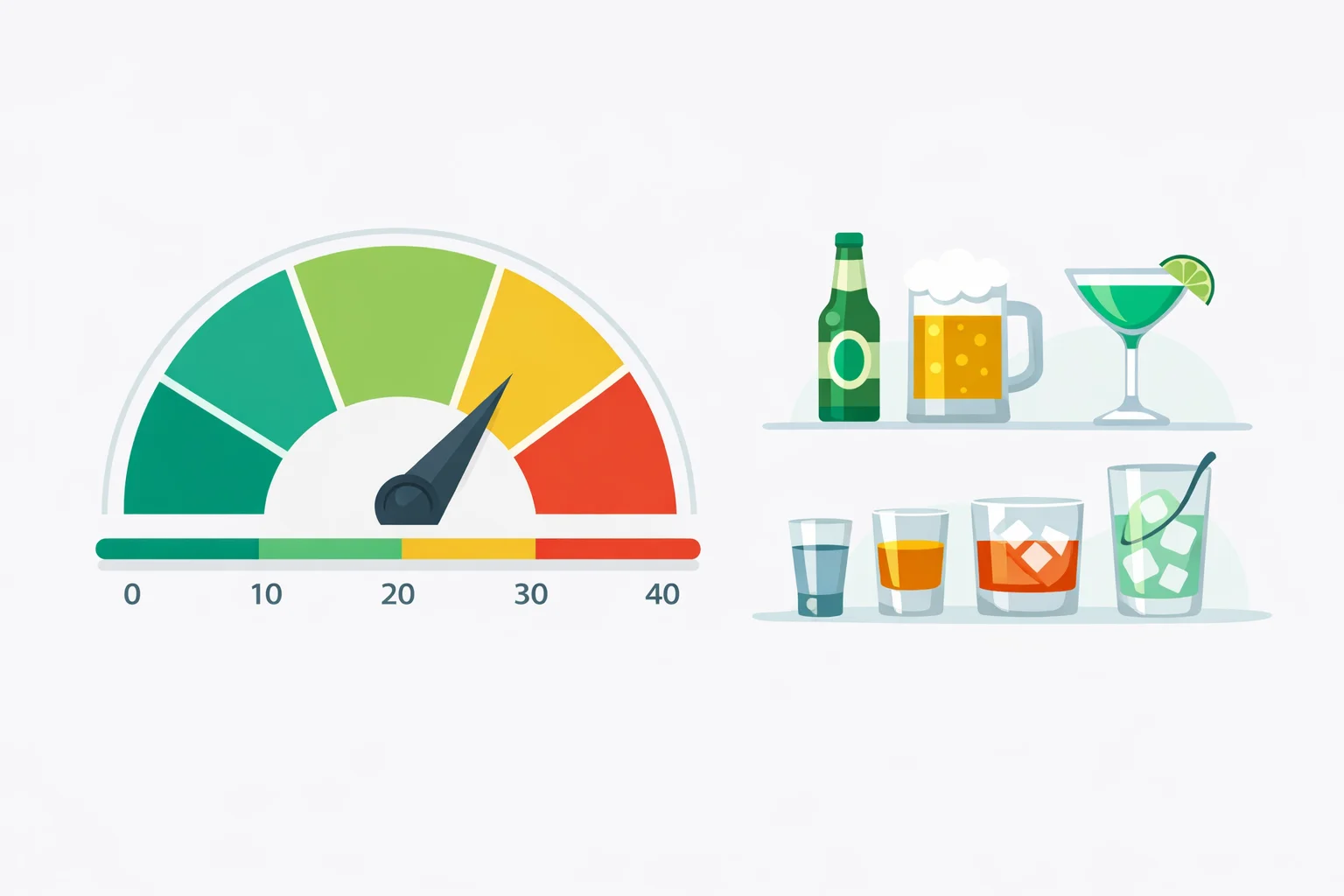
Use the AUDIT alcohol calculator to score the 10-item screening test, grade hazardous or dependent drinking risk, and see your zone-based intervention level.
AUDIT score
0 of 40 points (0%)
Sex at birth (sets the cut points)
Total-score cut point 8; AUDIT-C cut point 4. Women and adults over 65 metabolise less alcohol per kilogram, so the lower thresholds are widely used.
The definition the original AUDIT was written around. Answer items 1–3 in units of 10 g, so “six or more” on item 3 means 60 g of ethanol in one sitting.
How many standard drinks is my glass? (WHO 10 g)
| Serving | Pure ethanol | Standard drinks |
|---|---|---|
| Can of beer, 330 ml at 5% | 13.0 g | 1.3 |
| Pint of beer, 568 ml at 5% | 22.4 g | 2.2 |
| Small glass of wine, 150 ml at 12% | 14.2 g | 1.4 |
| Large glass of wine, 250 ml at 13% | 25.6 g | 2.6 |
| Shot of spirits, 44 ml at 40% | 13.9 g | 1.4 |
| Bottle of wine, 750 ml at 13% | 76.9 g | 7.7 |
Grams of ethanol = volume in ml × ABV × 0.789. Under-counting here is the single most common way an AUDIT score comes out too low: a 250 ml glass of 13% wine is 2.6 standard drinks, not one.
Answer all ten items. Items 4–10 ask about the last year; items 1–3 ask about your usual pattern.
Your AUDIT results
Total score
—
out of 40
Risk zone
—
answer every item
AUDIT-C subscore
—
items 1–3 only
Cut point 8 — hazardous use
Answer every item
Items 4–6 — dependence signal
Answer every item
Where your points come from
Two people can both score 12 and need completely different responses. Twelve points from consumption alone is a volume problem; twelve points concentrated in items 4–10 is a control-and-consequences problem that brief advice rarely fixes.
| Score | Zone | Matched response |
|---|---|---|
| 0 – 7 | Zone I — Low-risk drinking | Alcohol education; no intervention indicated |
| 8 – 15 | Zone II — Hazardous drinking | Simple advice — a 5-minute brief intervention on cutting back |
| 16 – 19 | Zone III — Harmful drinking | Brief counselling plus continued monitoring |
| 20 – 40 | Zone IV — Possible dependence | Referral to a specialist for diagnostic evaluation and treatment |
Answer every item to see your total score, risk zone, AUDIT-C subscore, dependence flag, and estimated weekly intake.
This AUDIT screening tool is informational and is not a diagnosis. A positive screen means a clinical conversation is warranted, not that you have an alcohol use disorder. Nothing you enter leaves your browser. If you drink heavily every day, do not stop abruptly without medical advice — unmanaged alcohol withdrawal can cause seizures and delirium tremens, and it is one of the few withdrawal syndromes that can be fatal.
Educational tool, not medical advice. Check this tool’s method and limitations before interpreting a result. Talk to a qualified healthcare professional before making decisions about medication, diet, exercise, or treatment. See our Terms of Use.
Your rating helps improve AUDIT Alcohol Calculator. We store only an anonymized vote (no personal data).
How to Use AUDIT Alcohol Calculator
Step 1: Set sex and your standard drink size
Choose male or female to set the thresholds: the total-score cut point moves between 8 and 7, and the AUDIT-C cut point between 4 and 3. Then pick whether one standard drink means 10 g of ethanol (WHO), 14 g (United States), or 8 g (one UK unit).
Step 2: Check what your usual glass counts as
Open the standard drink reference table and find your pour. A 250 ml glass of 13% wine is 25.6 g of ethanol, which is 2.6 WHO standard drinks, not one. Under-counting here is the most common reason a self-scored AUDIT reads too low.
Step 3: Answer the three consumption items
Items 1 to 3 ask how often you drink, how many standard drinks you have on a typical drinking day, and how often you have six or more in a single sitting. Answering Never to item 1 automatically skips and zeroes items 2 to 8, exactly as the official form directs.
Step 4: Answer the seven control and harm items
Items 4 to 10 all cover the last twelve months. Items 4 to 8 score 0 to 4, but items 9 and 10 score only 0, 2, or 4 because the values 1 and 3 do not exist on those two questions.
Step 5: Read your zone, subscore, and both flags
Your total lands in one of four WHO risk zones. Also read the AUDIT-C subscore, the items 4-6 dependence flag, and the items 2-3 hazardous-intake flag, since the last two fire even when the total sits below the cut point.
Step 6: Copy or print the breakdown
Use Copy summary to save the item-by-item scoring, risk zone, AUDIT-C subscore, domain split, and estimated weekly ethanol intake so you can take exact numbers to an appointment.
Key Features
- Full WHO 10-item AUDIT with the official 0/2/4 scoring on items 9 and 10
- AUDIT-C subscore computed alongside, with cut points of 4 for men and 3 for women
- Four WHO risk zones, each mapped to the intervention level it was designed to trigger
- Dependence flag on items 4-6 and hazardous-intake flag on items 2-3, both independent of the total
- Standard drink converter for the 10 g WHO, 14 g US, and 8 g UK definitions
- Estimated weekly ethanol intake checked against UK and US guideline limits
Understanding Results
Formula
The AUDIT score is a plain sum with one asymmetry. Items 1 through 8 each score 0, 1, 2, 3, or 4 across five response options. Items 9 and 10 offer only three options and score 0, 2, or 4 — the values 1 and 3 are not available on them. Add all ten and the range is 0 to 40. There is no weighting, no reverse-scored item, and no age or sex adjustment inside the arithmetic itself.
One conditional rule applies: if item 1 is answered “Never,” items 2 through 8 are skipped and score 0, leaving only items 9 and 10 live. A lifelong abstainer therefore has a maximum possible AUDIT score of 8, not 0. The AUDIT-C subscore is items 1 + 2 + 3 alone, giving a separate 0–12 total.
Reference Ranges & Interpretation
The WHO publishes AUDIT thresholds as intervention levels rather than severity labels. Zone I (0–7) calls for alcohol education only. Zone II (8–15) calls for simple advice — a five-minute brief intervention, which the 2018 Cochrane review of 69 trials found reduces consumption by about 20 g of ethanol per week. Zone III (16–19) calls for brief counselling plus continued monitoring, and zone IV (20–40) for referral to a specialist for diagnostic evaluation.
Two further rules from the WHO manual fire independently of the total. Any point scored across items 2 and 3 indicates consumption at a hazardous level in its own right, and any point scored on items 4, 5, or 6 suggests possible dependence — both can be true at a total of 5. A cut point of 7 rather than 8 is widely used for women and adults over 65. The AUDIT-C is positive at 4 or more in men (about 86% sensitivity for heavy drinking in the original 1998 validation) and at 3 or more in women, where specificity runs near 90%.
Assumptions & Limitations
Every answer is self-reported, and population surveys typically capture only 40–60% of the alcohol actually sold in the same country and year. The gap is widest among the heaviest drinkers, so the AUDIT skews toward false negatives exactly where a miss costs most. The instrument also assumes a shared definition of a standard drink, which does not exist: 10 g of ethanol under the WHO version, 14 g in the United States, 8 g per UK unit. Answering a 10 g form in 14 g drinks understates item 2 by roughly a third.
Items 4 through 10 cover a 12-month window, so a pattern that began six weeks ago will not register, while items 9 and 10 have no recency limit and keep scoring years after the drinking stopped. Older adults often score low despite risky intake because items 5 and 10 depend on work obligations and social feedback that retirement removes. The AUDIT measures behaviour, not organ damage — a normal score does not clear your liver. And if you drink heavily every day, do not stop abruptly on the strength of a score: withdrawal seizures typically appear 6–48 hours after the last drink and delirium tremens at 48–96 hours, so supervised withdrawal is the safe route. This tool does not provide a diagnosis or medical advice.
Complete Guide: AUDIT Alcohol Calculator
On this page
- Ten items, 0 to 40, and two that break the pattern
- Your glass is probably more than one standard drink
- The four zones and what each one actually triggers
- A score of 13: where the points came from
- AUDIT-C or the full AUDIT?
- Why a 6 can still be a problem
- Where an AUDIT alcohol calculator misreads people
- References
An AUDIT alcohol calculator adds ten answers into a number between 0 and 40, and the arithmetic is stranger than it looks. Items 1 through 8 score 0, 1, 2, 3, or 4. Items 9 and 10 score 0, 2, or 4 only — the values 1 and 3 do not exist on those two questions. Get that wrong and a hand-tallied score can land a full four points off, which is enough to move someone across the hazardous-drinking threshold in either direction. This guide covers the scoring rules, the standard-drink conversion that quietly corrupts most self-administered scores, the four WHO risk zones, and the two reading rules that fire even when your total looks fine.
Ten Items, 0 to 40, and Two That Break the Pattern
The Alcohol Use Disorders Identification Test came out of a World Health Organization collaborative project across six countries — Norway, Australia, Kenya, Bulgaria, Mexico, and the United States — screening 1,888 primary care attenders. The ten surviving items split into three blocks that measure genuinely different things: items 1–3 measure how much and how often you drink, items 4–6 measure loss of control, and items 7–10 measure damage already done.
Items 4 through 10 all ask about the last year. Items 1 through 3 ask about your usual pattern with no time frame at all, which is why someone who quit six months ago after a decade of heavy drinking can still post a score in the teens: the harm items remember, and item 10 in particular (“has anyone been concerned about your drinking?”) carries a permanent 2 points for a “yes, but not in the last year.”
There is also a skip rule almost every online version drops. If item 1 is answered “Never”, items 2 through 8 are not asked — they score zero automatically, and only items 9 and 10 remain live. A lifelong abstainer therefore has a maximum possible AUDIT score of 8, not 0, because past injury and past concern still count. Our calculator implements that skip and greys out the inapplicable items rather than silently letting you fill them in.
Your Glass Is Probably More Than One Standard Drink
Items 1–3 are denominated in “standard drinks,” and that phrase does not mean the same thing in two countries. The WHO wrote the AUDIT around a drink of 10 g of pure ethanol. The United States defines a standard drink as 14 g. A UK unit is 8 g. So “six or more drinks on one occasion” means 60 g of ethanol on the original form, 84 g on the American adaptation, and 48 g if you answer in UK units — a 75% spread on the single item that detects binge drinking.
The conversion is simple: grams of ethanol = volume in ml × ABV × 0.789 (the density of ethanol). Run it on real servings and the mismatch becomes obvious.
| What you poured | Pure ethanol | WHO drinks (10 g) | US drinks (14 g) | UK units (8 g) |
|---|---|---|---|---|
| 330 ml can of beer, 5% | 13.0 g | 1.3 | 0.9 | 1.6 |
| 568 ml pint of beer, 5% | 22.4 g | 2.2 | 1.6 | 2.8 |
| 150 ml glass of wine, 12% | 14.2 g | 1.4 | 1.0 | 1.8 |
| 250 ml large glass of wine, 13% | 25.6 g | 2.6 | 1.8 | 3.2 |
| 44 ml shot of spirits, 40% | 13.9 g | 1.4 | 1.0 | 1.7 |
| 750 ml bottle of wine, 13% | 76.9 g | 7.7 | 5.5 | 9.6 |
Three large glasses of wine is 7.7 WHO standard drinks, not three. Someone who answers “3 or 4” to item 2 while actually drinking that volume scores 1 point where the honest answer is 3, and shifts item 3 from “never six or more” to whatever their real frequency is. That single mis-count is the most common reason a self-administered AUDIT reads low. If you want the volume side handled properly, work your weekly total through the alcohol units calculator first, then bring the number back here.
The Four Zones and What Each One Actually Triggers
The WHO does not publish AUDIT thresholds as severity labels. It publishes them as intervention levels — each zone is tied to a specific action a clinician is meant to take, which is a more useful way to read your own score than treating 8 as a pass/fail line.
| Score | Zone | Intervention the WHO matches to it |
|---|---|---|
| 0–7 | I — Low risk | Alcohol education only |
| 8–15 | II — Hazardous | Simple advice: a single 5-minute conversation about cutting back |
| 16–19 | III — Harmful | Brief counselling plus continued monitoring |
| 20–40 | IV — Possible dependence | Referral for diagnostic evaluation and treatment |
Zone II is where the AUDIT earns its keep, and the effect size there is small but real: the 2018 Cochrane review of 69 trials found that brief intervention in primary care cut consumption by about 20 g of ethanol per week against controls — roughly two glasses of wine. That is not dramatic, but it is delivered in five minutes to a population of millions, and it is the reason screening exists at all. Zone IV is a different animal: it is a referral trigger, not a diagnosis, and a score of 20 does not mean you are dependent — it means the probability is high enough that a structured interview is warranted.
A Score of 13: Where the Points Came From
Take a 41-year-old who drinks after work most weekdays and more at weekends. His answers, and what each is worth:
| Item | Answer | Points |
|---|---|---|
| 1. How often do you drink? | 2–3 times a week | 3 |
| 2. Drinks on a typical day | 5 or 6 | 2 |
| 3. Six or more on one occasion | Monthly | 2 |
| 4. Couldn’t stop once started | Never | 0 |
| 5. Failed to do what was expected | Less than monthly | 1 |
| 6. Morning drink | Never | 0 |
| 7. Guilt or remorse | Monthly | 2 |
| 8. Memory loss | Less than monthly | 1 |
| 9. Injury | No | 0 |
| 10. Someone suggested cutting down | Yes, but not in the last year | 2 |
| Total | Zone II — hazardous | 13 |
Thirteen puts him in zone II, which nominally calls for five minutes of advice. But read the blocks separately: 7 of his 13 points are consumption, 1 is a dependence item, and 5 are harm. That single point on item 5 matters more than its size suggests — the WHO manual treats any score across items 4, 5, and 6 as a signal of possible dependence, independent of the total. And working his answer bands through the midpoints gives roughly 13.75 standard drinks a week, about 138 g of ethanol, which is 17 UK units against a 14-unit weekly guideline. His total says “brief advice.” The item pattern says “ask more questions.”
AUDIT-C or the Full AUDIT?
The AUDIT-C is not a different questionnaire — it is items 1, 2, and 3 of the AUDIT, scored 0–12. It exists because ten questions is too many for a busy intake form, and three questions catch most of what matters. Bush and colleagues validated it in 1998 in a US male veteran sample: at a cut point of 4 or more it identified heavy drinking or alcohol abuse with roughly 86% sensitivity. Bradley’s 2007 work in women set the cut point at 3 or more, where specificity runs around 90%.
The trade-off is precise. AUDIT-C only measures consumption, so it will flag a college student who binges on Saturdays and miss a steady daily drinker who never exceeds five in a sitting but has been advised to cut down twice. The full AUDIT catches the second person through items 4–10 and is the one to use whenever the answer will actually change what someone does. Use AUDIT-C when you are triaging a population; use the full ten items when you are assessing a person. Our calculator computes both simultaneously, so you never have to choose in advance.
Neither instrument measures alcohol in your body. For that you need a different tool entirely — the BAC calculator estimates blood alcohol concentration during a single session, and the EtG calculator covers the urine detection window after drinking stops. The AUDIT is a behaviour questionnaire; those are pharmacokinetics.
Why a 6 Can Still Be a Problem
A total under 8 reads as “zone I, no action” on most calculators, and that is where the WHO manual disagrees with the popular reading. It sets out two rules that fire independently of the total:
- One or more points across items 2 and 3 indicates consumption at or above a hazardous level in its own right. Someone answering “3 or 4 drinks” and “six or more, less than monthly” scores 2 — well inside zone I — while drinking at a level the manual explicitly names as hazardous.
- Any points on items 4, 5, or 6 suggest possible dependence and warrant a closer look, even at a total of 4.
The cut point itself also moves. The 8-point threshold was derived largely in men. Because women reach a higher blood alcohol concentration from the same dose — less body water per kilogram and lower gastric alcohol dehydrogenase activity — a threshold of 7 is widely recommended for women and for adults over 65, whose total body water falls by roughly 10–15% between age 30 and age 70. That one-point shift is not cosmetic: in the 7–8 band it changes zone assignment for a meaningful slice of screened women, which is why the calculator above asks for sex before it reports a verdict.
Where an AUDIT Alcohol Calculator Misreads People
Every item on the AUDIT is self-reported, and under-reporting is the norm rather than the exception. Population surveys typically account for only 40–60% of alcohol sold in the same country and year — the rest goes unreported. That gap is not distributed evenly; it is largest among the heaviest drinkers, which biases the AUDIT toward false negatives exactly where a false negative costs the most.
Three other groups are read poorly. Older adults often score low despite drinking at genuinely risky levels, because items 5 and 10 depend on work obligations and social feedback that retirement removes. People in early recovery score high on the permanent harm items even after a year of abstinence, so a score of 12 in someone sober since last spring means something entirely different from a 12 in an active drinker. And the instrument was designed for a 12-month window, so it cannot detect a pattern that started six weeks ago.
The AUDIT also says nothing about physical damage. A normal score does not clear your liver, and a high score does not confirm injury — roughly 90% of heavy drinkers develop fatty liver, but only 10–20% progress to cirrhosis. Blood work answers that question, not a questionnaire. If your score sits in zone III or IV, the liver function calculator is a reasonable next stop for interpreting ALT, AST, and GGT results, and the FIB-4 calculator estimates fibrosis risk from routine labs. Alcohol and mood also run in both directions — heavy drinking worsens depression and depression drives drinking — so a positive AUDIT is a sensible prompt to run the PHQ-9 depression screener as well.
One safety point outranks all of the above. If you drink heavily every day, do not use a high score as a reason to stop abruptly on your own. Alcohol withdrawal is one of the few withdrawal syndromes that can kill: seizures typically appear 6–48 hours after the last drink, and delirium tremens at 48–96 hours carries a mortality of about 1–4% even with treatment. Medically supervised withdrawal exists for exactly this reason.
References
- Babor TF, Higgins-Biddle JC, Saunders JB, Monteiro MG. AUDIT: The Alcohol Use Disorders Identification Test — Guidelines for Use in Primary Care, 2nd edition. World Health Organization, 2001.
- Bush K, Kivlahan DR, McDonell MB, Fihn SD, Bradley KA. The AUDIT alcohol consumption questions (AUDIT-C). Archives of Internal Medicine, 1998;158(16):1789–1795.
- Kaner EF, Beyer FR, Muirhead C, et al. Effectiveness of brief alcohol interventions in primary care populations. Cochrane Database of Systematic Reviews, 2018.
- National Institute on Alcohol Abuse and Alcoholism. What Is a Standard Drink? NIAAA, U.S. National Institutes of Health.

Written by Jurica Šinko
Founder & CEO
Entrepreneur and health information advocate, passionate about making health calculations accessible to everyone through intuitive digital tools.
View full profileFrequently Asked Questions
What is a bad AUDIT score?
Anything from 8 upward is a positive screen. The WHO splits the 0-40 range into four zones: 0-7 low risk, 8-15 hazardous drinking, 16-19 harmful drinking, and 20-40 possible dependence. A score of 20 or more is the point at which the manual recommends referral for a full diagnostic assessment rather than simple advice.
Is an AUDIT score of 8 alcoholism?
No. An 8 puts you at the very bottom of zone II, where the matched response is a single five-minute conversation about cutting back, not treatment. The AUDIT is a screening test, not a diagnostic one. Dependence is only suggested from 20 upward, and even then it has to be confirmed by a clinical interview against DSM-5 or ICD-11 criteria.
What is the difference between the AUDIT and the AUDIT-C?
The AUDIT-C is the first three items of the AUDIT scored 0-12, and it measures consumption only. The full AUDIT adds seven items covering loss of control and alcohol-related harm, scored 0-40. AUDIT-C is positive at 4 or more in men and 3 or more in women; the full AUDIT is positive at 8. Use AUDIT-C to triage a population and the full ten items to assess a person.
Why do AUDIT questions 9 and 10 not have a score of 1 or 3?
Those two items have only three response options instead of five: No scores 0, yes but not in the last year scores 2, and yes during the last year scores 4. The values 1 and 3 simply do not exist on them. This is the single most common hand-scoring error, and getting it wrong can shift a total by up to 4 points, which is enough to change the risk zone.
Is the AUDIT cut-off different for women?
Commonly, yes. The 8-point threshold was derived largely in men, so a cut point of 7 is widely recommended for women and for adults over 65. Women reach a higher blood alcohol concentration from the same dose because they have less body water per kilogram and lower gastric alcohol dehydrogenase activity. On the AUDIT-C the shift is from 4 to 3.
How many drinks per week is hazardous drinking?
The UK Chief Medical Officers put the low-risk ceiling at 14 units a week, which is 112 g of pure ethanol, for both sexes. US Dietary Guidelines cap intake at 2 standard drinks a day for men and 1 for women, or 196 g and 98 g of ethanol a week. On the AUDIT itself, any point scored across items 2 and 3 already indicates intake at a hazardous level, even if your total stays under 8.
Can I still score high on the AUDIT if I quit drinking a year ago?
Yes. Items 9 and 10 have no recency requirement, so a past injury or a past suggestion to cut down keeps scoring 2 points each indefinitely. That means a lifelong abstainer can score up to 8, and someone sober for a year can still land in zone II. Read the item pattern, not just the total: 12 points that are all harm-history in an abstainer is a different situation from 12 points in an active drinker.
Does a high AUDIT score mean I have liver damage?
No, the AUDIT asks nothing about your liver. About 90% of heavy drinkers develop fatty liver but only 10-20% progress to cirrhosis, and the questionnaire cannot tell which group you are in. Blood tests answer that: ALT, AST, and GGT show current injury, and a FIB-4 score estimates fibrosis from age, platelets, and transaminases.
Related Calculators
ADHD Test: Free Adult ASRS Screening Score, 18 Items
Free ADHD test using the WHO ASRS v1.1 screener. Answer 18 questions, score Part A against the cut-off of 4, then rule out the four conditions that mimic it.

Anxiety Calculator: Test Your Anxiety Symptom Level
Use our anxiety calculator to rate seven common symptoms, see your severity band, and get practical next steps you can try today. Free and completely private.
Autism Test: Free AQ-10 Adult Screening Score (0-10)
Free autism test using the AQ-10 screening questionnaire: score 10 items against the 6-point cut-off and see what a positive result really means for you.

Bedtime Calculator: Find the Best Time to Go to Bed Now
Enter your wake time and the bedtime calculator suggests bedtimes by 90-minute cycles. Add a fall-asleep buffer and choose 12/24-hour time for better mornings.

Circadian Rhythm Calculator: Align Sleep & Wake Times
Use the Circadian Rhythm Calculator to identify your chronotype and align sleep and wake times. See optimal windows, plan meals, and get blue-light tips.

Depression Calculator (PHQ-9): Check Symptoms in Minutes
Use our depression calculator to score the PHQ-9 in minutes. Answer nine questions about the last two weeks to estimate symptom severity and get clear guidance.