Use the PHQ-9 Calculator: Depression Screening & Severity Score
Free PHQ-9 calculator: score all nine Patient Health Questionnaire items, grade depression severity from minimal to severe, and check the diagnostic algorithm.
PHQ-9 score
0 of 27 points (0%)
Over the last two weeks, how often have you been bothered by any of the following problems? Select one option for each of the nine items.
This item is not added to the 0–27 score, but a depressive syndrome diagnosis formally requires at least some functional difficulty.
Your PHQ-9 results
Total score
—
out of 27
Severity band
—
answer all 9 items
Diagnostic algorithm
—
symptom-count method
Symptom domain breakdown
A somatic-heavy pattern can be inflated by medical illness, medication side effects, or sleep disorders rather than depression itself.
| Score | Severity | Recommended action |
|---|---|---|
| 0 – 4 | Minimal | No action needed; re-screen at a future visit if concerns arise |
| 5 – 9 | Mild | Watchful waiting; repeat the PHQ-9 in 2–4 weeks |
| 10 – 14 | Moderate | Treatment plan: counseling, follow-up, and/or medication |
| 15 – 19 | Moderately severe | Active treatment with medication and/or psychotherapy |
| 20 – 27 | Severe | Immediate treatment initiation; expedited referral to a specialist |
Answer all nine questions to see your total score, severity band, diagnostic algorithm result, and domain breakdown.
This PHQ-9 screening tool is informational and does not provide a diagnosis or medical advice. A positive screen means a clinical interview is warranted — not that you have major depression. If you are in crisis or thinking about harming yourself, call or text 988 in the US or contact local emergency services immediately.
Educational tool, not medical advice. Check this tool’s method and limitations before interpreting a result. Talk to a qualified healthcare professional before making decisions about medication, diet, exercise, or treatment. See our Terms of Use.
Your rating helps improve PHQ-9 Calculator: Depression Screening & Severity Score. We store only an anonymized vote (no personal data).
How to Use PHQ-9 Calculator: Depression Screening & Severity Score
Step 1: Rate the nine symptoms
For each of the nine questions, choose how often the symptom bothered you over the last two weeks: Not at all (0), Several days (1), More than half the days (2), or Nearly every day (3).
Step 2: Answer question 9 honestly
The self-harm item is scored like the others, but any answer above Not at all displays crisis resources and deserves follow-up regardless of your total score.
Step 3: Complete the difficulty question
Select how difficult these problems have made work, home life, or getting along with people. It is not added to the score, but the diagnostic algorithm formally requires at least Somewhat difficult.
Step 4: Read your score and severity band
Your total (0-27) appears instantly with its severity band — minimal (0-4), mild (5-9), moderate (10-14), moderately severe (15-19), or severe (20-27) — plus the recommended clinical action.
Step 5: Check the algorithm and copy your summary
Review the diagnostic algorithm result and the cognitive vs somatic subscores, then use Copy summary to save a dated record for tracking scores between appointments.
Key Features
- All nine official PHQ-9 items with 0-3 scoring
- Five severity bands with recommended clinical actions
- DSM-based diagnostic algorithm (second official scoring method)
- Cognitive-affective vs somatic symptom subscores
- Response, remission, and 5-point change thresholds
- Crisis resources shown for any positive answer on item 9
Understanding Results
How the PHQ-9 Calculator Scores Your Answers
The severity score is the sum of nine items, each rated 0 (not at all) to 3 (nearly every day) over the last two weeks, giving a 0–27 total. The separate diagnostic algorithm counts items scored 2 or higher — item 9 counts at 1 or higher — and requires a cardinal symptom (item 1 or 2): five or more endorsed symptoms suggests major depressive syndrome, while two to four suggests other depressive syndrome.
Reference Ranges & Interpretation
Severity bands from the original validation study (Kroenke et al., 2001): 0–4 minimal, 5–9 mild, 10–14 moderate, 15–19 moderately severe, 20–27 severe. A score of 10 or higher is the standard positive screen, with roughly 88% sensitivity and 85–88% specificity for major depression. During treatment, a 5-point drop is a clinically meaningful change, a 50% reduction counts as response, and a score below 5 counts as remission.
Assumptions & Limitations
The PHQ-9 is a screening and monitoring instrument, not a diagnosis. Its four somatic items (sleep, fatigue, appetite, psychomotor change) can be inflated by medical illness, medications, or sleep disorders; it cannot separate unipolar from bipolar depression; and item 9 is a safety flag, not a suicide risk assessment. Any positive screen — or any non-zero answer on item 9 — should lead to a conversation with a clinician.
Complete Guide: PHQ-9 Calculator: Depression Screening & Severity Score
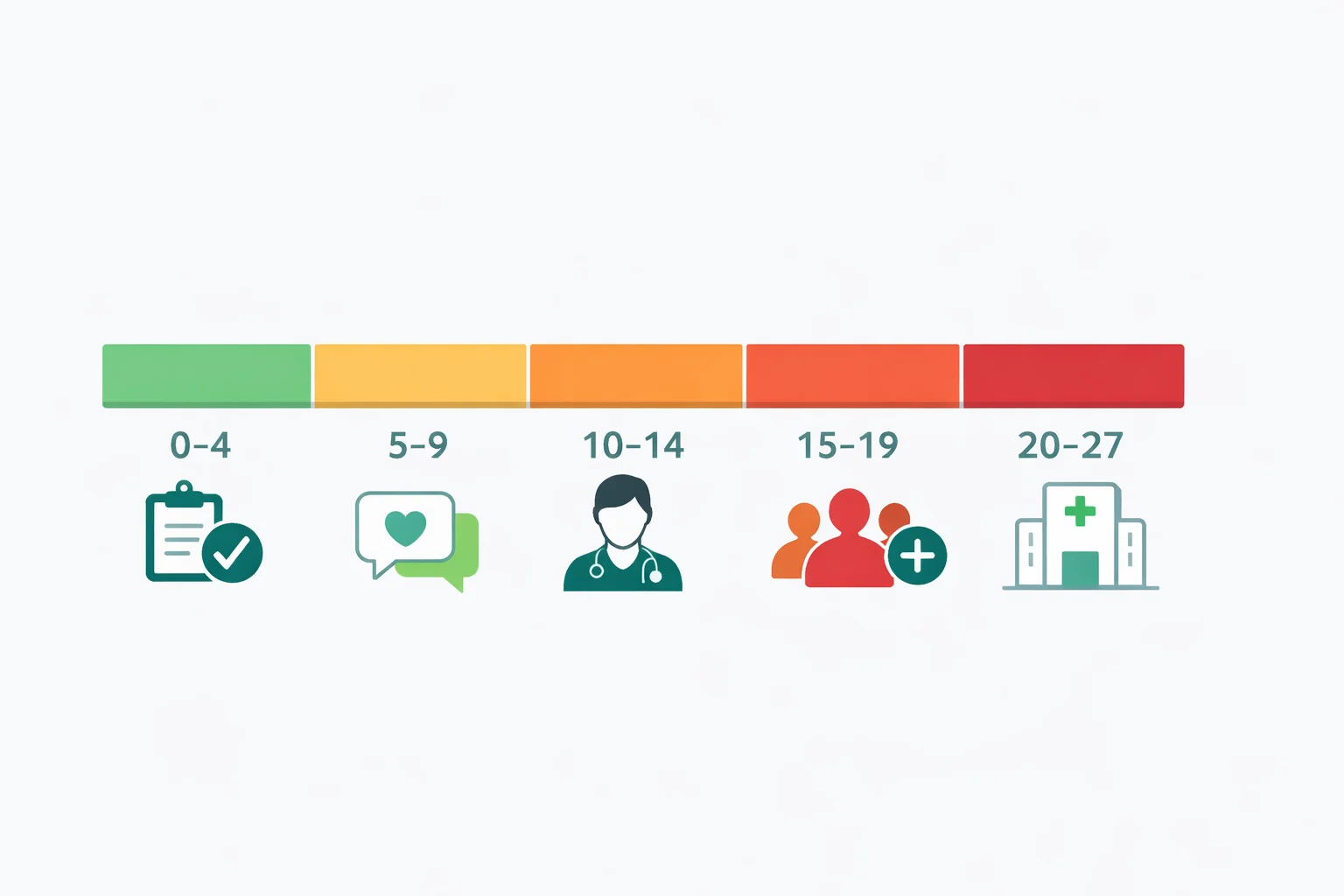
Table of contents
A PHQ-9 calculator does more than add nine numbers: at a cutoff score of 10, the Patient Health Questionnaire-9 detects major depression with roughly 88% sensitivity and 85% specificity — yet most online versions show you only half of its scoring system. The PHQ-9 was designed with two separate readouts. The first is the familiar 0–27 severity score. The second is a symptom-count diagnostic algorithm that maps your answers directly onto the DSM criteria for a depressive episode, and it can flag a problem even when the severity score looks unremarkable. This guide walks through both methods, scores a realistic response set step by step, and explains what to do with the result — including the thresholds clinicians use to call a treatment “working.”
Two Scores From One PHQ-9 Calculator
Each of the nine questions asks how often a symptom bothered you over the last two weeks, scored 0 (not at all), 1 (several days), 2 (more than half the days), or 3 (nearly every day). That two-week window isn't arbitrary — it mirrors the DSM-5 requirement that symptoms persist for at least two weeks before a major depressive episode can be diagnosed. The nine items themselves map one-to-one onto the nine DSM diagnostic criteria: anhedonia, low mood, sleep disturbance, fatigue, appetite change, guilt or worthlessness, poor concentration, psychomotor change, and thoughts of self-harm.
Summing the items gives the severity score: 0–4 is minimal, 5–9 mild, 10–14 moderate, 15–19 moderately severe, and 20–27 severe. The algorithm method ignores the sum entirely. It counts how many individual symptoms crossed a frequency threshold and checks whether at least one of the two cardinal symptoms — anhedonia (item 1) or depressed mood (item 2) — is among them. Two readouts, two different questions being answered: “how heavy is the symptom load?” versus “does the symptom pattern resemble a depressive episode?”
A Worked Response Set, Scored Both Ways
Take a realistic answer pattern: item 1 scored 2, item 2 scored 1, item 3 scored 2, item 4 scored 3, item 5 scored 1, item 6 scored 2, item 7 scored 1, and items 8 and 9 scored 0. The severity sum is 2+1+2+3+1+2+1+0+0 = 12 — squarely in the moderate band, where guidelines suggest a treatment plan built around counseling, follow-up, and possibly medication.
Now run the same answers through the algorithm. Four items reached the “more than half the days” threshold of 2 or higher: items 1, 3, 4, and 6. One of them is a cardinal symptom (item 1), but four endorsed symptoms fall short of the five needed for major depressive syndrome. The result: other depressive syndrome — a subthreshold pattern that still predicts real functional impairment and deserves follow-up. Same nine answers, two genuinely different clinical messages. That divergence is exactly why our calculator reports both, along with a cognitive-affective versus somatic subscore split that shows where the points came from.
The Diagnostic Algorithm Most Online Tools Skip
The algorithm's rules are short but strict. An item counts as “endorsed” only at a score of 2 or 3 — with one deliberate exception: item 9, the self-harm question, counts at any score of 1 or higher, because even occasional thoughts of death matter clinically. Major depressive syndrome requires five or more endorsed items including a cardinal symptom. Other depressive syndrome requires two to four endorsed items including a cardinal symptom. There's also a gate many people miss: the formal definition requires the tenth, unscored question — how difficult these problems have made work, home life, or relationships — to be answered at least “somewhat difficult.” Symptoms without functional impact don't constitute a syndrome.
Why bother with the stricter method? Specificity. A score of 11 built from nine scattered 1s and a single 2 describes a very different person than a score of 11 built from four symptoms present nearly every day. The severity sum treats them identically; the algorithm doesn't. In the original validation study, a PHQ-9 algorithm diagnosis of major depressive syndrome agreed with an independent mental-health-professional interview in 88% of cases.
PHQ-9 vs. PHQ-2: Which Screener, and When?
The PHQ-2 is simply the first two items of the PHQ-9 — the cardinal symptoms — scored 0–6. It exists for triage: a 30-second first pass in settings where administering nine items to everyone isn't practical. A PHQ-2 score of 3 or higher is a positive screen and the standard trigger for completing the full nine items. If that's where you are right now, start with our PHQ-2 calculator and come back here if it flags.
| Feature | PHQ-2 | PHQ-9 |
|---|---|---|
| Items | 2 | 9 (+1 unscored function item) |
| Score range | 0 – 6 | 0 – 27 |
| Standard cutoff | ≥ 3 | ≥ 10 |
| Severity grading | No | Five bands, minimal to severe |
| Tracks treatment change | No | Yes — validated for monitoring |
| Best use | First-pass triage | Full screen, severity, and follow-up |
There's a third sibling worth knowing: the PHQ-4 combines the PHQ-2 with the GAD-2 anxiety screener into a single four-item check. Roughly half of people with major depression also meet criteria for an anxiety disorder, so pairing the two screens catches comorbidity a depression-only tool misses. Our PHQ-4 mental health calculator covers that combined snapshot, and the GAD-2 anxiety calculator handles the anxiety arm on its own. And when low mood traces back to a specific traumatic event — an assault, a crash, a combat deployment — the PCL-5 PTSD checklist calculator screens that territory with 20 items the PHQ-9 never asks about, like flashbacks, avoidance, and hypervigilance.
What the Cutoff of 10 Actually Buys You
The threshold of 10 comes from Kroenke and Spitzer's original 2001 validation in 6,000 primary-care and obstetrics patients, where scores of 10 or above identified major depression with 88% sensitivity and 88% specificity. A 2019 individual-participant meta-analysis in the BMJ, pooling data from over 17,000 people, landed close by: 88% sensitivity and 85% specificity at the same cutoff. Meta-analytic work has since shown that cutoffs anywhere from 8 to 11 perform acceptably, which is why some health systems screen at 8 to favor sensitivity.
One number those headline stats hide: predictive value depends on how common depression is in the population being screened. In a typical primary-care clinic where perhaps 1 in 10 patients has major depression, a meaningful share of positive screens at the cutoff of 10 will be false positives — which is precisely why a positive PHQ-9 triggers a diagnostic interview rather than a prescription. Screening finds candidates; it doesn't issue diagnoses.
Response, Remission, and the 5-Point Rule
The PHQ-9's quiet superpower isn't screening at all — it's measurement-based care. Because the score moves reliably with clinical state, clinicians repeat it every 2–4 weeks during active treatment and read the trend against three fixed landmarks. A drop of 5 points is the accepted minimal clinically important difference — anything smaller may be measurement noise. Response means the score fell by at least 50% from baseline: an 18 becoming a 9, for instance. Remission means the score sits below 5. A patient who starts at 18 and reaches 11 has improved meaningfully but hasn't yet responded; guidelines would call that a signal to adjust the plan — a dose change, a therapy referral, or both — rather than declare victory.
If you're using this tool between appointments, copy your summary each time and note the date. A run of scores — 16, 13, 9, 6 over eight weeks — tells a clinician far more than any single measurement, and it's exactly the data measurement-based care runs on. If you'd rather work through the nine items with a gentler, more conversational walkthrough first, our depression calculator presents the same instrument with plain-language guidance around each severity band.
Where the PHQ-9 Falls Short
Four of the nine items — sleep, fatigue, appetite, and psychomotor change — are somatic, and every one of them can be driven by things other than depression. Chemotherapy, pregnancy, chronic kidney disease, hypothyroidism, and plain sleep deprivation all inflate the somatic half of the score. That's why our calculator splits the cognitive-affective and somatic subscores: a 12 that's mostly items 3, 4, and 5 in a patient with a new medical illness warrants a different conversation than a 12 anchored on hopelessness and worthlessness.
Three more boundaries matter. First, the PHQ-9 cannot distinguish unipolar from bipolar depression — and antidepressant monotherapy in unrecognized bipolar disorder can precipitate mania, so a history of elevated-mood episodes changes everything about treatment. Second, item 9 is a single question about thoughts of death or self-harm; it flags risk but is not a suicide risk assessment, and any non-zero answer deserves direct human follow-up regardless of the total. Third, self-completed scores tend to run slightly higher than interviewer-administered ones, so a borderline result is best repeated before anyone acts on it. None of this makes the instrument weak — it makes it a screener, which is what it was always designed to be.
References
- Kroenke K, Spitzer RL, Williams JB. The PHQ-9: validity of a brief depression severity measure. J Gen Intern Med. 2001;16(9):606-613. PubMed
- Levis B, Benedetti A, Thombs BD. Accuracy of Patient Health Questionnaire-9 (PHQ-9) for screening to detect major depression: individual participant data meta-analysis. BMJ. 2019;365:l1476. PubMed
- Manea L, Gilbody S, McMillan D. Optimal cut-off score for diagnosing depression with the Patient Health Questionnaire (PHQ-9): a meta-analysis. CMAJ. 2012;184(3):E191-E196. PubMed

Written by Jurica Šinko
Founder & CEO
Entrepreneur and health information advocate, passionate about making health calculations accessible to everyone through intuitive digital tools.
View full profileFrequently Asked Questions
What does a PHQ-9 score of 15 mean?
A score of 15 falls in the moderately severe band (15-19), where treatment guidelines recommend active treatment with antidepressant medication, psychotherapy, or both. It also sits well above the diagnostic cutoff of 10, so a clinical interview to confirm major depression is warranted. Bring the item-by-item breakdown to that appointment — it shows which symptoms carry the score.
What PHQ-9 score indicates depression?
A total of 10 or higher is the standard positive screen, detecting major depression with about 88% sensitivity and 85-88% specificity in validation studies. Scores of 5-9 indicate mild symptoms worth re-checking in 2-4 weeks. No score diagnoses depression by itself — a positive screen means a diagnostic interview should follow.
Is a PHQ-9 score of 7 considered depression?
A 7 lands in the mild band (5-9), below the diagnostic cutoff of 10. The usual advice is watchful waiting: repeat the questionnaire in 2-4 weeks and see a clinician if the score climbs or symptoms start interfering with work or relationships. If item 1 or 2 scored 2 or higher, take the result more seriously regardless of the total.
What is the PHQ-9 diagnostic algorithm?
It is the second official scoring method: count the items scored 2 or higher, with item 9 counting at 1 or higher. Five or more endorsed symptoms including anhedonia or low mood suggests major depressive syndrome; two to four suggests other depressive syndrome. The formal definition also requires at least Somewhat difficult on the functional impact question.
How much does a PHQ-9 score need to drop to show improvement?
A decrease of 5 or more points is the minimal clinically important difference — smaller shifts may just be measurement noise. Treatment response is defined as a 50% reduction from your starting score, and remission as a score below 5. Clinicians typically re-test every 2-4 weeks during active treatment.
Does question 9 on the PHQ-9 measure suicide risk?
Only partially. Item 9 asks about thoughts of being better off dead or of self-harm over the past two weeks, but it is a flag, not a full risk assessment. Any answer above 0 warrants direct follow-up with a clinician even when the total score is low. In the US you can call or text 988 any time, day or night.
Can medical illness raise a PHQ-9 score without depression?
Yes. Four items — sleep, fatigue, appetite, and psychomotor change — are somatic and are commonly elevated by hypothyroidism, cancer treatment, pregnancy, and chronic pain. A somatic-heavy score deserves a medical workup alongside the mood evaluation, which is why this calculator reports the cognitive-affective and somatic subscores separately.
Related Calculators
ADHD Test: Free Adult ASRS Screening Score, 18 Items
Free ADHD test using the WHO ASRS v1.1 screener. Answer 18 questions, score Part A against the cut-off of 4, then rule out the four conditions that mimic it.

Anxiety Calculator: Test Your Anxiety Symptom Level
Use our anxiety calculator to rate seven common symptoms, see your severity band, and get practical next steps you can try today. Free and completely private.
AUDIT Alcohol Calculator — Score Alcohol Use Disorder Risk
Use the AUDIT alcohol calculator to score the 10-item screening test, grade hazardous or dependent drinking risk, and see your zone-based intervention level.
Autism Test: Free AQ-10 Adult Screening Score (0-10)
Free autism test using the AQ-10 screening questionnaire: score 10 items against the 6-point cut-off and see what a positive result really means for you.

Bedtime Calculator: Find the Best Time to Go to Bed Now
Enter your wake time and the bedtime calculator suggests bedtimes by 90-minute cycles. Add a fall-asleep buffer and choose 12/24-hour time for better mornings.

Circadian Rhythm Calculator: Align Sleep & Wake Times
Use the Circadian Rhythm Calculator to identify your chronotype and align sleep and wake times. See optimal windows, plan meals, and get blue-light tips.