Use the OCD Test
This OCD test scores the Obsessive-Compulsive Inventory-Revised, an 18-statement questionnaire about the past month, and compares your total with its published cutoffs. If you already have a Yale-Brown Obsessive Compulsive Scale score from an assessment, switch to the interpreter to see its severity band and how much it has changed.
Answered 0 of 18 statements
18 statements left
The following statements refer to experiences that many people have in their everyday lives. Choose the option that best describes how much that experience has distressed or bothered you during the past month. Every statement needs an answer; the calculator does not assume zero for a skipped one.
Your OCD test results
OCI-R total
— / 72
answer all 18 statements
OCD component (15 items)
— / 60
total without the hoarding items
Hoarding subscale
— / 12
items 1, 7 and 13
Severity benchmark (adults already diagnosed with OCD)
—
Bands from Abramovitch et al. (2020), derived in 1,339 adults with a confirmed diagnosis. For someone without a diagnosis, a total in the 0–15 range mostly reflects ordinary everyday experiences, not “mild OCD”.
Symptom profile (each subscale 0–12)
Answer all 18 statements to see your total against the 21-point cutoff, the 15-item OCD component, the hoarding subscale and your six-theme symptom profile.
Neither tool diagnoses obsessive-compulsive disorder. The OCI-R is a screening questionnaire, and a Y-BOCS number only describes severity; a diagnosis needs a clinical interview that checks the time, distress and impairment criteria and rules out look-alike conditions. Answers stay in your browser and are not sent anywhere. If you are in crisis or thinking about harming yourself, call or text 988 in the US or contact local emergency services now.
Educational tool, not medical advice. Check this tool’s method and limitations before interpreting a result. Talk to a qualified healthcare professional before making decisions about medication, diet, exercise, or treatment. See our Terms of Use.
Your rating helps improve OCD Test. We store only an anonymized vote (no personal data).
How to Use OCD Test
Step 1: Choose the tool you need
Pick Take the OCD test to answer the 18 OCI-R statements, or Interpret a Y-BOCS score if a clinician, study or licensed form has already given you a 0 to 40 total.
Step 2: Rate every statement for the past month
For each statement choose Not at all (0), A little (1), Moderately (2), A lot (3) or Extremely (4) according to how much it distressed or bothered you. Skipped statements are not counted as zero.
Step 3: Read the total against the cutoffs
The results panel compares your 0 to 72 total with the 21-point cutoff, the 15-item OCD component with its cutoff of 12, and the hoarding subscale with its cutoff of 6.
Step 4: Check the symptom profile
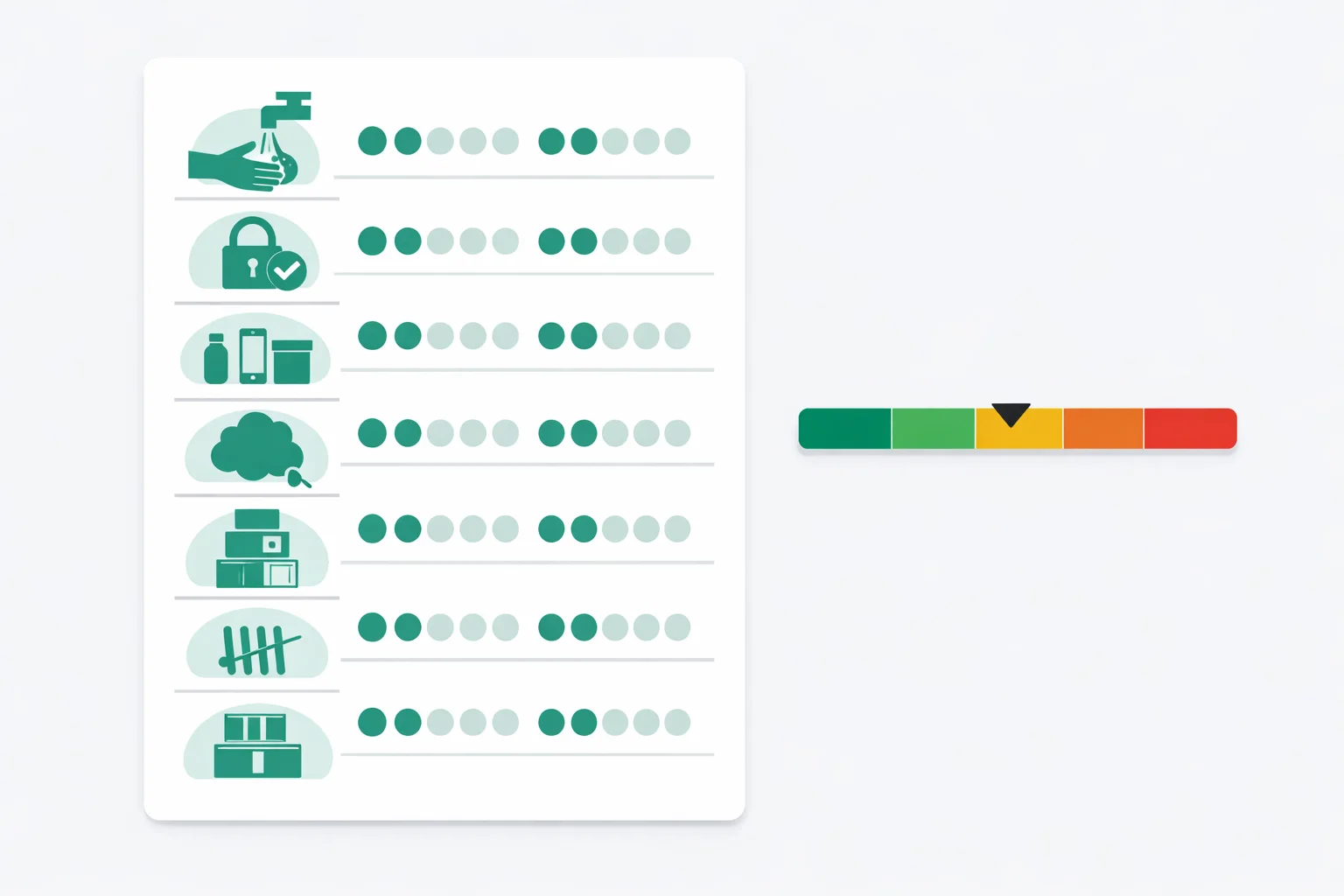
Six bars show where the points come from: washing, obsessing, ordering, checking, neutralizing and hoarding, each out of 12 with the average response label.
Step 5: Interpret or track a Y-BOCS score
Enter a total or the obsession and compulsion subtotals to see the conventional band and the Storch 2015 benchmark. Add an earlier score to see the percentage change against the 35% response, 25% partial-response and 12-point remission lines.
Step 6: Copy the summary for an appointment
Use Copy summary to capture item ratings, subscale scores and cutoff comparisons, then bring them to a clinician. Neither tool is a diagnosis.
Key Features
- All 18 OCI-R statements rated 0–4 for the past month, scored 0–72
- Screening cutoffs: 21 for the total, 12 for the 15-item OCD component, 6 for hoarding
- Six-theme symptom profile: washing, obsessing, ordering, checking, neutralizing, hoarding
- Y-BOCS score interpreter with conventional 0–40 bands and the Storch 2015 benchmarks
- Percentage change against the 35% response, 25% partial-response and 12-point remission lines
- Copyable summaries; answers stay in your browser
Understanding Results
Formula
OCI-R total = the sum of all 18 ratings, each 0 (Not at all) to 4 (Extremely), giving 0 to 72 with no weighting or reverse scoring. Each of the six subscales is the sum of its three items (0 to 12): hoarding uses items 1, 7 and 13; checking 2, 8 and 14; ordering 3, 9 and 15; neutralizing 4, 10 and 16; washing 5, 11 and 17; obsessing 6, 12 and 18. The 15-item OCD component is the total minus the hoarding subscale (0 to 60). The Y-BOCS total is the obsessions subtotal (items 1 to 5, 0 to 20) plus the compulsions subtotal (items 6 to 10, 0 to 20), and percentage change = (earlier total − current total) ÷ earlier total × 100.
Reference Ranges & Interpretation
| Score | Threshold | Source and meaning |
|---|---|---|
| Total (0–72) | 21 or higher | Foa et al. 2002: best separation of OCD from no diagnosis; 18 or higher separated OCD from other anxiety disorders |
| OCD component (0–60) | 12 or higher | Wootton et al. 2015: sensitivity 0.82, specificity 0.83 for OCD |
| Hoarding (0–12) | 6 or higher | Wootton et al. 2015: sensitivity 0.92, specificity 0.93 for hoarding disorder |
| Severity benchmark | 0–15 / 16–27 / 28–72 | Abramovitch et al. 2020: mild, moderate and severe among 1,339 adults diagnosed with OCD, keyed to Y-BOCS groups |
| Conventional band | Storch et al. 2015 benchmark | Consensus outcome definitions (2016) |
|---|---|---|
| 0–7 subclinical 8–15 mild 16–23 moderate 24–31 severe 32–40 extreme | 0–13 mild 14–25 moderate 26–34 moderate to severe 35–40 severe | Response: 35% or greater reduction plus CGI-I 1–2 for at least one week Partial response: 25% to under 35% plus CGI-I of at least 3 Remission: total of 12 or lower plus CGI-S 1–2 for at least one week Recovery: remission lasting at least one year |
The conventional Y-BOCS bands are used in most OCD trials and clinics, but Abramovitch and colleagues note they were never empirically derived and their precise origin cannot be located. The Storch benchmarks come from matching 954 patients’ scores to clinician severity ratings, which is why they run a little higher. A score of 16 is moderate on both.
Assumptions & Limitations
The OCI-R rates distress about 18 specific experiences over the past month, so obsessions with other themes or purely mental rituals can be under-counted, and its accuracy is weakest at the severe end. Several statements overlap with generalized anxiety and depression. Hoarding is scored separately because DSM-5 treats hoarding disorder as its own diagnosis. The Y-BOCS interpreter assumes the score came from a properly administered scale; self-report totals run about 1.4 points lower than clinician interviews on average, and this page cannot supply the CGI ratings or the one-week and one-year durations that the consensus definitions require. Neither tool checks the diagnostic criteria, so a positive screen means a clinical assessment is warranted, not that OCD is present.
Complete Guide: OCD Test
It is one in the morning. You have checked the stove four times, you know it is off, and you are back in the kitchen anyway because the thought that it might not be will not leave. So you type “do I have OCD test” into your phone. An OCD test cannot answer that question on its own, but the right one can tell you two useful things: whether what you are experiencing looks like the pattern clinicians call obsessive-compulsive disorder, and how far it sits above the level most people live with. This guide explains what the two instruments on this page measure, walks through a fully scored example, and shows exactly what the numbers do and do not mean.
In this guide
What an OCD test can and cannot tell you
Obsessive-compulsive disorder has two ingredients. Obsessions are recurrent thoughts, urges or images that arrive against your will and cause anxiety or disgust: fear of contamination, doubt that a door is locked, an unwanted violent or sexual image, a sense that something is not “just right”. Compulsions are the behaviours or mental acts you feel driven to perform in response: washing, checking, arranging, counting, praying, reviewing or asking for reassurance. The National Institute of Mental Health notes that people with OCD typically spend more than an hour a day on these thoughts and rituals and experience significant problems in daily life because of them. That time-and-impairment threshold, not the presence of an intrusive thought, is what separates a diagnosis from the odd doubt everyone has.
The condition is more common than its reputation suggests. NIMH cites a past-year prevalence of about 1.2% of US adults and a lifetime prevalence of 2.3%, with roughly half of past-year cases involving serious impairment. Symptoms usually begin between late childhood and young adulthood. A questionnaire can measure how much OCD-type experiences bother you and where they cluster. It cannot confirm the hour-a-day criterion, rule out the conditions discussed later, or judge whether you recognise your rituals as excessive. Those are interview jobs. Think of the score as the reason to book the interview, and the profile as what to talk about when you get there.
Two instruments, two jobs: OCI-R versus Y-BOCS
Most “OCD test” pages blur two very different instruments. The Obsessive-Compulsive Inventory-Revised is a self-report screen: you rate 18 statements and the total says whether your experience resembles that of people with the diagnosis. The Yale-Brown Obsessive Compulsive Scale is a severity measure: a clinician first establishes which obsessions and compulsions you have, then rates ten dimensions of how bad they are. One answers “does this look like OCD?”; the other answers “how severe is the OCD we already know about, and is treatment working?”.
| Feature | OCI-R (Foa et al. 2002) | Y-BOCS (Goodman et al. 1989) |
|---|---|---|
| Purpose | Screening and symptom profiling | Severity rating and treatment monitoring |
| Format | 18 statements, self-rated 0–4, past month | Symptom checklist, then 10 severity items rated 0–4 by a clinician (self-report versions exist) |
| Range | 0–72; six subscales of 0–12 | 0–40; obsessions 0–20 and compulsions 0–20 |
| What it rates | Distress about specific experiences | Time, interference, distress, resistance and control, whatever the symptom content |
| Key thresholds | 21 total; 12 on the 15-item OCD component | 16 moderate; 12 or lower remission; 35% reduction response |
| Availability | Freely reproduced with attribution | Copyrighted and trademarked; licence required for online use |
That last row is why this page works the way it does. You can take the OCI-R here in full. For the Y-BOCS, you bring a number from an assessment and the page interprets it. The two approaches complement each other: the OCI-R tells you whether to seek an assessment, and the Y-BOCS interpreter tells you what the score from that assessment means.
How the OCI-R is scored: 18 statements, six themes, 0 to 72
Every OCI-R statement uses the same five-point scale for the past month: Not at all (0), A little (1), Moderately (2), A lot (3) and Extremely (4). The total is the plain sum, so 18 statements give a 0 to 72 range with no weighting and no reverse-scored items. Foa and colleagues built the inventory from six symptom themes with three statements each, interleaved so that consecutive statements never share a theme: hoarding (statements 1, 7, 13), checking (2, 8, 14), ordering (3, 9, 15), neutralizing (4, 10, 16), washing (5, 11, 17) and obsessing (6, 12, 18). Each subscale therefore runs 0 to 12, and dividing by three gives an average response that maps straight back onto the scale labels.
One design detail matters for interpretation. The OCI-R asks how much each experience distressed or bothered you, not how much time it took or how hard it was to resist. Someone who has organised their life around a ritual so thoroughly that it no longer bothers them can score lower than their impairment warrants. This is a known limitation, and it is the main reason the severe end of the scale is less reliable than the middle.
A worked example: the 25-point checking-and-obsessing profile
Take our stove-checker and rate the statements as someone in that situation plausibly might. The three checking statements are all rated A lot (3, 3, 3). The obsessing statements, about controlling thoughts and unwanted intrusions, come out at 3, 2 and 3. Ordering gets 1, 1 and 2, because the kitchen has to be left a particular way before bed. Neutralizing is 0, 1 and 0, washing is 0, 1 and 0, and hoarding is 1, 0 and 1. The table shows how those ratings add up.
| Subscale (statements) | Ratings | Score / 12 | Average response |
|---|---|---|---|
| Checking (2, 8, 14) | 3, 3, 3 | 9 | 3.0 · A lot |
| Obsessing (6, 12, 18) | 3, 2, 3 | 8 | 2.7 · A lot |
| Ordering (3, 9, 15) | 1, 1, 2 | 4 | 1.3 · A little |
| Neutralizing (4, 10, 16) | 0, 1, 0 | 1 | 0.3 · Not at all |
| Washing (5, 11, 17) | 0, 1, 0 | 1 | 0.3 · Not at all |
| Hoarding (1, 7, 13) | 1, 0, 1 | 2 | 0.7 · A little |
| Total (18 statements) | 25 / 72 | OCD component 23 / 60 |
The total of 25 clears the 21-point cutoff, and the 15-item OCD component of 23 is almost twice its cutoff of 12. Hoarding, at 2, is well below its cutoff of 6. Among adults already diagnosed with OCD, a 25 falls in the moderate benchmark range of 16 to 27, and the profile says where the points come from: checking and obsessing carry 17 of the 25. That profile is more useful to a clinician than the total, because it names the target for exposure and response prevention before the first appointment. What the 25 does not say is that this person has OCD. It says the pattern of distress resembles that of people who do, strongly enough that an assessment is the sensible next step.
Where the 21-point cutoff comes from, and why 12 may matter more
Foa and colleagues validated the OCI-R in 215 people with OCD, 243 with other anxiety disorders and 677 non-anxious controls. Receiver operating characteristic analysis found that a total of 21 best separated OCD from people with no diagnosis, while a lower total of 18 best separated OCD from the other anxiety disorders, because anxious people without OCD also endorse several statements. Neither line is sharp. The accuracy at 21 is modest, which is why a score of 22 is a prompt rather than a proof and a score of 19 is not a clean bill of health.
The bigger revision came in 2015. When DSM-5 moved hoarding out of OCD into its own diagnosis, Wootton and colleagues re-examined the inventory in mixed clinical and non-clinical samples and showed that the three hoarding statements were diluting the screen. Scoring the remaining 15 statements on their own, a cutoff of 12 identified 82% of people with OCD and correctly excluded 83% of people without it, and the hoarding subscale alone, at 6 or higher, identified 92% of people with hoarding disorder with 93% specificity. The calculator reports both components for that reason. A total of 19 with an OCD component of 14 is a positive screen on the better-performing measure, even though the headline total sits under 21.
Severity benchmarks arrived in 2020, when Abramovitch and colleagues pooled 1,339 treatment-seeking adults with confirmed OCD and matched OCI-R totals to their Y-BOCS severity groups. Totals of 0 to 15 corresponded to mild OCD, 16 to 27 to moderate, and 28 or more to severe. The cutoff at 15 was reasonably accurate (sensitivity 0.70, specificity 0.59); the cutoff at 27 was weaker (0.62 and 0.59), reflecting the distress-only design. Two cautions follow. The bands describe people who already have the diagnosis, so a healthy person scoring 9 is not “mildly OCD”. And the authors themselves recommend adding a clinical interview or the Y-BOCS before treatment decisions rest on an OCI-R number.
Reading a Y-BOCS score from subclinical to extreme
Goodman and colleagues published the Y-BOCS in 1989 as a clinician-administered scale. After a symptom checklist establishes what the person’s obsessions and compulsions are, ten items rate five dimensions for obsessions (items 1 to 5) and the same five for compulsions (items 6 to 10): time occupied, interference with functioning, distress, effort to resist and degree of control. Each item scores 0 to 4, so the total runs 0 to 40 and each subtotal 0 to 20. Because it rates dimensions rather than content, it works equally for a hand-washer and for someone with purely mental rituals, which is exactly the gap the OCI-R leaves.
The bands most clinicians quote are 0 to 7 subclinical, 8 to 15 mild, 16 to 23 moderate, 24 to 31 severe and 32 to 40 extreme. They are so widely used that it is easy to assume they were validated. They were not: Abramovitch and colleagues note that the scheme “has never been subjected to empirical examination” and that, despite asking numerous experts, they could not locate its origin. The empirical alternative comes from Storch and colleagues, who in 2015 matched the Y-BOCS totals of 954 adults with OCD to clinicians’ global severity ratings. Their benchmarks are 0 to 13 mild, 14 to 25 moderate, 26 to 34 moderate to severe and 35 to 40 severe. The interpreter shows both, because a 24 is “severe” on one scheme and “moderate” on the other, and knowing which convention a report used prevents an argument about a label.
A practical point for anyone holding a self-rated Y-BOCS: interview and self-report versions agree well overall, but the interview tends to produce slightly higher totals. Federici and colleagues measured the gap at about 1.4 points, and Steketee, Frost and Bogart found the weakest agreement on the resistance items, which people find hard to rate about themselves. A self-report 15 and a clinician 16 are therefore not evidence of change.
What counts as getting better: the 35% rule and the 12-point line
For decades OCD trials defined “response” in incompatible ways, so in 2016 Mataix-Cols and colleagues ran a Delphi survey of several hundred OCD researchers and clinicians to agree on definitions. Treatment response is a reduction of at least 35% in the Y-BOCS total together with a clinician Clinical Global Impression-Improvement rating of 1 or 2 (very much or much improved), lasting at least a week. Partial response is a reduction of 25% to under 35% with a CGI-I of at least 3. Remission is a total of 12 or lower plus a CGI-Severity rating of 1 or 2, again for at least a week, and recovery is remission held for at least a year. Relapse in someone who had remitted is a return to 13 or more with a CGI-I of 6 or higher for at least a month.
The arithmetic is simple and worth doing by hand once. A baseline of 28 that falls to 17 is a drop of 11 points: 11 ÷ 28 = 0.393, a 39.3% reduction, which clears the response line. The same baseline falling to 20 is 8 ÷ 28 = 28.6%, a partial response. Falling to 24 is 14.3%, below either line. And a baseline of 20 that reaches 12 is a 40% reduction that also lands on the remission threshold, which is why the interpreter reports the two separately: a person can respond without remitting (40 to 24, a 40% drop that is still “severe” on the conventional bands) or remit without a large percentage change (14 to 12). The percentage always uses the earlier score as the denominator, so a baseline of 0 has no defined change and the tool refuses it rather than dividing by zero.
The clinician ratings and the durations are not decoration. A 36% drop measured on a single good day does not meet the definition, and the interpreter says so beside every result. Use it to understand a progress report, not to grade your own treatment week by week.
Why this page does not ask the Y-BOCS questions
Many websites reproduce the ten Y-BOCS severity items as a self-test. The scale’s owner, OCD Scales, LLC, states that the Y-BOCS suite is copyrighted, that the name is a trademark, that posting the scales on a website or distributing them in any form is not permitted, and that commercial use, inclusion in an app or digitisation each require a licensing agreement. This site is supported by advertising and holds no such licence, so the items are neither reproduced nor paraphrased here. The scale’s structure, its published bands and the consensus definitions are facts about the instrument and are described with attribution.
The OCI-R is in a different position. Foa and colleagues published it in 2002, and it is reproduced with attribution by university clinics, health systems and assessment platforms; the copyright line on those copies is simply the citation. That is why the test half of this page uses the OCI-R, and why the Y-BOCS half asks you for a number rather than for answers. If a clinician has given you a Y-BOCS total, the interpreter will make sense of it; if you have never had one, the OCI-R and its profile are the right place to start.
Conditions that push scores up without being OCD
Several OCI-R statements ask about controlling thoughts, checking and unwanted intrusions, all of which also appear in other conditions. Generalized anxiety produces worry that feels uncontrollable; depression brings rumination and doubt; both raise the obsessing subscale without any ritual. A GAD-7 anxiety screen and a PHQ-9 depression screen alongside the OCD test show whether OCD is the best explanation or one strand of a wider picture. Trauma-related intrusions are different again: they replay a real event rather than a feared one, and the PCL-5 checklist covers that territory.
Hoarding disorder is now its own diagnosis, which is why the calculator reports the three saving-and-discarding statements separately with their own cutoff. Obsessive-compulsive personality disorder is often confused with OCD by name, but it describes long-standing perfectionism and rigidity that the person usually endorses, without the unwanted intrusions and rituals that define OCD; high ordering points with no distress point that way. Repetitive behaviours in autism and the restlessness or forgetfulness-driven checking of ADHD can also inflate individual statements; the AQ-10 autism test and the ADHD test exist for those questions. Finally, the OCI-R misses obsessions it never asks about, such as fears of harming others, religious scrupulosity or relationship doubts, so a low total with hours lost each day to mental rituals is a false negative, not reassurance.
What to do with a positive screen
Book an assessment with a clinician who treats OCD and bring the copied summary. Expect them to ask something close to the five questions in the NICE guideline’s screening set: whether you wash or clean a lot, check things a lot, have a thought that keeps bothering you that you cannot get rid of, find that daily activities take a long time to finish, and are troubled by orderliness or mess. Fineberg and colleagues reported 94% sensitivity and 85% specificity for that five-question screen in a dermatology clinic, which is why it is a common opening move. A diagnosis then rests on the interview, and a clinician may administer the Y-BOCS to fix a baseline severity.
Treatment works for most people. NIMH describes exposure and response prevention, a specific form of cognitive behavioural therapy, as effective at reducing compulsions even in people who do not respond well to medication. Antidepressants that act on serotonin are the standard medication and can take 8 to 12 weeks before symptoms begin to improve. For severe OCD that has not responded to those approaches, a deep form of repetitive transcranial magnetic stimulation is FDA-approved, and deep brain stimulation remains an experimental option. Whatever the plan, the Y-BOCS interpreter on this page will show you what the follow-up scores mean in the language your clinician uses. If at any point you are thinking about harming yourself, call or text 988 in the US or contact local emergency services.
References
- Foa EB, Huppert JD, Leiberg S, Langner R, Kichic R, Hajcak G, Salkovskis PM. The Obsessive-Compulsive Inventory: development and validation of a short version. Psychol Assess. 2002;14(4):485–496. PubMed
- Wootton BM, Diefenbach GJ, Bragdon LB, Steketee G, Frost RO, Tolin DF. A contemporary psychometric evaluation of the Obsessive Compulsive Inventory-Revised (OCI-R). Psychol Assess. 2015;27(3):874–882. PMC
- Abramovitch A, Abramowitz JS, Riemann BC, McKay D. Severity benchmarks and contemporary clinical norms for the Obsessive-Compulsive Inventory-Revised (OCI-R). J Obsessive Compuls Relat Disord. 2020;27:100557. DOI
- Goodman WK, Price LH, Rasmussen SA, et al. The Yale-Brown Obsessive Compulsive Scale. I. Development, use, and reliability. Arch Gen Psychiatry. 1989;46(11):1006–1011; II. Validity. 1989;46(11):1012–1016. PubMed
- Storch EA, De Nadai AS, Conceição do Rosário M, et al. Defining clinical severity in adults with obsessive-compulsive disorder. Compr Psychiatry. 2015;63:30–35. PubMed
- Mataix-Cols D, Fernández de la Cruz L, Nordsletten AE, Lenhard F, Isomura K, Simpson HB. Towards an international expert consensus for defining treatment response, remission, recovery and relapse in obsessive-compulsive disorder. World Psychiatry. 2016;15(1):80–81. PMC
- Federici A, Summerfeldt LJ, Harrington JL, et al. Consistency between self-report and clinician-administered versions of the Yale-Brown Obsessive-Compulsive Scale. J Anxiety Disord. 2010;24(7):729–733. Steketee G, Frost R, Bogart K. The Yale-Brown Obsessive Compulsive Scale: interview versus self-report. Behav Res Ther. 1996;34(8):675–684. PubMed
- National Institute of Mental Health. Obsessive-Compulsive Disorder: When Unwanted Thoughts or Repetitive Behaviors Take Over (2023) and OCD statistics. nimh.nih.gov
- National Collaborating Centre for Mental Health. Obsessive-Compulsive Disorder: Core Interventions (NICE Clinical Guideline 31). 2006. Kühne F, Paunov T, Weck F. Recognizing obsessive-compulsive disorder: how suitable is the German Zohar-Fineberg obsessive-compulsive screen? BMC Psychiatry. 2021;21:450. PMC
- OCD Scales, LLC. Y-BOCS licensing and permissions. ocdscales.com
Sources checked September 7, 2026. Worked examples are calculations from the published scoring rules, not patient observations. Formula and browser checks do not constitute independent clinical review.

Written by Jurica Šinko
Founder & CEO
Entrepreneur and health information advocate, passionate about making health calculations accessible to everyone through intuitive digital tools.
View full profileFrequently Asked Questions
Is this OCD test a diagnosis?
No. The OCI-R is a screening questionnaire that measures how much OCD-type experiences have bothered you in the past month, and a Y-BOCS number only describes severity. A diagnosis of obsessive-compulsive disorder needs a clinical interview that confirms obsessions or compulsions are time-consuming (typically more than an hour a day) or cause significant distress or impairment, and that rules out look-alike conditions. A high score is a reason to book that assessment, not a verdict.
What OCI-R score suggests OCD?
Foa and colleagues found that a total of 21 or higher best separated people with OCD from people with no psychiatric diagnosis, and 18 or higher best separated OCD from other anxiety disorders. A 2015 re-analysis by Wootton and colleagues recommended scoring the 15 non-hoarding items separately, where a cutoff of 12 identified 82% of people with OCD and correctly excluded 83% of people without it. Both are screening lines with real false positives and false negatives.
What does a Y-BOCS score of 16 mean?
On the conventional bands a 16 is the bottom of the moderate range (16 to 23), and it is also the point at which obsessions and compulsions are usually considered clinically significant in OCD research. On the empirical benchmarks published by Storch and colleagues in 2015, a 16 sits in the moderate range of 14 to 25, which matched a clinician global-severity rating of moderately ill. Either way it is a score clinicians would normally act on, usually with exposure and response prevention therapy, medication, or both.
Why does this OCD test not ask the Y-BOCS questions?
The Yale-Brown Obsessive Compulsive Scale is copyrighted and trademarked by OCD Scales, LLC, which states that posting the scale on a website, digitising it or using it commercially requires a licence. This site has no such licence, so the ten severity items are not reproduced or paraphrased. Instead the page scores the freely reproduced OCI-R and interprets a Y-BOCS number you have already been given, using its published bands and the 2016 consensus definitions, which are facts about the scale rather than the scale itself.
How much does a Y-BOCS score need to fall to count as treatment response?
The 2016 international expert consensus defines response as a reduction of at least 35% from the earlier score together with a clinician rating of much or very much improved, lasting at least a week. A reduction of 25% to under 35% is a partial response. Remission is a total of 12 or lower plus a clinician rating of not ill or borderline, and recovery is that state held for at least a year. A fall from 28 to 17 is a 39% reduction and clears the response line; a fall from 28 to 20 is 29% and counts as partial.
Can I have OCD with a low OCI-R score?
Yes. The OCI-R only rates distress about 18 specific experiences, so someone whose obsessions are about religion, harm to others or relationships, or whose rituals are purely mental, can score low while spending hours a day on symptoms. Abramovitch and colleagues showed the inventory separates mild from moderate cases reasonably well but is weak at the severe end for exactly this reason. If a few statements are rated Extremely, or your own rituals are not on the list, a clinical interview is the better test.
Is being neat, organized or a perfectionist the same as OCD?
No. Liking order or holding high standards is not a disorder, and obsessive-compulsive personality disorder is a separate diagnosis built around rigidity and perfectionism that the person usually finds acceptable. OCD involves unwanted intrusive thoughts and rituals that the person experiences as excessive or senseless, that consume time and that cause distress. High ordering-subscale points alone, without distress or interference, do not indicate OCD.
How often should I retake the OCD test?
The OCI-R asks about the past month, so repeating it monthly matches its time frame; during treatment clinicians often use it every few weeks to track which symptom themes are moving. Keep the same rating habits each time, and judge progress on the trend across several administrations rather than one result. For Y-BOCS tracking, use the earlier-score field so the percentage change is calculated against the same baseline every time.
Related Calculators
ADHD Test: Free Adult ASRS Screening Score, 18 Items
Free ADHD test using the WHO ASRS v1.1 screener. Answer 18 questions, score Part A against the cut-off of 4, then rule out the four conditions that mimic it.

Anxiety Calculator: Test Your Anxiety Symptom Level
Use our anxiety calculator to rate seven common symptoms, see your severity band, and get practical next steps you can try today. Free and completely private.
AUDIT Alcohol Calculator — Score Alcohol Use Disorder Risk
Use the AUDIT alcohol calculator to score the 10-item screening test, grade hazardous or dependent drinking risk, and see your zone-based intervention level.
Autism Test: Free AQ-10 Adult Screening Score (0-10)
Free autism test using the AQ-10 screening questionnaire: score 10 items against the 6-point cut-off and see what a positive result really means for you.

Bedtime Calculator: Find the Best Time to Go to Bed Now
Enter your wake time and the bedtime calculator suggests bedtimes by 90-minute cycles. Add a fall-asleep buffer and choose 12/24-hour time for better mornings.

Circadian Rhythm Calculator: Align Sleep & Wake Times
Use the Circadian Rhythm Calculator to identify your chronotype and align sleep and wake times. See optimal windows, plan meals, and get blue-light tips.