Use the Meal Calorie Calculator
Free meal calorie calculator that splits your daily calorie target across breakfast, lunch, dinner and snacks, with per-meal protein, carb and fat grams.
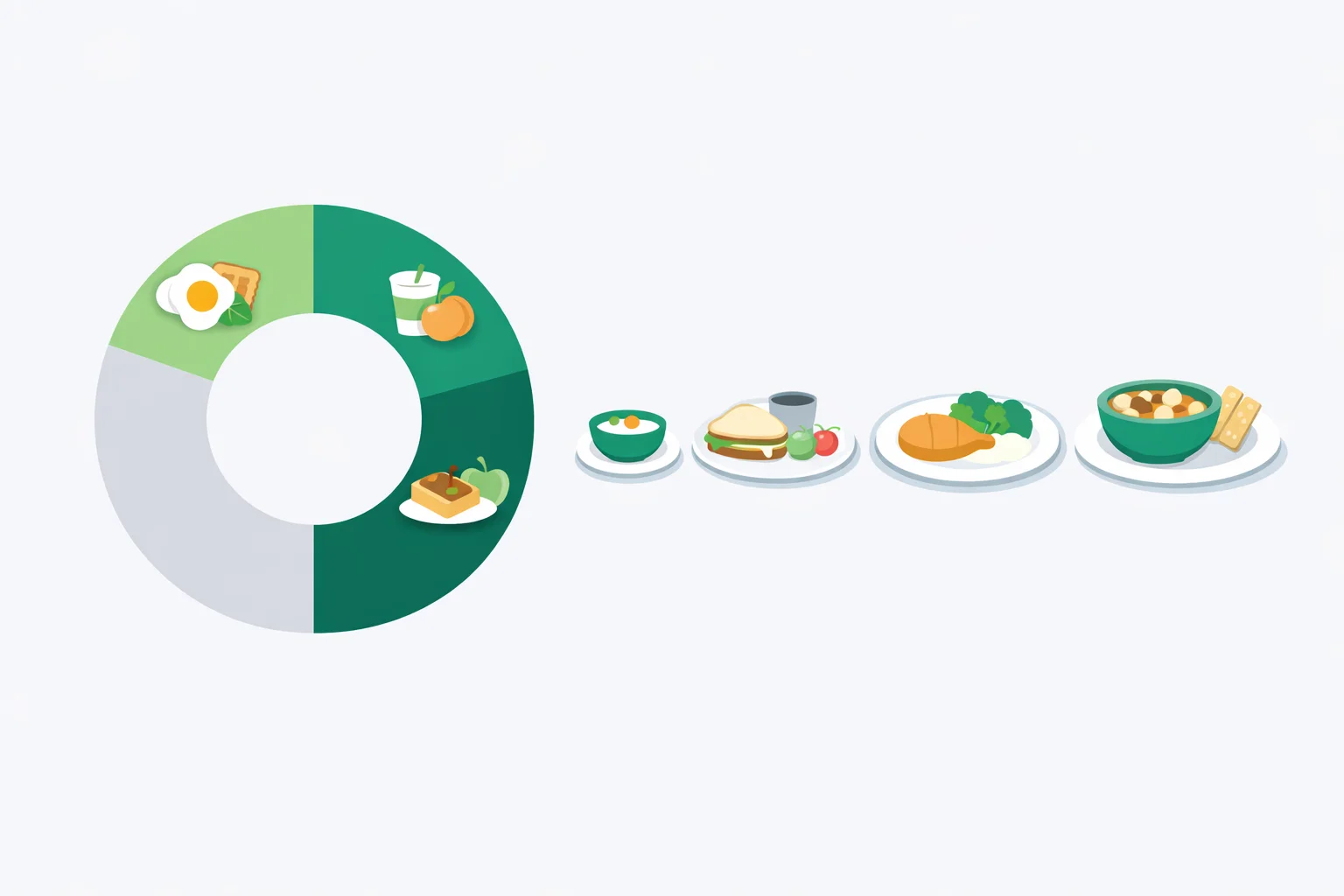
2,000 kcal across 4 eating occasions
300-600 kcal per occasion
1. Your daily calorie target
Use your maintenance calories, or your deficit or surplus target if you are dieting or gaining.
Don't know your daily target? Estimate it here
Mifflin-St Jeor estimate: 2,325 kcal/day
Uses your body weight from step 3. Mifflin-St Jeor lands within 10% of measured resting metabolic rate for about 80% of adults, so treat it as a starting point and adjust after two weeks of real weight data.
2. How you want to split the day
Share of daily calories
100%
3. Protein and fat (optional, for per-meal macros)
1.6 g/kg is the point where extra protein stops adding muscle in training adults.
Carbohydrate takes whatever calories are left after protein and fat.
Calories per eating occasion
300 - 600 kcal
3 main meals averaging 565 kcal, plus 1 snack.
Daily protein
120 g
Daily carbs
231 g
Daily fat
67 g
Eating window
12 h
Does a real meal fit your dinner budget of 600 kcal?
Tap any occasion above to change the budget. Calories are typical prepared portions, rounded.
| Meal or snack | kcal | Protein | Against your budget |
|---|---|---|---|
| Greek yogurt (170 g) with berries | 180 | 17 g | 420 kcal under |
| Six-inch turkey sub, no mayo | 280 | 18 g | 320 kcal under |
| Whey shake (1 scoop) in 250 ml milk | 245 | 33 g | 355 kcal under |
| Two scrambled eggs on wholemeal toast | 320 | 20 g | 280 kcal under |
| Porridge (60 g oats), milk, one banana | 400 | 14 g | 200 kcal under |
| Avocado toast with two poached eggs | 480 | 22 g | 120 kcal under |
| Chicken breast (150 g), rice (150 g cooked), broccoli | 520 | 52 g | 80 kcal under |
| Big Mac, no fries | 590 | 25 g | Fits |
| Salmon (150 g), potatoes (200 g), side salad | 610 | 42 g | Fits |
| Chicken Caesar salad, restaurant portion | 660 | 40 g | Fits |
| Chipotle chicken burrito bowl (rice, beans, salsa, cheese) | 700 | 45 g | 100 kcal over |
| Three slices of pepperoni pizza | 840 | 36 g | 240 kcal over |
This split at other daily targets
Your row is highlighted. Values rounded to the nearest 5 kcal.
| Daily target | Breakfast | Lunch | Afternoon snack | Dinner |
|---|---|---|---|---|
| 1,200 kcal | 300 | 360 | 180 | 360 |
| 1,500 kcal | 375 | 450 | 225 | 450 |
| 1,800 kcal | 450 | 540 | 270 | 540 |
| 2,000 kcal | 500 | 600 | 300 | 600 |
| 2,200 kcal | 550 | 660 | 330 | 660 |
| 2,500 kcal | 625 | 750 | 375 | 750 |
| 3,000 kcal | 750 | 900 | 450 | 900 |
How to read this: total daily intake drives weight change; the split decides how comfortable hitting that total feels. Meal-timing trials that hold calories and protein constant find little to no difference in fat loss between two, three and six meals a day. These figures are estimates for healthy adults and are not medical or dietetic advice. If you have diabetes, take insulin or other glucose-lowering medication, are pregnant, or are managing an eating disorder, agree meal sizes and timing with your clinician or dietitian before changing them.
Educational tool, not medical advice. Check this tool’s method and limitations before interpreting a result. Talk to a qualified healthcare professional before making decisions about medication, diet, exercise, or treatment. See our Terms of Use.
Your rating helps improve Meal Calorie Calculator. We store only an anonymized vote (no personal data).
How to Use Meal Calorie Calculator
Step 1: Enter your daily calorie target
Type your target into the Calories per day field, or tap one of the 1,500 to 2,500 kcal presets. If you do not know your number, open "Estimate it here", enter sex, age, height and activity level, and press Use this target — it runs Mifflin-St Jeor against the body weight from step 3 and writes the result into the field.
Step 2: Choose how you want to split the day
Pick one of the seven patterns: three meals with no snacks, three meals plus one or two snacks, front-loaded, back-loaded, a 16:8 window, or two meals a day. Selecting a pattern also sets a matching eating window, so the 16:8 option starts at midday rather than breakfast.
Step 3: Adjust any percentage you disagree with
Each occasion has an editable percentage box. Change one and the pattern switches to Custom, keeping your edits. The totals line turns amber if your shares do not add to 100 percent; Rescale to 100% fixes it proportionally. Set an occasion to 0 to remove it from the plan entirely.
Step 4: Set your first and last meal times
The First meal and Last meal fields define your eating window, and occasions are spaced evenly between them. A 07:30 to 19:30 window with four occasions puts them at 07:30, 11:30, 15:30 and 19:30, which is the four-hour spacing most protein-distribution research uses.
Step 5: Add body weight for per-meal macros
Enter body weight in kilograms or pounds, then set the protein slider (1.6 g/kg by default) and the fat slider (30 percent of calories by default). Each meal card then shows protein, carbohydrate and fat in grams, plus a bar tracking that meal against the 0.4 g/kg muscle-building protein dose.
Step 6: Sanity-check the plan against real food
Tap any occasion card to load its calorie budget into the comparison table, which shows whether a Chipotle bowl, three slices of pizza or a chicken and rice plate fits inside it. Use Copy split to paste the whole schedule into your notes or a tracking app.
Key Features
- Seven ready-made patterns, from three square meals to a 16:8 eating window
- Every occasion has an editable percentage, with one-tap rescaling back to 100%
- Protein spread evenly across occasions and checked against the 0.4 g/kg muscle dose
- Per-meal carbohydrate and fat grams derived from your protein and fat settings
- Real-meal comparison showing what actually fits a 400, 600 or 900 kcal plate
- Reference matrix of the same split at daily targets from 1,200 to 3,000 kcal
Understanding Results
Formula
Calories per occasion are a straight proportional division: meal kcal = daily target × (that occasion's share ÷ the sum of all shares). Dividing by the sum rather than by 100 is what lets you type 30, 40 and 40 without the tool silently under-feeding you — those shares are read as 27%, 36.5% and 36.5% of your target, and the day still totals exactly what you entered. On 2,000 kcal with the default 25 / 30 / 15 / 30 pattern, that is 500 kcal breakfast, 600 lunch, 300 snack, 600 dinner.
Protein does not follow the calorie split. Daily protein is body weight × your g/kg setting, and it is then divided evenly across occasions, because the muscle protein synthesis response is triggered per meal rather than per day. A cap stops any occasion from exceeding 55% of its own calories as protein — otherwise a 150 kcal snack would be asked to carry 30 g of protein, which is 80% of its budget — and the protein that cap displaces is redistributed to the occasions with room. Fat is daily target × your fat percentage, carbohydrate takes whatever calories are left, and both are then spread across occasions in proportion to the calories each has remaining once its protein is assigned.
Reference Ranges & Interpretation
A main meal for an adult on a maintenance intake usually lands between 400 and 700 kcal, and a snack between 150 and 300 kcal. Those are consequences of arithmetic, not rules: 25% to 35% of a 2,000 kcal target is 500 to 700 kcal, and 10% to 15% is 200 to 300. The figure that carries independent meaning is protein per meal. Roughly 0.4 g per kg of body weight maximises the muscle protein synthesis response in a single sitting — 30 g at 75 kg, 40 g at 100 kg — and four such occasions reach 1.6 g/kg a day, the intake beyond which added protein produces no further measurable gain in trained adults.
Watch the shape of the split as well as the totals. A plan where breakfast carries 8 g of protein and dinner carries 60 g hits the same daily number as four 30 g meals but wastes most of the evening dose; controlled feeding work comparing 30/30/30 g against 10/15/65 g at an identical daily 90 g found the even distribution produced about 25% more muscle protein synthesis over 24 hours. The per-meal bars in the calculator flag exactly this — an occasion that never reaches the 0.4 g/kg line stays grey.
Assumptions & Limitations
The split is an adherence tool, not a metabolic one. Meal frequency does not change the thermic effect of food, which runs at about 10% of intake whether it arrives in two sittings or six, and meta-analyses of meal-frequency trials show no fat-loss advantage once calories and protein are matched. If you eat the same 2,000 kcal, the pattern you choose will not decide whether you lose weight — it decides whether you can keep eating 2,000 kcal without raiding the cupboard at 22:00.
Three limits are worth naming. The Mifflin-St Jeor estimate behind the optional target lands within 10% of measured resting metabolic rate for roughly 80% of adults, so the daily number feeding every split here can be 200 kcal out in either direction; adjust it after two weeks of real weight data. Even spacing across the eating window ignores training time, and if you lift weights you will want a protein-containing occasion within a few hours either side of the session rather than a mathematically even one. And the tool assumes a healthy adult with no glycaemic constraint — if you take insulin, carbohydrate per meal is a dosing input rather than a preference, and meal sizes should be set with your diabetes team.
Complete Guide: Meal Calorie Calculator
On this page
- The meal size everyone asks for doesn't exist
- Six meals, two meals, and a metabolism claim that never held up
- The one thing your split genuinely changes
- Which split fits the day you actually have?
- Big breakfast or big dinner? Two trials, two answers
- What a meal calorie calculator does with 1,700 kcal at 68 kg
- Four ways people quietly break their own split
- What to do with these numbers this week
- References
A meal calorie calculator settles an argument you normally have about eleven seconds to resolve: you're at the counter, the sandwich board says 640 kcal, and you need to know whether that fits. Most people answer it with a number they half-remember from somewhere — 500 kcal a meal, maybe 400 if they're dieting. That number is the problem. There is no correct calorie count for a meal in isolation, and treating one as though there is produces plans that are either quietly starving or quietly 400 kcal over every single day.
What follows takes apart four things people believe about calories per meal — that a standard meal size exists, that more meals burn more energy, that timing decides fat loss, and that where the calories land is a detail — and replaces each with the arithmetic and the trial data. One of those four beliefs turns out to be partly right, and it isn't the one most people bet on.
The Meal Size Everyone Asks For Doesn't Exist
Ask how many calories per meal you should eat and the honest answer is a percentage, not a number. A meal is a share of a daily budget, so the same plate is generous or reckless depending entirely on what the day allows. Take 600 kcal — a chicken and rice plate, or a Big Mac without fries. On a 2,400 kcal maintenance intake that's 25% of the day and completely unremarkable. On a 1,300 kcal cut it's 46%, and the remaining 700 kcal has to cover breakfast, a snack and dinner. Same food, opposite verdict.
This is why a calories per meal calculator has to start from your daily total rather than from a rule of thumb. Divide first, then look at food. If you don't have a daily number yet, the daily calorie calculator estimates it from your body size and activity, or use the built-in Mifflin-St Jeor estimator in step 1 above and push the result straight into the target field.
Once you divide, the numbers get boring in a useful way. Three meals and a snack out of 2,000 kcal is 500, 600, 300 and 600. Out of 1,600 it's 400, 480, 240 and 480. Nobody needs to memorise a meal size; they need to remember one percentage set and do a two-second division.
Six Meals, Two Meals, and a Metabolism Claim That Never Held Up
The six-small-meals advice rests on the idea that eating more often keeps the metabolic fire burning. The mechanism it points at is real — digesting food costs energy, roughly 10% of what you eat for a mixed diet — but the arithmetic kills the claim. That 10% is proportional to intake, not to the number of sittings. Two thousand calories spread over six meals costs about 200 kcal to process. The same 2,000 kcal in two meals costs about 200 kcal to process. There is no frequency bonus, because there was never a per-meal fee.
The trials say the same thing. When Cameron and colleagues put 16 adults with obesity on an identical 700 kcal daily deficit for eight weeks and varied only meal frequency — three meals against six — both groups lost about 5% of body weight, with no difference in weight lost, fat lost, or measured appetite. Broader reviews of meal-frequency studies land in the same place once calories and protein are matched. So pick three meals or six for whichever keeps you comfortable, but don't pick either expecting a metabolic dividend.
The One Thing Your Split Genuinely Changes
Here's the belief that turns out to be partly right. How you distribute calories barely matters for fat loss, but how you distribute protein measurably changes what your muscle does with it. Muscle protein synthesis responds per meal, and it saturates. Feed a 75 kg adult 20 g of protein and the response is submaximal; feed 30 g and it's close to maximal; feed 70 g in one sitting and the extra 40 g is largely oxidised rather than banked.
Mamerow and colleagues tested this directly. Healthy adults ate 90 g of protein a day in two patterns: evenly, at 30 g per meal, or skewed the way most people actually eat — 10 g at breakfast, 16 g at lunch, 63 g at dinner. Same protein, same calories, same food quality. The even distribution produced about 25% more muscle protein synthesis across 24 hours. Areta's work adds the spacing detail: 80 g of whey delivered as four 20 g doses every three hours beat both eight 10 g doses every 90 minutes and two 40 g doses every six hours.
That's why this meal calorie split calculator distributes protein evenly rather than in proportion to calories, and flags any occasion that falls short of roughly 0.4 g per kilogram of body weight — the per-meal dose Schoenfeld and Aragon recommend across a minimum of four meals to reach 1.6 g/kg a day. The arithmetic is tidy: 0.4 g/kg × 4 occasions = 1.6 g/kg. If you want to set the daily ratio itself rather than accept 1.6 g/kg, the macronutrient calculator handles that side.
Which Split Fits the Day You Actually Have?
Since the physiology is mostly neutral, choose the pattern that survives contact with your schedule. This is the table I'd want before picking one — each row lists who the pattern suits, what it costs you, and the real per-meal calories on a 2,000 kcal target.
| Pattern | Choose it if | The trade-off | On 2,000 kcal |
|---|---|---|---|
| 3 meals, no snacks | You'd rather not think about food between meals. | 700 kcal plates need actual cooking, not grabbing. | 600 / 700 / 700 |
| 3 meals + 1 snack | You crash around 16:00 and arrive at dinner ravenous. | The snack is the first thing to drift over budget. | 500 / 600 / 300 / 600 |
| 3 meals + 2 snacks | Your target is above 2,800 kcal, or large plates make you uncomfortable. | Five logging events a day, and five chances to under-count. | 500 / 200 / 540 / 200 / 560 |
| Front-loaded | Evening grazing is your failure mode, or you train before work. | An 800 kcal breakfast is a lot to build before 08:00. | 800 / 700 / 500 |
| Back-loaded | You finish late, or dinner is the family meal you won't shrink. | A 1,000 kcal dinner leaves no room for a second helping. | 400 / 600 / 1,000 |
| 16:8 window | You're genuinely not hungry before midday. | Protein per occasion jumps to 40–55 g for a 75 kg adult. | 700 / 300 / 1,000 |
| Two meals a day | You want the least possible friction and decision-making. | Hardest pattern for reaching 1.6 g/kg protein without a shake. | 900 / 1,100 |
Notice what the right-hand column exposes. Two meals a day sounds simple until you see 1,100 kcal on a plate and realise that's a restaurant portion you now have to build at home twice. Meanwhile the 3 + 2 pattern reads as fiddly, but 200 kcal snacks are the easiest thing in the list to buy pre-portioned. Cross-check any pattern against the food you actually eat with the food calorie calculator before you commit to it for a month.
Big Breakfast or Big Dinner? Two Trials, Two Answers
Front-loading has the most-cited result in this whole area. Jakubowicz randomised 93 women with metabolic syndrome to an identical 1,400 kcal diet for 12 weeks, differing only in where the calories sat: 700 kcal at breakfast and 200 at dinner, or the reverse. The big-breakfast group lost 8.7 kg. The big-dinner group lost 3.6 kg. A 5 kg gap from moving the same food around the clock is a striking finding, and it's the study every front-loading article quotes.
It is not the last word. Ruddick-Collins and colleagues ran a tighter design in Aberdeen — 30 adults with overweight or obesity, a randomised crossover so each person served as their own control, four weeks per arm, morning-loaded against evening-loaded at matched calories and protein. Weight loss came out the same in both arms, and so did total energy expenditure. What did differ was appetite: participants reported meaningfully less hunger on the morning-loaded diet. Read the two together and the practical conclusion isn't that breakfast burns better. It's that front-loading makes it easier to stay inside the calories, which in a free-living 12-week trial looks exactly like a metabolic advantage.
What a Meal Calorie Calculator Does With 1,700 kcal at 68 kg
Take a 68 kg woman on a mild deficit at 1,700 kcal, running three meals plus an afternoon snack at 25 / 30 / 15 / 30, protein at 1.6 g/kg and fat at 30% of calories. Calories first: 425 at breakfast, 510 at lunch, 255 for the snack, 510 at dinner.
Protein next, and it doesn't follow those percentages. Daily protein is 68 × 1.6 = 109 g, divided evenly across four occasions for 27 g each. Check that against the per-meal dose: 0.4 × 68 = 27.2 g. The split lands exactly on the muscle protein synthesis threshold at every single occasion, snack included — which is the whole argument for even distribution in one line. Fat is 30% of 1,700 = 510 kcal, or 57 g a day. Protein uses 436 kcal, fat 510, so carbohydrate takes the remaining 754 kcal, or 188 g. Those daily totals then get spread across occasions in proportion to the calories each has left after its protein is assigned.
| Occasion | Calories | Protein | Carbs | Fat |
|---|---|---|---|---|
| Breakfast (25%) | 425 | 27 g | 47 g | 14 g |
| Lunch (30%) | 510 | 27 g | 60 g | 18 g |
| Snack (15%) | 255 | 27 g | 22 g | 7 g |
| Dinner (30%) | 510 | 27 g | 60 g | 18 g |
The snack row is the interesting one. Twenty-seven grams of protein inside 255 kcal is 42% of that occasion's calories, which rules out most things marketed as snacks — a cereal bar gets you 4 g. Greek yogurt at 17 g per 170 g pot, cottage cheese, a whey shake in water, or two hard-boiled eggs plus a pot of skyr are what actually clear that bar. This is the part of meal planning that a calorie-only split hides from you, and it's the reason the calculator prints protein on every card.
Four Ways People Quietly Break Their Own Split
Saving calories for dinner. Skipping a 400 kcal breakfast to bank room for the evening is the most common self-sabotage in calorie tracking, and it inverts the appetite finding above. You arrive at dinner with 900 kcal available and the hunger of a nine-hour fast, which reliably overshoots.
Liquid calories outside the split. A large latte is 190 kcal, a pint of lager 220, a 500 ml orange juice 225. Three of those in a day is 600 kcal — more than the entire dinner allowance on a 1,600 kcal plan — and almost nobody assigns them to an occasion. Give drinks a share, or count them into the nearest meal.
Weekend drift. Two restaurant meals on a Saturday typically run 700–900 kcal each against a planned 600. That's roughly 600 surplus calories, or about 4% of a 14,000 kcal week from two meals. Two such weekends a month is most of a 250 g/week fat-loss rate, which is why weight-loss plots flatten while daily logs look fine.
Snack creep. A snack budgeted at 250 kcal that becomes a 420 kcal muffin adds 170 kcal a day, or about 1,200 a week — roughly a third of the deficit in a 500 kcal/day plan. Snacks drift because they're the only occasion people buy rather than build. If your snack is bought, check the label against the card before it becomes the default.
What to Do With These Numbers This Week
Run the split once, then stop optimising it. Pick the pattern that matches your schedule from the table above, write down the four numbers, and build a short repeatable list: two breakfasts, three lunches and three dinners that hit their targets within about 50 kcal. That's eight recipes, not a diet, and it removes the daily decision that makes calorie targets exhausting. The meal plan calculator turns the same targets into specific foods and a grocery list if you want the meal planning calorie calculator side rather than the split.
Then leave it alone for a fortnight and watch body weight instead of meal sizes. If the trend is flat and you wanted a loss, adjust the daily target — not the split. Calories per meal for weight loss follow the daily number; they don't set it. And if you find yourself hungry at a predictable time every day, that's the one signal worth acting on: move 100 kcal from the meal after it to the meal before it, and check again next week.
References
- Mamerow MM, et al. Dietary protein distribution positively influences 24-h muscle protein synthesis in healthy adults. Journal of Nutrition. 2014. PubMed 24477298
- Schoenfeld BJ, Aragon AA. How much protein can the body use in a single meal for muscle-building? Journal of the International Society of Sports Nutrition. 2018. PubMed 29497353
- Areta JL, et al. Timing and distribution of protein ingestion during prolonged recovery from resistance exercise alters myofibrillar protein synthesis. Journal of Physiology. 2013. PubMed 23459753
- Jakubowicz D, et al. High caloric intake at breakfast versus dinner differentially influences weight loss of overweight and obese women. Obesity. 2013. PubMed 23512957
- Ruddick-Collins LC, et al. Timing of daily calorie loading affects appetite and hunger responses without changes in energy metabolism. Cell Metabolism. 2022. PubMed 36167077
- Cameron JD, Cyr MJ, Doucet E. Increased meal frequency does not promote greater weight loss in subjects who were prescribed an 8-week equi-energetic energy-restricted diet. British Journal of Nutrition. 2010. PubMed 19943985
- U.S. Department of Agriculture and U.S. Department of Health and Human Services. Dietary Guidelines for Americans, 2020–2025. dietaryguidelines.gov

Written by Marko Šinko
Co-Founder & Lead Developer
Computer scientist and developer working on calculator implementation, data handling, and accessible interfaces. His authorship describes development work, not independent medical review.
View full profileFrequently Asked Questions
How many calories should I eat per meal?
Divide your daily target rather than guessing a fixed number. On 2,000 kcal split across three meals and one snack, that is roughly 500 kcal at breakfast, 600 at lunch, 600 at dinner and 300 for the snack. On 1,500 kcal the same pattern gives 375, 450, 450 and 225. There is no universal per-meal calorie figure — 600 kcal is a sensible dinner on 2,000 kcal a day and half the daily budget on 1,200.
Is 500 calories a lot for one meal?
On a 2,000 kcal target, 500 kcal is exactly 25 percent of your day and a completely normal meal — roughly a 150 g chicken breast with 150 g of cooked rice and vegetables. The same 500 kcal is 42 percent of a 1,200 kcal target, which leaves only 700 kcal for everything else. Judge meal size as a percentage of your daily total, not as an absolute.
How many calories per meal to lose weight?
Set the deficit first, then divide it. A 500 kcal daily deficit takes most adults from about 2,100 to 1,600 kcal, which across three meals and a snack is roughly 400, 480, 480 and 240 kcal. Weight loss comes from the daily total; the split only decides how hungry you feel getting there. Front-loading calories into breakfast and lunch helps if your problem is evening snacking.
Should my biggest meal be breakfast or dinner?
The evidence points weakly toward breakfast but does not settle it. In a 12-week trial of 93 women on an identical 1,400 kcal diet, the group eating a 700 kcal breakfast lost 8.7 kg while the group eating that 700 kcal at dinner lost 3.6 kg. Tightly controlled feeding studies with matched protein have found much smaller or no differences. Pick the pattern you can repeat for months, because adherence outweighs timing.
Does eating 6 small meals a day boost your metabolism?
No. The thermic effect of food runs at roughly 10 percent of what you eat regardless of how many sittings it arrives in, so 2,000 kcal spread over six meals burns the same 200 kcal in digestion as 2,000 kcal over two. A meta-analysis of 15 meal-frequency studies found no fat-loss advantage once calories and protein were matched. Choose a frequency for appetite control, not for metabolic rate.
How many calories should a snack be?
Between 10 and 15 percent of your daily target, which is 200 to 300 kcal on a 2,000 kcal plan and 150 to 225 kcal on 1,500. Anything under about 100 kcal rarely blunts hunger long enough to change what you eat at the next meal, and anything above 350 kcal usually functions as a fourth meal — in which case give it a meal-sized share in the calculator instead.
How much protein should each meal contain?
Aim for about 0.4 g per kilogram of body weight per occasion, so roughly 30 g for a 75 kg adult and 40 g at 100 kg. Four such meals land you at 1.6 g/kg a day, the point where extra protein stops adding measurable muscle in training adults. Below about 0.24 g/kg per meal — 18 g at 75 kg — the muscle protein synthesis response is submaximal, which is why a 900 kcal dinner and a 90 kcal breakfast is a poor split for anyone lifting weights.
How many calories per meal on 16:8 intermittent fasting?
Two meals plus one snack inside the eight-hour window is the usual shape: on 2,000 kcal that is about 700 kcal at midday, a 300 kcal snack, and 1,000 kcal at dinner. Compressing the day makes meals large — a 1,000 kcal dinner is three slices of pizza plus a side — and pushes protein to 40 to 50 g per meal for a 75 kg adult. That is achievable but needs planning, which is the main reason people abandon the window rather than the fasting itself.
Related Calculators

BMR Calculator: Basal Metabolic Rate by Proven Formulas
Use our BMR calculator to estimate your basal metabolic rate using Mifflin–St Jeor or revised Harris–Benedict formulas. Choose metric or US units and see TDEE.
Caffeine Content Calculator — Coffee, Energy Drinks & Tea
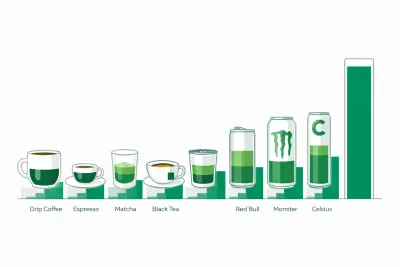
Free caffeine content calculator showing how much caffeine is in coffee, espresso, tea, Red Bull, Monster and Celsius, plus your safe daily limit by weight.
Caffeine Half-Life Calculator: How Long Caffeine Lasts
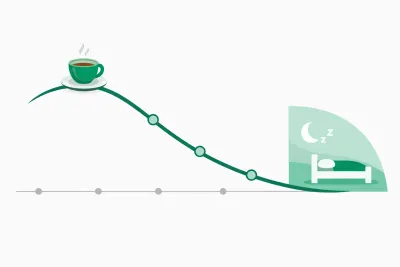
Free caffeine half-life calculator showing how much caffeine is left at bedtime, your personal clearance rate, and the latest safe cutoff time to drink.

Calorie Calculator: Daily TDEE and Intake Estimate
Use our calorie calculator to estimate daily energy needs (TDEE) from age, sex, height, weight, and activity. See maintain, loss, and gain targets instantly.
Calorie Deficit Calculator — Set a Safe Daily Deficit
Use our calorie deficit calculator to set a safe daily calorie target. Estimate TDEE, choose a weekly weight-loss rate, and see deficit, timeline, and guidance.
Calorie Density Calculator: Calories per Gram of Food
Free calorie density calculator that turns calories and grams into kcal per gram, sorts any food into four energy density bands, and compares two foods.