Use the Creatine Dosage Calculator
Compare daily grams, optional loading portions, and the amount of creatine monohydrate needed for four weeks.
Clinical treatment and medically supervised protocols are outside this tool.
Equivalent: 70.00 kg. Tool range: 40–150 kg; these are scope limits, not safety cutoffs.
Choose a value within the commonly studied 3–5 g/day range to compare supply needs. This selection is not calculated from your weight.
Daily intake from day 1
3.0 g/day
Continue 3 g each day, including rest days. Research commonly allows about 3–4 weeks for stores to rise without loading.
First 28 days
84.0 g
Total supplement required
Maintenance per week
21 g
7 × 3 g/day
Weight-based maintenance reference
2.10 g/day
70.00 kg × 0.03 g/kg/day. A separate research reference, not your selected 3 g/day and not a minimum requirement. It can fall below 3 g/day.
Your 28-day intake schedule
Bar height shows grams taken each day. It does not measure muscle saturation or predict strength gains.
Daily only: 28 × 3 g = 84.0 g total.
| Approach | Daily amount | 28-day total |
|---|---|---|
| Daily only (selected) | 3 g | 84 g |
| 5-day load | 21.0 g, then 3 g | 174.0 g |
| 6-day load | 21.0 g, then 3 g | 192.0 g |
| 7-day load | 21.0 g, then 3 g | 210.0 g |
Before using a protocol
Check the product label for grams of creatine monohydrate, not total blend weight. These calculations do not establish supplement suitability or a safe upper limit. Kidney disease, abnormal kidney tests, pregnancy, breastfeeding, age under 18, or medicines affecting kidney function require individual professional advice.
Educational tool, not medical advice. Check this tool’s method and limitations before interpreting a result. Talk to a qualified healthcare professional before making decisions about medication, diet, exercise, or treatment. See our Terms of Use.
Your rating helps improve Creatine Dosage Calculator. We store only an anonymized vote (no personal data).
How to Use Creatine Dosage Calculator
Step 1: Check the intended population
Select Who is this for? The tool compares sports-nutrition protocols for generally healthy adults aged 18 and older; other selections show guidance instead of doses.
Step 2: Enter your body weight
Enter Body weight in kg or lb. Switching units converts the value. The tool covers 40–150 kg and flags values outside this range.
Step 3: Compare daily only with optional loading
Choose Daily only for no loading phase, or Optional loading and a Loading duration of 5, 6, or 7 days.
Step 4: Choose a maintenance amount
Select Daily maintenance of 3, 4, or 5 grams to compare published protocols. The separate 0.03 g/kg/day reference is not substituted for this selection.
Step 5: Review portions and supply
Review the daily grams, loading portions if selected, and total supplement needed over 28 days. Use Copy summary to save the comparison.
Key Features
- Optional 0.3 g/kg/day loading for 5, 6, or 7 days
- Daily-only and loading protocols compared side by side
- Separate 0.03 g/kg/day maintenance reference
- Loading portions and total grams for the first 28 days
- Kilogram and pound inputs with automatic conversion
- Copyable protocol summary and intake schedule
Understanding Results
Formula
Loading grams/day = body weight in kg × 0.3. Weight-based maintenance reference = kg × 0.03, shown separately from the selected 3–5 g/day. Pounds convert to kilograms by multiplying by 0.45359237. The 28-day total is (loading days × loading grams/day) + (remaining days × maintenance grams/day). Without loading, it is 28 × the daily amount.
Reference Ranges & Interpretation
These are supplementation protocols, not diagnostic ranges or safe upper limits. The NIH Office of Dietary Supplements describes loading for 5–7 days followed by 3–5 g/day. The ISSN position stand gives 0.3 g/kg/day loading and discusses research using 0.03 g/kg/day maintenance. A daily-only approach raises stores more gradually.
Assumptions & Limitations
This tool compares creatine monohydrate protocols for generally healthy adults. It does not estimate baseline muscle stores, absorption, kidney function, or an individual saturation date. The 40–150 kg input range is a product scope restriction, not a clinical threshold. Total body weight can overstate the relevance of weight-scaled dosing when body fat is high. The number of loading portions is rounded up so each is approximately 5 g or less; this is a practical division rule, not a biological safety limit. Obtain individual advice for kidney disease, abnormal kidney tests, pregnancy, breastfeeding, age under 18, or relevant medications.
Complete Guide: Creatine Dosage Calculator
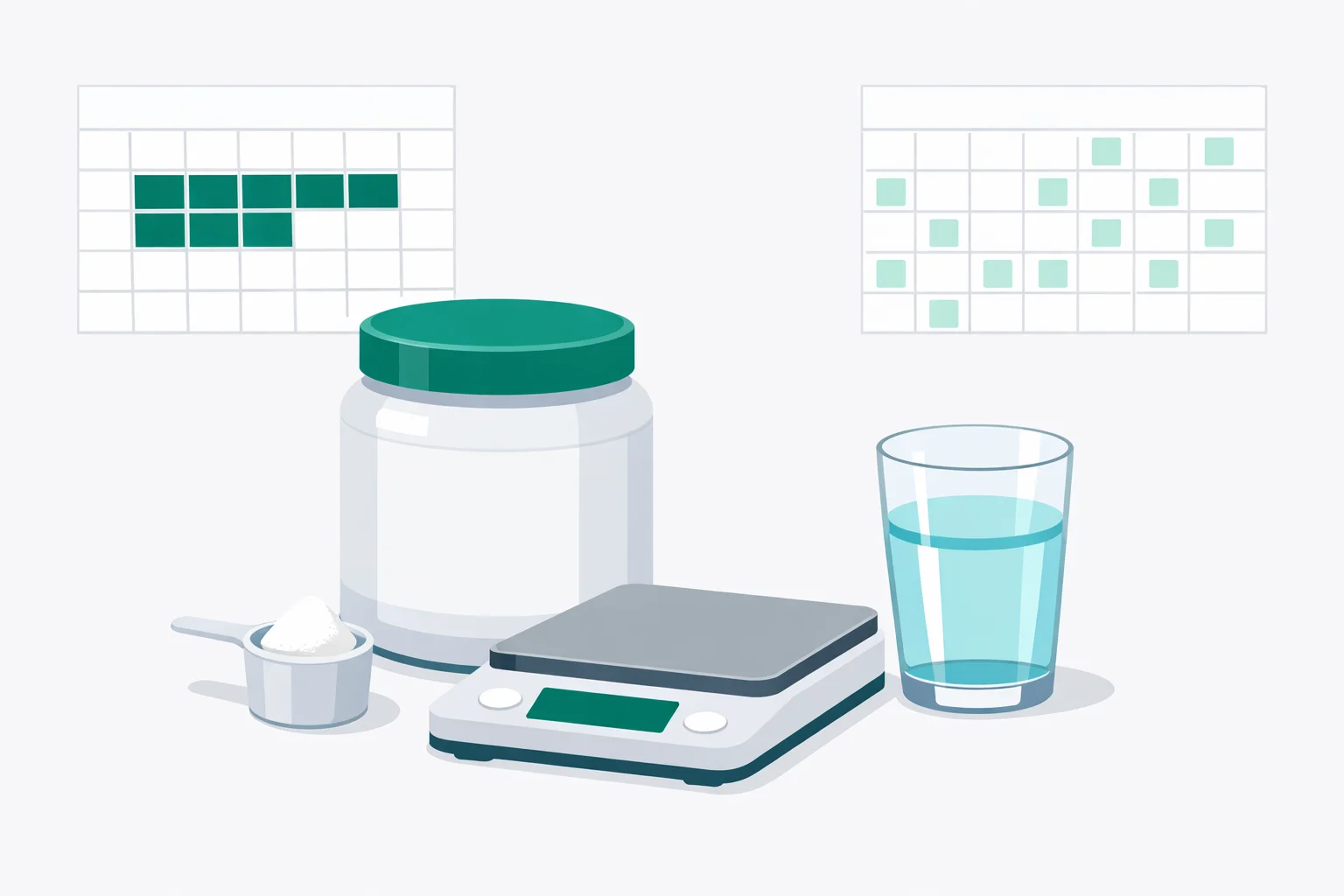
A creatine dosage calculator answers two different planning questions: how much to take each day, and whether to use a short loading phase first. Consider a 70 kg adult comparing 3 g daily with a five-day, weight-based load followed by the same 3 g daily. The first approach uses 84 g over four weeks; the second uses 174 g. That extra 90 g buys a different initial protocol, not a promise of twice the muscle gain. The useful comparison is timing, daily portions, and supplement supply.
In this guide
Loading vs. daily only: choose the timeline
Loading introduces a larger daily amount for a brief period, then drops to maintenance. The ISSN position stand describes approximately 0.3 g/kg/day for 5–7 days followed by 3–5 g/day. The loading figure is the whole-day total. At 70 kg, 0.3 × 70 = 21 g for the entire day, divided into smaller portions. Multiplying that 21 g by four would be a dosing error. [1]
Skipping the load is also a studied approach. Hultman and colleagues reported a similar increase in muscle total creatine with 3 g/day over 28 days compared with 20 g/day over 6 days, with a slower rise in the lower-dose group. This finding supports a choice between protocols; it does not establish that every person reaches the same concentration on those exact days. [2]
A practical decision framework
- Want one consistent amount from the start? Compare daily-only plans at 3, 4, and 5 g/day.
- Considering a faster initial increase in stores? Compare a 5–7-day load, including how many portions the daily total requires.
- Already taking a consistent maintenance amount? Compare ongoing weekly supply; a new tub is not a reason to restart loading.
- Need medical guidance? Resolve suitability before treating any gram calculation as an intake plan.
Why the creatine dosage calculator shows 2.1 g beside 3–5 g
A commonly cited weight-based maintenance reference is 0.03 g/kg/day, used in research discussed by the ISSN. [1] For 70 kg, that gives 2.1 g/day. It cannot also equal 3 g/day unless someone changes the rule. Rounding 2.1 up to 3 and calling the result a direct weight calculation hides that change. This page keeps the reference and selected daily amount separate.
The arithmetic has a useful crossover: 3 ÷ 0.03 = 100 kg. Below 100 kg, this reference is below 3 g/day; at 100 kg it equals 3 g/day; at 120 kg it equals 3.6 g/day. None of those comparisons establishes an individual minimum or an optimal amount. The 3–5 g range is a separate, commonly studied fixed-dose convention described by NIH. [3]
Total body weight also fails to distinguish muscle from fat. Two people at 100 kg produce the same 30 g loading calculation even if their body composition differs substantially. Substituting an estimated lean mass into a total-weight formula creates a different method; this tool does not do that. A lean body mass calculator can explain the distinction, but its result is not a validated creatine dosing correction.
A 70 kg example: count the first 28 days
Supply planning requires both phases. At 70 kg, five loading days use 5 × 21 = 105 g. There are 23 days left in the four-week window. With 3 g/day maintenance, those days use 23 × 3 = 69 g. Add the phases: 105 + 69 = 174 g. Counting 28 maintenance days on top of the load would incorrectly describe a 33-day supply as a 28-day supply.
| Protocol | 3 g maintenance | 5 g maintenance |
|---|---|---|
| Daily only | 84 g | 140 g |
| 5-day load at 21 g/day | 174 g | 220 g |
| 6-day load at 21 g/day | 192 g | 236 g |
| 7-day load at 21 g/day | 210 g | 252 g |
Each additional loading day replaces a maintenance day. At 3 g maintenance, that increases the four-week total by 21 − 3 = 18 g. At 5 g maintenance, the increase is 16 g. This is why adding two loading days changes 174 g to 210 g in one column, but 220 g to 252 g in the other. These are calculated supply totals, not evidence that one protocol produces better performance.
A 300 g tub of pure creatine monohydrate illustrates the shopping implication. At 3 g/day without loading it contains 100 daily amounts. After the five-day example above, 126 g remains: another 42 days at 3 g/day. The original tub therefore covers 70 days in that example. Those figures assume the labeled mass is entirely creatine monohydrate and exclude powder lost during measuring.
Grams, scoops, and divided portions
Dividing 21 g into four portions gives 5.25 g each; dividing it into five gives 4.2 g. The calculator uses enough portions to keep each at approximately 5 g or less. That division is an explicit convenience rule, not a claim that 5.01 g is harmful or that everyone tolerates 5 g. Loading portions are spread across the day; they are not extra amounts to add to the displayed daily total.
A scoop marked as a serving is not automatically 5 g of creatine. If a product supplies 3 g per serving, one and a half labeled servings provides 4.5 g. For a blend weighing 10 g per serving but containing only 3 g creatine, measuring 5 g of powder provides 1.5 g creatine, assuming the blend is uniform. Check both serving size and creatine content before converting grams into scoops.
Display rounding is another small source of error. A 75 kg example gives 22.5 g/day; five portions give exactly 4.5 g each. At 80 kg, 24 g divided into five gives 4.8 g. A scale whose resolution is only whole grams cannot reproduce either portion precisely. Extra decimal places in a calculator do not make the product label, scoop, or kitchen scale equally precise.
What does muscle saturation actually mean?
Creatine and phosphocreatine participate in rapid ATP regeneration in muscle. The NIH review finds the most relevant performance applications in repeated, high-intensity efforts, rather than treating creatine as a general endurance booster. [3] Muscle saturation describes stores within muscle tissue. It is not the fraction of a tub consumed or the number of days completed.
A running sum such as 3 × 14 = 42 g is intake, not retention. It cannot tell us how many grams were absorbed, retained in muscle, or eliminated. Consequently, a graph labeled 50% saturated after 14 of 28 days would make an unsupported biological claim. The schedule above deliberately graphs grams per day. Its change from a taller loading bar to a shorter maintenance bar is a change in intake, not a sudden loss of stored creatine.
The 28-day lower-dose finding came from a specific study in men. [2] Diet, baseline stores, and individual response complicate applying it to a different person. There is no input here for muscle biopsy data, and weight cannot replace that measurement. Treat the 5–7-day and 3–4-week descriptions as study-based timing context rather than a personalized countdown.
Scale weight is not a muscle-gain forecast
Creatine supplementation can increase scale weight through water retention. [3] A change soon after starting therefore cannot be read as an equal change in muscle protein or body fat. For example, moving from 70 to 71 kg raises a 0.3 g/kg calculation from 21 to 21.3 g/day. That 0.3 g arithmetic difference does not demonstrate a new need to increase intake.
Record the start of supplementation alongside body-weight measurements so the timing remains visible. A weight gain calculator models a different question about energy intake; it cannot attribute a creatine-associated scale change to new tissue. Likewise, dietary protein and creatine are separate inputs to a training plan. Use the protein intake for muscle gain calculator for protein planning, rather than counting creatine powder as protein grams.
Kidney tests and the limits of adult protocols
Creatine and creatinine are related but different compounds. Creatinine is used in kidney-function assessment, and creatine use can influence its interpretation. A 2021 evidence review discusses why a creatinine change alone does not necessarily establish kidney damage in a creatine user. [4] Tell the clinician ordering kidney tests what you take; do not dismiss an abnormal result or recalculate a supplement dose from it yourself.
This page limits its automated comparison to generally healthy adults aged 18 or older. Kidney disease, abnormal kidney tests, pregnancy, breastfeeding, and medication-related concerns call for individual assessment. The 40–150 kg input bounds merely prevent the tool from extending its calculations indefinitely. A weight inside that interval is not medical clearance, and a weight outside it does not establish a contraindication.
Before measuring a first portion, reconcile three quantities: grams of creatine monohydrate per labeled serving, total grams for the day, and grams per portion. In the 70 kg loading example those last two numbers are 21 g/day and 4.2 g per portion across five portions. Keeping those units visible prevents a daily total from becoming a repeated single dose.
Sources and methodology
- Kreider RB et al. (2017). ISSN position stand on creatine safety and efficacy. Source for 0.3 g/kg/day loading, 5–7 days, and discussion of research using 0.03 g/kg/day maintenance.
- Hultman E et al. (1996). Muscle creatine loading in men. Journal of Applied Physiology 81:232–237. Source for the 20 g/day for 6 days versus 3 g/day for 28 days comparison.
- NIH Office of Dietary Supplements. Dietary Supplements for Exercise and Athletic Performance. Adult protocols, performance context, and reported effects.
- Antonio J et al. (2021). Common questions and misconceptions about creatine supplementation. Creatinine interpretation and discussion of the evidence.
The supply table and portion calculations are arithmetic examples derived from the stated protocols. They are not clinical validation of this website or a prediction of individual outcomes. Sources checked September 6, 2026.

Written by Jurica Šinko
Founder & CEO
Entrepreneur and health information advocate, passionate about making health calculations accessible to everyone through intuitive digital tools.
View full profileFrequently Asked Questions
How much creatine should I take daily?
A commonly studied creatine monohydrate maintenance range for healthy adults is 3–5 g/day. Body weight alone cannot select an optimal dose for you. This calculator compares amounts within that range and shows a separate 0.03 g/kg/day research reference.
How do I calculate a creatine loading dose by body weight?
Multiply body weight in kilograms by 0.3 to get the total grams per day for a short loading protocol. At 70 kg, that is 21 g/day for 5–7 days, divided into smaller portions. The 0.3 g/kg figure is a daily total, not the amount for each portion.
Do I need to load creatine for it to work?
No. In the Hultman study, 3 g/day for 28 days increased muscle total creatine gradually, with a similar increase to 20 g/day for 6 days. Loading changes the speed of the initial increase; these study timings do not predict your exact response.
Why does 0.03 g/kg give less than 3 grams for my weight?
The two methods are different protocols. At 70 kg, 0.03 × 70 gives 2.1 g/day, while the commonly studied fixed maintenance range is 3–5 g/day. The calculator displays 2.1 g as a research reference and keeps it separate from your selected maintenance amount.
Should I take creatine on rest days?
The daily protocols shown here include all 7 days of the week, including rest days. For example, 3 g/day requires 21 g for a full week. Do not multiply the daily amount by your number of workouts or use a loading-sized catch-up dose.
Is one scoop of creatine always 5 grams?
No. A scoop is a volume measure, and the product label determines how many grams of creatine it provides. If one labeled serving provides 3 g of creatine, two servings provide 6 g; if it is a blend, total powder weight is not the same as creatine content.
Will creatine make me gain fat during loading?
An early increase on the scale can reflect water retention rather than fat or newly built muscle. The calculator cannot forecast kilograms gained from a creatine dose. Note when supplementation starts so a short-term weight change is not mistaken for a change in body fat.
Can I use this calculator if I have kidney disease?
No automated dose is provided for kidney disease or other situations needing individual medical advice. Select the medical-advice option and discuss supplementation with your clinician. Tell the clinician about creatine before kidney blood tests, because creatine use can affect serum creatinine interpretation.
Related Calculators

BMR Calculator: Basal Metabolic Rate by Proven Formulas
Use our BMR calculator to estimate your basal metabolic rate using Mifflin–St Jeor or revised Harris–Benedict formulas. Choose metric or US units and see TDEE.
Caffeine Content Calculator — Coffee, Energy Drinks & Tea
Free caffeine content calculator showing how much caffeine is in coffee, espresso, tea, Red Bull, Monster and Celsius, plus your safe daily limit by weight.
Caffeine Half-Life Calculator: How Long Caffeine Lasts
Free caffeine half-life calculator showing how much caffeine is left at bedtime, your personal clearance rate, and the latest safe cutoff time to drink.

Calorie Calculator: Daily TDEE and Intake Estimate
Use our calorie calculator to estimate daily energy needs (TDEE) from age, sex, height, weight, and activity. See maintain, loss, and gain targets instantly.

Calorie Deficit Calculator — Set a Safe Daily Deficit
Use our calorie deficit calculator to set a safe daily calorie target. Estimate TDEE, choose a weekly weight-loss rate, and see deficit, timeline, and guidance.

Calorie Density Calculator: Calories per Gram of Food
Free calorie density calculator that turns calories and grams into kcal per gram, sorts any food into four energy density bands, and compares two foods.