Use the Vancomycin Calculator
Free vancomycin calculator to estimate maintenance dose and interval from weight, age, and renal function, targeting therapeutic trough and AUC ranges.
Actual (total) body weight drives the mg/kg dose.
Used for ideal/adjusted weight in obese patients.
Dosing strategy
Loading dose
2000mg
IV once, then start maintenance after one interval
Maintenance dose
1250mg
every 12 hours · 2500 mg/day
CrCl (Cockcroft-Gault)
83.3 mL/min
Vd (0.7 L/kg)
52.5 L
Clearance
4.18 L/h
Half-life
8.7 h
Estimated AUC₂₄ / MIC (target 400–600)
599mg·h/LEstimated steady-state trough
14.9mg/LEmpiric Interval by CrCl
Empiric starting points only. Verify with a measured level after the 3rd–4th dose (or earlier AUC sampling).
Clinical disclaimer
This vancomycin calculator gives population-based empiric estimates for adult, non-dialysis patients with stable renal function. Estimated trough and AUC₂₄ assume a one-compartment model (Vd 0.7 L/kg) and are not a substitute for measured serum levels or Bayesian software. It does not apply to hemodialysis, CRRT, pediatrics, pregnancy, or unstable kidney function. Always confirm dosing with therapeutic drug monitoring and current institutional protocols.
Educational tool, not medical advice. Check this tool’s method and limitations before interpreting a result. Talk to a qualified healthcare professional before making decisions about medication, diet, exercise, or treatment. See our Terms of Use.
Your rating helps improve Vancomycin Calculator. We store only an anonymized vote (no personal data).
How to Use Vancomycin Calculator
Step 1: Enter patient details
Enter age, biological sex, body weight, and height. Height lets the tool switch to adjusted body weight if the patient is obese.
Step 2: Enter serum creatinine
Type the latest serum creatinine in mg/dL or µmol/L. This drives the Cockcroft-Gault creatinine clearance estimate.
Step 3: Choose the dosing strategy
Pick a loading dose (default 25 mg/kg), a maintenance dose (default 15 mg/kg), and leave the interval on Auto to follow the CrCl nomogram.
Step 4: Read the loading and maintenance doses
See the loading dose to give once and the maintenance dose with its interval and total daily milligrams.
Step 5: Check the trough and AUC bands
Confirm the estimated steady-state trough sits near 10–20 mg/L and AUC₂₄ falls in the 400–600 target band before ordering.
Key Features
- Weight-based loading dose (20–35 mg/kg, capped at 3000 mg)
- Cockcroft-Gault CrCl with auto adjusted body weight for obesity
- Empiric interval nomogram driven by kidney function
- Population-PK estimate of steady-state trough and AUC₂₄
- AUC 400–600 and trough 10–20 mg/L target color coding
Understanding Results
Formula
The calculator runs three linked equations. First, creatinine clearance by Cockcroft-Gault: CrCl (mL/min) = [(140 − age) × weight] ÷ (72 × serum creatinine), multiplied by 0.85 for women. Second, the doses: loading = chosen mg/kg × actual body weight (capped at 3000 mg, rounded to 250 mg), and maintenance = chosen mg/kg × actual body weight (capped at 2000 mg/dose), with the interval taken from a CrCl nomogram. Third, a one-compartment pharmacokinetic model estimates exposure: volume of distribution Vd ≈ 0.7 L/kg, clearance ≈ 0.79 × CrCl plus a small non-renal term, AUC₂₄ = total daily dose ÷ clearance, and the steady-state trough from Cmin = Cmax × e^(−ke·τ).
Reference Ranges & Interpretation
Aim for an AUC₂₄/MIC of 400–600 mg·h/L — the efficacy-and-safety window in the 2020 ASHP/IDSA consensus guideline. Trough targets are 10–15 mg/L for most infections and 15–20 mg/L for serious MRSA. Troughs under 10 mg/L risk treatment failure and resistance; AUC over 600 or troughs over 20 mg/L roughly double the acute kidney injury rate. The interval nomogram gives every 8 hours at CrCl ≥ 110 down to every 24–48 hours below 40 mL/min.
Assumptions & Limitations
These are population estimates for adults with stable kidney function, not measured concentrations. The one-compartment model assumes a fixed Vd of 0.7 L/kg and predictable clearance, which breaks down in sepsis with rapid fluid shifts, augmented renal clearance, low muscle mass (a flatteringly low creatinine inflates CrCl), and extremes of body size. The tool does not cover hemodialysis, CRRT, pediatric, or pregnant patients. Always confirm with therapeutic drug monitoring, Bayesian software where available, and your institution's protocol.
Vancomycin Calculator: How to Estimate Loading Dose, Maintenance Dose, and AUC Targets
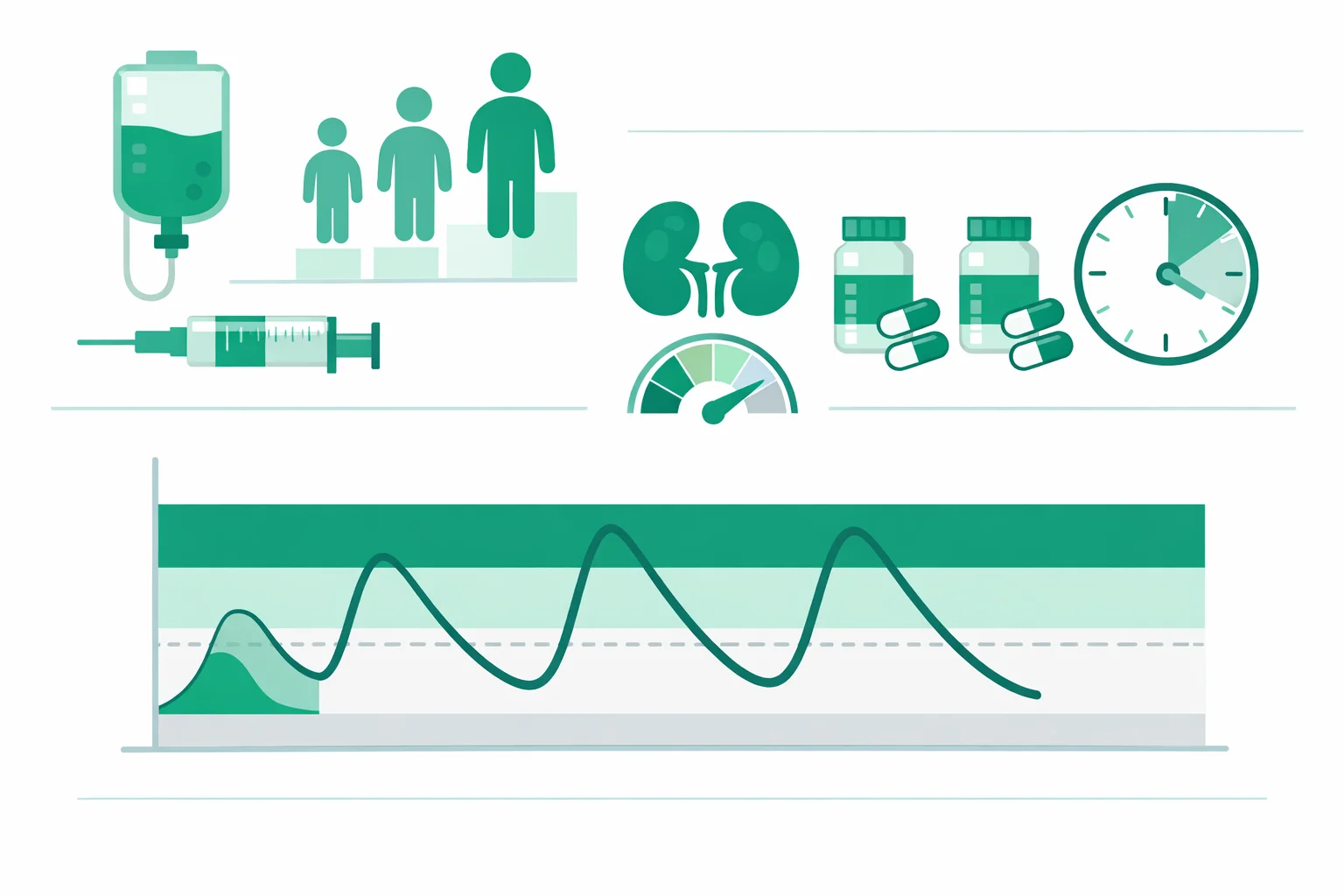
A vancomycin calculator turns four bedside numbers — age, weight, sex, and serum creatinine — into a defensible empiric IV regimen for MRSA and other gram-positive infections. The drug has a narrow therapeutic window: too little and a bacteremia smolders, too much and the kidneys take a hit. Roughly 5–15% of patients on vancomycin develop acute kidney injury, and the risk climbs sharply once the 24-hour exposure (AUC₂₄) passes 600 mg·h/L. Acting as a vancomycin loading dose calculator, dosing-interval guide, and vancomycin AUC calculator in one, this guide walks through a full worked example, explains why the loading dose and maintenance dose follow different rules, and shows how to read the estimated trough and AUC the calculator above produces.
A Worked Example: Dosing a 75 kg Patient
Take a 60-year-old man, 75 kg, 175 cm, with a serum creatinine of 1.0 mg/dL admitted with MRSA bacteremia. Start by estimating renal function with the Cockcroft-Gault equation, the same formula behind our Cockcroft-Gault calculator: CrCl = [(140 − 60) × 75] ÷ (72 × 1.0) = 6000 ÷ 72 ≈ 83 mL/min. Normal renal function, so no dose reduction is needed yet.
Now the two doses. The loading dose is 25 mg/kg × 75 kg = 1875 mg, rounded to 2000 mg IV once. The maintenance dose is 15 mg/kg × 75 kg = 1125 mg, rounded to 1000 mg. Because CrCl sits in the 70–109 mL/min band, the empiric interval is every 12 hours — a total of 2000 mg/day. Feed that regimen through a one-compartment model (volume of distribution ≈ 0.7 L/kg = 52.5 L, clearance ≈ 0.79 × CrCl) and the estimated steady-state trough lands near 12 mg/L with an AUC₂₄ of about 480 mg·h/L. Both sit comfortably inside target, which is why the calculator above flags this regimen green on first load.
Why the Loading Dose Ignores Kidney Function
New prescribers often try to shrink the loading dose for a patient with poor kidneys. That is a mistake. The loading dose fills the volume of distribution — roughly 0.7 L/kg of body water — and that volume does not change because the kidneys are failing. The IDSA/ASHP 2020 consensus guideline recommends 20–35 mg/kg of actual body weight (commonly 25–30 mg/kg) for seriously ill patients regardless of CrCl, capped around 2000–3000 mg. Skipping or cutting the load is the single biggest reason a patient spends the first 24–36 hours subtherapeutic while the infection keeps seeding.
Kidney function only governs how fast the drug leaves — and that is the maintenance dose's job. Picture filling a bathtub (loading dose) versus how far you open the drain (clearance). A clogged drain means you refill less often, not that you pour in less at the start.
How the Vancomycin Calculator Sets the Maintenance Dose and Interval
Maintenance dosing is where CrCl earns its keep. The dose per administration stays weight-based (15–20 mg/kg of actual body weight), but the interval stretches as clearance falls. A practical empiric nomogram:
| CrCl (mL/min) | Interval | Typical 70 kg daily dose |
|---|---|---|
| ≥ 110 | every 8 hours | ~3000 mg/day |
| 70–109 | every 12 hours | ~2000 mg/day |
| 40–69 | every 24 hours | ~1000–1250 mg/day |
| 20–39 | every 24–48 hours | level-guided |
| < 20 / dialysis | dose by levels | per nephrology/pharmacy |
These bands are starting points, not endpoints. A patient with CrCl 95 who is septic and volume-expanded may clear vancomycin faster than the nomogram predicts and need q8h despite "normal" numbers. For the mg/kg arithmetic itself, the same logic powers our general mg/kg dosage calculator.
AUC/MIC vs Trough: Which Target Should You Use?
For two decades clinicians chased a trough of 15–20 mg/L for serious MRSA. The 2020 guideline changed that: the efficacy target is now an AUC₂₄/MIC of 400–600 (assuming an MIC of 1 mg/L), and trough-only dosing is discouraged because it overshoots exposure and drives nephrotoxicity. Here is how the two approaches compare:
| Feature | Trough-based (old) | AUC-based (current) |
|---|---|---|
| Target | 15–20 mg/L | AUC₂₄ 400–600 |
| Sampling | 1 trough before 4th dose | 2 levels or Bayesian model |
| AKI risk | Higher (overshoots) | Lower |
| Best for | Quick bedside checks | Serious MRSA, prolonged courses |
The calculator above reports both so you can sanity-check a regimen either way: a trough of 10–15 mg/L usually corresponds to an AUC near 400–550 for typical clearance, which is why the green bands overlap. Where they diverge — say a trough of 18 with an AUC over 650 — the AUC is the one to trust.
Obesity, Low Creatinine, and Other Traps
Two patient types break naive dosing. In obesity, using total body weight in Cockcroft-Gault overestimates CrCl, so the calculator switches to adjusted body weight once total weight exceeds 1.25 × ideal body weight (IBW + 0.4 × excess) — the same correction behind our adjusted body weight calculator. The dose itself still uses actual weight, but the loading dose is capped near 3000 mg because a 150 kg patient does not need 4500 mg up front.
The second trap is the frail, low-muscle-mass patient with a serum creatinine of 0.5 mg/dL. Plugging that tiny number into the denominator inflates CrCl to 150+ mL/min and suggests aggressive q8h dosing. Many clinicians round low creatinine up to 0.8–1.0 mg/dL in elderly patients to avoid overdosing. When in doubt, anchor on a measured level rather than a flattering estimate.
Four Dosing Mistakes That Cause Failures
- Skipping the loading dose. Without it, steady state takes 3–4 half-lives (often 24–48 hours), leaving early bacteremia underexposed.
- Capping the rate too low. Vancomycin must run no faster than 1000 mg/hour to avoid "vancomycin infusion reaction" (formerly red-man syndrome); a 2000 mg dose needs at least a 2-hour infusion.
- Dosing by trough alone in renal impairment. A trough of 18 with CrCl 30 can hide an AUC well above 700 and a doubled AKI risk.
- Forgetting to recheck after fluid shifts. Sepsis resuscitation expands volume of distribution and renal clearance; a regimen that was therapeutic on day 1 can drift subtherapeutic by day 3.
When to Draw the First Level
For trough monitoring, draw the level within 30 minutes before the 4th dose, once steady state is reached. For AUC monitoring, two levels (a peak 1–2 hours post-infusion and a trough) let you calculate clearance directly, or a single trough can feed a Bayesian program. Recheck levels at least weekly, after any dose change, and whenever renal function moves by more than 50%. If kidney function is the moving target, pair this tool with our creatinine clearance calculator to track CrCl trends over the course of therapy.
One caution if an aminoglycoside is running alongside for gram-negative cover: the monitoring logic does not transfer. Vancomycin is exposure-driven and targets an AUC₂₄/MIC of 400–600, while gentamicin is peak-driven and targets a Cmax/MIC ratio of 10 or above with a trough that should be undetectable. Applying vancomycin trough thinking to an aminoglycoside produces unnecessary dose reductions, so run the second drug through our gentamicin dosing calculator rather than adapting the numbers on this page.
Used well, a vancomycin calculator gets a patient to a therapeutic regimen on day one and keeps the AUC inside 400–600 — the band where the drug clears MRSA without taxing the kidneys. The next concrete step after running your numbers above: order the loading dose now, schedule the first level before the 4th maintenance dose, and document the CrCl you assumed so the regimen can be re-checked when labs return.
References
- Rybak MJ, et al. Therapeutic Monitoring of Vancomycin for Serious MRSA Infections: ASHP/IDSA/PIDS/SIDP Consensus Guideline. Am J Health-Syst Pharm. 2020. academic.oup.com
- Cockcroft DW, Gault MH. Prediction of creatinine clearance from serum creatinine. Nephron. 1976;16(1):31–41. pubmed.ncbi.nlm.nih.gov

Written by Jurica Šinko
Founder & CEO
Entrepreneur and health information advocate, passionate about making health calculations accessible to everyone through intuitive digital tools.
View full profileFrequently Asked Questions
How is the vancomycin loading dose calculated?
The loading dose is 20–35 mg/kg of actual body weight, most often 25–30 mg/kg, capped near 2000–3000 mg. It is given once regardless of kidney function because it fills the volume of distribution. For a 75 kg patient at 25 mg/kg that is about 1875 mg, rounded to 2000 mg IV.
What is a normal vancomycin trough level?
For most infections the target trough is 10–15 mg/L; for serious MRSA it is 15–20 mg/L. Below 10 mg/L risks treatment failure and resistance, while troughs above 20 mg/L sharply raise the risk of acute kidney injury.
What is the target AUC for vancomycin?
Current guidelines target an AUC₂₄/MIC of 400–600 mg·h/L (assuming an MIC of 1 mg/L). AUC below 400 is usually subtherapeutic; above 600 the nephrotoxicity risk climbs. The 2020 ASHP/IDSA consensus now prefers AUC monitoring over trough-only dosing.
Why does the loading dose not change with kidney function?
Kidney function controls how fast vancomycin is cleared, not the volume it distributes into. The loading dose fills roughly 0.7 L/kg of body water, which is unchanged in renal failure. Only the maintenance interval is stretched as creatinine clearance falls.
How do I dose vancomycin in an obese patient?
Use actual body weight for the mg/kg dose but cap the loading dose near 3000 mg. For the Cockcroft-Gault creatinine clearance, switch to adjusted body weight once total weight exceeds 1.25 times ideal body weight to avoid overestimating renal function and overdosing.
How often should vancomycin be given based on creatinine clearance?
A common empiric nomogram gives every 8 hours for CrCl ≥ 110, every 12 hours for 70–109, every 24 hours for 40–69, and every 24–48 hours for 20–39 mL/min. Below 20 mL/min or on dialysis, dose by measured levels.
When should I draw the first vancomycin level?
For trough monitoring, draw the level within 30 minutes before the 4th dose once steady state is reached. For AUC monitoring, draw a peak 1–2 hours post-infusion plus a trough, or use a single trough with Bayesian software. Recheck weekly or after any 50% change in renal function.
Can this vancomycin calculator be used for dialysis or children?
No. This tool models adult, non-dialysis patients with stable kidney function using a one-compartment estimate. It does not apply to hemodialysis, CRRT, pediatrics, pregnancy, or unstable renal function, where dosing must follow specialist protocols and measured levels.
Related Calculators

Adjusted Body Weight Calculator — Dosing Weight (ABW)
Compute ABW for dosing with our adjusted body weight calculator, alongside IBW reference. Essential for accurate medication dosing, especially in obesity.

Alcohol Calculator: Drinks, Calories, Cost and BAC
Use our alcohol calculator to track standard drinks, alcohol calories, cost, and estimated BAC. Plan sessions, see time to sober, and make informed choices.

Alcohol Units Calculator UK — Weekly Tracking & Limits
Free alcohol units calculator for UK weekly tracking. Convert drinks to units, check against the 14-unit guideline, and see calories, standard drinks, and more.

BAC Calculator — Estimate Blood Alcohol Level by Drink
Use our BAC calculator to estimate blood alcohol levels from drinks, ABV, weight, sex, and hours. See limit markers, impairment ranges, and time to sober.

Caffeine Calculator: Daily Intake Tracker & Safe Limits
Use our caffeine calculator to total daily milligrams from coffee, tea, energy drinks, and custom doses, then check the running total against the 400 mg limit.
Carboplatin AUC Calculator — Calvert Formula Dosing
Free carboplatin AUC calculator using the Calvert formula to find chemotherapy dose in mg from target AUC, GFR, and Cockcroft-Gault creatinine clearance.