Use the Carboplatin AUC Calculator
Free carboplatin AUC calculator using the Calvert formula to find chemotherapy dose in mg from target AUC, GFR, and Cockcroft-Gault creatinine clearance.
AUC 5–6 is typical for every-3-week regimens; AUC 2 for weekly dosing. Confirm against your protocol.
Female sex applies the 0.85 Cockcroft-Gault factor and a lower Devine IBW base.
Adults 18+. Pediatric carboplatin dosing uses a different (Newell) formula.
Needed for ideal and adjusted body weight (Devine formula).
Use a recent, stable value. Very low creatinine inflates the calculated GFR and dose.
Auto switches to adjusted body weight when actual weight exceeds 120% of ideal.
Safety adjustments
Carboplatin Dose (Calvert Formula)
Dose = 5 × (63.6 + 25) = 443 mg
GFR Used in the Formula
GFR used: 63.6 mL/min
Cockcroft-Gault CrCl
63.6 mL/min
Dosing weight (Adjusted (auto))
62.1 kg
SCr used
0.9 mg/dL
Ideal body weight
56.9 kg
Adjusted body weight
62.1 kg
Max dose at 125 cap
750 mg
Dose at Other Target AUC Values
Using this patient's GFR of 63.6 mL/min. Typical uses are reference only — follow your regimen protocol.
| Target AUC | Dose | Typical Use |
|---|---|---|
| AUC 2 | 177 mg | Weekly dosing, often with radiation or weekly paclitaxel |
| AUC 3 | 266 mg | Reduced-intensity combination or frail patients |
| AUC 4 | 354 mg | Combination regimens after prior chemotherapy |
| AUC 5 ✓ | 443 mg | Common combination target (e.g., with paclitaxel or pemetrexed) |
| AUC 6 | 532 mg | Standard every-3-week combination or single-agent target |
| AUC 7.5 | 665 mg | Historic single-agent maximum in untreated patients |
Clinical disclaimer
This carboplatin AUC calculator is an educational tool for the Calvert formula. Chemotherapy doses must be verified independently by an oncologist and an oncology pharmacist against the treatment protocol, current labs, and institutional policy. Estimated GFR from serum creatinine can be unreliable in unstable renal function, extremes of body composition, amputation, or recent nephrotoxic therapy — a measured or confirmed GFR may be required.
Educational tool, not medical advice. Check this tool’s method and limitations before interpreting a result. Talk to a qualified healthcare professional before making decisions about medication, diet, exercise, or treatment. See our Terms of Use.
Your rating helps improve Carboplatin AUC Calculator. We store only an anonymized vote (no personal data).
How to Use Carboplatin AUC Calculator
Step 1: Set the target AUC
Choose the target AUC from your protocol — tap a preset (2, 4, 5, 6) or type a custom value such as 5 for a standard every-3-week doublet.
Step 2: Enter patient details
Select biological sex, then enter age, height, and actual body weight. Height feeds the ideal and adjusted body weight used in the clearance estimate.
Step 3: Enter serum creatinine
Type a recent, stable serum creatinine in mg/dL or µmol/L. This drives the Cockcroft-Gault GFR that the Calvert formula multiplies.
Step 4: Choose weight and safety options
Pick a dosing weight strategy (auto, actual, ideal, or adjusted) and keep the 125 mL/min GFR cap on. Toggle the 0.7 mg/dL creatinine floor if your center uses it.
Step 5: Read the dose
The carboplatin dose in mg appears instantly with the formula breakdown, the GFR used, and a table of doses at other AUC targets. Use Copy summary to save it.
Key Features
- Calvert formula dosing: Dose = AUC × (GFR + 25)
- Built-in Cockcroft-Gault GFR estimate from age, weight, and creatinine
- FDA 125 mL/min GFR cap and 0.7 mg/dL creatinine floor toggles
- Actual, ideal, or adjusted body weight selection for obesity
- Dose table across AUC 2 to 7.5 for the same patient
- Metric and imperial units with instant recalculation
Understanding Results
Formula
The dose comes from the Calvert equation: Dose (mg) = target AUC × (GFR + 25). Target AUC is the drug exposure your protocol wants, in mg/mL·min. GFR is the glomerular filtration rate in mL/min — here estimated as creatinine clearance from the Cockcroft-Gault equation, CrCl = [(140 − age) × weight] / (72 × serum creatinine), multiplied by 0.85 for females. The constant 25 mL/min represents carboplatin cleared by non-renal routes. Because the whole result rides on GFR, a small creatinine change moves the dose a lot: at AUC 5, a GFR of 75 gives 500 mg while a GFR of 100 gives 625 mg.
Reference Ranges & Interpretation
Target AUC is set by regimen, not by the calculator: AUC 1.5–2 for weekly schedules, AUC 4–5 for combinations or pretreated patients, and AUC 5–6 for standard every-3-week doublets. With the recommended 125 mL/min GFR cap in place, the dose ceiling is target AUC × 150 — that is 300 mg at AUC 2, 750 mg at AUC 5, and 900 mg at AUC 6. If your result exceeds those figures, the GFR cap was almost certainly turned off. Doses are commonly rounded to the nearest 5–10 mg without affecting exposure.
Assumptions & Limitations
This tool assumes an adult with stable renal function and a reliable, steady-state serum creatinine. It is not valid for pediatric dosing, which uses the Newell formula. The Cockcroft-Gault estimate loses accuracy in rapidly changing kidney function, amputation or paraplegia, pregnancy, extremes of body size, and soon after nephrotoxic therapy — situations where a measured GFR is preferable. Do not substitute a lab eGFR (mL/min/1.73 m²) without de-indexing it to absolute mL/min first. Every calculated dose must be verified by an oncologist and oncology pharmacist before administration.
Complete Guide: Carboplatin AUC Calculator
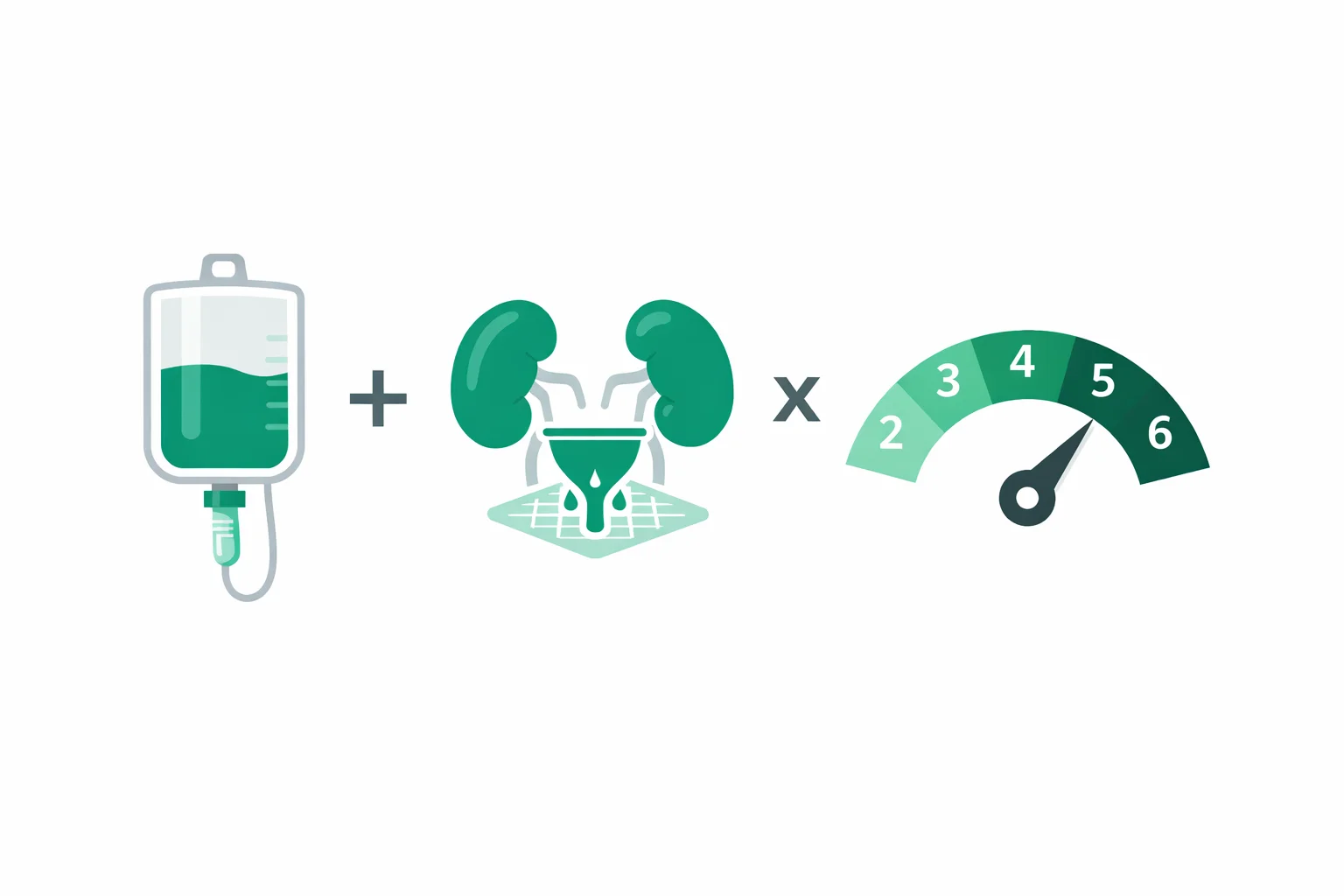
A carboplatin AUC calculator does something no mg/m² dosing chart can: it doses a chemotherapy drug by how fast the patient's kidneys clear it, not by how large the patient is. Nearly every other cytotoxic drug is dosed by body surface area. Carboplatin isn't — and that single exception, formalized by the Calvert formula in 1989, is why an oncology pharmacist needs a serum creatinine before the pharmacy will release a single bag. This guide compares AUC-based dosing against BSA-based dosing, walks through a full Calvert calculation, and explains the two safety adjustments — the 125 mL/min GFR cap and the 0.7 mg/dL creatinine floor — that separate a defensible dose from a dangerous one.
Table of Contents
- Why Carboplatin Skips mg/m² When Almost Every Other Drug Uses It
- The Calvert Formula, Worked Step by Step
- How This Carboplatin AUC Calculator Handles the 125 mL/min Cap
- Actual, Ideal, or Adjusted: Which Weight Belongs in Cockcroft-Gault?
- AUC 2 vs. AUC 5 vs. AUC 6: Matching the Target to the Regimen
- When the Calvert Formula Misleads
- References
Why Carboplatin Skips mg/m² When Almost Every Other Drug Uses It
Carboplatin is eliminated almost entirely by the kidneys, largely as unchanged drug filtered at the glomerulus. Its dose-limiting toxicity — thrombocytopenia, with the platelet nadir typically landing 14 to 21 days after infusion — tracks the drug's plasma exposure (the area under the concentration-time curve, or AUC), not the patient's size. Calvert and colleagues showed in 1989 that two patients with identical body surface area but different renal function can have wildly different exposure from the same mg/m² dose. Dosing to a target AUC in mg/mL·min fixes that: you pick the exposure you want, measure how fast the patient clears the drug, and solve for the milligrams.
| Dimension | BSA dosing (mg/m²) | AUC dosing (Calvert) |
|---|---|---|
| Dose driver | Body size (height + weight via BSA) | Renal drug clearance (GFR) |
| Formula | Dose = mg/m² × BSA | Dose = target AUC × (GFR + 25) |
| What it corrects for | Larger bodies distribute more drug | Slower kidneys retain more drug |
| Failure mode | Overdoses renal impairment; underdoses fast clearers | Only as good as the GFR estimate fed into it |
| Typical drugs | Paclitaxel, cisplatin, doxorubicin | Carboplatin (adults) |
Notice what's missing from the Calvert equation: body surface area doesn't appear at all. Height and weight still matter, but only indirectly — they feed the Cockcroft-Gault clearance estimate. If a regimen pairs carboplatin with a BSA-dosed partner like paclitaxel, you'll still need a BSA calculator for the partner drug, which is why chemotherapy orders routinely carry both numbers.
The Calvert Formula, Worked Step by Step
The equation itself is short: Dose (mg) = target AUC × (GFR + 25). The 25 isn't arbitrary — it represents non-renal platinum clearance in mL/min, the small fraction of carboplatin the body eliminates even if the kidneys contributed nothing. Since few clinics measure GFR directly with a tracer, everyday practice substitutes creatinine clearance from the Cockcroft-Gault equation. Here's the full chain for a 62-year-old woman, 165 cm, 70 kg, serum creatinine 0.9 mg/dL, targeting AUC 5:
- Cockcroft-Gault numerator: (140 − 62) × 70 kg = 5,460
- Denominator: 72 × 0.9 mg/dL = 64.8
- 5,460 ÷ 64.8 = 84.3, then × 0.85 (female factor) = 71.6 mL/min
- Calvert: 5 × (71.6 + 25) = 5 × 96.6 = 483 mg
Most infusion pharmacies round that to 480 or 485 mg — rounding within about 5% of the calculated dose is standard practice and doesn't meaningfully change exposure. What does change exposure is the creatinine. Drop it from 0.9 to 0.6 mg/dL in the same patient and clearance jumps to 107.4 mL/min, pushing the AUC 5 dose to 662 mg — a 37% increase from a lab shift that might reflect low muscle mass rather than better kidneys. That sensitivity is the entire reason the safety adjustments below exist.
How This Carboplatin AUC Calculator Handles the 125 mL/min Cap
In 2010, US laboratories standardized creatinine assays to IDMS (isotope dilution mass spectrometry), which reads roughly 10–20% lower than older methods at normal levels. Lower creatinine in the denominator means Cockcroft-Gault silently inflated everyone's clearance overnight — and with it, every Calvert dose. The FDA and the National Cancer Institute responded by recommending that estimated GFR be capped at 125 mL/min for carboplatin dosing. The cap puts a ceiling on the dose: maximum dose = target AUC × 150. That works out to 900 mg at AUC 6, 750 mg at AUC 5, 600 mg at AUC 4, and 300 mg at AUC 2. Our carboplatin AUC calculator applies the cap by default and shows both the uncapped clearance and the capped GFR whenever they differ, so you can see exactly when the ceiling engaged.
Many institutions layer on a second guard: flooring serum creatinine at 0.7 mg/dL before calculating clearance. A creatinine of 0.4 mg/dL in a cachectic 55 kg patient usually signals depleted muscle mass, not supranormal filtration. Without the floor, that 0.4 turns into a clearance estimate near double the true value. The calculator offers the floor as a toggle because practice varies — some centers cap, some floor, some do both. Neither adjustment is optional thinking; skipping both after 2010 is how AUC 6 orders quietly became AUC 7.5 exposures.
Actual, Ideal, or Adjusted: Which Weight Belongs in Cockcroft-Gault?
Cockcroft-Gault was derived in 1976 from mostly normal-weight men, and it assumes weight is a proxy for muscle mass. In obesity that assumption breaks — adipose tissue doesn't generate creatinine — so actual body weight overestimates clearance. The common institutional rule: when actual weight exceeds 120% of ideal body weight (Devine formula: 50 kg for men or 45.5 kg for women, plus 2.3 kg per inch over 5 feet), switch to adjusted body weight, calculated as IBW + 0.4 × (actual − IBW).
The stakes are concrete. Take a 60-year-old man, 170 cm, 110 kg, creatinine 1.0 mg/dL. His Devine IBW is 65.9 kg, and 110 kg is 167% of that, so adjusted weight applies: 65.9 + 0.4 × 44.1 = 83.5 kg. Run both through Cockcroft-Gault and you get 122 mL/min with actual weight versus 93 mL/min with adjusted — at AUC 6 that's an 883 mg dose versus 707 mg, a 176 mg gap from the weight choice alone. Notably, the 2021 ASCO guideline on dosing obese adults with cancer endorses keeping the full calculated AUC dose (with a capped GFR) rather than applying arbitrary reductions for obesity — the correction belongs in the clearance estimate, not in a haircut to the final dose. For a deeper look at how weight choices shift clearance itself, see our creatinine clearance calculator.
AUC 2 vs. AUC 5 vs. AUC 6: Matching the Target to the Regimen
The target AUC is a protocol decision, not a calculation. Higher targets buy more tumor kill at the price of deeper platelet nadirs; in Calvert's original series, exposures much above AUC 7 added toxicity without added response in pretreated patients. Typical assignments look like this:
| Target AUC | Typical setting | Max dose (125 cap) |
|---|---|---|
| 1.5–2 | Weekly dosing, often with radiation or weekly paclitaxel | 225–300 mg |
| 4–5 | Combination regimens, heavily pretreated or frail patients | 600–750 mg |
| 5–6 | Standard every-3-week doublets (e.g., with paclitaxel or pemetrexed) | 750–900 mg |
| 6–7.5 | Single-agent dosing in untreated patients (historic upper range) | 900–1,125 mg |
Two patterns worth internalizing. First, prior chemotherapy shifts targets down roughly one AUC unit — Calvert's group recommended AUC 5 rather than 6–7 for pretreated patients because marrow reserve is already spent. Second, the same target produces very different milligram doses across patients: at AUC 5, a fit 45-year-old clearing 120 mL/min gets 725 mg while an 80-year-old clearing 40 mL/min gets 325 mg. Both receive the same exposure. That's the formula working as designed, not an error to "fix" by averaging.
When the Calvert Formula Misleads
Every weakness of the Calvert method is really a weakness of the GFR estimate underneath it. The original study measured GFR directly with chromium-51 EDTA — a tracer study most clinics never run — in patients whose clearance ranged from 33 to 136 mL/min. Substituting Cockcroft-Gault works acceptably inside that range but degrades at the edges. Be skeptical when creatinine is actively rising or falling (a single value assumes steady state), after amputation or in paraplegia (muscle mass no longer matches the age-weight assumption), in pregnancy, or within weeks of nephrotoxic therapy like cisplatin. In those cases a measured urine collection or nuclear medicine GFR beats any equation.
One more trap: substituting a lab-reported eGFR directly into Calvert. Laboratory eGFR from CKD-EPI or MDRD is normalized to 1.73 m² of body surface area (units of mL/min/1.73 m²), while Calvert needs an absolute clearance in mL/min. For a patient whose BSA is far from 1.73 m² — say a 1.45 m² elderly woman or a 2.2 m² tall man — the normalized value must be de-indexed by multiplying by BSA/1.73 first, or the dose lands 15–25% off. Our eGFR calculator explains that normalization in detail. When in doubt, the Cockcroft-Gault route with a sensible weight and the 125 mL/min cap remains the convention most protocols and the NCI guidance assume.
References
- Calvert AH, Newell DR, Gumbrell LA, et al. Carboplatin dosage: prospective evaluation of a simple formula based on renal function. J Clin Oncol. 1989;7(11):1748–1756. PubMed
- National Cancer Institute, Cancer Therapy Evaluation Program. Carboplatin dosing recommendations following IDMS standardization of serum creatinine. CTEP Guidance
- Griggs JJ, Bohlke K, Balaban EP, et al. Appropriate systemic therapy dosing for obese adult patients with cancer: ASCO guideline update. J Clin Oncol. 2021;39(18):2037–2048. PubMed

Written by Jurica Šinko
Founder & CEO
Entrepreneur and health information advocate, passionate about making health calculations accessible to everyone through intuitive digital tools.
View full profileFrequently Asked Questions
What is the Calvert formula for carboplatin dosing?
The Calvert formula is Dose (mg) = target AUC × (GFR + 25). The target AUC (usually 2 to 6 mg/mL·min) sets the drug exposure, GFR is the glomerular filtration rate in mL/min, and 25 accounts for non-renal clearance. For AUC 5 and a GFR of 75 mL/min, the dose is 5 × (75 + 25) = 500 mg.
How do you calculate a carboplatin AUC 5 dose?
Multiply 5 by the sum of the patient GFR and 25. Estimate GFR from serum creatinine using the Cockcroft-Gault equation, then apply Dose = 5 × (GFR + 25). A patient with a GFR of 80 mL/min gets 5 × 105 = 525 mg; a patient with a GFR of 40 mL/min gets 5 × 65 = 325 mg for the same AUC target.
Why is GFR capped at 125 mL/min for carboplatin?
Since US labs standardized creatinine to IDMS methods in 2010, estimated GFR reads about 10 to 20 percent higher, which inflated Calvert doses. The FDA and NCI recommend capping GFR at 125 mL/min, which limits the dose to target AUC × 150 — for example 750 mg at AUC 5 and 900 mg at AUC 6.
What is the maximum carboplatin dose at AUC 6?
With GFR capped at 125 mL/min, the maximum AUC 6 dose is 6 × (125 + 25) = 900 mg. At AUC 5 the ceiling is 750 mg, and at AUC 2 it is 300 mg. Doses above these usually mean the GFR cap was not applied.
Should I use actual or ideal body weight for carboplatin?
Use actual body weight unless the patient is obese. When actual weight exceeds 120 percent of ideal body weight, most centers switch to adjusted body weight, calculated as IBW + 0.4 × (actual − IBW), inside the Cockcroft-Gault clearance estimate. This prevents the dose from being overstated by excess fat mass.
Can I use a lab eGFR instead of Cockcroft-Gault for the Calvert formula?
Not directly. A lab eGFR from CKD-EPI or MDRD is normalized to 1.73 m² body surface area, while Calvert needs absolute clearance in mL/min. De-index it first by multiplying by the patient BSA divided by 1.73. For a patient with a BSA of 1.45 m², skipping this step overstates GFR by about 19 percent.
What target AUC is used with paclitaxel for carboplatin?
Standard every-3-week carboplatin-paclitaxel regimens target AUC 5 to 6. Weekly schedules use a lower target near AUC 2. Heavily pretreated patients are often dosed at AUC 5 rather than 6 because their bone marrow reserve is reduced, lowering the platelet nadir risk.
Related Calculators

Adjusted Body Weight Calculator — Dosing Weight (ABW)
Compute ABW for dosing with our adjusted body weight calculator, alongside IBW reference. Essential for accurate medication dosing, especially in obesity.

Alcohol Calculator: Drinks, Calories, Cost and BAC
Use our alcohol calculator to track standard drinks, alcohol calories, cost, and estimated BAC. Plan sessions, see time to sober, and make informed choices.

Alcohol Units Calculator UK — Weekly Tracking & Limits
Free alcohol units calculator for UK weekly tracking. Convert drinks to units, check against the 14-unit guideline, and see calories, standard drinks, and more.

BAC Calculator — Estimate Blood Alcohol Level by Drink
Use our BAC calculator to estimate blood alcohol levels from drinks, ABV, weight, sex, and hours. See limit markers, impairment ranges, and time to sober.

Caffeine Calculator: Daily Intake Tracker & Safe Limits
Use our caffeine calculator to total daily milligrams from coffee, tea, energy drinks, and custom doses, then check the running total against the 400 mg limit.
Cockcroft-Gault Calculator — Equation, Formula & Dosing
Free Cockcroft-Gault calculator using the original 1976 equation and formula. Enter age, weight, sex, and serum creatinine to get renal dose adjustments.