Use the STOP-BANG Calculator
Free STOP-BANG calculator: score all 8 obstructive sleep apnea risk factors, apply the refined rule that escalates borderline 3-4 scores, and act on it.
STOP-BANG score (out of 8)
6 of 8 criteria met
| 3 = positive screen| 5 = high risk
STOP — the four symptom questions
Each “yes” scores one point. Ask a bed partner about the snoring and breathing-pause questions if you can — self-report misses observed apneas badly.
BANG — the four measured factors
BMI, Age, Neck circumference and Gender. Measure your neck around the Adam's apple, or read your dress-shirt collar size.
Scores a point above 50 — strictly over 50, so exactly 50 scores nothing.
Male scores a point, and also sets the neck threshold to 43 cm / 17 in.
Scores a point at 43 cm or more for men. Equivalent to your collar size.
Calculated BMI
30.9
Scores a point only above 35 kg/m²
Your STOP-BANG result
Total score
6
out of 8
Risk category
High risk
5 – 8 points
STOP subscore
3 / 4
symptoms
BANG subscore
3 / 4
demographics
Where your points came from
- Snoring loudly+1
- Tired or sleepy in the daytime+1
- Observed apnea, choking or gasping0
- Pressure — hypertension, treated or not+1
- BMI over 35 kg/m²0
- Age over 50 years+1
- Neck circumference ≥ 43 cm+1
- Gender — male+1
Symptoms vs. body factors
A 4 made of four BANG points is a 58-year-old man with a thick neck and obesity who sleeps fine. A 4 made of four STOP points is someone whose partner watches them stop breathing. Identical totals, very different pre-test probabilities — which is precisely why the refined rule looks at the STOP subscore instead of the total.
| Score | Risk category | What it means |
|---|---|---|
| 0 – 2 | Low risk | Moderate-to-severe OSA is unlikely. A score of 2 or less has a high negative predictive value — this is the one thing STOP-BANG does really well. |
| 3 – 4 | Intermediate | A positive screen, but the least decisive band. Apply the refined rule below before deciding whether to test. |
| 5 – 8 | High risk | Specificity finally becomes useful here. A sleep study is generally warranted, and perioperative precautions apply before surgery. |
How well a score of 3 or more actually performs
| Target | Severity | Sensitivity | Specificity |
|---|---|---|---|
| Any OSA | AHI > 5 | 83.6% | 56.4% |
| Moderate-to-severe OSA | AHI > 15 | 92.9% | 43.0% |
| Severe OSA | AHI > 30 | 100% | 37.0% |
From the original surgical validation of 746 patients (Chung et al., 2008). Read the two columns together: a score of 3 or more catches essentially every case of severe apnea, and in exchange it labels roughly six in ten healthy people as positive. STOP-BANG is built to rule out, not to rule in.
Your STOP-BANG score is 6 / 8, which places you in the high risk of moderate-to-severe obstructive sleep apnea category. Specificity finally becomes useful here. A sleep study is generally warranted, and perioperative precautions apply before surgery.
If you have surgery coming up
STOP-BANG was designed in a pre-operative clinic, and that is still where it carries the most weight. Undiagnosed OSA raises the risk of post-operative respiratory complications, so a score of 6 usually prompts anesthesia to plan for it — careful opioid dosing, extended recovery-room monitoring, and sometimes a sleep study before an elective operation. Tell the pre-admission team your score rather than waiting to be asked. If daytime sleepiness is your main symptom, pair this with the Epworth Sleepiness Scale, which measures something STOP-BANG never asks about.
The STOP-BANG questionnaire screens for the risk of obstructive sleep apnea. It cannot diagnose it, cannot grade its severity, and cannot replace a home sleep apnea test or in-lab polysomnography — only a sleep study measures your apnea-hypopnea index. A low score does not rule OSA out in someone with strong symptoms. Nothing you enter here leaves your browser.
Educational tool, not medical advice. Check this tool’s method and limitations before interpreting a result. Talk to a qualified healthcare professional before making decisions about medication, diet, exercise, or treatment. See our Terms of Use.
Your rating helps improve STOP-BANG Calculator. We store only an anonymized vote (no personal data).
How to Use STOP-BANG Calculator
Step 1: Answer the four STOP questions
Tap Yes or No for loud snoring, daytime tiredness, observed breathing pauses, and high blood pressure. Ask a bed partner about the snoring and apnea questions - self-report misses witnessed apneas badly, and that item is the strongest predictor of the eight.
Step 2: Enter age, height and weight
Type your age in years, then your height and weight in metric or imperial using the unit toggle. BMI is calculated for you and scores a point only above 35 kg/m squared, not 30.
Step 3: Measure your neck and set sex at birth
Measure around the Adam’s apple, or use your dress-shirt collar size. The threshold is sex-specific: 43 cm (17 in) for men, 41 cm (16 in) for women. Choosing Male also adds the eighth point.
Step 4: Read your score and risk band
The sticky bar shows your total out of 8 with markers at 3 (positive screen) and 5 (high risk). Low is 0-2, intermediate 3-4, and high 5-8.
Step 5: Check the refined-rule banner
If you scored 3 or 4, the calculator applies Chung’s 2016 refinement and tells you whether your score escalates to high risk - or explains exactly which condition you failed.
Step 6: Copy your summary
Use Copy summary to save a dated, item-by-item record with your STOP and BANG subscores. Bring it to a pre-admission clinic or GP appointment instead of describing your snoring from memory.
Key Features
- All 8 official STOP-BANG items with BMI calculated for you
- Refined 2016 rule that escalates borderline 3-4 scores to high risk
- Sex-specific neck thresholds: 43 cm for men, 41 cm for women
- STOP symptom subscore separated from BANG body factors
- Sensitivity and specificity table for the cut-off of 3
- Copy-ready summary for a pre-operative or GP appointment
Understanding Results
How the STOP-BANG Calculator Scores Your Answers
There is no equation — the total is a plain count of eight yes-or-no criteria, one point each, for a score of 0 to 8. Four are symptoms you report (Snoring loud enough to be heard through a closed door, Tiredness in the daytime, Observed apneas or gasping, and Pressure meaning hypertension treated or not). Four are measured (BMI above 35 kg/m², Age above 50, Neck circumference of 43 cm/17 in for men or 41 cm/16 in for women, and Gender male). Note that BMI and age use strict inequalities: a BMI of exactly 35 or an age of exactly 50 scores zero. This calculator also reports the STOP subscore separately, because the refined 2016 rule depends on it rather than on the total.
Reference Ranges & Interpretation
The published bands are 0–2 low risk, 3–4 intermediate risk, and 5–8 high risk of moderate-to-severe obstructive sleep apnea. In the original validation of 746 surgical patients (Chung et al., Anesthesiology, 2008), a cut-off of 3 gave sensitivity of 83.6% for any OSA (AHI > 5), 92.9% for moderate-to-severe disease (AHI > 15), and 100% for severe disease (AHI > 30), against specificities of 56.4%, 43.0% and 37.0% respectively. Read those columns together: the questionnaire is built to rule out rather than rule in, so a low score is far more informative than a high one. The 2016 Chest refinement escalates a 3 or 4 to high risk when at least 2 STOP items are positive plus one of male sex, BMI above 35, or a neck at the sex-specific threshold.
Assumptions & Limitations
STOP-BANG estimates risk; it cannot diagnose sleep apnea or grade its severity, and the score bears no relationship to the apnea-hypopnea index a sleep study would produce. It was derived in a pre-operative surgical population, which is where its performance is best characterised. Because the gender item is fixed, a woman scores one point lower than a man with identical symptoms and anatomy, and the three escalation factors in the refined rule lean the same way — so a woman with witnessed apneas can sit in the intermediate band while an equivalent man is high risk. Lean adults with craniofacial contributors such as retrognathia, large tonsils or a high-arched palate can carry severe apnea with a score of 2, and adults under 50 automatically forfeit the age point. Two items also depend on information you may not have: witnessed apneas need a bed partner, and untreated, undiagnosed hypertension will be answered “no”. Persistent symptoms should be investigated regardless of the total.
Complete Guide: STOP-BANG Calculator
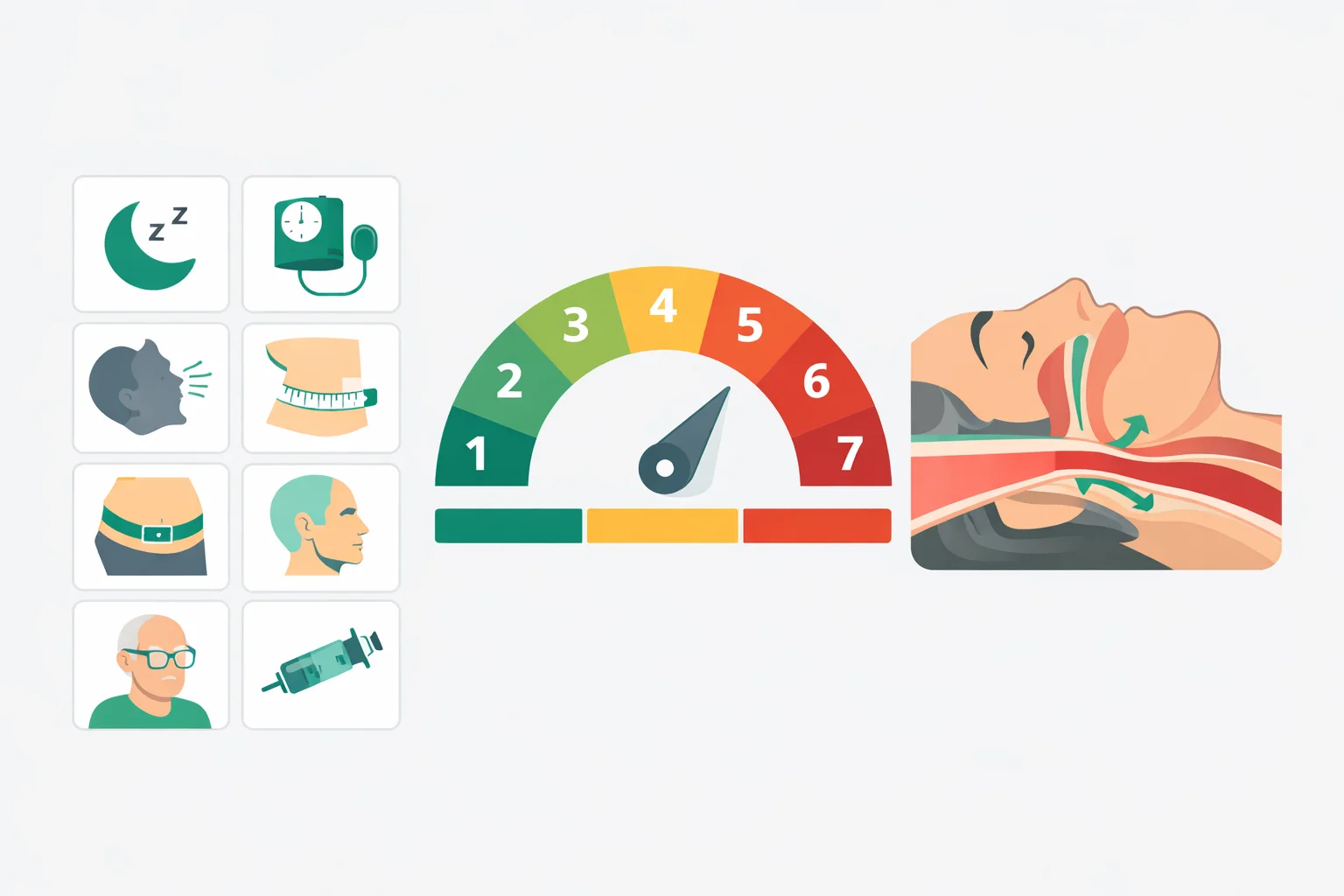
On this page
- Two men, the same score of 4, two different answers
- The eight items and the thresholds people get wrong
- Why a score of 3 barely narrows anything down
- The refined rule that rescues the 3–4 band
- Where the score under-reads: women and thin sleepers
- A score of 6 is not an AHI of 6
- You scored 5 or more. What happens next?
- References
Most people meet a STOP-BANG calculator about three weeks before an operation, in a pre-admission clinic, when a nurse asks whether anyone has ever seen them stop breathing in their sleep. That is not an accident of history. Frances Chung’s group at the University of Toronto built the questionnaire in 2008 specifically to find surgical patients with undiagnosed obstructive sleep apnea before an anesthetist gave them opioids and sent them to a quiet ward. Eight yes-or-no items, one point each, a total between 0 and 8. What follows is how those eight points are actually assigned, why two people with the same total can leave the clinic on different pathways, and why the score is far better at clearing you than at convicting you.
Two Men, the Same Score of 4, Two Different Answers
Take Tom, 58, booked for a knee replacement. He takes ramipril for blood pressure, his BMI is 31, and his collar size is 44 cm. He sleeps quietly, wakes refreshed, and his wife has never noticed anything odd. He scores a point for pressure, a point for being over 50, a point for the neck measurement, and a point for being male. Total: 4. Every one of those points came from the BANG half — the demographic half. His STOP subscore is 1.
Now take Ray, 46, booked for the same operation. BMI 33, neck 40 cm, no hypertension, and he is under 50 — so he scores nothing at all for BMI, age or neck. But he snores loudly enough to be heard through a shut door, he is exhausted by mid-afternoon, and his partner has watched him stop breathing and gasp awake. That is three STOP points plus one for being male. Total: 4.
Identical totals, and on the classic 0–8 reading both men are simply “intermediate risk.” Clinically they are not remotely the same. Tom has a set of statistical risk markers and no symptoms; Ray has witnessed apneas, which is the single most predictive item on the questionnaire. The refined scoring rule described below separates them: Ray is escalated to high risk, Tom is not. If you enter both profiles into the calculator above you will see the escalation banner fire for one and not the other — that is the mechanism doing its job.
The Eight Items and the Thresholds People Get Wrong
Four items are subjective (STOP) and four are measured (BANG). The measured four are where most online versions quietly drift from the official questionnaire, so they are worth stating precisely.
| Letter | Item | Scores a point when |
|---|---|---|
| S | Snoring | Loud enough to be heard through a closed door |
| T | Tiredness | Often tired, fatigued or sleepy in the daytime |
| O | Observed apnea | Someone has seen you stop breathing, choke or gasp |
| P | Pressure | Hypertension, treated or untreated |
| B | BMI | Above 35 kg/m² — not 30, and not 35 exactly |
| A | Age | Above 50 years — 50 on the nose scores zero |
| N | Neck | 43 cm / 17 in or more for men; 41 cm / 16 in for women |
| G | Gender | Male |
Two of those routinely trip people up. The BMI cut-off is 35, not 30 — a BMI of 33 scores nothing here even though it is firmly in the obese range, which surprises people who have just checked their BMI with our adult BMI calculator. And the neck threshold is sex-specific on the current questionnaire: 43 cm for men, 41 cm for women. The 2008 paper used a single 40 cm cut-off for everyone, and plenty of calculators still do, which inflates scores for men with average necks. Measure around the Adam’s apple with a soft tape, or just read your dress-shirt collar size. The blood pressure item counts treated hypertension too — if you are on medication and your reading is now normal, you still score the point, so check what your blood pressure category actually was before treatment.
Why a Score of 3 Barely Narrows Anything Down
The conventional positive screen is 3 or more, and it is a deliberately blunt instrument. In the original validation of 746 surgical patients, a cut-off of 3 detected 83.6% of any obstructive sleep apnea (AHI above 5), 92.9% of moderate-to-severe disease (AHI above 15), and 100% of severe disease (AHI above 30). Those are excellent catch rates. The price is specificity: 56.4%, 43.0% and 37.0% respectively. At the severe end, the questionnaire misses nobody and flags roughly six in ten healthy people along the way.
That trade-off is the whole design philosophy, and it inverts how most people read a screening result. STOP-BANG is a rule-out tool. A score of 0–2 is genuinely reassuring, because a test with 100% sensitivity for severe disease cannot return a negative in someone who has it. A score of 3 is close to a coin toss. The pooled meta-analysis by Nagappa and colleagues across 17 studies and 8,047 patients found the same pattern holds outside the operating theatre: high sensitivity, mediocre specificity, and a negative result that is worth far more than a positive one.
Consider what a 3 can be made of. A 51-year-old man with treated blood pressure has already scored 3 before anyone asks a single question about his sleep. He has no symptoms whatsoever. He is, on paper, a positive screen. This is why the 3–4 band frustrates clinicians and why the refinement below exists.
The Refined Rule That Rescues the 3–4 Band
In 2016 Chung, Abdullah and Liao published a refinement in Chest aimed squarely at the mushy middle. Instead of treating every 3 and 4 alike, it asks a second question: how many of those points came from the STOP half? The rule escalates a 3 or 4 to high risk when at least two STOP items are positive and at least one of three specific body factors is also present:
- STOP score of 2 or more plus male sex
- STOP score of 2 or more plus BMI above 35 kg/m²
- STOP score of 2 or more plus a neck of 43 cm (men) or 41 cm (women)
Run Tom and Ray back through it. Tom’s STOP subscore is 1, so he fails the first condition immediately and stays intermediate despite his 44 cm neck. Ray has a STOP subscore of 3 and is male, so his 4 becomes a high-risk 4. The refinement effectively says that symptoms are the engine and body factors are the amplifier — a pile of demographic points with a silent night is a much weaker signal than the same total built from snoring, exhaustion and witnessed apneas. The calculator above applies this rule automatically and tells you which condition triggered, or why none did.
Where the Score Under-Reads: Women and Thin Sleepers
Here is an uncomfortable consequence worth sitting with. Give Ray’s exact symptoms to a 46-year-old woman — BMI 33, neck 40 cm, loud snoring, daytime exhaustion, witnessed breathing pauses, no hypertension. She scores S, T and O for a total of 3, one point lower than Ray, purely because the G point is unavailable to her. Then apply the refined rule: her STOP subscore is 3, so she clears the first condition, but she is not male, her BMI is under 35, and her 40 cm neck sits below the 41 cm female threshold. Nothing escalates. She lands in intermediate risk with the same witnessed apneas that put Ray in the high-risk column.
That is not a flaw in the arithmetic; it reflects real epidemiology, since OSA is roughly two to three times more common in men. But it does mean the questionnaire is structurally less sensitive in women, who also tend to present differently — insomnia, morning headache and fatigue rather than thunderous snoring and observed apneas. The practical response is to weight a woman’s symptom pattern more heavily than her total, and to treat any positive O item as significant on its own regardless of the band it lands in. The same caution applies to lean patients with craniofacial factors such as a small or set-back jaw, large tonsils or a high-arched palate: airway anatomy causes apnea, and BMI is only a crude proxy for it. A slim 35-year-old with retrognathia can have an AHI of 40 and a STOP-BANG of 2.
A Score of 6 Is Not an AHI of 6
This confusion comes up constantly, so it is worth being blunt: the STOP-BANG score and the apnea-hypopnea index are unrelated numbers that happen to share a similar range. Your score is a count of risk factors out of 8. The AHI is the number of times per hour your breathing stops or shallows during a sleep study — 5 to 15 is mild, 15 to 30 moderate, above 30 severe. A STOP-BANG of 6 tells you a sleep study is justified. It tells you nothing about what that study will find.
Only a sleep study produces an AHI, and there are two kinds. A home sleep apnea test straps a few sensors to your chest and finger and is the usual next step for someone with a high STOP-BANG and no complicating conditions. In-lab polysomnography adds EEG, leg leads and video, and is reserved for suspected central apnea, significant heart or lung disease, or a negative home test in someone who still clearly has symptoms. If your main complaint is daytime sleepiness rather than the airway itself, the Epworth Sleepiness Scale calculator measures a genuinely different quantity — sleep propensity — and correlates only weakly with the AHI, which is exactly why the two questionnaires are used together rather than interchangeably. If snoring is the thing driving you to look this up, our snoring severity calculator works through the positional and nasal triggers that STOP-BANG reduces to a single yes-or-no box.
You Scored 5 or More. What Happens Next?
A score of 5 to 8 is where specificity finally becomes useful, and it should produce an action rather than a note to self. Three concrete steps, in order:
- Ask for a sleep study by name. “My STOP-BANG is 6, including witnessed apneas — can I be referred for a home sleep apnea test?” is a far more efficient sentence than “I think I snore a lot.” Bring the copied summary from the calculator; the item-by-item breakdown is what a clinician actually needs.
- Tell the pre-admission team before any operation. This is the setting the tool was built for. A high score typically changes anesthetic planning — more conservative opioid dosing, longer recovery-room monitoring with oximetry, and occasionally a sleep study before an elective procedure goes ahead. The Society of Anesthesia and Sleep Medicine explicitly endorses STOP-BANG for this purpose.
- Do not stop at “lose weight.” Weight loss genuinely helps — a 10% reduction in body weight is associated with roughly a 26% fall in AHI — but it takes months and does not treat tonight. Positional therapy for supine-dominant apnea, treating nasal obstruction, and avoiding alcohol within three hours of bed all act sooner. None of them substitutes for a diagnosis.
And if you scored 0 to 2 with no symptoms at all, take the reassurance seriously — that is the one verdict this questionnaire delivers with real confidence. If you scored 0 to 2 but still wake unrefreshed every morning, the problem is more likely to be sleep quantity or insomnia than a collapsing airway; the sleep debt calculator is the more useful place to look next.
References
- Chung F, Yegneswaran B, Liao P, et al. STOP Questionnaire: A Tool to Screen Patients for Obstructive Sleep Apnea. Anesthesiology. 2008;108(5):812–821. PubMed
- Chung F, Abdullah HR, Liao P. STOP-Bang Questionnaire: A Practical Approach to Screen for Obstructive Sleep Apnea. Chest. 2016;149(3):631–638. PubMed
- Nagappa M, Liao P, Wong J, et al. Validation of the STOP-Bang Questionnaire as a Screening Tool for Obstructive Sleep Apnea among Different Populations: A Systematic Review and Meta-Analysis. PLoS One. 2015;10(12):e0143697. PubMed
- American Academy of Sleep Medicine. Obstructive Sleep Apnea — patient information and severity definitions. sleepeducation.org

Written by Jurica Šinko
Founder & CEO
Entrepreneur and health information advocate, passionate about making health calculations accessible to everyone through intuitive digital tools.
View full profileFrequently Asked Questions
What is a bad STOP-BANG score?
A score of 5 to 8 is the high-risk band and is the one worth acting on, because that is where the questionnaire finally becomes specific enough to be useful. Scores of 3 to 4 are a positive screen but only about as informative as a coin toss on their own. A score of 0 to 2 is genuinely reassuring for moderate-to-severe apnea.
Is a STOP-BANG score of 3 bad?
A 3 is technically positive but weak on its own. A 51-year-old man treated for blood pressure scores 3 before anyone asks a single question about his sleep. What matters is where those points came from: under the 2016 refinement, a 3 or 4 counts as high risk only when at least 2 of the 4 STOP symptom items are positive AND you are male, have a BMI above 35, or have a large neck.
What neck size counts for the STOP-BANG questionnaire?
On the current questionnaire the threshold is 43 cm (17 inches) for men and 41 cm (16 inches) for women, measured around the Adam’s apple. Your dress-shirt collar size is a fair substitute. The original 2008 paper used a single 40 cm cut-off for everybody, and calculators still using it will over-score men with average necks by one point.
Does a BMI of 32 score a point on STOP-BANG?
No. The BMI item only scores above 35 kg/m squared, so a BMI of 32 or 35.0 exactly earns nothing, even though 32 sits well inside the obese range. This surprises people constantly. The age item works the same way - it needs age above 50, so someone who is exactly 50 scores zero for it.
Can you have sleep apnea with a low STOP-BANG score?
Yes, and three groups are missed most often. Women cannot score the gender point, so identical symptoms score one point lower than in a man. Lean people with craniofacial factors - a set-back jaw, large tonsils, a high-arched palate - can have an apnea-hypopnea index above 30 with a STOP-BANG of 2. Adults under 50 lose the age point automatically. Persistent symptoms outrank a low score.
What STOP-BANG score requires a sleep study?
A score of 5 or more usually justifies referral for a home sleep apnea test, as does a 3 or 4 that escalates under the refined rule. Witnessed breathing pauses are worth raising at any total, since that item predicts apnea better than any other. The decision is also driven by context: an upcoming operation lowers the threshold for testing considerably.
Why does STOP-BANG give men an automatic point?
Because obstructive sleep apnea is roughly two to three times more common in men, so male sex carries real predictive weight. The side effect is that the questionnaire is structurally less sensitive in women, whose symptoms also skew toward insomnia, fatigue and morning headache rather than window-rattling snoring. Weight a woman’s symptom pattern more heavily than her total.
Is a STOP-BANG score of 6 the same as an AHI of 6?
No - they are unrelated numbers that happen to share a similar range. The STOP-BANG score counts risk factors out of 8. The apnea-hypopnea index counts breathing events per hour during a sleep study, where 5 to 15 is mild, 15 to 30 moderate, and above 30 severe. A STOP-BANG of 6 says a sleep study is justified; it predicts nothing about what that study will measure.
Related Calculators
ADHD Test: Free Adult ASRS Screening Score, 18 Items
Free ADHD test using the WHO ASRS v1.1 screener. Answer 18 questions, score Part A against the cut-off of 4, then rule out the four conditions that mimic it.

Anxiety Calculator: Test Your Anxiety Symptom Level
Use our anxiety calculator to rate seven common symptoms, see your severity band, and get practical next steps you can try today. Free and completely private.
AUDIT Alcohol Calculator — Score Alcohol Use Disorder Risk
Use the AUDIT alcohol calculator to score the 10-item screening test, grade hazardous or dependent drinking risk, and see your zone-based intervention level.
Autism Test: Free AQ-10 Adult Screening Score (0-10)
Free autism test using the AQ-10 screening questionnaire: score 10 items against the 6-point cut-off and see what a positive result really means for you.

Bedtime Calculator: Find the Best Time to Go to Bed Now
Enter your wake time and the bedtime calculator suggests bedtimes by 90-minute cycles. Add a fall-asleep buffer and choose 12/24-hour time for better mornings.

Circadian Rhythm Calculator: Align Sleep & Wake Times
Use the Circadian Rhythm Calculator to identify your chronotype and align sleep and wake times. See optimal windows, plan meals, and get blue-light tips.