Use the Relative Fat Mass Calculator (RFM)
Free relative fat mass calculator estimates body fat percentage from height and waist with the validated RFM formula, a simpler, more accurate BMI alternative.
Sex
Units
Measure at the top of the hip bone (iliac crest), tape level, after a normal exhale — do not suck in.
Relative Fat Mass (estimated body fat)
24.4%
Height ÷ waist
1.978
Fat mass
19.5 kg
Lean mass
60.5 kg
Over fitness cap
+6.4%
ACE body-fat categories — Men
| Category | Body fat range |
|---|---|
| Essential | 0-6% |
| Athlete | 6-14% |
| Fitness | 14-18% |
| Average | 18-25% |
| Obese | 25%+ |
Educational tool, not medical advice. Check this tool’s method and limitations before interpreting a result. Talk to a qualified healthcare professional before making decisions about medication, diet, exercise, or treatment. See our Terms of Use.
Your rating helps improve Relative Fat Mass Calculator (RFM). We store only an anonymized vote (no personal data).
How to Use Relative Fat Mass Calculator (RFM)
Step 1: Select sex and units
Choose male or female and switch between cm/kg or in/lb. The RFM formula uses a different baseline (64 for men, 76 for women), so this changes your result.
Step 2: Enter your height
Type your height in the Height field. RFM uses the ratio of height to waist, so this is half of the calculation.
Step 3: Measure and enter your waist
Measure your waist at the top of the hip bone after a normal exhale, then enter it in the Waist circumference field. Keep the tape level and snug.
Step 4: Add weight (optional)
Enter your weight to also see fat mass and lean mass in kilograms or pounds. The body-fat percentage itself does not need weight.
Step 5: Read your RFM and category
Your body-fat percentage, ACE category, and position on the colored band scale update instantly as you type.
Key Features
- RFM formula validated against DXA body-fat scans
- Needs only height and waist — no scale required
- Separate equations for men and women
- Metric and imperial units with instant auto-calculation
- Adds fat-mass and lean-mass when you enter weight
- ACE body-fat category shown on a visual band scale
Understanding Results
Relative Fat Mass Calculator Formula
RFM is a sex-adjusted linear equation published by Woolcott and Bergman in 2018:
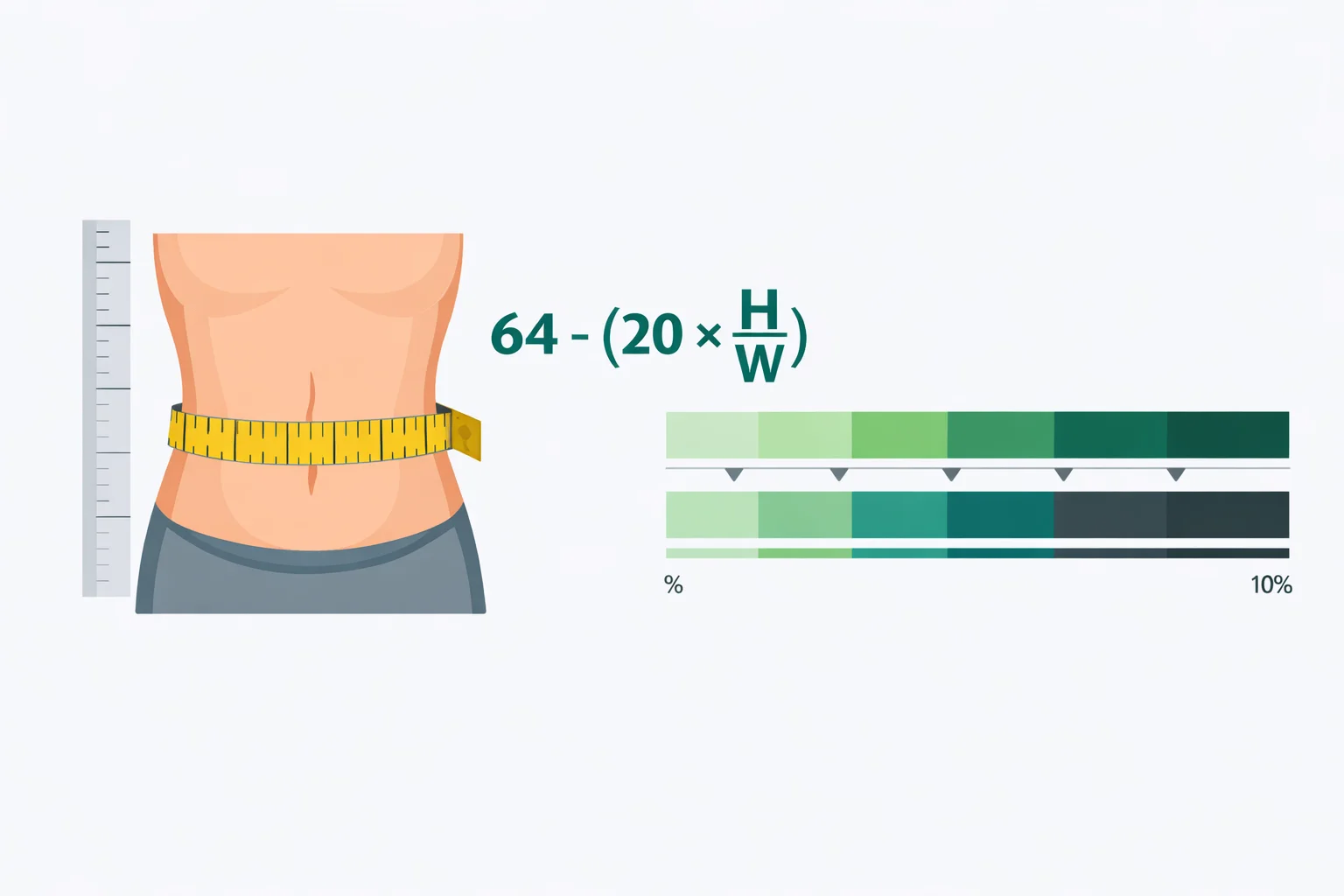
RFM = 64 − (20 × height ÷ waist) + (12 × sex)
where sex = 0 for men and 1 for women, and height and waist are in the same units. That collapses to 64 − 20 × (height ÷ waist) for men and 76 − 20 × (height ÷ waist) for women. Because height and waist divide each other, the ratio is unitless — centimeters and inches give the identical percentage. The result estimates whole-body fat percentage; entering weight additionally yields fat mass (% × weight) and lean mass.
Reference Ranges & Interpretation
Interpret the percentage with American Council on Exercise (ACE) body-fat bands. For men: 2–5% essential, 6–13% athletes, 14–17% fitness, 18–24% average, 25%+ obese. For women: 10–13% essential, 14–20% athletes, 21–24% fitness, 25–31% average, 32%+ obese. The 12-point sex offset reflects women’s higher essential fat. A man at 24% is one point below the obese cutoff, while a woman at 24% sits in the fitness band — always read the number against the correct column.
Assumptions & Limitations
RFM assumes a typical adult fat distribution and was validated in people aged 20–80, so it is not appropriate for children, pregnancy, or athletes with very high abdominal muscle mass, where it overestimates fat. It reads any waist girth as fat, so hernia, ascites, or post-meal bloating inflate the result by 1–2 points. It is a screening estimate within roughly 3–5 percentage points of a DXA scan — not a diagnosis. Consult a clinician if your RFM climbs alongside rising blood pressure, glucose, or cholesterol.
Complete Guide: Relative Fat Mass Calculator (RFM)
On this page
A relative fat mass calculator turns two tape-measure numbers — your height and your waist — into an estimate of whole-body fat percentage, and it does so with surprising fidelity. When Orison Woolcott and Richard Bergman published the RFM equation in Scientific Reports in 2018, they tested it against DXA scans in 12,581 American adults and found it tracked measured body fat more closely than body mass index, especially in women. That is the headline: a single subtraction beat the most widely used screening number in medicine, using no scale at all.
This guide walks through exactly how RFM works, why dropping weight from the equation helps, how it stacks up against the Navy tape test and waist-to-height ratio, and what to actually do once you have your percentage. You will see the formula, a full worked example, and the body-fat bands that sort a 19% reading from a 31% one.
RFM vs. BMI: why two inputs beat weight
BMI divides weight by height squared, so it cannot tell a muscular 90 kg rugby player from a sedentary 90 kg office worker of the same height — both score a BMI of about 27.8 at 180 cm, yet their body fat might differ by 20 percentage points. RFM sidesteps that problem by ignoring weight entirely. It reads body fat off the relationship between your height and your waist, and waist circumference is a direct proxy for visceral and subcutaneous abdominal fat, the depots most tightly linked to metabolic disease.
Because waist sits in the denominator of the RFM ratio, the equation is sensitive to belly fat in a way the scale is not. Hold height at 178 cm and let the waist grow from 85 cm to 90 cm: a man's RFM rises from 22.1% to 24.4%, a 2.3-point jump that BMI would only register if total weight also climbed. That makes RFM a useful companion to the adult BMI calculator rather than a replacement — BMI flags overall mass, RFM flags where that mass sits.
The relative fat mass formula
RFM is a sex-adjusted linear equation. The published form is:RFM = 64 − (20 × height ÷ waist circumference) + (12 × sex)where sex equals 0 for men and 1 for women, and height and waist are measured in the same units. Plugging in the sex term collapses it into two clean expressions:
- Men: RFM = 64 − 20 × (height ÷ waist)
- Women: RFM = 76 − 20 × (height ÷ waist)
The 12-point offset for women reflects higher essential fat — women carry roughly 10–13% essential fat versus 2–5% in men, so the equation shifts the baseline up. One quiet advantage worth noting: because height and waist are divided by each other, the ratio is unitless. You can enter both in centimeters or both in inches and get the identical percentage, which is why this tool never asks you to convert.
A worked example: 178 cm, 90 cm waist
Take a 40-year-old man who is 178 cm tall with a 90 cm waist. Work the men's equation step by step:
- Height ÷ waist = 178 ÷ 90 = 1.978
- 20 × 1.978 = 39.56
- RFM = 64 − 39.56 = 24.4% body fat
That 24.4% lands in the "average" band for men (18–24% is acceptable, 25%+ is the obese threshold), so he sits right on the edge. If he also weighs 80 kg, multiplying gives a fat mass of 0.244 × 80 = 19.5 kg and a lean mass of 60.5 kg — the two extra outputs this calculator returns when you add weight. Now run a woman who is 165 cm with an 85 cm waist: 165 ÷ 85 = 1.941, times 20 is 38.82, and 76 − 38.82 = 37.2% body fat, which falls in the obese band for women (32%+). Same arithmetic, different baseline.
How accurate is RFM against a DXA scan?
In the validation study, RFM correlated more strongly with DXA-measured body fat than BMI did, and it misclassified body-fat-defined obesity less often — the misclassification rate for women dropped from roughly 1 in 8 with BMI to a smaller fraction with RFM. The equation was derived in one NHANES sample and confirmed in a second, which is why it generalizes better than formulas tuned to a single gym or clinic population. Still, "more accurate than BMI" is a low bar in absolute terms: RFM typically lands within about 3–5 percentage points of a DXA reading for an individual, so treat it as a screening estimate, not a lab result.
For a different two-site or three-site estimate to compare against, the Navy body fat method and a caliper-based body fat percentage calculator use entirely different inputs, so agreement across methods raises your confidence. Disagreement of more than 5 points usually points to a measurement error — most often a waist taped at the wrong landmark.
Reading your RFM: body-fat categories for men and women
RFM returns a body-fat percentage, so you interpret it with the same American Council on Exercise bands used for any body-fat estimate. The cutoffs differ by sex because of that essential-fat gap:
| Category | Men | Women |
|---|---|---|
| Essential fat | 2–5% | 10–13% |
| Athletes | 6–13% | 14–20% |
| Fitness | 14–17% | 21–24% |
| Average | 18–24% | 25–31% |
| Obese | 25%+ | 32%+ |
A 24.4% reading for a man is "average" but one point from the obese cutoff; the same percentage in a woman would sit comfortably in the "average" range. That sex split is the single most common source of confusion when people compare numbers with a partner.
RFM vs. the Navy tape test vs. waist-to-height ratio
All three waist-based methods sidestep the scale, but they ask for different measurements and answer slightly different questions:
| Method | Inputs | Output |
|---|---|---|
| RFM | Height + waist | Body fat % |
| Navy tape | Height + neck + waist (+ hip for women) | Body fat % |
| Waist-to-height | Height + waist | Risk ratio (≤0.5 target) |
RFM and waist-to-height ratio use the exact same two numbers, but RFM maps them onto a percentage and a category, while waist-to-height ratio keeps a bare ratio with a simple 0.5 cutoff. The Navy method needs a neck measurement and a logarithmic equation, which adds a second tape landmark and a second chance for error. If you want a geometry-based central-fat score instead, the body roundness index calculator uses the same inputs through an ellipse formula. The practical takeaway: RFM gives you the most information per measurement.
Where RFM falls short
The equation was built and validated in adults aged 20–80, so it is not appropriate for children or teenagers, whose body-fat-to-waist relationship changes with growth. It also assumes a typical fat distribution: a powerlifter with a thick, muscular waist can score an inflated RFM because the formula reads any waist girth as fat, and a person with significant abdominal muscle hypertrophy or a hernia bulge will be overestimated. Pregnancy, ascites, and post-surgical swelling all distort waist circumference and therefore the result.
Measurement technique is the other weak point. Taping the waist at the navel instead of the iliac crest, or measuring after a big meal, can shift the reading by 3–6 cm, which moves RFM by more than a full percentage point. Breathe out normally, keep the tape level and snug without compressing, and take the average of two readings — the same discipline you would use with a waist-to-hip ratio calculator.
What to do with your number
If your RFM sits above the fitness cap for your sex (17% for men, 24% for women), the most reliable lever is a small, steady reduction in waist circumference rather than chasing a scale weight. Because RFM responds to waist directly, a 4 cm reduction at a fixed height can drop a man's RFM by roughly 2 points — a visible change in a few months of consistent habits. Set a calorie target first; the TDEE calculator estimates your maintenance energy so you can plan a modest 300–500 kcal deficit, and a calorie calculator turns that into daily intake.
Re-measure every two to four weeks under the same conditions — same time of day, same tape landmark, after a normal exhale — and watch the four-week trend rather than single readings. Pair RFM with one weight-based metric and one lab marker (fasting glucose or blood pressure) for a fuller picture. If several signals move together in the wrong direction, that is the cue to talk to a clinician about a structured plan.
This guide is educational and not a substitute for medical advice. RFM is a screening estimate; a clinician can interpret it alongside your history, medications, and any direct body-composition testing.
References
- Woolcott OO, Bergman RN. "Relative fat mass (RFM) as a new estimator of whole-body fat percentage." Scientific Reports, 2018.
- Centers for Disease Control and Prevention. Assessing weight & body measures.

Written by Jurica Šinko
Founder & CEO
Entrepreneur and health information advocate, passionate about making health calculations accessible to everyone through intuitive digital tools.
View full profileFrequently Asked Questions
Is RFM more accurate than BMI?
In the 2018 validation against DXA scans of 12,581 adults, RFM tracked measured body fat more closely than BMI and misclassified obesity less often, especially in women. RFM still lands within about 3 to 5 percentage points of a DXA reading, so treat it as a screening estimate rather than a lab result.
What is a healthy RFM for men?
For men, 14 to 17 percent body fat is the fitness range and 18 to 24 percent is average; 25 percent and above is the obese threshold. A man with a height-to-waist ratio of 2.0 scores an RFM of 24 percent, right at the edge of the average band.
What is a good RFM for women?
Women carry more essential fat, so the bands shift up: 21 to 24 percent is fitness, 25 to 31 percent is average, and 32 percent or higher is obese. A woman whose RFM reads 30 percent sits in the average range, not overweight.
How do I measure my waist for RFM?
Measure at the top of the hip bone (iliac crest) with the tape level all the way around, snug but not compressing, after a normal exhale. A 3 to 6 cm error in waist placement shifts RFM by more than a full percentage point.
Does RFM need my body weight?
No. The RFM body-fat percentage comes from height and waist only. Weight is optional and is used solely to convert your percentage into fat mass and lean mass in kilograms or pounds.
Why does RFM use a different formula for men and women?
The equation adds 12 points for women, using 76 instead of 64, to account for higher essential fat — roughly 10 to 13 percent in women versus 2 to 5 percent in men. Without that offset, body fat in women would be underestimated.
Can I enter height and waist in inches instead of centimeters?
Yes. RFM divides height by waist, so the ratio is unitless. Entering 178 cm and 90 cm gives the same 24.4 percent as 70.1 in and 35.4 in, which is why you never have to convert units.
When is RFM unreliable?
RFM overestimates body fat in people with a muscular or distended waist, such as powerlifters, or with a hernia, pregnancy, or ascites, because it reads any waist girth as fat. It is also not validated for anyone under 20, whose body-fat-to-waist relationship is still changing.
Related Calculators
ABSI Calculator: A Body Shape Index & Mortality Risk
Free ABSI calculator computes A Body Shape Index from waist, height, and BMI to estimate visceral fat and mortality risk independent of body mass index.

Adult BMI Calculator for Men & Women — WHO BMI Guide
Use the adult BMI calculator to find your BMI with WHO categories. Enter metric or imperial units to see your status and BMI ranges quickly and clearly.
Army Body Fat Calculator — AR 600‑9 Standard Compliance
Check compliance with the Army body fat calculator per AR 600-9 standards. Enter circumference measures by sex to estimate body fat % and see pass/fail status.
Body Adiposity Index Calculator (BAI) — Body Fat %
Free body adiposity index calculator estimates body fat percentage from hip circumference and height using the BAI formula, no weight or scale needed.
Body Composition Calculator — Fat, Lean Mass Breakdown
Use our body composition calculator to estimate body fat percentage, fat mass, and lean mass from tape measurements. Switch units and get clear categories.

Body Fat Calculator — Percentage for Men & Women (Tape)
Estimate with the body fat percentage calculator (body fat calculator) using Navy circumference equations. Supports metric/imperial and sex‑specific inputs.