Use the ABSI Calculator (A Body Shape Index)
Free ABSI calculator computes A Body Shape Index from waist, height, and BMI to estimate visceral fat and mortality risk independent of body mass index.
Sex
Units
Age and sex set the reference mean the z-score is measured against.
Measure at the level of the navel (or the midpoint between the lowest rib and the iliac crest), tape level, after a normal exhale.
ABSI z-score (mortality risk vs. age & sex)
+0.02
ABSI = 0.08093 · higher than 51% of men your age
Middle fifth — mortality hazard close to the population median.
ABSI value
0.08093
BMI (for contrast)
26.5
Overweight
Percentile
51th
Age/sex mean ABSI
0.08087
ABSI z-score mortality-risk quintiles (Krakauer 2012)
| Risk level | ABSI z-score |
|---|---|
| Very low | < -0.868 |
| Low | -0.868 to -0.272 |
| Average | -0.272 to 0.229 |
| High | 0.229 to 0.798 |
| Very high | > 0.798 |
Educational tool, not medical advice. Check this tool’s method and limitations before interpreting a result. Talk to a qualified healthcare professional before making decisions about medication, diet, exercise, or treatment. See our Terms of Use.
Your rating helps improve ABSI Calculator (A Body Shape Index). We store only an anonymized vote (no personal data).
How to Use ABSI Calculator (A Body Shape Index)
Step 1: Set sex and age
Choose male or female and enter your age. ABSI compares your waist-for-size against the average for people of the same age and sex, so both fields shape the z-score.
Step 2: Pick your units
Switch between cm/kg and in/lb. The calculator converts everything to meters and kilograms internally before applying the ABSI formula.
Step 3: Enter height and weight
Type your height and weight so the tool can compute BMI, which sits in the denominator of the ABSI equation.
Step 4: Measure and enter your waist
Measure at the level of the navel with the tape horizontal, after a normal exhale, then enter the value in the Waist circumference field.
Step 5: Read your ABSI and risk band
Your ABSI value, age- and sex-adjusted z-score, percentile, and one of five mortality-risk quintiles update instantly as you type.
Key Features
- Computes A Body Shape Index from waist, height, and weight
- Age- and sex-adjusted ABSI z-score and percentile
- Five mortality-risk quintiles from very low to very high
- Shows BMI beside ABSI to separate body mass from body shape
- Metric and imperial units with instant auto-calculation
- Uses smoothed NHANES 1999–2004 US reference norms
Understanding Results
The ABSI Calculator Formula: A Body Shape Index Explained
ABSI, published by Krakauer and Krakauer in 2012, divides waist circumference by a size term built from BMI and height:
ABSI = waist ÷ (BMI2/3 × height1/2)
with waist and height in meters and BMI in kg/m². The exponents (two-thirds on BMI, one-half on height) were chosen so the size term cancels the normal way waist grows with body size, leaving a value that is statistically independent of height, weight, and BMI. Worked example: a person 1.75 m tall, 70 kg, with an 0.85 m waist has BMI 22.9, so ABSI = 0.85 ÷ (22.92/3 × √1.75) = 0.85 ÷ 10.66 = 0.0798. The result carries the awkward units m11/6kg−2/3, which is why it is always converted to a z-score before it means anything.
Z-Score Ranges & Mortality Quintiles
The z-score = (your ABSI − the age/sex mean) ÷ the age/sex standard deviation, using smoothed NHANES 1999–2004 US norms. Krakauer mapped it to five mortality-risk quintiles: Very low below −0.868, Low from −0.868 to −0.272, Average from −0.272 to +0.229, High from +0.229 to +0.798, and Very high above +0.798. A z of 0 is exactly average for your demographic; the calculator also converts it to a percentile, so +1.0 lands near the 84th percentile of waist-for-size. Reference mean ABSI rises with age — roughly 0.077 at 20 to 0.087 at 80 in men — which is why the tool asks your age rather than using one fixed cutoff.
Assumptions & Limitations
The reference norms come from US adults, so people of South or East Asian ancestry may carry elevated visceral-fat risk at a lower ABSI than these cutoffs suggest. ABSI is validated for adults 18–85 and is undefined for children; pregnancy, ascites, or a large hernia inflate the waist and the score. It is also a weaker predictor at very low body weight. Most important, ABSI estimates population-level risk, not an individual diagnosis — a 2 to 3 cm waist measurement error can shift the z-score by half a category, so measure carefully and confirm elevated results with a clinician alongside blood pressure, glucose, and lipid testing.
Complete Guide: ABSI Calculator (A Body Shape Index)
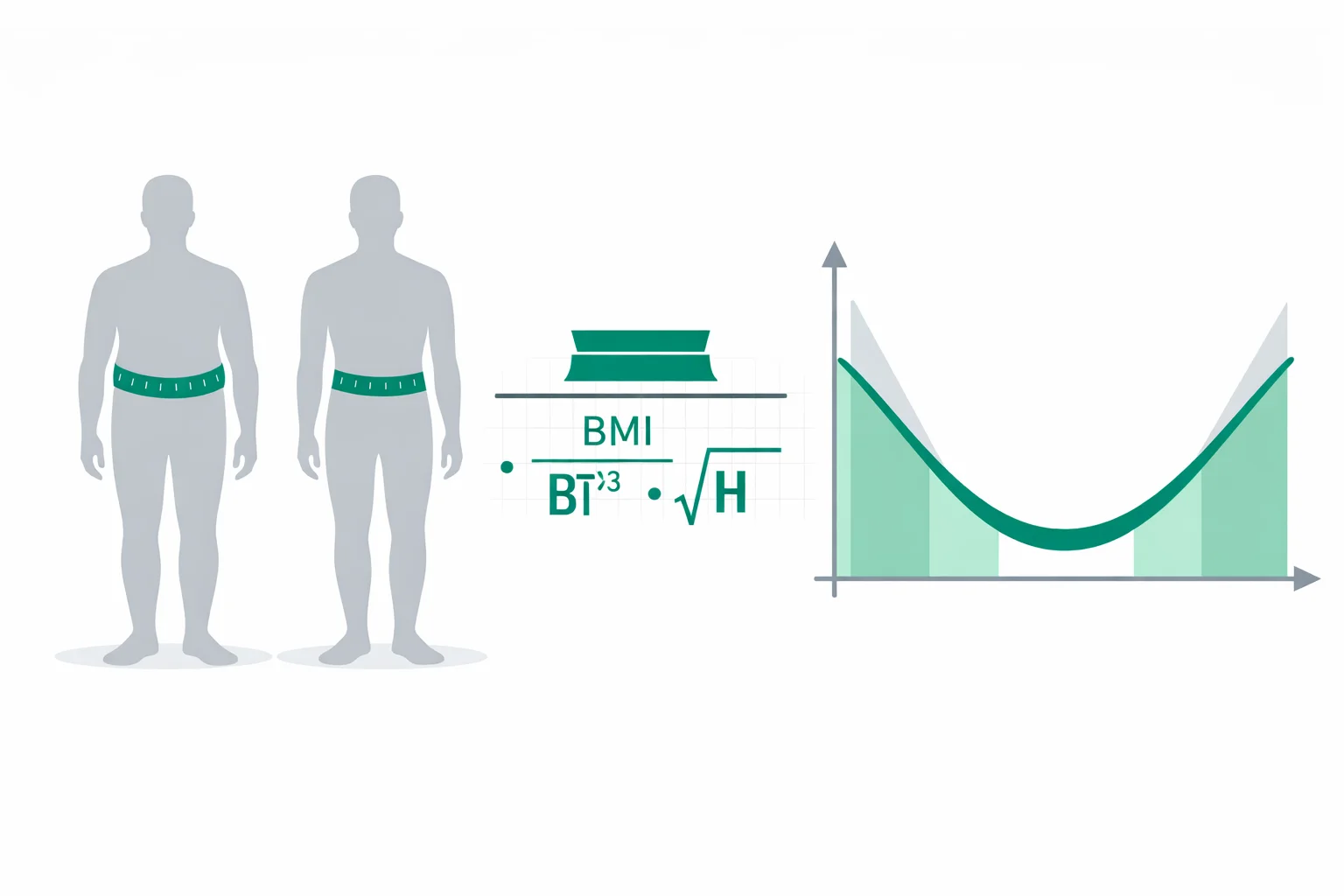
On this page
An ABSI calculator answers a question your bathroom scale and BMI cannot: is your waist too big for your size? A Body Shape Index (ABSI) takes waist circumference and deliberately strips out the parts of it that just track being tall or heavy, leaving a pure signal of central fat. Nir and Jesse Krakauer introduced it in 2012 after showing, in a US sample of more than 14,000 adults, that this leftover signal predicts death independently of body mass index. This guide walks two real bodies through the math, shows you how to read the z-score this calculator returns, and explains what a "high" result should — and shouldn't — make you do.
Two men, one BMI, two very different risks
Picture two 30-year-old men who are both 175 cm tall and both weigh 86 kg. They have the identical body mass index of 28.1 — textbook "overweight," and indistinguishable on any BMI chart. But one carries his 86 kg with a 90 cm (35.4 in) waist and heavier legs; the other has a 105 cm (41.3 in) waist and thin limbs. The scale calls them twins. A Body Shape Index does not. Here is the arithmetic the calculator runs for each, using ABSI = waist ÷ (BMI2/3 × √height), with waist and height in meters:
- Shared denominator: BMI2/3 = 28.12/3 = 9.24, and √1.75 = 1.323, so the denominator is 9.24 × 1.323 = 12.22.
- Man A (90 cm waist): ABSI = 0.90 ÷ 12.22 = 0.0736 → z-score −1.57 → roughly the 6th percentile → Very low risk.
- Man B (105 cm waist): ABSI = 1.05 ÷ 12.22 = 0.0859 → z-score +1.71 → roughly the 96th percentile → Very high risk.
Same height, same weight, same BMI — and yet the Krakauer mortality model places these two men at opposite ends of the risk distribution. That gap is the entire reason ABSI exists. BMI told you how much mass they carry; ABSI tells you where it sits, and where it sits is what tracks visceral fat and premature death.
What A Body Shape Index actually measures
Raw waist circumference is a decent risk marker, but it is contaminated: taller people and heavier people have bigger waists for reasons that have nothing to do with dangerous belly fat. Krakauer used regression on national survey data to find the exact powers of height and weight that waist "naturally" scales with, then divided them out. The result is the formula this ABSI calculator uses:
ABSI = waist circumference ÷ (BMI2/3 × height1/2)
with waist and height in meters and BMI in kg/m². Because those specific exponents (two-thirds on BMI, one-half on height) cancel the normal scaling of waist with body size, ABSI is statistically independent of height, weight, and BMI. A value near 0.080 is typical for adults; the whole population only spans roughly 0.070 to 0.090, so small digits matter. The trade-off is that the raw number is abstract — its units are m11/6kg−2/3, which mean nothing intuitively. That is why nobody interprets the raw ABSI directly. You convert it to a z-score.
How do you read an ABSI z-score?
The z-score rescales your raw ABSI against people of the same age and sex, because a "normal" waist-for-size at 25 is different from one at 65. The calculator subtracts the reference mean and divides by the reference standard deviation drawn from the smoothed NHANES 1999–2004 US norms. A z-score of 0 means your body shape is dead average for your demographic; +1 means you sit one standard deviation toward higher risk; −1 means one deviation toward lower. Krakauer split the distribution into five mortality-risk quintiles:
| ABSI z-score | Risk quintile | Roughly what it means |
|---|---|---|
| Below −0.868 | Very low | Waist small for your size; lowest death rate |
| −0.868 to −0.272 | Low | Below-average central fat |
| −0.272 to +0.229 | Average | Middle fifth of the population |
| +0.229 to +0.798 | High | Above-average waist-for-size |
| Above +0.798 | Very high | Top fifth; steepest mortality hazard |
These cut-points are fixed, not relative to your input, so they let you compare a 28-year-old woman and a 70-year-old man on the same scale. A woman whose ABSI sits at the 90th percentile carries the same relative shape risk as a man at his own 90th percentile, even though their raw waist measurements are miles apart. If you already track your waist-to-height ratio, think of the ABSI z-score as the age- and sex-adjusted cousin that also removes the influence of overall weight.
ABSI vs. BMI vs. waist-to-height ratio
These three indices are not rivals so much as different lenses, and using them together beats any one alone. The key distinction is what each one is allowed to "see":
| Index | Inputs | Captures | Blind spot |
|---|---|---|---|
| BMI | Height, weight | Overall mass | Ignores fat location and muscle |
| Waist-to-height | Height, waist | Central fat vs. height | Still partly tracks total size |
| ABSI | Height, weight, waist | Waist adjusted for height and weight | Abstract units; weaker for low weight |
Because ABSI is engineered to be uncorrelated with BMI, the two add information rather than repeat it. A normal-BMI person with a high ABSI (the "skinny-fat" pattern) and an obese-BMI person with an average ABSI both slip through a BMI-only screen. Run your numbers through the adult BMI calculator for the mass axis, then use this page for the shape axis. For a geometry-based alternative that models the torso as an ellipse, the body roundness index calculator uses the same waist and height inputs through a different equation, and comparing the two is a useful cross-check.
What the mortality research actually found
In the original 2012 analysis of NHANES linked to death records, all-cause mortality rose steadily and almost linearly across ABSI values — and crucially, it kept rising even after the researchers adjusted for BMI, blood pressure, cholesterol, smoking, and diabetes. People in the top ABSI group died at meaningfully higher rates than those in the bottom group with the same BMI. BMI itself showed its familiar U-shape (risk high at both low and high extremes), but ABSI climbed in one direction: more waist-for-size, more hazard.
The finding has since replicated well beyond the US. A 2020 analysis of a large European cohort concluded, in its own title, that A Body Shape Index "achieves better mortality risk stratification than alternative indices of abdominal obesity" — outperforming waist circumference and waist-to-hip ratio at ranking who was most likely to die. That is a strong claim for a number you can compute with a cloth tape and this calculator. The catch, discussed next, is that population-level prediction is not the same as individual diagnosis.
Where ABSI is weak — and where it isn't
ABSI is a screening index built on a US survey population, so three limits are worth naming. First, the reference means and standard deviations behind the z-score come from NHANES 1999–2004 US adults; body-shape norms differ across ancestries, so a South Asian or East Asian individual may carry higher visceral-fat risk at a lower ABSI than the US norms imply. Second, ABSI is validated for adults 18 and older — it is not defined for children, and pregnancy, ascites, or a large hernia inflate waist and therefore the score. Third, ABSI is a weaker mortality predictor at the very low end of body weight, where other causes of a small waist dominate.
What ABSI is not weak at is the thing it was designed for: flagging the waist-heavy person whom BMI reassures. Measurement technique is your main lever for accuracy here. Because the whole population spans barely 0.02 ABSI units, a 2–3 cm error in waist placement can shift your z-score by half a category. Measure over bare skin at the level of the navel (or midway between your lowest rib and the top of your hip bone), keep the tape horizontal, exhale normally, and do not suck in. If you also track your waist-to-hip ratio, use the same landmark each time so the two numbers stay comparable.
What to do with a high ABSI
A high or very-high ABSI is a prompt, not a verdict. Because ABSI is driven by waist relative to size, the needle moves when abdominal girth shrinks — and visceral fat is famously the first fat to respond to a modest, sustained energy deficit and regular activity. For the two men above, Man B does not need to become Man A overnight; trimming even 4–5 cm off a 105 cm waist would drop his z-score by roughly a full point and out of the top quintile. Set a realistic energy target with the TDEE calculator, aim for a 300–500 kcal daily deficit, and prioritize protein and resistance training to protect the lean mass that keeps your metabolism up.
Re-measure every four to six weeks under the same conditions, and watch the trend rather than any single reading. Pair ABSI with one direct fat estimate — the relative fat mass calculator turns height and waist into a body-fat percentage — plus one lab marker such as fasting glucose or blood pressure. When shape risk, body fat, and a metabolic marker all point the same way, that convergence is the real signal to bring to a clinician, who can decide whether imaging or bloodwork is warranted.
This guide is educational and not a substitute for medical advice. ABSI estimates population-level mortality risk from body shape; only a clinician can interpret it alongside your history, medications, and other measurements.
References
- Krakauer NY, Krakauer JC. "A New Body Shape Index Predicts Mortality Hazard Independently of Body Mass Index." PLOS ONE, 2012.
- Christakoudi S, et al. "A Body Shape Index (ABSI) achieves better mortality risk stratification than alternative indices of abdominal obesity." Scientific Reports, 2020.
- Centers for Disease Control and Prevention. Assessing weight & body measures.

Written by Jurica Šinko
Founder & CEO
Entrepreneur and health information advocate, passionate about making health calculations accessible to everyone through intuitive digital tools.
View full profileFrequently Asked Questions
What is a good ABSI score?
There is no single good ABSI number, because it is judged against your age and sex. Raw adult ABSI clusters tightly around 0.079 to 0.083, but what matters is the z-score: anything below −0.272 puts you in the lower two risk quintiles, meaning a smaller waist for your body size and a below-average death rate.
What is a normal ABSI z-score?
A normal, average ABSI z-score sits between −0.272 and +0.229 — the middle fifth of the population for your age and sex. A z-score of 0 means your waist-for-size is exactly typical, and every +1.0 shifts you one standard deviation toward higher mortality risk.
How is ABSI different from BMI?
BMI uses only height and weight, so two people with the same BMI can have very different waistlines. ABSI adds waist circumference and mathematically removes height and weight, isolating central fat. Two men at BMI 28.1 with 90 cm and 105 cm waists score ABSI z-scores of −1.57 and +1.71 — opposite ends of the risk scale.
Where do I measure my waist for ABSI?
Measure at the level of the navel, or midway between your lowest rib and the top of the hip bone, with the tape horizontal and after a normal exhale — do not suck in. Because the whole population spans only about 0.02 ABSI units, a 2 to 3 cm tape error can move your z-score by half a risk category.
Is a high ABSI dangerous?
A high ABSI (z-score above +0.229) is linked to higher all-cause mortality even after adjusting for BMI, blood pressure, and smoking, and the top quintile above +0.798 carries the steepest hazard. It is a population screening signal, not a diagnosis, so pair it with blood pressure and fasting glucose before drawing conclusions.
Can I have a normal BMI but a high ABSI?
Yes. Because ABSI is designed to be statistically independent of BMI, a lean-looking person with a normal BMI but a proportionally large waist — the skinny-fat pattern — can land in the High or Very high band. That is precisely the hidden risk a BMI-only screen misses.
What ABSI value counts as high risk?
Risk is read from the z-score, not the raw value: +0.229 to +0.798 is High and above +0.798 is Very high. For a 40-year-old man whose reference mean ABSI is about 0.081, that corresponds to raw ABSI above roughly 0.082 and 0.084 respectively.
Related Calculators

Adult BMI Calculator for Men & Women — WHO BMI Guide
Use the adult BMI calculator to find your BMI with WHO categories. Enter metric or imperial units to see your status and BMI ranges quickly and clearly.
Army Body Fat Calculator — AR 600‑9 Standard Compliance
Check compliance with the Army body fat calculator per AR 600-9 standards. Enter circumference measures by sex to estimate body fat % and see pass/fail status.
Body Adiposity Index Calculator (BAI) — Body Fat %
Free body adiposity index calculator estimates body fat percentage from hip circumference and height using the BAI formula, no weight or scale needed.
Body Composition Calculator — Fat, Lean Mass Breakdown
Use our body composition calculator to estimate body fat percentage, fat mass, and lean mass from tape measurements. Switch units and get clear categories.

Body Fat Calculator — Percentage for Men & Women (Tape)
Estimate with the body fat percentage calculator (body fat calculator) using Navy circumference equations. Supports metric/imperial and sex‑specific inputs.

Body Measurement Calculator: Wrist Size & Frame Guide
Use our body measurement calculator to capture wrist, waist, hip, and height. View WHR, WHtR, and a wrist-based frame size hint with metric/US units and labels.