Use the Body Adiposity Index Calculator (BAI)
Free body adiposity index calculator estimates body fat percentage from hip circumference and height using the BAI formula, no weight or scale needed.
Widest part of the buttocks, tape level all around.
Measure without shoes, standing tall.
Used to pick age-specific healthy ranges.
Within the recommended body-fat range for your age and sex.
Healthy body-fat ranges (women) — Gallagher et al., 2000
| Age | Underfat | Healthy | Overfat | Obese |
|---|---|---|---|---|
| 20–39● | < 21% | 21–33% | 33–39% | ≥ 39% |
| 40–59 | < 23% | 23–34% | 34–40% | ≥ 40% |
| 60–79 | < 24% | 24–36% | 36–42% | ≥ 42% |
BAI estimates body fat from hip circumference and height only — no weight or scale. It tends to overestimate fat in lean, muscular people and underestimate it in some populations. Use it as a screening indicator, not a diagnosis, and confirm concerns with a clinician.
Educational tool, not medical advice. Check this tool’s method and limitations before interpreting a result. Talk to a qualified healthcare professional before making decisions about medication, diet, exercise, or treatment. See our Terms of Use.
Your rating helps improve Body Adiposity Index Calculator (BAI). We store only an anonymized vote (no personal data).
How to Use Body Adiposity Index Calculator (BAI)
Step 1: Select your sex
Choose Female or Male so the calculator applies the correct age-adjusted healthy body-fat ranges.
Step 2: Pick your units
Toggle Metric (cm) or US (ft/in) to match the tape measure and ruler you are using.
Step 3: Enter your hip circumference
Measure the widest part of your buttocks with a level, non-stretch tape and type the value in.
Step 4: Add height and age
Enter your height without shoes and your age; age selects the correct Gallagher reference band.
Step 5: Read your BAI
Your estimated body-fat percentage, category, and position on the underfat-to-obese scale appear instantly.
Key Features
- Estimates body fat % from hip and height only
- No weight, scale, or calipers required
- Age- and sex-adjusted healthy ranges (Gallagher 2000)
- Metric (cm) and US (ft/in) units
- Visual underfat–healthy–overfat–obese scale
- Copy-ready result summary
Understanding Results
Formula
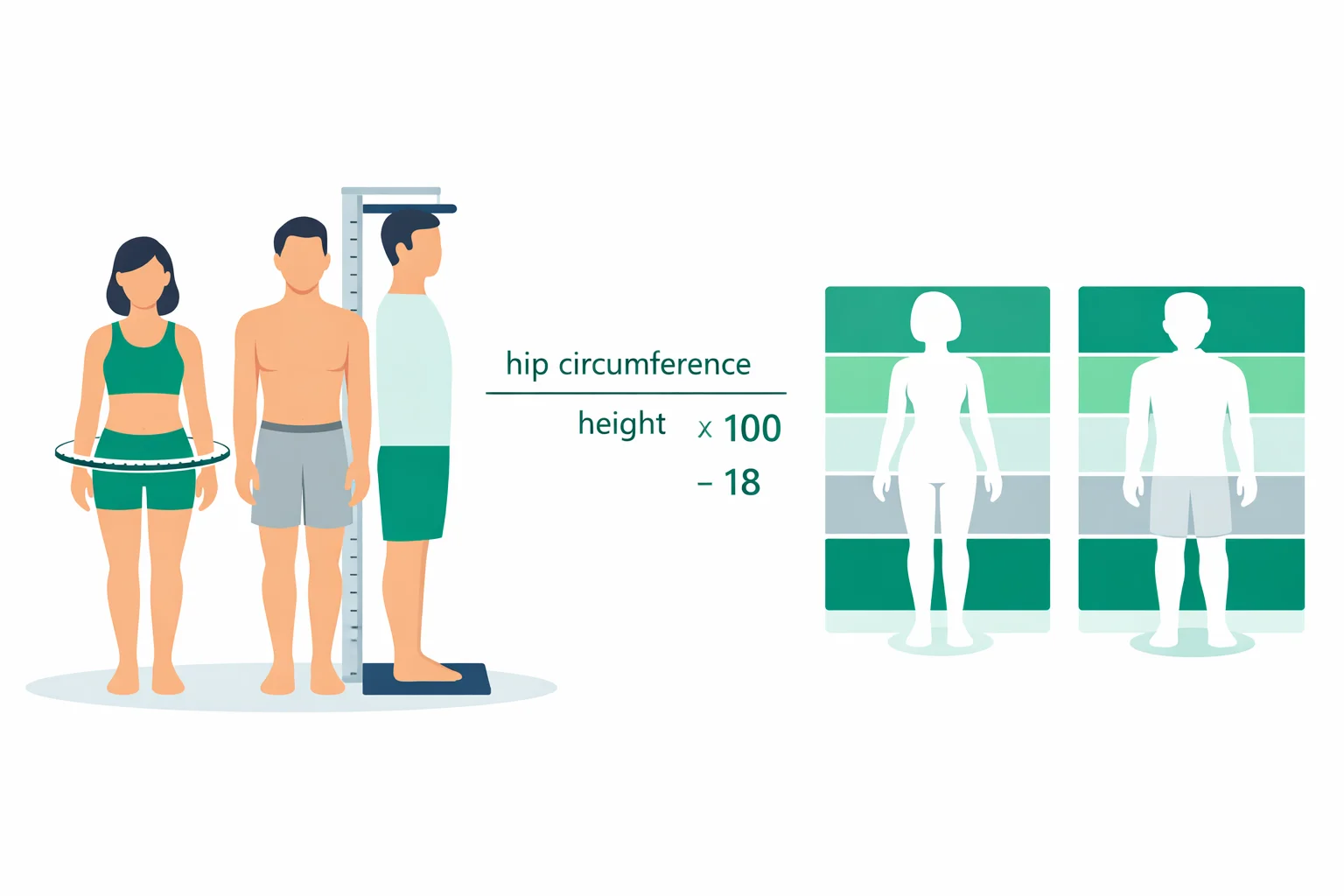
The Body Adiposity Index is BAI = hip circumference (cm) ÷ height (m)1.5 − 18. Your hip measurement is taken at the widest part of the buttocks and entered in centimeters, while your height is used in meters and raised to the power 1.5. The result is read directly as an estimated body-fat percentage — a BAI of 26 means about 26% of your body mass is estimated to be fat. Example: a 96 cm hip with a 1.70 m height gives 96 ÷ 2.217 − 18 = 25.3%.
Reference Ranges & Interpretation
Because BAI returns a body-fat percentage, it is interpreted against age- and sex-specific healthy ranges from Gallagher et al. (2000). Healthy body fat is roughly 21–33% for women and 8–20% for men aged 20–39, with both bands rising a few points after 40 and again after 60. Values below the healthy floor read as underfat; above it, overfat; and at or beyond the obesity threshold (39% for younger women, 25% for younger men), obese. The calculator highlights the matching row and marks your position on the scale.
Assumptions & Limitations
BAI assumes an adult body between roughly 20 and 79 years old and a typical relationship between hip girth and total fat. It overestimates body fat in lean, muscular people and can underestimate it in severe obesity. It does not apply to pregnancy, children, teenagers, or elite athletes, and it was originally validated in Mexican-American and African-American adults, so accuracy varies by population. Treat the result as a screening estimate, cross-check it with a second method, and consult a clinician before acting on a concerning number.
Complete Guide: Body Adiposity Index Calculator (BAI)
On this page
This body adiposity index calculator estimates your body-fat percentage from just two measurements — hip circumference and height — with no scale, no calipers, and no weight required. That is unusual. Almost every other body-fat tool starts by asking what you weigh. BAI throws the scale out entirely, which is exactly why researchers built it for field studies in places where reliable scales are hard to find. On this page you'll see the formula worked out with real numbers, how BAI compares with BMI, how to read your result by age and sex, and the specific situations where the number misleads you.
The one thing that makes BAI different: no scale
Here's the misconception worth clearing up first: many people assume you can't estimate body fat without stepping on a scale. You can. Richard Bergman and colleagues introduced the Body Adiposity Index in the journal Obesity in 2011 after analysing more than 1,700 Mexican-American and African-American adults. They found that the ratio of hip size to height, raised to a specific power, tracked percent body fat well enough to skip weight altogether. For someone measuring a large group in the field — or anyone whose weight swings with hydration, glycogen, or muscle gains — dropping the scale removes a real source of noise.
The trade-off is that BAI leans entirely on one circumference. Get the hip measurement wrong by 3 cm and your estimated body fat shifts by more than a full percentage point. So the payoff of a scale-free method is only as good as your tape technique, which is covered in detail below.
What the body adiposity index calculator estimates
BAI returns a single number that is meant to be read directly as a percent body fat — a BAI of 26 means roughly 26% of your body mass is estimated to be fat. That is different from BMI, which produces an abstract kg/m² figure you then have to map onto categories. The index keys off hip circumference because gluteal-femoral (hip and thigh) girth reflects overall adiposity across a population reasonably well, especially in women, whose fat storage skews toward the hips.
Because it reports a body-fat estimate, BAI competes with tools like the body fat percentage calculator and the Navy body fat calculator rather than with shape-only indices. What sets it apart is the minimal input list: one circumference and your height.
The BAI formula, worked out step by step
The equation is compact:BAI = hip circumference (cm) ÷ height (m)1.5 − 18Notice that height is in meters and raised to the power 1.5, while the hip is in centimeters. The mismatch in units is deliberate — it's how the original regression was fit — so don't convert everything to the same unit.
Work through a realistic example. Take a woman with a 96 cm hip circumference and a height of 1.70 m:
- Height to the 1.5 power: 1.701.5 = 2.217
- Divide hip by that: 96 ÷ 2.217 = 43.3
- Subtract 18: 43.3 − 18 = 25.3% body fat
For a 30-year-old woman, 25.3% sits comfortably inside the healthy 21–33% band. Change nothing but the hip — say it's actually 102 cm — and BAI climbs to 28.0%, still healthy but noticeably higher. That sensitivity is why a careful tape reading matters so much with this particular index.
BAI vs BMI: which number should you trust?
The most common search around this tool is "BAI vs BMI," and the honest answer is that they measure different things. BMI is weight ÷ height² — a density proxy that can't tell muscle from fat. A 95 kg powerlifter and a 95 kg sedentary person of the same height get the identical BMI, even though their body fat differs by 20 points. BAI ignores weight, so it never confuses a heavy, muscular frame with a fat one on the basis of the scale.
But BMI has the edge on validation. Decades of mortality and disease data are anchored to BMI cutoffs, while BAI is younger and less proven, and studies since 2011 have shown it's no more accurate than BMI for many groups — sometimes less. The practical move is to run both. Compare your BAI here with your BMI from the adult BMI calculator: when the two disagree sharply (for instance, a "normal" BMI but a high BAI, or vice versa), that gap is itself a signal worth investigating with a more direct measurement.
How to measure your hips so the number means something
Since BAI rides entirely on hip circumference, technique is everything. The hip measurement here is the widest part of your buttocks, not your waist and not your hip bones:
- Stand with your feet together and weight evenly balanced — feet apart widens the reading.
- Wear thin clothing or none; bulky fabric can add 2–4 cm.
- Wrap a non-stretch tape around the fullest point of the glutes, keeping it perfectly horizontal front and back.
- Snug, not tight — the tape shouldn't dent the skin.
- Take three readings and average them. If two differ by more than 1 cm, re-measure.
Consistency beats precision when you're tracking change. Measure at the same time of day, in the same posture, and you'll see genuine trends rather than tape noise. If you also track fat distribution, the waist-to-hip ratio calculator reuses this exact hip number alongside your waist.
Reading your BAI by age and sex
A body-fat percentage only means something in context. Healthy ranges rise with age (you naturally carry more fat at 60 than at 25) and differ sharply by sex — women need more essential fat than men. This calculator interprets your BAI against the widely cited Gallagher reference table (2000), which sets healthy body fat at roughly 21–33% for a woman in her twenties or thirties and 8–20% for a man of the same age.
| Group | Healthy body fat | Obesity threshold |
|---|---|---|
| Women 20–39 | 21–33% | ≥ 39% |
| Women 40–59 | 23–34% | ≥ 40% |
| Women 60–79 | 24–36% | ≥ 42% |
| Men 20–39 | 8–20% | ≥ 25% |
| Men 40–59 | 11–22% | ≥ 28% |
| Men 60–79 | 13–25% | ≥ 30% |
The calculator highlights the row matching your age and marks where your BAI lands on the underfat–healthy–overfat–obese scale, so you don't have to eyeball it.
Where BAI gets it wrong
BAI is not a universal tool, and pretending otherwise is how people get bad numbers. Its biggest documented flaw: it systematically overestimates body fat in lean, muscular men and can underestimate it at the higher end of obesity. A fit man with 95 cm hips and a 1.80 m height computes to a BAI near 21% — flagged "overfat" — when a DXA scan might read him at 14%. The index simply wasn't built to separate muscular glutes from fatty ones.
Other cases where BAI is unreliable: pregnancy, competitive athletes, people with unusual body proportions, and children or teenagers, for whom none of these adult formulas apply. Ethnicity matters too — the original sample was Mexican-American and African-American, and validation in other populations has been mixed. For a muscle-aware estimate, the lean body mass calculator and a shape-based index like the body roundness index calculator give useful second opinions.
BAI compared with other body-fat methods
No field method matches a lab scan, but they trade accuracy for convenience differently. Here's how BAI stacks up:
| Method | Inputs | Best for | Main weakness |
|---|---|---|---|
| BAI | Hip + height | No-scale field use, women | Overestimates in lean men |
| BMI | Weight + height | Population screening | Can't split fat from muscle |
| Navy tape | Neck, waist, hip, height | Free at-home estimate | Sensitive to waist placement |
| Skinfold calipers | 3–7 skinfold sites | Trained assessors | Highly technique-dependent |
| DXA scan | Full-body X-ray | Reference standard | Cost and clinic access |
The takeaway: BAI wins on simplicity and loses on accuracy in muscular men. If your BAI and a tape-based Navy estimate agree within a few points, you can be fairly confident. When they diverge, trust the method with more inputs, or get a scan.
What to do with your result
Treat BAI as a starting point and a tracking tool, not a verdict. If your estimate sits in the overfat or obese band and agrees with a second method, the highest-leverage change is reducing central fat through a modest, steady calorie deficit paired with resistance training — the combination that preserves muscle while fat comes off. Re-measure your hips every two to four weeks under identical conditions and watch the trend, not the daily wobble.
If your number lands in the healthy range, use BAI to hold the line: a creeping hip measurement is an early, scale-free warning that adiposity is rising before your clothes tell you. Either way, pair it with at least one other reading — BMI, a tape estimate, or a waist ratio — and bring the full picture to a clinician if several indicators point the same direction. One number never tells the whole story; a small panel of them usually does.
References
- Bergman RN, et al. "A better index of body adiposity." Obesity, 2011. PubMed
- Gallagher D, et al. "Healthy percentage body fat ranges: an approach for developing guidelines based on body mass index." American Journal of Clinical Nutrition, 2000. PubMed
- National Institutes of Health. "Assessing Your Weight and Health Risk." NHLBI

Written by Jurica Šinko
Founder & CEO
Entrepreneur and health information advocate, passionate about making health calculations accessible to everyone through intuitive digital tools.
View full profileFrequently Asked Questions
What is a good BAI number?
A "good" BAI is one that falls inside the healthy body-fat range for your age and sex. For a woman aged 20-39 that is roughly 21-33%, and for a man of the same age it is about 8-20%. Both healthy bands shift a few points higher after age 40 and again after 60.
Is BAI more accurate than BMI?
Not clearly. Studies since 2011 found BAI is generally no more accurate than BMI at estimating body fat, and it can be worse for muscular men. Its real advantage is that it needs no scale. Running both and comparing is more useful than choosing one.
What is the BAI formula?
BAI = hip circumference in centimeters divided by height in meters to the power 1.5, minus 18. For a 96 cm hip and 1.70 m height: 96 / (1.70^1.5) - 18 = 25.3% estimated body fat. Height is in meters while the hip is in centimeters on purpose.
Why does BAI use hip circumference instead of weight?
The index was built so field researchers could estimate body fat without a scale. Hip and thigh girth reflects overall adiposity across a population reasonably well, especially in women. Dropping weight removes the noise from hydration, glycogen, and muscle changes.
Why is my BAI high even though I am lean and muscular?
BAI systematically overestimates body fat in lean, muscular people. A fit man with 95 cm hips and 1.80 m height computes near 21% and gets flagged "overfat," while a DXA scan might read 14%. The formula cannot tell muscular glutes from fatty ones, so cross-check with a tape-based or scan method.
How do I measure my hips for BAI?
Measure the widest part of your buttocks, not your waist or hip bones. Stand with feet together, wear thin clothing, keep the tape level all the way around, and take three readings to average. A 3 cm error changes the estimate by more than one percentage point.
Can I use BAI during pregnancy or for children?
No. BAI was validated in non-pregnant adults roughly 20-79 years old. It does not apply to pregnancy, children, or teenagers, and the Gallagher body-fat reference ranges it uses were not derived for those groups.
Related Calculators
ABSI Calculator: A Body Shape Index & Mortality Risk
Free ABSI calculator computes A Body Shape Index from waist, height, and BMI to estimate visceral fat and mortality risk independent of body mass index.

Adult BMI Calculator for Men & Women — WHO BMI Guide
Use the adult BMI calculator to find your BMI with WHO categories. Enter metric or imperial units to see your status and BMI ranges quickly and clearly.

Army Body Fat Calculator — AR 600‑9 Standard Compliance
Check compliance with the Army body fat calculator per AR 600-9 standards. Enter circumference measures by sex to estimate body fat % and see pass/fail status.
Body Composition Calculator — Fat, Lean Mass Breakdown
Use our body composition calculator to estimate body fat percentage, fat mass, and lean mass from tape measurements. Switch units and get clear categories.

Body Fat Calculator — Percentage for Men & Women (Tape)
Estimate with the body fat percentage calculator (body fat calculator) using Navy circumference equations. Supports metric/imperial and sex‑specific inputs.

Body Measurement Calculator: Wrist Size & Frame Guide
Use our body measurement calculator to capture wrist, waist, hip, and height. View WHR, WHtR, and a wrist-based frame size hint with metric/US units and labels.