Use the Ponderal Index Calculator
Free ponderal index calculator computes weight in kg divided by height cubed, a height-stable leanness measure for tall, short, and newborn bodies alike.
Your current body weight.
Standing height without shoes.
Weight is well-proportioned to height for most adults.
Adult ponderal index ranges (kg/m³)
| Range | Category | What it suggests |
|---|---|---|
| Below 11 | Below typical | Lean or slender build for height |
| 11 – 14 | Typical | Weight well-proportioned to height |
| 14 – 17 | Above typical | Heavier for height; check waist and body fat |
| Over 17 | High | Substantially heavier for height |
This tool is informational and not medical advice. The ponderal index describes body proportion using weight and height; it does not measure body fat directly. For newborns, always confirm findings with your pediatric team.
Educational tool, not medical advice. Check this tool’s method and limitations before interpreting a result. Talk to a qualified healthcare professional before making decisions about medication, diet, exercise, or treatment. See our Terms of Use.
Your rating helps improve Ponderal Index Calculator. We store only an anonymized vote (no personal data).
How to Use Ponderal Index Calculator
Step 1: Pick a mode
Choose Adult / Child for the kg/m³ index or Newborn for the neonatal (×100 g/cm³) index.
Step 2: Set your units
Toggle Metric or US, then enter weight (kg, lb, g, or lb/oz) and height or crown-heel length.
Step 3: Read the ponderal index
Your index and category appear instantly, with BMI shown alongside in adult mode for comparison.
Step 4: Check the range
Use the highlighted reference row to see whether you fall below, within, or above the typical band.
Step 5: Copy your summary
Tap Copy summary to save the result, then discuss any newborn or clinical concern with a professional.
Key Features
- Weight ÷ height cubed (kg/m³) with instant auto-calculation
- Adult and newborn modes with the correct formula for each
- BMI shown side by side to reveal height distortion
- Metric and US units (kg/cm, lb/ft-in, g, lb-oz)
- Color-coded reference ranges for tall, short, and newborn bodies
Understanding Results
Formula
The adult ponderal index is weight in kilograms divided by height in metres cubed: PI = mass (kg) ÷ height (m)³, reported in kg/m³. A 70 kg adult who is 1.75 m tall has a height cube of 1.75³ = 5.359 m³, giving 70 ÷ 5.359 = 13.1 kg/m³. For a newborn the index is birth weight (g) × 100 ÷ length (cm)³, so a 3,400 g baby of 50 cm scores (3,400 × 100) ÷ 125,000 = 2.72. Cubing height, rather than squaring it as BMI does, is what keeps the value stable across body sizes.
Reference Ranges & Interpretation
Adults typically fall between 11 and 14 kg/m³. Under 11 points to a lean build for height, 14–17 is heavier-for-height and worth pairing with a waist measurement, and above 17 signals substantially more mass on the frame. Newborns use a separate scale: 2.2–3.0 is proportionate, below 2.2 flags asymmetric growth restriction (long but thin), and above 3.0 is heavier-for-length. Adult bands are approximate because the ponderal index is less formally standardized than BMI’s 18.5 / 25 / 30 cut-offs.
Assumptions & Limitations
The ponderal index uses only weight and height, so it cannot separate muscle from fat — a 100 kg athlete at 1.80 m reads 17.1 kg/m³ despite low body fat. Children need age-specific growth references rather than the adult 11–14 window, and the newborn scale (×100 g/cm³) is not comparable to the adult scale (kg/m³). Use the result as a body-proportion descriptor, and confirm any newborn or clinical concern with a healthcare professional.
Complete Guide: Ponderal Index Calculator

On this page
This ponderal index calculator divides your weight by your height cubed instead of squared, and that single change in the exponent is the whole point. Picture two men who both weigh 90 kg and both score a BMI of 27.8. One stands 1.70 m, the other 1.90 m. BMI calls them identical. The ponderal index does not: the shorter man lands at 18.3 kg/m³ while the taller man sits at 13.1 kg/m³ — a gap of five full points that reflects a real difference in how their mass is distributed over their frame. This guide explains the formula, shows why cubing height matters for very tall, very short, and newborn bodies, and gives you the reference ranges to read your own result.
Two bodies, same BMI, different ponderal index
BMI treats the body as if it grows in two dimensions. Real bodies grow in three. When you get taller, your weight rises roughly with the cube of height, not the square — a person who is 20% taller is, all else equal, closer to 1.2³ = 1.73× heavier, not 1.2² = 1.44×. Because BMI only squares height, it systematically flatters tall people (making them look heavier than they are) and penalizes short people. The ponderal index uses the cube, so it stays far more stable across the height spectrum. That is exactly why neonatologists and researchers studying height outliers reach for it.
The ponderal index formula
For adults, the formula — also called Rohrer’s index or the corpulence index — is weight in kilograms divided by height in metres cubed:
PI = mass (kg) / height (m)³ → units: kg/m³
Work through the tall man above. Height 1.90 m cubed is 1.90 × 1.90 × 1.90 = 6.859 m³. Divide 90 kg by 6.859 and you get 13.1 kg/m³. Now the short man: 1.70³ = 4.913 m³, and 90 ÷ 4.913 = 18.3 kg/m³. Same weight, same BMI, but the ponderal index separates them because it accounts for the third dimension of body size. Most adults land between roughly 11 and 14 kg/m³, with values under 11 indicating a lean build and values above 14 signalling more mass packed onto the frame.
Ponderal index vs BMI: when the cube wins
Neither number measures body fat directly — both are shortcuts that use weight and height as a proxy for build. The difference is which heights they distort. If you are near average height (about 1.60–1.80 m), BMI and the ponderal index tell nearly the same story, and BMI wins on convenience because everyone knows the cut-offs. Step away from average height and the ponderal index earns its keep. Compare how each metric rates the same weight across three heights:
| Person (80 kg) | Height | BMI (kg/m²) | Ponderal Index (kg/m³) |
|---|---|---|---|
| Short frame | 1.60 m | 31.3 (obese) | 19.5 |
| Average frame | 1.75 m | 26.1 (overweight) | 14.9 |
| Tall frame | 1.95 m | 21.0 (normal) | 10.8 |
BMI swings a full 10 points across those three heights for the same 80 kg; the ponderal index spreads them more evenly and keeps the tall frame from being labelled “normal” purely because BMI under-counts height. If you want the mainstream number alongside this one, run the adult BMI calculator and compare, or use the reverse BMI calculator to find the weight that would hit a target score.
What is a normal ponderal index?
For adults there is no single globally-ratified cut-off the way BMI has 18.5, 25, and 30, because the ponderal index is used less in routine clinics. A practical working band, and the one this calculator highlights, is 11 to 14 kg/m³ for typical proportions. Below 11 usually means a slender or athletic build for height; 14 to 17 is heavier-for-height and worth pairing with a waist measurement; above 17 flags substantially more mass on the frame. Because these bands are approximate, treat the ponderal index as a shape descriptor rather than a diagnosis — combine it with a waist-to-height ratio calculator to capture where the weight actually sits.
The newborn ponderal index and growth restriction
The place the ponderal index genuinely earns clinical trust is the delivery room. For a newborn, the formula becomes birth weight in grams times 100, divided by crown-heel length in centimetres cubed, giving values around 2.2 to 3.0. A baby of 3,400 g and 50 cm scores (3400 × 100) / 50³ = 340,000 / 125,000 = 2.72 — comfortably proportionate. Now take a baby of the same 50 cm length but only 2,500 g: the index drops to 2.00, below the 2.2 threshold. That pattern — adequate length but low weight — is the signature of asymmetric intrauterine growth restriction, where a placenta-limited fetus spares brain and skeletal growth while sacrificing fat and muscle. A low ponderal index at birth is associated with higher rates of neonatal complications, which is why it remains a quick bedside screen even in an era of detailed ultrasound.
The newborn scale is not interchangeable with the adult one — the ×100 convention and the use of grams and centimetres mean a healthy baby’s 2.7 is not comparable to an adult’s 13. Toggle the calculator to Newborn mode and it applies the correct formula and reference band automatically.
Three mistakes that skew the number
First, mixing unit systems: entering height in centimetres but treating it as metres inflates the cube error a thousand-fold, so a 175 cm entry must become 1.75 m before cubing. The calculator handles the conversion, but hand-calculators trip here constantly. Second, reading a muscular athlete’s high ponderal index as excess fat — a 100 kg rugby forward at 1.80 m scores 17.1 kg/m³, which reflects dense muscle, not adiposity, so confirm with a body fat percentage calculator. Third, applying adult bands to children: the ponderal index shifts with age through childhood, so paediatric interpretation needs age-specific growth references, not the adult 11–14 window.
When to use a ponderal index calculator
Choose the ponderal index over BMI in three concrete situations: when you are notably tall or short and suspect BMI is mislabelling you, when you are assessing a newborn’s body proportions, and when you are comparing bodies across a wide height range in research or population work. For everyday weight tracking at average height, BMI is faster and more widely understood — and pairing either with a target from the ideal body weight calculator gives you a goal rather than just a label. The ponderal index does one thing well: it keeps the maths honest when height stops being average.
References
- Fok TF, et al. “Ponderal index in the assessment of neonatal nutritional status.” National Library of Medicine (NIH). pubmed.ncbi.nlm.nih.gov
- World Health Organization. “Body mass index and anthropometric reference data.” who.int

Written by Jurica Šinko
Founder & CEO
Entrepreneur and health information advocate, passionate about making health calculations accessible to everyone through intuitive digital tools.
View full profileFrequently Asked Questions
What is a normal ponderal index for an adult?
Most adults fall between about 11 and 14 kg/m³. Below 11 usually reflects a lean or athletic build for height, while values from 14 to 17 are heavier-for-height and above 17 indicate substantially more mass on the frame. These bands are approximate because the index is less standardized than BMI.
How is the ponderal index calculated?
For adults, divide weight in kilograms by height in metres cubed. A 70 kg person who is 1.75 m tall has a height cube of 5.359 m³, so 70 ÷ 5.359 = 13.1 kg/m³. For newborns the formula is birth weight in grams times 100, divided by crown-heel length in centimetres cubed.
What is the difference between ponderal index and BMI?
BMI divides weight by height squared; the ponderal index divides by height cubed. Because real bodies scale in three dimensions, cubing height keeps the number stable for very tall and very short people, whereas BMI over-counts tall bodies and under-counts short ones. At average height the two agree closely.
What does a low ponderal index mean in a newborn?
A neonatal ponderal index below 2.2 means the baby is long but underweight, the classic sign of asymmetric intrauterine growth restriction. For example, a 2,500 g baby measuring 50 cm scores 2.00. A low value is linked to higher neonatal complication rates and should be reviewed by the pediatric team.
Why does the ponderal index suit tall and short people better?
When height rises 20%, weight tends to rise by roughly 1.2³ (about 73%), not 1.2² (44%). Squaring height, as BMI does, therefore flatters tall people and penalizes short people. Cubing height matches how mass actually scales, so an 80 kg person reads 10.8 at 1.95 m and 19.5 at 1.60 m.
Can a muscular person have a high ponderal index?
Yes. The ponderal index uses only weight and height, so dense muscle raises it just as fat does. A 100 kg athlete at 1.80 m scores 17.1 kg/m³ despite low body fat. Confirm with a body fat percentage or waist measurement before reading a high value as excess weight.
Is the ponderal index also called the corpulence or Rohrer index?
Yes. Ponderal index, corpulence index, and Rohrer index all refer to the same weight-divided-by-height-cubed measure (kg/m³). The names come from different researchers, but the formula and interpretation are identical for adults.
Related Calculators
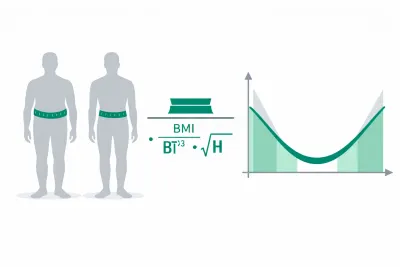
ABSI Calculator: A Body Shape Index & Mortality Risk
Free ABSI calculator computes A Body Shape Index from waist, height, and BMI to estimate visceral fat and mortality risk independent of body mass index.

Adult BMI Calculator for Men & Women — WHO BMI Guide
Use the adult BMI calculator to find your BMI with WHO categories. Enter metric or imperial units to see your status and BMI ranges quickly and clearly.

Army Body Fat Calculator — AR 600‑9 Standard Compliance
Check compliance with the Army body fat calculator per AR 600-9 standards. Enter circumference measures by sex to estimate body fat % and see pass/fail status.
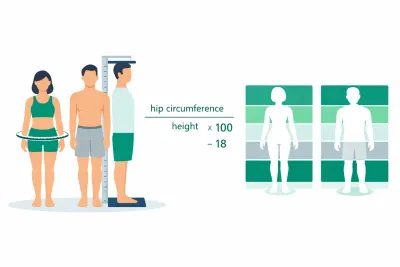
Body Adiposity Index Calculator (BAI) — Body Fat %
Free body adiposity index calculator estimates body fat percentage from hip circumference and height using the BAI formula, no weight or scale needed.
Body Composition Calculator — Fat, Lean Mass Breakdown
Use our body composition calculator to estimate body fat percentage, fat mass, and lean mass from tape measurements. Switch units and get clear categories.

Body Fat Calculator — Percentage for Men & Women (Tape)
Estimate with the body fat percentage calculator (body fat calculator) using Navy circumference equations. Supports metric/imperial and sex‑specific inputs.