Use the FIB-4 Calculator
Free FIB-4 calculator scores liver fibrosis risk from age, AST, ALT, and platelet count, with age-adjusted FIB4 cutoffs and a bonus APRI score included.
FIB-4 index
1.97
Patient & Lab Values
Aspartate aminotransferase (SGOT).
Alanine aminotransferase (SGPT).
Same number your CBC shows in 10³/µL.
Optional: AST upper limit of normal (adds APRI score)
Your lab's AST reference ceiling (often 35–40 U/L).
FIB-4 Index
Cannot rule advanced fibrosis in or out
Formula: (54 × 40) ÷ (200 × √30) = 1.97
Low-risk cutoff
1.45
High-risk cutoff
3.25
Platelets used
200×10⁹/L
APRI score
0.5
APRI = 0.5
Indeterminate range.
AST-to-Platelet Ratio Index: <0.5 unlikely, >1.5 likely significant fibrosis, >2.0 cirrhosis (WHO cutoffs). A second opinion alongside FIB-4.
FIB-4 Interpretation (standard cutoffs)
| Risk | FIB-4 | What it means |
|---|---|---|
| Low | < 1.45 | Advanced fibrosis ruled out (NPV ~90%) |
| Indeterminate | 1.45 – 3.25 | Needs elastography or specialist review |
| High | > 3.25 | Refer to hepatology; likely F3–F4 |
Cutoffs validated for chronic hepatitis C and NAFLD/MASLD. Not designed for acute hepatitis or patients under 35.
Suggested next step
An indeterminate FIB-4 cannot rule fibrosis in or out. Guidelines recommend a second non-invasive test — transient elastography or an ELF blood test — rather than stopping here.
Disclaimer
This FIB-4 calculator is for education only and does not diagnose liver disease. The score estimates the probability of advanced fibrosis but cannot replace elastography, biopsy, or specialist assessment. Discuss any abnormal result with your healthcare provider before acting on it.
Educational tool, not medical advice. Check this tool’s method and limitations before interpreting a result. Talk to a qualified healthcare professional before making decisions about medication, diet, exercise, or treatment. See our Terms of Use.
Your rating helps improve FIB-4 Calculator. We store only an anonymized vote (no personal data).
How to Use FIB-4 Calculator
Step 1: Enter your age and liver enzymes
Type your age in years, then your AST and ALT values in U/L from your most recent blood test.
Step 2: Enter your platelet count
Add your platelet count and pick the matching unit: ×10⁹/L (e.g. 200) or the raw per-µL count (e.g. 200000).
Step 3: Read your FIB-4 index
The FIB-4 score appears instantly with a Low, Indeterminate, or High badge and a color-coded risk bar.
Step 4: Check the age-adjusted cutoff
If you are 65 or older, the calculator automatically raises the low-risk threshold from 1.45 to 2.0 to cut false positives.
Step 5: Add AST upper limit for APRI
Open the optional field and enter your AST upper limit (often 35–40) to get a second fibrosis score, APRI, for context.
Key Features
- FIB-4 index from age, AST, ALT, and platelet count
- Low / indeterminate / high fibrosis risk classification
- Age-adjusted cutoff (2.0) applied automatically at age 65+
- Optional APRI score using your AST upper limit
- Platelet unit toggle (×10⁹/L or per µL) plus copyable summary
Understanding Results
Formula
The FIB-4 index is (Age × AST) ÷ (Platelet count × √ALT). Age is in years, AST and ALT are in U/L, and platelets are in ×10⁵/L (the same figure a CBC reports as 10³/µL). The equation deliberately rewards a falling platelet count and a rising AST — the two lab changes that track most closely with a stiffening liver. A worked case: a 60-year-old with AST 58, ALT 30, and platelets 140 scores (60 × 58) ÷ (140 × √30) = 3,480 ÷ 767 = 4.54, a high-risk result.
Reference Ranges & Interpretation
Standard cutoffs are below 1.45 = low risk (advanced fibrosis ruled out with ~90% negative predictive value), 1.45–3.25 = indeterminate, and above 3.25 = high risk for stage F3–F4 fibrosis. Because age sits in the numerator, adults 65 and older run high by default, so this calculator raises the low-risk cutoff to 2.0 past that age. The thresholds are validated for chronic hepatitis C and NAFLD/MASLD; FIB-4 is not designed for adults under 35, where it underperforms.
Assumptions & Limitations
FIB-4 estimates a probability, not a diagnosis. Anything that independently lowers platelets — immune thrombocytopenia, recent chemotherapy, or hypersplenism — inflates the score, and an acute hepatitis flare spikes AST, both producing false highs; retest once enzymes settle. A low or indeterminate score never replaces clinical judgment, and any high result should be confirmed with transient elastography (FibroScan) or, rarely, biopsy. Always review your number with a healthcare professional before acting on it.
Complete Guide: FIB-4 Calculator
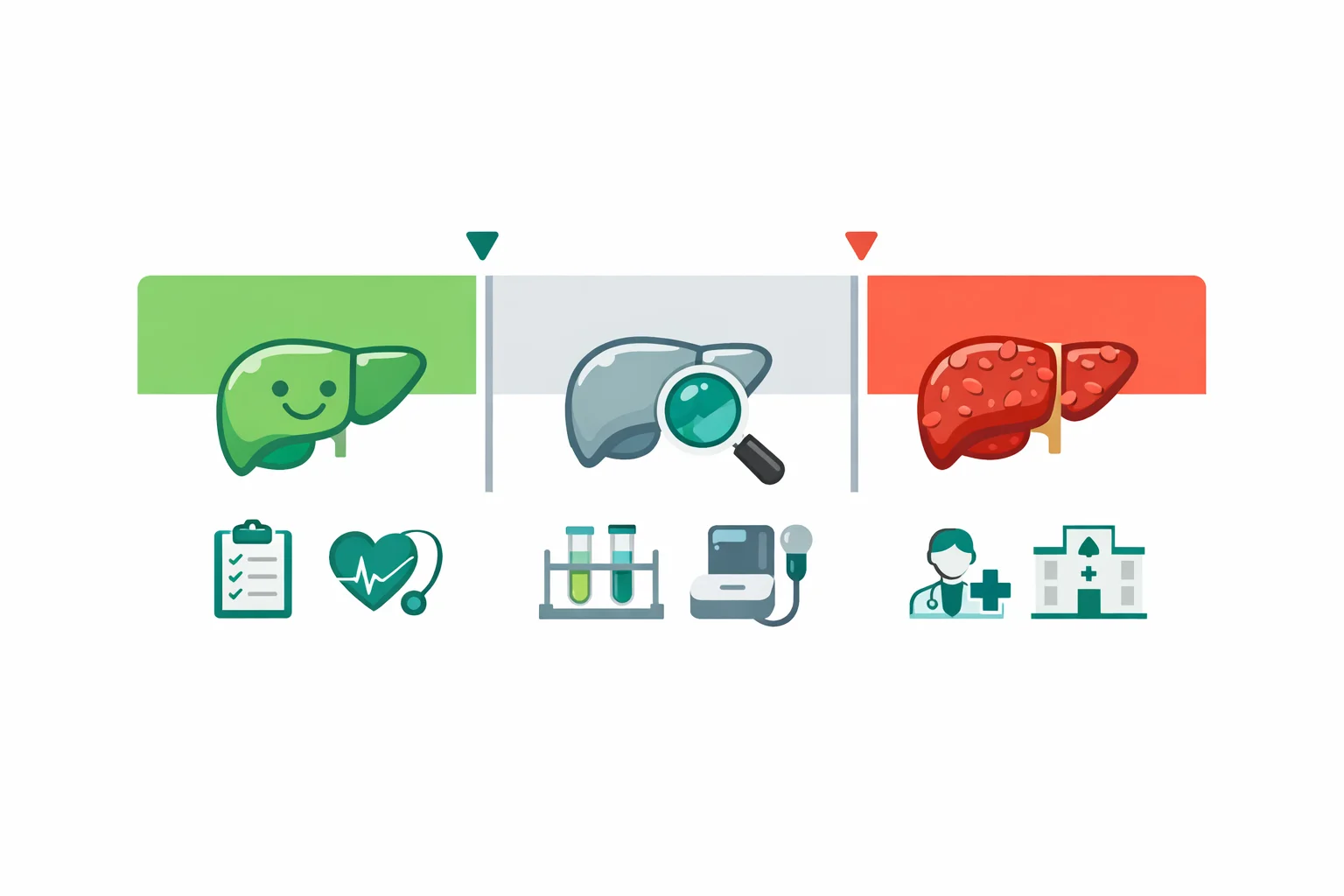
On this page
The FIB-4 calculator can rule out advanced liver scarring in roughly 90% of patients without a single needle, which is why this liver fibrosis calculator has quietly become the first test ordered when fatty liver or hepatitis is suspected. It combines four numbers you almost certainly already have on file — your age, AST, ALT, and platelet count — into one index that sorts people into three buckets: probably fine, probably scarred, or unclear. The catch is that most people misread it. They assume a normal ALT means a healthy liver, or that an “indeterminate” result is a dead end. Both assumptions are wrong, and this guide explains why.
What the FIB-4 Calculator Score Really Tells You
FIB-4 stands for Fibrosis-4. It estimates the chance that the liver has progressed to advanced fibrosis — stages F3 (bridging fibrosis) and F4 (cirrhosis) on the 0–4 METAVIR scale. It does not grade inflammation, measure fat, or diagnose a specific disease. What it does well is separate the large group of people who can safely be reassured from the small group who need a hepatologist. Developed in 2006 for HIV/hepatitis C co-infection, it was later validated across hepatitis C, hepatitis B, and non-alcoholic fatty liver disease (now called MASLD), which is why primary-care and diabetes guidelines now treat it as the front-line screen for the estimated 1 in 4 adults worldwide with fatty liver.
Three Myths That Send People to the Wrong Test
Myth 1: “My ALT is normal, so my liver is fine.” Up to 70% of people with significant fibrosis from fatty liver have ALT values inside the lab's reference range. FIB-4 catches many of them because it leans on the AST-to-ALT relationship and the platelet drop that comes with a stiffening liver, not on a single enzyme. Myth 2: “You need a biopsy to know.” Biopsy samples roughly 1/50,000th of the liver and carries a real bleeding risk; FIB-4 plus an elastography scan now replaces biopsy for most fibrosis staging. Myth 3: “An indeterminate score is useless.” It is actually doing its job — narrowing a whole population down to the ~30% who need one more test instead of biopsying everyone.
The Formula and a Worked Example
The equation is FIB-4 = (Age × AST) ÷ (Platelet count × √ALT), where age is in years, AST and ALT are in U/L, and platelets are in ×10⁵/L (the same number a CBC reports as 10³/µL). If you are unsure what your own platelet value means in isolation, our platelet count calculator grades it against normal, thrombocytopenia, and thrombocytosis ranges. Notice how the math punishes a falling platelet count and a rising AST — the two changes that track most closely with scarring. Take a 60-year-old with AST 58, ALT 30, and platelets 140: FIB-4 = (60 × 58) ÷ (140 × √30) = 3,480 ÷ (140 × 5.48) = 3,480 ÷ 767 = 4.54. That sits well above the 3.25 high-risk threshold, so this person needs hepatology referral, not reassurance. Because the same AST/ALT pair drives our AST/ALT ratio calculator, the two tools pair naturally — a De Ritis ratio above 1 plus a high FIB-4 strengthens the case for fibrosis.
Cutoffs, and Why Age 65 Changes Them
The classic thresholds are below 1.45 = low risk, 1.45 to 3.25 = indeterminate, and above 3.25 = high risk. The low cutoff is built for ruling out: a FIB-4 under 1.45 has about 90% negative predictive value for advanced fibrosis. The high cutoff is built for ruling in, with a positive predictive value around 65–80% depending on the population. But age is baked into the numerator, so older adults drift upward by default. In people 65 and over, using 1.45 produces too many false positives, so validation studies recommend raising the lower cutoff to 2.0. The calculator above applies this automatically once age hits 65.
| Population | Low-risk cutoff | High-risk cutoff |
|---|---|---|
| Adults 35–64 | < 1.45 | > 3.25 |
| Adults 65 and older | < 2.0 | > 3.25 |
| Under 35 | Not validated — FIB-4 underperforms in young adults | |
FIB-4 vs. APRI vs. FibroScan vs. Biopsy
FIB-4 is not the only non-invasive option, and knowing where it sits helps you read the result. APRI uses just AST and platelets and is cheaper to remember but slightly less accurate; the calculator above computes it for you when you enter your lab's AST upper limit. Transient elastography (FibroScan) physically measures liver stiffness in kilopascals and is the usual confirmatory test after an abnormal FIB-4. Biopsy remains the reference standard but is reserved for unclear cases. A sensible pathway: FIB-4 first, FibroScan if the score is indeterminate or high, biopsy only if the picture still does not add up.
| Test | Inputs | Best use |
|---|---|---|
| FIB-4 | Age, AST, ALT, platelets | First-line rule-out screen |
| APRI | AST, AST ceiling, platelets | Resource-limited settings, hepatitis |
| FibroScan | Ultrasound elastography probe | Confirming an abnormal FIB-4 |
| Liver biopsy | Tissue sample | Reference standard for unclear cases |
Once cirrhosis is on the table, FIB-4 hands off to prognostic scores. The MELD score calculator and Child-Pugh calculator take over to grade severity and predict outcomes, while a broader liver function calculator helps interpret the full enzyme panel that flagged the problem in the first place.
What to Do With an Indeterminate Score
Landing between 1.45 and 3.25 frustrates people, but it is the expected outcome for roughly 30% of those screened. The correct move is a second non-invasive test rather than repeating the bloods or jumping to biopsy. Transient elastography is the usual next step; where it is unavailable, an Enhanced Liver Fibrosis (ELF) blood test serves the same purpose. The point of the indeterminate zone is triage efficiency: instead of scanning everyone, the score reserves the expensive equipment for the minority whose FIB-4 could not settle the question. If your number sits here, treat it as “needs one more look,” not “something is wrong.”
When FIB-4 Gives the Wrong Answer
Three situations distort the score. First, anything that independently drops platelets — immune thrombocytopenia, recent chemotherapy, hypersplenism unrelated to liver disease — inflates FIB-4 and can produce a false high. Second, an acute hepatitis flare sends AST soaring for reasons that have nothing to do with chronic scarring, so a FIB-4 drawn during an alcohol binge or a viral spike overstates fibrosis; wait for enzymes to settle and recheck. Third, age over-weights the result in the very old and under-weights it in adults under 35, where the score simply was not validated. Read FIB-4 as a probability, not a verdict, and always pair an abnormal number with the clinical picture and a confirmatory scan before drawing conclusions.
References
- Sterling RK, et al. Development of a simple noninvasive index to predict significant fibrosis (FIB-4). Hepatology. PubMed 2006
- McPherson S, et al. Age as a confounding factor for the accuracy of non-invasive fibrosis tests. Am J Gastroenterol. PubMed 2017

Written by Marko Šinko
Co-Founder & Lead Developer
Computer scientist and developer working on calculator implementation, data handling, and accessible interfaces. His authorship describes development work, not independent medical review.
View full profileFrequently Asked Questions
What is a good FIB-4 score?
A FIB-4 below 1.45 is considered low risk and rules out advanced liver fibrosis with about 90% negative predictive value. Scores between 1.45 and 3.25 are indeterminate, and anything above 3.25 is high risk for stage F3–F4 fibrosis. In adults 65 and older the low-risk cutoff is raised to 2.0.
How is the FIB-4 score calculated?
FIB-4 = (Age × AST) ÷ (Platelet count × √ALT), where age is in years, AST and ALT are in U/L, and platelets are in ×10⁹/L. For example, age 60, AST 58, ALT 30, and platelets 140 give (60 × 58) ÷ (140 × 5.48) = 4.54, a high-risk result.
What FIB-4 score indicates cirrhosis?
A FIB-4 above 3.25 suggests advanced fibrosis or cirrhosis and warrants hepatology referral, but the score cannot confirm cirrhosis on its own. Positive predictive value at this threshold is roughly 65–80%, so a confirmatory FibroScan or biopsy is still needed.
Can FIB-4 be high without liver disease?
Yes. Anything that lowers platelets independently — immune thrombocytopenia, chemotherapy, or hypersplenism — inflates FIB-4 and can create a false high. An acute hepatitis flare also spikes AST, overstating fibrosis, so retest once enzymes settle.
Why does FIB-4 use a different cutoff after age 65?
Age sits in the numerator, so older adults drift upward by default. Using 1.45 in people 65 and over produces too many false positives, so validation studies recommend a low-risk cutoff of 2.0. This calculator applies the higher cutoff automatically.
What is the difference between FIB-4 and APRI?
Both are non-invasive fibrosis scores. FIB-4 uses age, AST, ALT, and platelets, while APRI uses only AST (relative to its upper normal) and platelets. FIB-4 is generally more accurate; APRI is simpler and common in resource-limited settings. This tool computes both.
Do I need to fast before the blood tests for FIB-4?
No fasting is required for AST, ALT, or platelet count, the three labs FIB-4 needs. Avoid strenuous exercise and alcohol in the 24–48 hours before testing, since both can transiently raise AST and skew the score upward.
Is a normal ALT enough to rule out liver fibrosis?
No. Up to 70% of people with significant fibrosis from fatty liver have an ALT inside the normal range. FIB-4 catches many of these cases because it weighs the AST-to-ALT relationship and the platelet drop, not a single enzyme.
Related Calculators
A1C Calculator — Convert HbA1c to eAG with Targets
Use our A1C calculator to convert HbA1c to estimated average glucose (eAG). See normal, prediabetes, and diabetes thresholds in mg/dL and mmol/L. Fast results.
Albumin Calculator — Serum Albumin Level Interpretation
Free albumin calculator to interpret serum albumin levels, grade hypoalbuminemia, and compute A/G ratio plus albumin-corrected calcium from your lab results.
Albumin-Corrected Anion Gap Calculator — Hidden Acidosis
Use our albumin-corrected anion gap calculator to raise the anion gap by 2.5 per 1 g/dL of low albumin and reveal a hidden high-gap metabolic acidosis.

ANC Calculator: Absolute Neutrophil Count & Neutropenia
Free ANC calculator to calculate absolute neutrophil count from WBC and differential. Get ANC in cells/uL and x10^9/L with instant neutropenia grading.
Anion Gap Calculator — Metabolic Acidosis Evaluation
Free anion gap calculator finds serum anion gap from sodium, chloride, and bicarbonate, with albumin correction and delta ratio for metabolic acidosis.
AST/ALT Ratio Calculator — Free De Ritis Ratio Tool
Use our free AST/ALT ratio calculator to compute the De Ritis index instantly. Visual ratio chart, enzyme-level assessment, and clinical patterns guide.