Use the MET Calculator
Free MET calculator converts MET values into calories burned for 144 activities, with a personalised 1-MET baseline, MET-minutes, and relative intensity.
4.3 METs · 30 min
150 kcal
1. About you
2. Pick a MET value
Walking, 3.5 mph (brisk)
150kcal
in 30 minutes · 115 kcal above resting
MET value
4.3
15.0 mL/kg/min
Calories per minute
5.0
300 kcal/hour
MET-minutes
129
516 per week
Your 1 MET
3.10
mL/kg/min (vs 3.5 assumed)
Resting metabolism
1,674
kcal/day (Mifflin-St Jeor)
Time to burn 300 kcal
60
minutes at this MET
Your baseline vs the textbook 3.5 mL/kg/min
The standard MET formula assumes everyone rests at 3.5 mL of oxygen per kg per minute. Your estimated resting rate is 3.10, so the two answers differ.
Personalised
150 kcal
115 kcal net · baseline 1.16 kcal/min
Standard formula
169 kcal
130 kcal net · MET × 3.5 × kg ÷ 200
The generic formula reads 11.4% high for your body — a gap of 19 kcal on this session alone, or 77 kcal across a week at 4 sessions.
How hard this is for you specifically
A 6-MET activity is a warm-up for a trained 25-year-old and near-maximal for a sedentary 70-year-old. This compares the activity against your oxygen-uptake reserve, the way ACSM prescribes exercise intensity.
Estimated peak capacity
12.1 METs
Average for a 35-year-old man (FRIEND registry)
Weekly MET-minutes vs the guideline target
Physical activity guidelines translate to roughly 500–1,000 MET-minutes per week. Repeating this session 4 times a week gives you 516.
You clear the minimum. Another 3.8 sessions a week would reach the upper target.
What each MET band costs at 75.0 kg
| METs | Intensity | kcal / 30 min | Min for 500 kcal | % of your peak |
|---|---|---|---|---|
| 1.5 | Sedentary | 52 | 287 | 5% |
| 2.5 | Light | 87 | 172 | 14% |
| 3.5 | Moderate | 122 | 123 | 23% |
| 4.5 | Moderate | 157 | 96 | 32% |
| 6.0 | Vigorous | 209 | 72 | 45% |
| 8.0 | Vigorous | 279 | 54 | 63% |
| 10.0 | Very vigorous | 349 | 43 | 81% |
| 12.0 | Very vigorous | 418 | 36 | 99% |
Highlighted row is closest to your selected activity. Calories use your personalised baseline, not the 3.5 constant.
Read this before you trust the number
MET values are population averages measured in laboratory conditions, and individual oxygen cost for the same task varies by roughly 10–20% with fitness, technique, terrain, and body composition. Peak MET capacity here is a reference average, not a measured exercise-test result. If you are managing a heart or lung condition, use the MET capacity from your own stress test and confirm activity targets with your clinician.
Educational tool, not medical advice. Check this tool’s method and limitations before interpreting a result. Talk to a qualified healthcare professional before making decisions about medication, diet, exercise, or treatment. See our Terms of Use.
Your rating helps improve MET Calculator. We store only an anonymized vote (no personal data).
How to Use MET Calculator
Step 1: Enter your body stats
Fill in Body weight, Height, Age, and Sex at birth. Height and age are not padding: they feed the Mifflin-St Jeor equation that replaces the generic 3.5 mL/kg/min constant with your own resting metabolic rate.
Step 2: Choose an activity or type a MET value
Leave the mode on "From an activity" and search the 144-entry Compendium list, or narrow it with the category pills (Walking, Running, Cycling, Gym, Sports, Water, Winter, Home & Work). If you already have a MET number from a machine console or a stress-test report, switch to "Enter METs directly" and type it or drag the slider.
Step 3: Set duration and weekly frequency
Enter the session length in the Duration field or tap a 15, 30, 45, or 60 minute chip, then set Sessions per week. Frequency only affects the weekly MET-minutes total, not the per-session calorie figure.
Step 4: Compare your calories against the standard formula
The green panel shows calories on your personalised baseline. Scroll to "Your baseline vs the textbook 3.5" to see what the generic MET x 3.5 x kg / 200 formula would have said and how many calories separate the two over a week.
Step 5: Check how hard the activity is for you
The relative intensity panel converts the MET value into a percentage of your oxygen-uptake reserve using the peak MET average for your age and sex. If you know your own peak METs or VO2 max, enter it in the override field: divide a VO2 max in mL/kg/min by 3.5 to convert it.
Step 6: Track your weekly MET-minutes
The last panel plots your weekly MET-minutes against the 500 to 1,000 range that physical activity guidelines translate to, and tells you how many more sessions would close the gap. Use Copy results to save the full summary.
Key Features
- 144 Compendium of Physical Activities MET values, searchable and filtered by category
- Personalised 1-MET baseline from your own resting metabolism instead of the fixed 3.5 constant
- Side-by-side comparison of the textbook formula against your personalised calorie result
- Relative intensity as a share of oxygen-uptake reserve, against FRIEND peak MET norms for your age and sex
- MET-minutes per session and per week, tracked against the 500-1,000 guideline range
- Reference table of kcal per 30 minutes and minutes to burn 500 kcal at your body weight
Understanding Results
The Formula Behind This MET Calculator
The textbook conversion every MET table implies is a single line, where 3.5 is the assumed resting oxygen uptake in millilitres per kilogram per minute:
kcal = METs × 3.5 × weight (kg) × minutes ÷ 200
This page reports that figure, but leads with a second one. Because a MET is by definition a multiple of your resting metabolic rate, the constant can be replaced with your own. The calculator estimates resting metabolism from the Mifflin-St Jeor equation (10 × kg + 6.25 × cm − 5 × age, +5 for men or −161 for women), divides by 1,440 minutes to get resting calories per minute, then multiplies by METs and duration:
kcal = METs × (RMR ÷ 1,440) × minutes
Two derived numbers follow. Net calories strip out the resting energy you would have spent anyway: net = gross × (METs − 1) ÷ METs, so an 8-MET session nets seven-eighths of its gross total. Relative intensity expresses the activity as a share of oxygen-uptake reserve — (activity METs − 1) ÷ (peak METs − 1) × 100 — which is how ACSM prescribes exercise intensity to an individual rather than to a population.
MET-minutes are simply METs × minutes, computed on gross METs by convention, and summed across the week.
Reference Ranges & Interpretation
MET values sort activities into intensity bands that physical activity research and the CDC use directly. The 3.0 and 6.0 boundaries are the ones that carry guideline consequences:
| MET range | Band | Typical activity | Guideline credit |
|---|---|---|---|
| 1.0–1.5 | Sedentary | Sitting, desk work, driving | None |
| 1.6–2.9 | Light | Slow walking, Hatha yoga, washing dishes | None |
| 3.0–5.9 | Moderate | Brisk walking, doubles tennis, mowing the lawn | Moderate minutes |
| 6.0–8.7 | Vigorous | Jogging, cycling 12–14 mph, singles tennis | Vigorous (counts double) |
| 8.8+ | Very vigorous | Running 10 min/mile or faster, skipping rope | Vigorous (counts double) |
For weekly volume, aim for 500–1,000 MET-minutes. That range is what the WHO recommendation of 150–300 weekly minutes of moderate activity translates to, and it is the band where mortality benefit accumulates fastest before flattening.
For peak capacity, FRIEND registry means run from 13.7 METs for men aged 20–29 down to 6.5 for men aged 70–79, and 10.7 down to 5.8 for women across the same span. Under 5 METs indicates poor prognosis and limited independence; 10 or more is excellent. Sources: the 2011 Compendium of Physical Activities and the WHO guidelines on physical activity and sedentary behaviour.
Assumptions & Limitations
Compendium MET values are population means measured on mostly young, lean, healthy adults performing a task at a defined speed or effort. Individual oxygen cost for the identical task varies by roughly 10–20% with movement economy, technique, terrain, footwear and ambient temperature. Sport entries are whole-session averages that include standing and substitutions, and resistance-training entries average the rest between sets, which is why 3.5 METs looks low to anyone who has just finished a heavy squat session.
The personalised baseline is an improvement on the 3.5 constant, not a measurement. Mifflin-St Jeor predicts resting metabolic rate within 10% for about 80% of adults, and it was validated on people without significant metabolic disease; it reads high for very lean athletes and can drift for anyone with thyroid dysfunction, on beta blockers, or after substantial weight loss. Peak MET capacity here is a reference average by age and sex, not your result — an untrained 45-year-old may sit 30% below the FRIEND mean, and a trained one well above it. Use the override field if you have a real graded exercise test.
The model also ignores excess post-exercise oxygen consumption, altitude, and the extra cost of carrying a load, and it assumes steady-state effort for the whole duration you enter. Treat the output as a planning estimate. Anyone with a cardiac, respiratory, or metabolic condition, or who has been told to keep exercise below a specific MET level, should work from the capacity measured in their own stress test and confirm targets with their clinician.
Complete Guide: MET Calculator
On this page
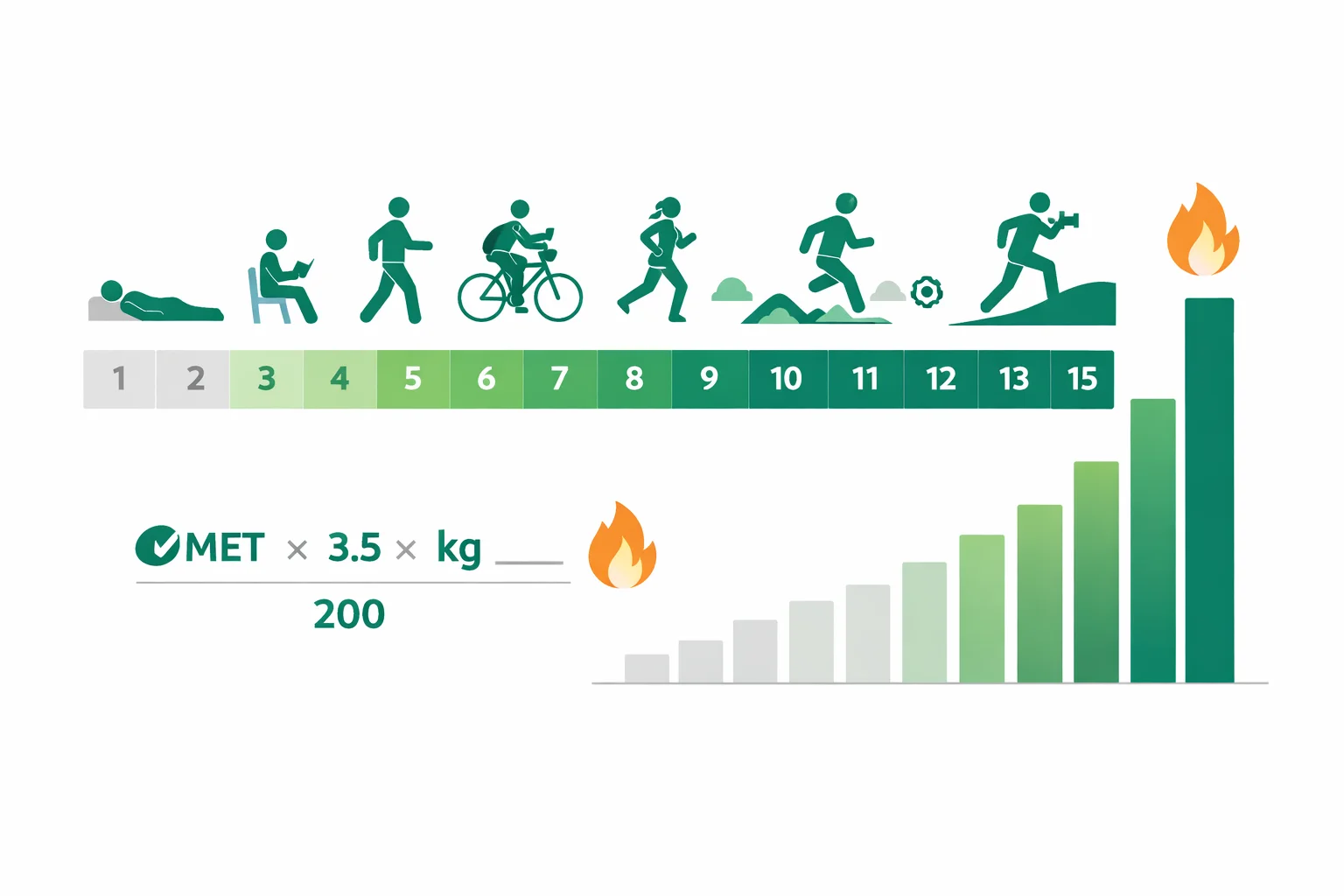
A MET calculator runs one line of arithmetic: kcal/min = METs × 3.5 × body weight in kg ÷ 200. Feed it 8 METs, 75 kg and 30 minutes and it returns 315 calories. Working out calories from METs really is that simple, which is exactly why the formula appears on every fitness site, every treadmill console, and inside most wearables. It is also built on a constant — that 3.5 — that was measured on one reference man in the 1970s and does not describe most of the people using it. This guide covers what a metabolic equivalent actually is, where the standard formula breaks, and the two calculations that matter more than the calorie figure: relative intensity and MET-minutes.
One MET Is 3.5 Millilitres of Oxygen per Kilogram per Minute
A metabolic equivalent of task is a ratio, not an energy unit. One MET is the rate at which you consume oxygen sitting still: conventionally 3.5 mL of oxygen per kilogram of body weight per minute, which works out to roughly 1 kilocalorie per kilogram per hour. Every other MET value is a multiple of that. Walking at 3.5 mph costs 4.3 METs, so it burns 4.3 times as much energy per minute as sitting. Running a 6-minute mile costs 14.5 METs. Sleeping costs 0.95.
The 200 in the denominator is not arbitrary either. Divide by 1,000 to convert millilitres of oxygen to litres, then multiply by 5, because burning one litre of oxygen releases about 5 kilocalories at a normal mixed-fuel respiratory quotient. Those two steps collapse into a single divide-by-200. Here is the full chain for a 75 kg adult doing 30 minutes of circuit training at 8.0 METs:
- METs to oxygen. 8.0 × 3.5 = 28.0 mL/kg/min.
- Oxygen to litres per minute. 28.0 × 75 kg ÷ 1,000 = 2.10 L/min.
- Litres to calories. 2.10 × 5 kcal = 10.5 kcal/min.
- Calories to session total. 10.5 × 30 min = 315 kcal.
That 315 is a gross figure — it includes the energy you would have spent lying on the sofa for the same half hour. Strip the resting MET out and the workout itself contributed 8 − 1 = 7 METs of surplus, or 315 × 7/8 = 276 net calories. Which number you want depends on what you are doing with it. Log the net figure if your daily target already comes from a TDEE calculator, because that estimate already contains your resting metabolism. Use gross only when you are building the entire day from zero.
The 3.5 Problem: A Constant That Fits Almost Nobody
The 3.5 mL/kg/min figure describes the resting oxygen uptake of a healthy 40-year-old man weighing 70 kg. It was never meant to be universal, and it is not. Byrne and colleagues measured resting metabolic rate directly in 642 adults across a BMI range of 18 to 64 and found a mean of 2.6 mL/kg/min. The textbook constant overstated their measured resting oxygen uptake by 35%. Their paper is titled, with no ambiguity, “Metabolic equivalent: one size does not fit all.”
The reason is body composition. MET values are expressed per kilogram of total body weight, but fat tissue is metabolically quiet — it burns roughly 4.5 kcal/kg/day against 13 kcal/kg/day for skeletal muscle and far more for organs. Add 30 kg of adipose tissue and the denominator grows faster than the numerator, so oxygen uptake per kilogram falls. Age pushes the same direction. The result is systematic and one-directional: for heavier and older adults, a standard MET calculator always reads high, never low.
The calculator above sidesteps the constant entirely. Instead of assuming your resting rate, it estimates it from your height, weight, age and sex with the Mifflin-St Jeor equation, then treats 1 MET as yourresting rate rather than the reference man's. Same three people, same 30-minute 8-MET session:
| 30 min at 8.0 METs | 25 y, 58 kg woman | 40 y, 78 kg man | 55 y, 115 kg man |
|---|---|---|---|
| Their actual 1 MET (mL/kg/min) | 3.14 | 3.05 | 2.41 |
| Standard formula says | 244 kcal | 328 kcal | 483 kcal |
| Personalised baseline says | 219 kcal | 285 kcal | 332 kcal |
| Overestimate | 10% | 13% | 31% |
Look at the third column. The heaviest person — the one most likely to be tracking calories for weight loss — gets the largest phantom credit: 151 calories per session. Train four times a week and the standard formula has invented 604 calories, roughly a fifth of a pound of fat per month that never existed. The lean 25-year-old, who probably cares least, gets the most accurate reading. That inversion is the practical cost of a fixed constant.
Absolute vs. Relative METs: The Same 6 METs, Two Different Workouts
Here is the distinction that separates a MET table from an actual training prescription. Absolute intensity is the oxygen cost of the task, and it is the same for everyone: cycling at 12 mph is 8.0 METs whether an Olympian or a beginner does it. Relative intensity is what fraction of your own ceiling that represents, and it is different for every single person.
ACSM prescribes exercise in relative terms, using oxygen-uptake reserve — the span between resting and peak. The arithmetic is one line:
% reserve = (activity METs − 1) ÷ (peak METs − 1) × 100
Run a 6-MET activity — a doubles tennis match, say — through it for two people. A 28-year-old man with an average peak capacity of 13.7 METs is working at (6 − 1) ÷ 12.7 = 39% of reserve, which ACSM classifies as light. A 68-year-old woman with a peak of 6.7 METs is at (6 − 1) ÷ 5.7 = 88%, which is vigorous and one notch below maximal. The CDC would label that match “moderate” for both of them. For one of them, that label is dangerously wrong.
| Age | Peak METs, men | Peak METs, women | 6 METs is… (men / women) |
|---|---|---|---|
| 20–29 | 13.7 | 10.7 | 39% / 52% |
| 40–49 | 10.8 | 9.2 | 51% / 61% |
| 60–69 | 7.8 | 6.7 | 74% / 88% |
| 70–79 | 6.5 | 5.8 | 91% / 104% |
Those peak values are population means from the FRIEND registry, the reference database built from cardiopulmonary exercise tests on healthy American adults. Read the bottom-right cell carefully: for the average woman in her seventies, a 6-MET activity is beyond her measured peak capacity. She cannot sustain it, which is why exercise prescription for older adults has to start from relative intensity, not from a Compendium table. If you have had a graded exercise test or estimated your ceiling with a VO2 max calculator, enter that number in the calculator above instead of the age-based average — divide a VO2 max in mL/kg/min by 3.5 to convert it to peak METs.
MET-Minutes: The Unit Guidelines Are Actually Written In
Calories are what people want from a metabolic equivalent calculator. MET-minutes are what the science uses. Multiply the MET value by the duration and you get a single number that captures volume and intensity together: 30 minutes at 8 METs is 240 MET-minutes, and so is 60 minutes at 4 METs. The WHO and the US Physical Activity Guidelines both translate to a target of roughly 500 to 1,000 MET-minutes per week, which is where the familiar “150 minutes of moderate activity” comes from — 150 minutes at about 4 METs is 600 MET-minutes.
The virtue of the unit is that it is agnostic about how you assemble the week. Three routes to the same guideline:
- Five 30-minute brisk walks at 4.3 METs = 645 MET-min. Clears the minimum.
- Three 45-minute rides at 8.0 METs = 1,080 MET-min. Past the upper target on three sessions.
- Two 60-minute Hatha yoga classes at 2.5 METs = 300 MET-min. Two full hours of exercise a week that does not reach the floor.
That third line is the one worth sitting with. Yoga is genuinely valuable for mobility, balance and stress, but at 2.5 METs it sits below the 3.0 threshold that defines moderate activity at all. It contributes almost nothing to the cardiorespiratory target no matter how long you do it. The minutes-based guideline hides this; the MET-minute version makes it obvious. One caveat on the arithmetic: MET-minutes are conventionally computed with gross METs, not net, so do not subtract the resting 1 before multiplying.
What Peak METs Predict About Your Health
Outside the gym, METs are a prognostic instrument. Myers and colleagues followed 6,213 men referred for treadmill testing and found that peak exercise capacity was a stronger predictor of death than smoking status, hypertension, diabetes or elevated BMI. Each 1-MET increase in exercise capacity was associated with a 12% improvement in survival. Not 1% — twelve. Moving from 7 peak METs to 9 is worth more, in that dataset, than most of what appears on a standard risk panel.
The thresholds clinicians work from are worth knowing. A peak capacity under 5 METs signals poor prognosis and severely limited function — someone at that level struggles with everyday tasks like carrying groceries upstairs, which costs about 7.5 METs. Above 8 METs the outlook is good, and 10 METs or more puts you in the range where further gains produce diminishing returns on mortality. The 4-MET mark shows up in preoperative assessment: it is roughly the cost of climbing two flights of stairs without stopping, which is why an anaesthetist asks about stairs rather than ordering a treadmill test.
This reframes what the calculator above is for. The calorie output answers a question about today. The peak-MET line answers a question about the next twenty years, and it is the one you can actually move: peak capacity responds to training in weeks, while the Compendium value of your chosen activity never changes.
Reading a Compendium Entry Without Getting Burned
Nearly every MET value in circulation traces back to one source: the Compendium of Physical Activities, whose 2011 revision catalogued 821 activities under five-digit codes. Its precision is the point. There is no MET value for “running” — there are fourteen, from 6.0 at a 15-minute mile to 23.0 at a 4.3-minute mile. Picking “running, general” when you actually ran 10-minute miles throws the estimate off by 20%. Three traps catch people:
Sport values are game averages, not effort averages. Basketball is listed at 8.0 METs, but a game is sprints interleaved with standing at the free-throw line. The 8.0 covers the whole clock. Enter it for 45 minutes of continuous full-court play and you will understate; enter it for 45 minutes of a recreational game with substitutions and it is about right.
Weight training at 3.5 METs includes the rest between sets. That number surprises lifters, who reasonably feel they are working harder than a 3.5-MET walk. During a heavy set you are — but sets occupy maybe 15% of the session. The Compendium averages the whole hour. This is also why MET-based calorie estimates systematically undersell resistance training: they capture none of the elevated post-exercise oxygen consumption or the metabolic value of the muscle you build.
Most values were measured on young, lean, fit subjects. Economy of movement varies by 10–20% between individuals doing the identical task. An experienced swimmer covers the same 100 m at a lower oxygen cost than a novice thrashing through it, yet both look up 5.8 METs for “freestyle, moderate.” The 2024 Compendium update began publishing separate adult and older-adult values for exactly this reason. In water the gap is wider than anywhere else, because propelling efficiency in trained front crawl is roughly 0.6 against nearer 0.3 in novices — a swim pace calculator that reports SWOLF and distance per stroke will separate those two swimmers in a way a single MET value never can.
When METs Are the Wrong Tool
METs are a general-purpose estimator, which means something more specific usually beats them. A quick decision framework:
- Use METs when you know what you did and for how long, and no device recorded it — gardening, a dance class, a hike, an hour of shovelling snow. This is the case METs were designed for, and nothing else covers that breadth.
- Use distance and body weight for walking and running. Energy cost tracks distance far more tightly than duration, so a speed-specific equation beats a MET lookup. The running calorie calculator and the walking calorie calculator use the ACSM metabolic equations, which model speed and grade directly instead of binning them.
- Use power output if you have it. A cycling power meter or a rowing ergometer reports actual mechanical work in watts; divide by a gross efficiency of about 0.22 and you have energy expenditure with no population averaging at all. This is the most accurate field method available. Cyclists should anchor those watts to a threshold first — the FTP calculator turns a 20-minute test into functional threshold power and the seven training zones that scale every other number in a power file.
- Be careful with heart rate. It looks personalised, but heart rate drifts upward with heat, dehydration, caffeine and fatigue at unchanged workload, and it lags at the start of intervals. It is a good intensity signal and a mediocre calorie estimator.
For a session built from several different activities — a warm-up, a lift, a conditioning finisher — stack them in the calories burned calculator, which totals MET-based estimates across a list. And if the reason you are here is a daily calorie target rather than a single workout, start from resting metabolism with the BMR calculator instead — the same Mifflin-St Jeor equation this page uses to personalise your 1-MET baseline.
One last piece of practical advice. If you take a single number away from the calculator above, make it your percentage of oxygen-uptake reserve, not the calorie total. Calorie estimates from any field method carry error bars wide enough to swallow a day's deficit. Relative intensity tells you whether the session you just did was actually training you, and it is the number that changes when you get fitter.
References
- Ainsworth BE, Haskell WL, Herrmann SD, et al. 2011 Compendium of Physical Activities: a second update of codes and MET values. Medicine & Science in Sports & Exercise, 2011;43(8):1575-1581.
- Byrne NM, Hills AP, Hunter GR, Weinsier RL, Schutz Y. Metabolic equivalent: one size does not fit all. Journal of Applied Physiology, 2005;99(3):1112-1119.
- Kaminsky LA, Arena R, Myers J. Reference standards for cardiorespiratory fitness measured with cardiopulmonary exercise testing: data from the Fitness Registry and the Importance of Exercise National Database (FRIEND). Mayo Clinic Proceedings, 2015;90(11):1515-1523.
- Myers J, Prakash M, Froelicher V, et al. Exercise capacity and mortality among men referred for exercise testing. New England Journal of Medicine, 2002;346:793-801.
- World Health Organization. WHO Guidelines on Physical Activity and Sedentary Behaviour, 2020.

Written by Jurica Šinko
Founder & CEO
Entrepreneur and health information advocate, passionate about making health calculations accessible to everyone through intuitive digital tools.
View full profileFrequently Asked Questions
How do you calculate calories burned from METs?
Multiply the MET value by 3.5, by your weight in kilograms, and by the number of minutes, then divide by 200. A 75 kg adult doing 30 minutes of circuit training at 8.0 METs burns 8.0 x 3.5 x 75 x 30 / 200 = 315 calories. The 200 exists because you divide millilitres of oxygen by 1,000 to get litres, then multiply by the roughly 5 calories released per litre of oxygen.
What does 1 MET equal in calories?
One MET is defined as 3.5 mL of oxygen per kilogram of body weight per minute, which is about 1 calorie per kilogram per hour. For a 70 kg adult that is roughly 70 calories an hour, or 1.2 calories a minute, at complete rest. Every MET value is a multiple of that: a 4.3 MET brisk walk costs 4.3 times as much energy per minute as sitting still.
How many METs is walking?
It depends entirely on speed. The Compendium lists walking at 2.0 mph as 2.8 METs, 3.0 mph as 3.5, 3.5 mph as 4.3, 4.0 mph as 5.0, and 4.5 mph as 7.0. Only from 3.0 mph upward does walking clear the 3.0 MET threshold that defines moderate-intensity activity. Add a 6% incline at 3.5 mph and it jumps to 6.0 METs, which is vigorous.
Is 6 METs considered vigorous exercise?
In absolute terms yes: 6.0 METs is the standard cutoff between moderate and vigorous activity. But relative to your own capacity it varies enormously. For a 25-year-old man with a peak of 13.7 METs, a 6 MET activity uses 39% of his oxygen-uptake reserve, which ACSM classes as light. For a 68-year-old woman with a peak of 6.7 METs it uses 88%, which is near-maximal.
What is a good MET score for my age?
FRIEND registry reference means for peak exercise capacity are 13.7 METs for men in their twenties, 10.8 in their forties, and 7.8 in their sixties; for women, 10.7, 9.2, and 6.7 respectively. A peak below 5 METs signals poor prognosis, above 8 is good, and 10 or more is excellent. Each 1-MET gain in exercise capacity was associated with a 12% improvement in survival in a study of 6,213 men.
What is the difference between METs and MET-minutes?
METs measure intensity at a single moment; MET-minutes measure the total dose by multiplying intensity by duration. Thirty minutes at 8 METs and sixty minutes at 4 METs both come to 240 MET-minutes. Guidelines are written in MET-minutes because they let a short hard session and a long easy one be compared on the same scale.
How many MET-minutes per week do I need?
Between 500 and 1,000 MET-minutes a week, which is what the 150-minutes-of-moderate-activity guideline works out to at about 4 METs. Five 30-minute brisk walks at 4.3 METs gives 645. Three 45-minute rides at 8.0 METs gives 1,080. Two hour-long Hatha yoga classes at 2.5 METs gives only 300, which is why yoga alone does not satisfy the cardiorespiratory target.
Why does this MET calculator give fewer calories than others?
Because most MET calculators assume your resting rate is exactly 3.5 mL/kg/min, and for most adults it is not. Byrne and colleagues measured resting metabolism in 642 adults and found a mean of 2.6 mL/kg/min, meaning the standard constant overstated their true resting oxygen uptake by 35%. This calculator estimates your baseline from height, weight, age and sex instead. The gap is around 10% for a lean 25-year-old and above 30% for a 115 kg 55-year-old.
Related Calculators

5K Pace Calculator — Splits, Finish Time & Pace Zones
Train smarter with the 5K pace calculator: convert goal time to precise per-km and per-mile pace and split targets. Get fast, accurate results instantly.

Agility Calculator for T‑Test and Pro Agility (5‑10‑5)
Use our agility calculator to time T‑Test and pro agility shuttles, compare attempts, track change‑of‑direction speed, check asymmetry, and monitor progress.

Speed, Agility & Power — Athletic Performance Calculator
Analyze running pace, race predictions, strength 1RM, and jump power in one athletic performance calculator. Mobile‑first with quick inputs and clear results.
Bench Press Calculator — 1RM, Strength Level & Training
Free bench press calculator to estimate your one-rep max (1RM), compare strength standards by body weight and sex, and get percentage-based training loads.

Bench Press Calculator — 1RM Max, Sets & Plate Math
Use our bench press calculator to estimate your 1RM from reps and weight, auto‑build working sets, warm‑up ladder, and plate math in kg/lb. Mobile‑friendly.
Body Recomposition Calculator — Recomp Fat Loss & Muscle
Free body recomposition calculator projects fat loss and muscle gain month by month from your calories, protein, body fat and training age. Plan a real recomp.