Use the Stimulant Conversion Calculator
Free stimulant conversion calculator for ADHD medication switches: convert Concerta, Ritalin, Adderall and Vyvanse doses with the 2:1 potency ratio chart.
Osmotic pump: 22% immediate overcoat, 78% ascending release over ~10 h.
Prodrug cleaved by red-cell enzymes. 1 mg yields ~0.295 mg d-amphetamine base.
Enter the total across the whole day, not a single tablet. For Concerta, that is typically 1 dose per day.
Concerta 36 mg/day → Vyvanse
50 mg/day
Dispensable as 50 mg once daily · -5% vs the exact calculation
Exact equipotent value: 52.82 mg/day · available strengths 10, 20, 30, 40, 50, 60, 70 mg
MPH-equivalent
31.1 mg
base per day
Amphetamine-equiv.
15.6 mg
base per day
Dose intensity
Moderate
typical maintenance band
Coverage
12–14 h
was 10–12 h
Methylphenidate-equivalent scale
31.1 mg base/day
Morning bolus, before and after
Equal total milligrams do not mean an equal first hour. This compares the immediate-release share each product delivers up front — the part patients feel as onset.
The target front-loads considerably less. An equipotent total dose can still feel weaker in the first hour — the usual reason a "correct" conversion gets reported as ineffective.
Equivalent dose in every other product
from Concerta 36 mg/dayRitalin, Methylin
MPH30 mg/day
10 mg three times daily · exact 36 mg
Ritalin SR, Metadate ER
MPH40 mg/day
20 mg twice daily · exact 36 mg
Ritalin LA, Metadate CD
MPH40 mg/day
40 mg once daily · exact 36 mg
Daytrana
MPH30 mg/day
30 mg once daily · exact 27.1 mg
Focalin
MPH20 mg/day
10 mg twice daily · exact 18 mg
Focalin XR
MPH20 mg/day
20 mg once daily · exact 18 mg
Adderall
AMP20 mg/day
10 mg twice daily · exact 21.4 mg
Adderall XR
AMP20 mg/day
20 mg once daily · exact 21.4 mg
Vyvanse
AMP50 mg/day
50 mg once daily · exact 52.8 mg
Dexedrine, Zenzedi
AMP20 mg/day
10 mg twice daily · exact 21.2 mg
Dexedrine Spansule
AMP20 mg/day
20 mg once daily · exact 21.2 mg
Above the highest single strength — needs multiple units.
Educational tool, not medical advice. Check this tool’s method and limitations before interpreting a result. Talk to a qualified healthcare professional before making decisions about medication, diet, exercise, or treatment. See our Terms of Use.
Your rating helps improve Stimulant Conversion Calculator. We store only an anonymized vote (no personal data).
How to Use Stimulant Conversion Calculator
Step 1: Pick the product you are converting from
Choose the current medication in the "Convert from" menu. Products are grouped by class, so Ritalin, Concerta, Focalin and the methylphenidate patch sit in one group and Adderall, Vyvanse and Dexedrine in the other. The help text under the menu states the release profile for that product.
Step 2: Enter the total daily dose, not one tablet
Type the milligrams for the whole day in the dose field. Ritalin 10 mg taken three times a day is 30, not 10. The preset buttons load the strengths that product is actually sold in, and the help text reminds you how many doses per day that product usually takes.
Step 3: Choose the target medication
Select the product you are switching to in the "Convert to" menu. Use the Swap button to reverse the direction and carry the calculated dose back across, which is how you check a conversion in both directions.
Step 4: Decide whether to round to a dispensable dose
Leave "Round to a dose you can actually dispense" ticked to snap the answer to a real strength and schedule such as 50 mg once daily. Untick it to see the exact equipotent number and judge for yourself how far the nearest capsule sits from it.
Step 5: Read the morning bolus comparison, not just the total
Check the immediate-release bars underneath the result. Concerta releases 22% of its dose up front while Vyvanse releases none, so two conversions with identical daily milligrams can produce very different first hours. The banner flags a large front-loading change.
Step 6: Cross-check against every other product
Scroll to the grid showing the equivalent dose in all remaining products, and open the Product Reference tab for the full table of base factors, immediate-release shares and durations behind each number.
Key Features
- Converts across 12 ADHD stimulant products in both drug classes
- Salt and prodrug base factors, including lisdexamfetamine 0.295 cleavage yield
- Immediate-release share comparison showing morning bolus before and after
- Snaps every result to a dispensable strength and dosing schedule
- Methylphenidate- and amphetamine-equivalent totals with intensity banding
Understanding Your Stimulant Conversion Results
The Two-Step Formula Behind This Stimulant Conversion Calculator
Every stimulant conversion runs through one common yardstick: methylphenidate-equivalent milligrams of active base per day. Step one strips out the salt or prodrug. Each product carries a base factor — the milligrams of active stimulant delivered per labelled milligram — so active base = labelled dose × base factor. Methylphenidate HCl is 0.865 base by weight, mixed amphetamine salts 0.727, dextroamphetamine sulfate 0.734, and lisdexamfetamine just 0.295 because the prodrug has to be cleaved by red-cell enzymes before any d-amphetamine appears. Dexmethylphenidate is the outlier at 1.73, above 1.0 only because it is the active isomer on its own and is therefore worth about twice racemic methylphenidate per milligram.
Step two crosses the drug classes. Amphetamine base is roughly twice as potent per milligram as methylphenidate base, so amphetamine milligrams are multiplied by 2 to reach the methylphenidate scale and methylphenidate milligrams are divided by 2 to reach the amphetamine scale. Reversing both steps produces the target dose: target mg = (MPH-equivalent ÷ class factor) ÷ target base factor. Worked end to end, Concerta 36 mg gives 36 × 0.865 = 31.1 MPH-equivalent mg, which is 15.6 amphetamine base mg, which divided by the 0.295 lisdexamfetamine yield lands on 52.8 mg — dispensed as the 50 mg Vyvanse capsule.
Dose Intensity Bands and Product Ceilings
The intensity bar reads in methylphenidate-equivalent base milligrams per day: under 15 mg is below usual adult maintenance, 15–35 mg is the typical maintenance band, 35–52 mg is the upper adult range, and anything above 52 mg exceeds most labelled maximums once salt weight is accounted for. Product ceilings bite before the pharmacology does. US labelling caps Concerta at 72 mg/day, immediate-release methylphenidate at 60 mg/day, Focalin XR at 40 mg/day, Adderall XR at 30 mg/day and Vyvanse at 70 mg/day, and the calculator flags any converted result that sits above the highest available strength for that product.
Two numbers matching does not mean two days matching. The immediate-release share differs sharply by formulation — 100% for Ritalin and Adderall IR, 50% for Adderall XR and Focalin XR, 22% for Concerta's osmotic overcoat, and 0% for Vyvanse and the wax-matrix SR tablets. That figure drives onset, and it is the number patients actually perceive. The morning-bolus bars below the result exist so the front-loading change is visible before someone switches and reports the new medicine as weaker.
Assumptions & Limitations
The 2:1 methylphenidate-to-amphetamine ratio is a population average drawn from head-to-head titration studies, not a pharmacokinetic constant. Individual responders sit anywhere between about 1:1 and 3:1, and roughly 40% of people who fail one class respond to the other — a fact no milligram ratio can encode. Base factors assume oral dosing in an adult with normal absorption; the transdermal 1.15 factor additionally assumes a nine-hour wear time and varies with skin site.
This calculator produces an equipotent reference point, not a prescription. Real-world cross-class switches are usually restarted near the bottom of the target product's range and re-titrated over two to four weeks. Do not start, stop or change a controlled stimulant based on this page without a licensed prescriber.
Complete Guide: Stimulant Conversion Calculator
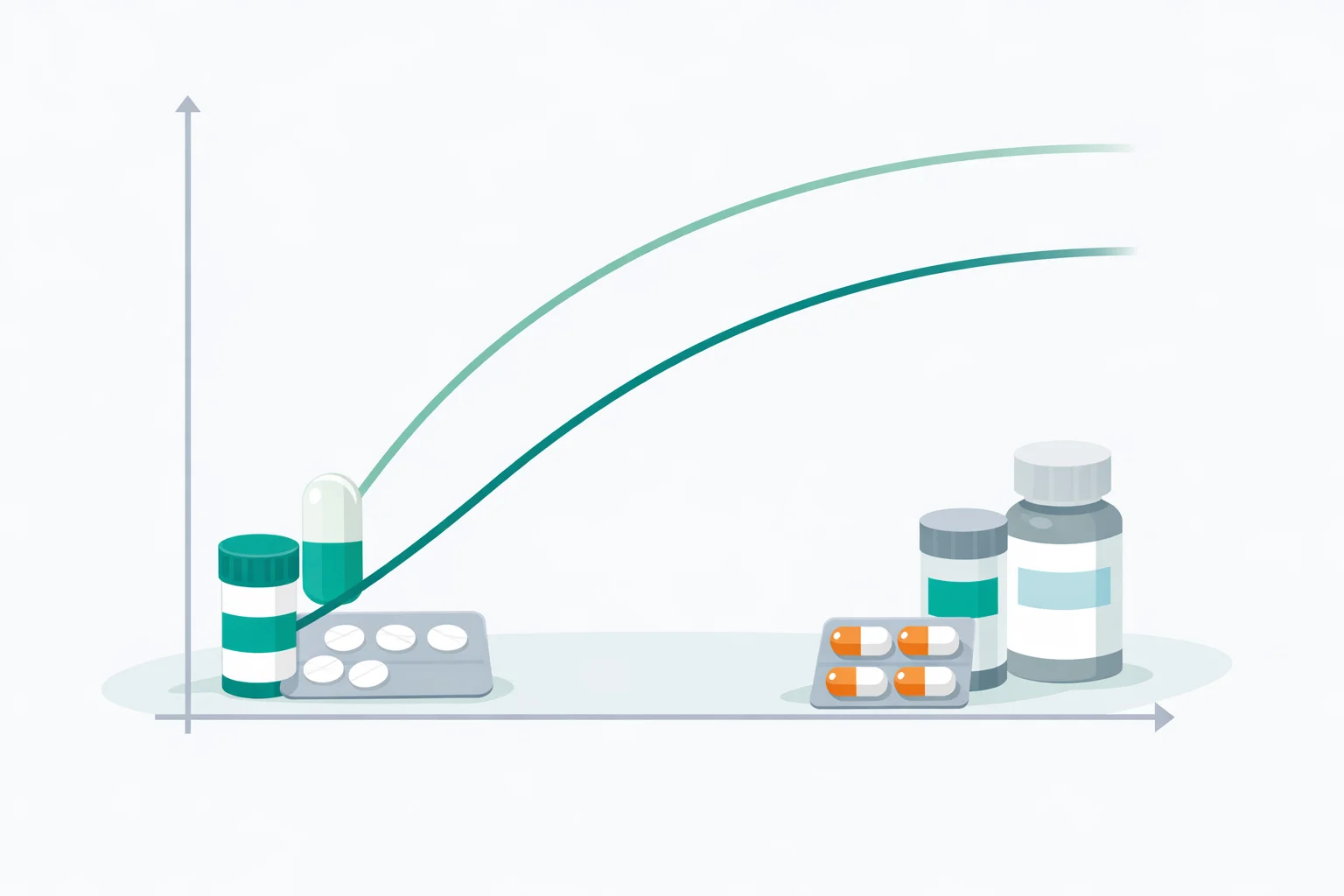
A stimulant conversion calculator has to solve a problem most dose charts quietly skip: 70 mg of Vyvanse contains only about 20.6 mg of actual d-amphetamine. Lisdexamfetamine is a prodrug, and enzymes in your red blood cells have to cleave the lysine molecule off before a single milligram becomes active. That 0.295 yield is why the highest Vyvanse capsule maps onto a mid-range 30 mg Adderall XR capsule instead of something twice its size — and why switching between two amphetamines, nominally the same drug class, still needs arithmetic rather than intuition.
This guide covers what the numbers behind an ADHD medication conversion actually represent, which conversions are chemistry and which are educated averages, and the delivery difference that explains most reports of a "correct" switch feeling wrong.
On this page
Labelled Milligrams Are Not Drug Milligrams
Every ADHD stimulant is dispensed as a salt or a prodrug, and the number on the bottle counts the whole molecule. Methylphenidate hydrochloride weighs 269.77 g/mol against methylphenidate's own 233.31, so a 10 mg tablet carries 8.65 mg of drug. Adderall's four-salt blend is about 72.7% amphetamine base. Dextroamphetamine sulfate runs 73.4%. These are small haircuts, and if you only ever switch within one product family you can ignore them.
Lisdexamfetamine breaks that comfort. The lysine chain attached to d-amphetamine is heavy, and the conversion yield is 29.5% — so a 70 mg capsule delivers roughly 20.6 mg of active drug, less than a 30 mg Adderall XR capsule's 21.8 mg. Anyone converting Vyvanse by treating milligrams as milligrams overshoots by a factor of about 2.5. The calculator above carries these factors explicitly in its Product Reference tab so you can see exactly which number is doing the work.
Dexmethylphenidate goes the other direction. Racemic methylphenidate is a 50/50 mix of d- and l-isomers, and only the d-isomer binds meaningfully at the dopamine transporter — the l-isomer is largely cleared on first pass. Strip it out and each remaining milligram is worth double, which is why Focalin 10 mg and Ritalin 20 mg are genuinely interchangeable rather than approximately so.
Where the 2:1 Methylphenidate-to-Amphetamine Ratio Comes From
The cross-class step in any methylphenidate to amphetamine conversion is a single number: amphetamine base is treated as twice as potent per milligram. It did not come from a binding assay. It was reverse-engineered from titration endpoints — when clinical trials titrate both classes to optimal effect in comparable ADHD populations, the amphetamine arms settle at roughly half the daily milligrams of the methylphenidate arms. Typical adult maintenance doses bear this out: 30–40 mg/day for methylphenidate against 15–20 mg/day for amphetamine.
Mechanistically the two drugs are not doing the same job. Methylphenidate blocks the dopamine and norepinephrine transporters, raising synaptic levels by preventing reuptake. Amphetamine blocks them too, but it also enters the neuron via those same transporters, disrupts vesicular storage through VMAT2, and reverses transporter direction to actively push dopamine out. That extra releasing action is the reason amphetamine achieves more per milligram — and also the reason a ratio built on averages cannot predict any individual's response.
Spread across real people, the ratio scatters from about 1:1 to 3:1. That scatter has a well-documented consequence: in crossover trials, roughly 40% of children who respond poorly to one stimulant class respond well to the other, and about 90% respond to at least one when both are tried. A cross-class conversion is therefore a starting point for a new titration, never a substitution.
Which Conversions Are Arithmetic and Which Are Guesses
Not every number this calculator produces carries the same confidence, and it helps enormously to know which tier you are in before you act on a result. Use this framework:
| Conversion type | Example | Confidence |
|---|---|---|
| Same molecule, different release | Concerta 36 mg → Ritalin 12 mg three times daily | Exact — total mg transfer 1:1 |
| Racemate to single isomer | Ritalin 20 mg → Focalin 10 mg | Exact — the l-isomer is inert |
| Salt or prodrug swap, same class | Adderall XR 30 mg → Vyvanse 70 mg | High — label-confirmed pairing |
| Cross-class switch | Concerta 36 mg → Adderall XR 20 mg | Population average only — re-titrate |
| Oral to transdermal | Ritalin 20 mg → Daytrana patch | Widest error — wear time dominates |
The top three rows are worth trusting to the milligram. The bottom two are orientation. If your conversion sits in the bottom half of that table, the calculated figure tells you which end of the target product's range to start in — not what to take.
Worked Example: Concerta 54 mg to Vyvanse
Take an adult stable on Concerta 54 mg once daily who needs to move to lisdexamfetamine because of a supply problem. Four steps:
- Strip the salt. 54 mg × 0.865 = 46.7 mg of methylphenidate base per day.
- Cross the class divide. 46.7 ÷ 2 = 23.4 mg of amphetamine base equivalent.
- Undo the prodrug yield. 23.4 ÷ 0.295 = 79.2 mg of lisdexamfetamine.
- Meet reality. Vyvanse tops out at 70 mg per day, so the exact equipotent figure is not prescribable.
That fourth step is the useful one. Concerta's 72 mg ceiling and Vyvanse's 70 mg ceiling do not sit at the same place on the potency scale — 72 mg of Concerta works out to 62.3 methylphenidate-equivalent milligrams, while 70 mg of Vyvanse reaches only 41.3. Anyone in the top third of the Concerta range simply cannot be converted to an equipotent Vyvanse dose, and no amount of careful arithmetic changes that. The practical answer is a different amphetamine product, or accepting a step down and re-titrating. Our general dosage calculator handles the weight-based side of that re-titration for paediatric cases.
Same Total Dose, 78-Point Swing in the Morning Bolus
Here is what conversion charts almost never show. Two products can be equipotent across the day and still deliver wildly different first hours, because the immediate-release fraction is a formulation choice, not a dose property.
| Product | Immediate share | Delivery mechanism |
|---|---|---|
| Ritalin, Adderall IR | 100% | Plain tablet, single peak at 1–2 h |
| Adderall XR, Focalin XR | 50% | Bimodal beads, second pulse at ~4 h |
| Concerta | 22% | OROS overcoat, then ascending release over 10 h |
| Vyvanse, Ritalin SR | 0% | Enzymatic cleavage or wax matrix — no bolus |
Convert Adderall XR 20 mg to its Concerta equivalent of roughly 34 mg and the daily exposure is matched — but the morning bolus drops from 10 mg to 7.5 mg of labelled drug, and the perceived onset softens further because the OROS pump ramps up rather than spikes. Go all the way from Ritalin to Vyvanse and the immediate share falls from 100% to zero, a 100-point swing in what arrives in the first hour at an unchanged daily total.
This is the single most common reason a numerically correct conversion gets reported back as "it stopped working." The medication did not weaken; the onset cue disappeared. Vyvanse in particular needs two to three hours before the effect is obvious, and people used to a Ritalin spike often conclude within 40 minutes that the switch failed. The bar chart under the calculator's result exists to make this visible in advance. If the difference matters clinically, the fix is usually a small immediate-release booster alongside the extended-release base — not a higher total dose.
When the Math Produces an Unprescribable Number
Every product has a labelled adult ceiling, and those ceilings are not aligned on the potency scale. Converted to methylphenidate-equivalent base milligrams per day, the maximums land at 62.3 for Concerta 72 mg, 51.9 for immediate-release methylphenidate 60 mg, 69.2 for Focalin XR 40 mg, 43.6 for Adderall XR 30 mg and 41.3 for Vyvanse 70 mg. The amphetamine products cap out roughly a third lower than the methylphenidate products.
Two consequences follow. High-dose methylphenidate patients often have no equipotent single-capsule amphetamine option, and clinicians reach for a combination — extended-release base plus an afternoon immediate-release dose. Meanwhile a patient at the top of the Adderall XR range converts comfortably into the middle of the Concerta range, which is why that direction is the easier switch. Dose ceilings also interact with metabolism: methylphenidate is hydrolysed by carboxylesterase CES1, while amphetamine depends partly on CYP2D6, so a poor CYP2D6 metaboliser can experience amphetamine exposure well above what the milligrams imply. If you are tracking how long a dose persists between administrations, our drug half-life calculator models the elimination curve directly.
Four Mistakes That Wreck a Stimulant Conversion
Entering one tablet instead of the whole day. Ritalin 10 mg three times daily is 30 mg/day, and entering 10 produces a target dose one third of what is needed. This is the most frequent error with immediate-release products, which is why the calculator states each product's usual doses-per-day next to the input.
Treating Vyvanse milligrams as amphetamine milligrams. The 0.295 yield means 60 mg of Vyvanse is about 17.7 mg of d-amphetamine, not 60. Skipping that step overshoots a switch by roughly 240%, and with a Schedule II stimulant that is not a rounding error.
Converting Focalin as if it were Ritalin. Dexmethylphenidate and methylphenidate share a name fragment and nothing else dose-wise. Focalin XR 20 mg is equivalent to about 40 mg of racemic methylphenidate, and reading it as 20 halves the patient's dose overnight.
Jumping straight to the calculated cross-class dose. The 2:1 ratio predicts a population, not a person. Standard practice on a cross-class switch is to start at or near the bottom of the target range and re-titrate over two to four weeks, using the calculated equivalent only as an upper bound on where titration is likely to end. If cardiovascular tolerability is part of the decision — stimulants raise resting heart rate by roughly 3–6 bpm and systolic pressure by 2–4 mmHg — our blood pressure calculator is a useful companion during titration.
One habit worth adopting: run the conversion in both directions. Convert A to B, then use the Swap button to convert the result back. If you do not land close to where you started, a rounding step or a ceiling has quietly absorbed part of the dose, and that is exactly the information you want before writing anything down.
References
- U.S. Food and Drug Administration. Drugs@FDA prescribing information — labelled strengths, maximum daily doses and release characteristics for Concerta, Ritalin, Focalin, Adderall XR, Vyvanse and Daytrana.
- National Institute for Health and Care Excellence. NG87: Attention deficit hyperactivity disorder — diagnosis and management — titration approach and cross-class switching guidance.
- Cortese S, et al. Comparative efficacy and tolerability of medications for ADHD: a systematic review and network meta-analysis. The Lancet Psychiatry, 2018 — the head-to-head evidence base behind class-level potency comparisons.
Educational content only. Stimulants are controlled substances; conversions here are reference estimates and do not replace a prescriber's judgement.

Written by Jurica Šinko
Founder & CEO
Entrepreneur and health information advocate, passionate about making health calculations accessible to everyone through intuitive digital tools.
View full profileFrequently Asked Questions
How many mg of Vyvanse equals 30 mg of Adderall XR?
Adderall XR 30 mg converts to roughly 70 mg of Vyvanse, and that pairing comes straight from the lisdexamfetamine label rather than from a potency estimate. The arithmetic works because Adderall is about 72.7% amphetamine base by weight while lisdexamfetamine yields only 29.5% d-amphetamine after enzymatic cleavage: 30 × 0.727 = 21.8 mg base, and 21.8 ÷ 0.295 = 74 mg, which rounds to the 70 mg capsule. Vyvanse also has no immediate-release fraction at all, so the same base dose feels slower to arrive.
What is the conversion ratio between methylphenidate and amphetamine?
The standard teaching ratio is 2:1, meaning 20 mg of racemic methylphenidate is treated as roughly equivalent to 10 mg of amphetamine base. That number is a population average pulled from head-to-head titration studies, not a pharmacokinetic constant. Individual responders can sit anywhere from 1:1 to 3:1, which is why the ratio is a starting point for a conversation and not a substitution rule.
How do you convert Concerta to Ritalin?
Concerta and Ritalin are the same molecule, so the total daily milligrams transfer one-for-one: Concerta 36 mg equals 36 mg of methylphenidate across the day, usually written as Ritalin 12 mg three times daily. The catch is delivery, not dose. Concerta releases 22% of the capsule immediately and the remaining 78% on an ascending curve over about ten hours, so an immediate-release schedule of the same total will peak higher three separate times.
Is 1 mg of Focalin the same as 2 mg of Ritalin?
Yes, that 2:1 relationship is the one conversion in this whole space that rests on chemistry rather than clinical averages. Ritalin is a racemic 50/50 mixture of d- and l-methylphenidate, but only the d-isomer is pharmacologically active, so Focalin 10 mg delivers the same active drug as Ritalin 20 mg. Focalin XR uses 50/50 bimodal beads, releasing the second pulse about four hours after the first.
Can you switch from methylphenidate to amphetamine at an equivalent dose?
You can calculate the equivalent, but most prescribers deliberately do not use it. Around 40% of people who respond poorly to one stimulant class respond well to the other, which means the two classes are not interchangeable at the receptor level even when the milligrams line up. Common practice is to restart near the bottom of the range for the target product and re-titrate over two to four weeks rather than jumping to the calculated number.
Why does my new stimulant feel weaker at the same equivalent dose?
Almost always because the immediate-release fraction changed rather than the total dose. Ritalin delivers 100% of the dose up front, Concerta 22%, Adderall XR 50%, and Vyvanse 0% since the prodrug has to be cleaved by red-cell enzymes first. Moving from a front-loaded product to a flat one removes the onset spike people read as the medication working, even when the total exposure across the day is identical.
What is the maximum daily dose of ADHD stimulants for adults?
US labelling caps Concerta at 72 mg per day, Adderall XR at 30 mg, Vyvanse at 70 mg, Focalin XR at 40 mg and immediate-release methylphenidate at 60 mg. Converting to a number above the ceiling for the target product is one of the most common ways a paper conversion turns out to be unprescribable, and this calculator flags results that exceed the highest available strength.
Does the methylphenidate patch convert the same as oral tablets?
No. Daytrana bypasses hepatic first-pass metabolism, so a 10 mg patch worn for nine hours delivers materially more methylphenidate to the bloodstream than a 10 mg oral dose. This calculator applies a 1.15 factor to reflect that, but transdermal exposure also scales with wear time and skin site, so patch conversions carry wider error bars than any oral-to-oral switch.
Related Calculators

Adjusted Body Weight Calculator — Dosing Weight (ABW)
Compute ABW for dosing with our adjusted body weight calculator, alongside IBW reference. Essential for accurate medication dosing, especially in obesity.

Alcohol Calculator: Drinks, Calories, Cost and BAC
Use our alcohol calculator to track standard drinks, alcohol calories, cost, and estimated BAC. Plan sessions, see time to sober, and make informed choices.

Alcohol Units Calculator UK — Weekly Tracking & Limits
Free alcohol units calculator for UK weekly tracking. Convert drinks to units, check against the 14-unit guideline, and see calories, standard drinks, and more.

BAC Calculator — Estimate Blood Alcohol Level by Drink
Use our BAC calculator to estimate blood alcohol levels from drinks, ABV, weight, sex, and hours. See limit markers, impairment ranges, and time to sober.

Caffeine Calculator: Daily Intake Tracker & Safe Limits
Use our caffeine calculator to total daily milligrams from coffee, tea, energy drinks, and custom doses, then check the running total against the 400 mg limit.
Carboplatin AUC Calculator — Calvert Formula Dosing
Free carboplatin AUC calculator using the Calvert formula to find chemotherapy dose in mg from target AUC, GFR, and Cockcroft-Gault creatinine clearance.