Use the Steroid Taper Calculator
Free steroid taper calculator to build a gradual prednisone or corticosteroid tapering schedule by starting dose and duration to limit adrenal suppression.
Doses convert to a prednisone-equivalent taper.
≈ 40 mg prednisone-equivalent
Drives the HPA-suppression risk estimate.
Stop completely, or hold at physiologic dose.
Steps at or below 10 mg prednisone are held twice as long for adrenal recovery.
Taper length
20wks
140 days
Dose levels
13
step-downs
Start (pred-eq)
40mg
40 mg Prednisone
Total exposure
1,453
mg·days pred-eq
High HPA-suppression risk
High-dose or long-duration therapy strongly suppresses cortisol production. Taper slowly, hold longer near physiologic dose, and treat any major illness or surgery with stress-dose steroids. Adrenal recovery can take weeks to months after the last dose.
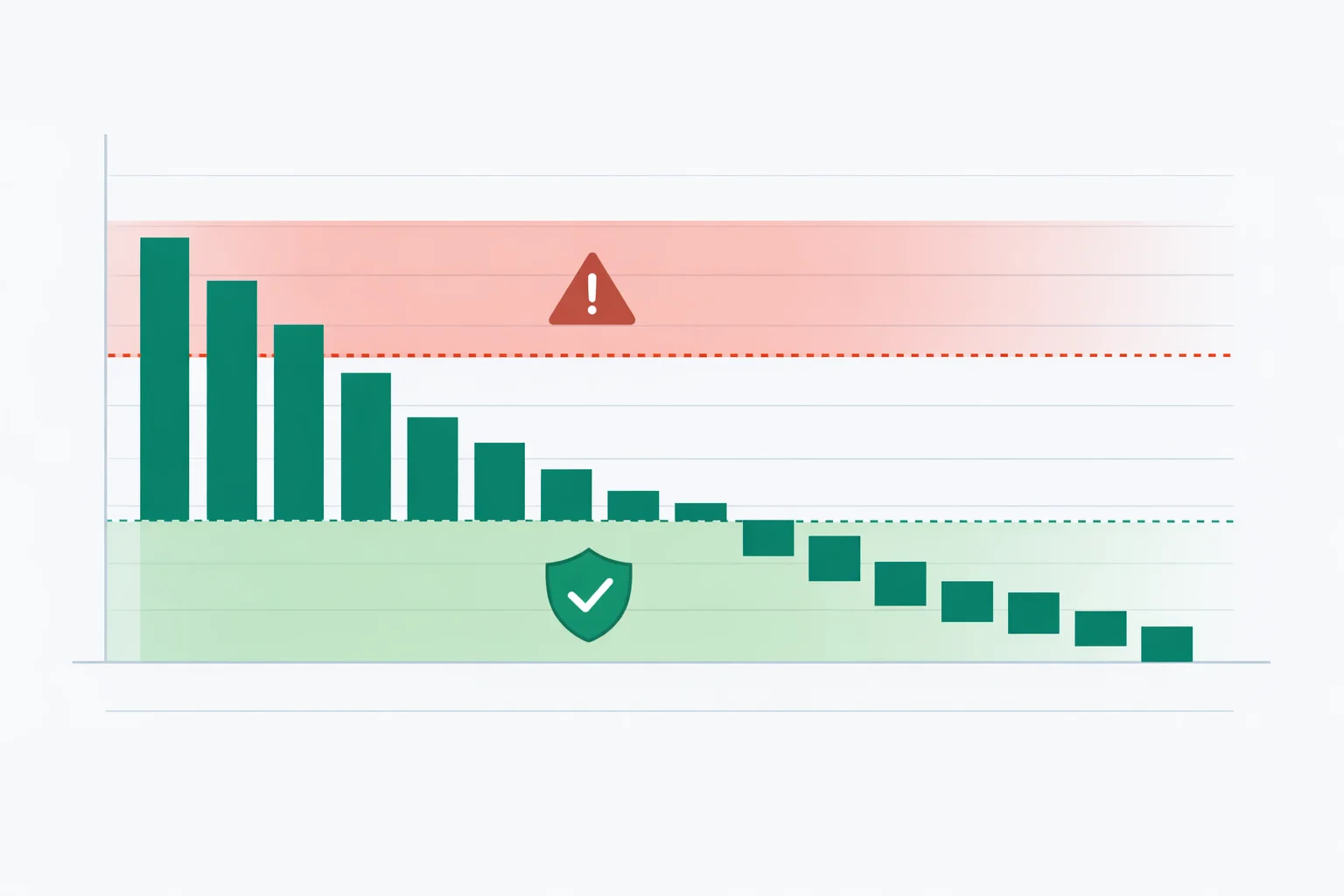
Step-down chart (Prednisone mg/day)
Day-by-day taper schedule
| Step | Prednisone dose | Pred-eq | Days | Day range |
|---|---|---|---|---|
| 1 | 40 mg | 40 mg | 7 | Day 1–7 |
| 2 | 30 mg | 30 mg | 7 | Day 8–14 |
| 3 | 25 mg | 25 mg | 7 | Day 15–21 |
| 4 | 20 mg | 20 mg | 7 | Day 22–28 |
| 5 | 15 mg | 15 mg | 7 | Day 29–35 |
| 6 | 12.5 mg | 12.5 mg | 7 | Day 36–42 |
| 7 | 10 mg | 10 mg | 14 | Day 43–56 |
| 8 | 7.5 mg | 7.5 mg | 14 | Day 57–70 |
| 9 | 5 mg | 5 mg | 14 | Day 71–84 |
| 10 | 4 mg | 4 mg | 14 | Day 85–98 |
| 11 | 3 mg | 3 mg | 14 | Day 99–112 |
| 12 | 2 mg | 2 mg | 14 | Day 113–126 |
| 13 | 1 mg | 1 mg | 14 | Day 127–140 |
| ✓ | Day 141: discontinue Prednisone | |||
Amber rows (≤10 mg prednisone-equivalent) are the slow, adrenal-recovery phase.
Clinical disclaimer
This steroid taper calculator builds an illustrative, rule-of-thumb step-down schedule for adults. It is not a prescription. Real tapers depend on the underlying disease, flare risk, prior steroid history, and adrenal testing — and may need to pause or reverse if symptoms return. Never stop or change corticosteroids without your prescriber, and seek urgent care for signs of adrenal crisis (severe fatigue, vomiting, dizziness, low blood pressure).
Educational tool, not medical advice. Check this tool’s method and limitations before interpreting a result. Talk to a qualified healthcare professional before making decisions about medication, diet, exercise, or treatment. See our Terms of Use.
Your rating helps improve Steroid Taper Calculator. We store only an anonymized vote (no personal data).
How to Use Steroid Taper Calculator
Step 1: Choose the corticosteroid
Pick your steroid (prednisone, prednisolone, methylprednisolone, dexamethasone, hydrocortisone, or triamcinolone). The tool converts it to a prednisone-equivalent dose automatically.
Step 2: Enter your current daily dose
Type the milligrams you take per day. The calculator shows the prednisone-equivalent so you can compare it against the body’s physiologic ~5 mg.
Step 3: Enter time on steroids and choose a goal
Add how many weeks you have been on steroids (this drives the HPA-suppression risk estimate) and pick whether to stop completely or hold at a physiologic dose.
Step 4: Select a taper pace
Choose Fast (~4 days), Standard (weekly), or Slow (every 2 weeks) per step. Steps at or below 10 mg prednisone are automatically held twice as long.
Step 5: Read the schedule and chart
Review the day-by-day table, step-down chart, and total taper length, then copy the plan to discuss with your prescriber.
Key Features
- Converts 6 corticosteroids to a prednisone-equivalent taper
- Dose-tiered step-downs (10/5/2.5/1 mg) with day-by-day schedule
- Fast, standard, and slow paces with doubled holds below 10 mg
- HPA-suppression risk estimate from dose and therapy duration
- Step-down chart, cumulative exposure, and copy-ready plan
Understanding Results
How the schedule is built
Your dose is first converted to a prednisone-equivalent using anti-inflammatory potency: 5 mg prednisone = 5 mg prednisolone = 4 mg methylprednisolone = 4 mg triamcinolone = 0.75 mg dexamethasone = 20 mg hydrocortisone. The taper then steps down in dose-tiered increments — 10 mg above 40 mg, 5 mg from 20–40 mg, 2.5 mg from 10–20 mg, and 1 mg below 5 mg — until it reaches your goal (stop at 0, or hold at the physiologic ~5 mg). Each level is held for the chosen pace (4, 7, or 14 days), and any step at or below 10 mg prednisone-equivalent is held twice as long. Cumulative exposure is the sum of each dose multiplied by its days, in prednisone-equivalent mg·days.
Reference ranges & interpretation
Physiologic cortisol output equals roughly 5–7.5 mg of prednisone per day — the threshold below which a taper turns slow. HPA-axis suppression becomes likely after about 3 weeks of supraphysiologic dosing, and high (≥40 mg) or long (≥3 months) courses raise the risk further. The clinical step-down rule mirrored here is 5–10 mg every 1–2 weeks above 20 mg, 2.5 mg between 10 and 20 mg, and 1 mg every 2–4 weeks below 10 mg, per Endocrine Society and NICE corticosteroid-withdrawal guidance.
Assumptions & limitations
This tool produces an illustrative, rule-of-thumb schedule for adults — not a prescription. It assumes once-daily oral dosing and stable disease, and it does not account for the specific condition being treated, prior steroid history, inhaled or topical steroids, pregnancy, children, or alternate-day regimens. Real tapers must pause or reverse if the underlying disease flares or withdrawal symptoms appear, and a minority need an ACTH stimulation test before the final dose. Never change corticosteroids without your prescriber, and seek urgent care for signs of adrenal crisis.
Complete Guide: Steroid Taper Calculator
On this page
A steroid taper calculator turns a single starting dose into a printable, day-by-day step-down plan — so a patient finishing a course of prednisone for a bad asthma flare, lupus, or polymyalgia rheumatica knows exactly what to take and for how long. The tool above converts whatever corticosteroid you're on into its prednisone-equivalent, applies dose-tiered reduction steps, and slows the final stretch where the adrenal glands are waking back up. This guide walks through a complete taper, explains the biology behind the steps, and shows where most people get it wrong.
A real 40 mg prednisone taper, step by step
Take a common case: 40 mg of prednisone daily for six weeks, now ready to come off. At a standard (weekly) pace, the calculator drops the dose in larger chunks while it's high, then in smaller ones as it approaches the body's own output of roughly 5–7.5 mg prednisone-equivalent per day. The schedule looks like this:
| Dose | Reduction step | Days held |
|---|---|---|
| 40 → 30 mg | −10 mg | 7 |
| 30 → 20 mg | −5 mg | 7 each |
| 20 → 10 mg | −2.5 mg | 7 each |
| 10 → 5 mg | −2.5 mg | 14 each |
| 5 → 0 mg | −1 mg | 14 each |
Notice the shape: fast at the top, deliberately slow at the bottom. The jump from 40 to 30 mg barely registers physiologically because the body is flooded with steroid either way. But the move from 5 mg to 0 is the hardest step in the whole plan, which is why the calculator doubles the hold time below 10 mg. Comparing the prednisone dose you take with what your adrenal glands would normally make is the whole point of a steroid conversion calculator — physiologic cortisol output is about 5–7.5 mg of prednisone-equivalent per day.
Why you can't just stop high-dose steroids
Your adrenal glands normally release about 5–10 mg of cortisol daily, controlled by a feedback loop called the HPA (hypothalamic-pituitary-adrenal) axis. When you take supraphysiologic steroids — anything above ~7.5 mg prednisone-equivalent — that loop senses there's plenty of cortisol around and switches off the signal (ACTH) that keeps the adrenal glands active. After two to three weeks of suppression the glands shrink and stop producing cortisol on their own.
Stop abruptly and you're left with neither source: the pill is gone and the adrenal glands are still asleep. The result is adrenal insufficiency — profound fatigue, nausea, joint pain, low blood pressure, and in severe cases an adrenal crisis that needs emergency hydrocortisone. Tapering keeps a steady, declining level of steroid in the system long enough for the HPA axis to restart, which can take days at low suppression and many weeks after long, high-dose courses.
When a taper is needed — and when it isn't
Not every steroid course needs a slow taper, and a one-size-fits-all corticosteroid taper schedule can do harm. The dividing line is roughly three weeks of continuous therapy. A five-day burst of 40 mg prednisone for a chest infection rarely suppresses the HPA axis enough to require weaning — many guidelines allow stopping a short course outright. Cross the three-week mark, or use high doses, and a taper becomes the safer default. The duration field in the calculator drives exactly this judgment:
- Under 3 weeks, moderate dose: low suppression risk — a taper is often optional and mainly controls the disease.
- 3 weeks to 3 months: moderate risk — step down to physiologic dose before stopping.
- Over 3 months or doses ≥40 mg: high risk — taper slowly and consider an ACTH stimulation test before the final cut.
If you take a high-potency drug like dexamethasone, the picture changes because a small number of milligrams packs a large steroid punch — a dexamethasone to prednisone calculator shows that 4 mg of dexamethasone equals roughly 27 mg of prednisone, so a "low" dexamethasone dose can be deeply suppressive.
How fast can you come down?
Taper speed is a trade-off between adrenal safety and disease control. Come down too fast and you risk both withdrawal symptoms and a flare of the condition you were treating; too slow and you prolong side effects like weight gain, high blood sugar, bone loss, and infection risk. The calculator offers three paces, and the difference is dramatic for a 40 mg starting dose:
| Pace | Time per step | Best for |
|---|---|---|
| Fast | ~4 days | Shorter courses, stable disease, lower suppression risk |
| Standard | 7 days | The typical outpatient prednisone taper |
| Slow | 14 days | Long-term steroids, prior withdrawal, fragile disease (e.g., PMR, vasculitis) |
A widely used clinical rule of thumb mirrors the calculator's tiers: reduce by 5–10 mg every 1–2 weeks while above 20 mg, by 2.5 mg every 1–2 weeks between 10 and 20 mg, and by 1 mg every 2–4 weeks below 10 mg. The goal isn't a fixed calendar — it's the slowest taper you can tolerate without symptoms returning.
The last 10 mg: where adrenal recovery happens
Above 10 mg prednisone, you're still taking more steroid than your body makes, so the adrenal glands stay dormant and the reductions are easy. Drop below ~7.5 mg and you cross into physiologic territory: now the taper itself is asking the HPA axis to take over. This is why so many people sail down to 5 mg and then stall — fatigue, body aches, and low mood appear not because the disease is back but because cortisol production hasn't caught up.
That's the reasoning behind doubling the hold time at and below 10 mg. Some patients need 1 mg decrements every two to four weeks for the final stretch, and a minority need an ACTH (cosyntropin) stimulation test to confirm the adrenal glands can respond before the last pill is dropped. Steroids also have very different durations of action — checking a drug half-life calculator explains why dexamethasone (36–54 hour biological half-life) suppresses the axis far longer than hydrocortisone (8–12 hours).
Withdrawal vs. a disease flare
The trickiest part of any taper is telling steroid-withdrawal symptoms apart from the original illness flaring up. Withdrawal tends to be diffuse — tiredness, nausea, muscle and joint aches, headache, and mood changes that creep in within a day or two of a dose drop and ease over the following week. A true flare usually brings back the specific signs of your condition: a wheeze and cough in asthma, joint swelling in rheumatoid arthritis, shoulder and hip stiffness in polymyalgia rheumatica. When in doubt, the safe move is to hold the current dose (or step back up one level) and contact your prescriber rather than push through.
Common steroid taper calculator mistakes
- Treating the schedule as fixed. A taper is a plan, not a contract. If symptoms return at 10 mg, holding for an extra two weeks is normal and expected.
- Ignoring stress dosing. During major illness, surgery, or trauma, a suppressed patient may need extra hydrocortisone. Tapering off does not instantly restore a normal stress response.
- Forgetting the drug switch. If you're converting from dexamethasone or methylprednisolone to prednisone, run the equivalent dose first — a calculation error here can mean a 20–30% over- or under-dose at the start of the taper.
- Stopping at 5 mg cold. Physiologic dose is the hardest place to leave, not the easiest. The jump from 5 mg to 0 deserves the slowest steps of the entire plan.
Use the schedule above as a starting framework to discuss with your doctor, print the copy-ready plan, and adjust the pace to how you actually feel. The right taper is the one your body tolerates — measured in how you feel on each step, not in how quickly you reach zero.
References
- Endocrine Society. Adrenal Insufficiency and Steroid Withdrawal.
- Liu D, et al. "A practical guide to the monitoring and management of the complications of systemic corticosteroid therapy." Allergy Asthma Clin Immunol. 2013.
- National Institute for Health and Care Excellence (NICE). Corticosteroids — oral: withdrawing treatment.

Written by Jurica Šinko
Founder & CEO
Entrepreneur and health information advocate, passionate about making health calculations accessible to everyone through intuitive digital tools.
View full profileFrequently Asked Questions
Do I need to taper prednisone after a 5-day course?
Usually not. Courses shorter than about 3 weeks rarely suppress the HPA axis enough to require tapering, so many short bursts (such as 40 mg for 5 days) can be stopped outright. Tapering becomes the safer default once therapy passes 3 weeks or uses high doses. Always confirm with your prescriber.
How fast can you taper off prednisone?
A common rule is to reduce by 5–10 mg every 1–2 weeks above 20 mg, by 2.5 mg between 10 and 20 mg, and by just 1 mg every 2–4 weeks below 10 mg. The slowest steps are at the bottom because that is where the adrenal glands must restart. The right speed is the slowest one that keeps your disease controlled without withdrawal symptoms.
What is the physiologic dose of prednisone?
Your adrenal glands normally make the equivalent of about 5–7.5 mg of prednisone per day. That is why most tapers slow dramatically near 5 mg — below this point the steroid pill is replacing cortisol your body should be producing, and the HPA axis needs time to take over.
What are the symptoms of steroid withdrawal?
Steroid withdrawal causes diffuse symptoms: deep fatigue, nausea, body and joint aches, headache, dizziness, and low mood, often within a day or two of dropping the dose. Severe cases cause low blood pressure and an adrenal crisis needing emergency treatment. These differ from a disease flare, which brings back the specific signs of your original condition.
How do I switch from dexamethasone or methylprednisolone to prednisone?
Convert by anti-inflammatory potency first: 4 mg of methylprednisolone and 0.75 mg of dexamethasone each equal 5 mg of prednisone. So 4 mg of dexamethasone is roughly 27 mg of prednisone. The calculator does this automatically, but getting the equivalent dose right matters because a 20–30% error at the start skews the whole taper.
Why is the last 5 mg of prednisone the hardest to stop?
Above 10 mg the adrenal glands stay dormant, so reductions feel easy. Below 7.5 mg you enter physiologic territory and the taper asks your body to resume making cortisol. Recovery can lag, producing fatigue and aches that feel like a relapse. This is why many people stall at 5 mg and why the final 1 mg steps should be the slowest.
Can I just stop steroids if I feel fine?
Not after prolonged or high-dose therapy. Feeling well does not mean the adrenal glands have recovered — suppression can persist for weeks to months after the last dose. Stopping abruptly risks adrenal insufficiency, and during major illness or surgery a recently tapered patient may still need stress-dose hydrocortisone.
What should I do if symptoms come back during the taper?
Hold the current dose or step back up one level rather than pushing through, then contact your prescriber. A taper is a flexible plan, not a fixed contract. Pausing for an extra one to two weeks at a step where symptoms appear is normal and often all that is needed before resuming the step-down.
Related Calculators

Adjusted Body Weight Calculator — Dosing Weight (ABW)
Compute ABW for dosing with our adjusted body weight calculator, alongside IBW reference. Essential for accurate medication dosing, especially in obesity.

Alcohol Calculator: Drinks, Calories, Cost and BAC
Use our alcohol calculator to track standard drinks, alcohol calories, cost, and estimated BAC. Plan sessions, see time to sober, and make informed choices.

Alcohol Units Calculator UK — Weekly Tracking & Limits
Free alcohol units calculator for UK weekly tracking. Convert drinks to units, check against the 14-unit guideline, and see calories, standard drinks, and more.

BAC Calculator — Estimate Blood Alcohol Level by Drink
Use our BAC calculator to estimate blood alcohol levels from drinks, ABV, weight, sex, and hours. See limit markers, impairment ranges, and time to sober.

Caffeine Calculator: Daily Intake Tracker & Safe Limits
Use our caffeine calculator to total daily milligrams from coffee, tea, energy drinks, and custom doses, then check the running total against the 400 mg limit.
Carboplatin AUC Calculator — Calvert Formula Dosing
Free carboplatin AUC calculator using the Calvert formula to find chemotherapy dose in mg from target AUC, GFR, and Cockcroft-Gault creatinine clearance.