Use the Squat Calculator
Free squat calculator to estimate your one-rep max, compare your strength-to-bodyweight ratio against level standards, and plan percentage-based training loads.
Est. squat 1RM
117.5 kg
Units
Sex
3–8 reps is most accurate
Half squats inflate apparent 1RM — we normalize to parallel.
Bar position
Low-bar typically allows ~4% more load than high-bar.
Estimated Squat 1RM (parallel)
117.5 kg
1.46× bodyweight · High-bar · projected low-bar: 122.5 kg
+2.5 kg to Intermediate
Beginner
60.0 kg
0.75× BW
Novice
100.0 kg
1.25× BW
Intermediate
120.0 kg
1.5× BW
Advanced
160.0 kg
2× BW
Elite
180.0 kg
2.25× BW
Training Percentage Chart
| % of 1RM | Weight | Rep range | Training goal |
|---|---|---|---|
| 95% | 110.0 kg | 1–2 | Peaking / Max strength |
| 90% | 105.0 kg | 1–3 | Strength (heavy singles/doubles) |
| 85% | 100.0 kg | 3–5 | Strength (core sets) |
| 80% | 92.5 kg | 4–6 | Strength–Hypertrophy |
| 75% | 87.5 kg | 5–8 | Hypertrophy / Volume |
| 70% | 82.5 kg | 8–10 | Hypertrophy / Endurance |
| 65% | 75.0 kg | 10–12 | Muscular endurance |
Warm-Up Ladder to Your Working Weight
Squat-specific progression — never skip the empty bar.
Empty bar
20 kg
10 reps
40% warm-up
48 kg
5 reps
60% primer
70 kg
3 reps
75% feel set
88 kg
2 reps
85% opener
100 kg
1 reps
Plate Math (per side)
20 kg Olympic bar
5×5 working
88 kg
25 + 5 + 2.5 + 1.25
3×3 heavy
100 kg
25 + 15
Top single
110 kg
25 + 20
Progressive Overload Starting Weights
Starting Strength (3×5)
87.5 kg
Start: 3×5 @ 75%
+2.5–5 kg per session
StrongLifts 5×5
82.5 kg
Start: 5×5 @ 70%
+2.5 kg per session
5/3/1 Wendler
75.0 kg
Start: 3 working sets (65–95%) @ 65%
+5 kg per 3-wk cycle
Squat Strength Standards (Male)
1RM targets by body weight, in kg
| BW (kg) | Beginner | Novice | Intermediate | Advanced | Elite |
|---|---|---|---|---|---|
| 60 | 45 | 75 | 90 | 120 | 135 |
| 70 | 52.5 | 87.5 | 105 | 140 | 157.5 |
| 80 | 60 | 100 | 120 | 160 | 180 |
| 90 | 67.5 | 112.5 | 135 | 180 | 202.5 |
| 100 | 75 | 125 | 150 | 200 | 225 |
| 110 | 82.5 | 137.5 | 165 | 220 | 247.5 |
| 120 | 90 | 150 | 180 | 240 | 270 |
Disclaimer
Estimates use the Epley formula with depth normalization and published strength standards. Your true 1RM may differ based on stance, mobility, technique, and training history. Always squat in a rack with safeties set at the bottom-of-rep depth, or use a competent spotter. This tool is for training guidance, not medical advice.
Educational tool, not medical advice. Check this tool’s method and limitations before interpreting a result. Talk to a qualified healthcare professional before making decisions about medication, diet, exercise, or treatment. See our Terms of Use.
Your rating helps improve Squat Calculator. We store only an anonymized vote (no personal data).
How to Use Squat Calculator
Step 1: Choose units and sex
Toggle between kg/lb and male/female. Strength standards are sex-specific and the standards table repopulates automatically when you switch.
Step 2: Enter your bodyweight
Type your current bodyweight in the Bodyweight field. This drives the strength-to-bodyweight ratio and the level classification.
Step 3: Enter weight squatted and reps
Enter the heaviest working set you completed cleanly. Sets of 3–8 reps taken close to failure give the most accurate Epley estimate.
Step 4: Select depth and bar position
Pick Parallel, ATG, or Half squat so the calculator can normalize your estimate. Toggle High-bar or Low-bar to see the projected equivalent 1RM in the other style.
Step 5: Read your 1RM and strength level
Your parallel-normalized 1RM appears instantly with a classification from Beginner to Elite and a progress bar showing how close you are to the next level.
Step 6: Use the training, warm-up, and plate tables
Scroll down for percentage-based training weights, a full warm-up ladder, plate math per side, and starting weights for 3×5, 5×5, and 5/3/1 programs.
Key Features
- Epley-based 1RM estimation from any working set
- Depth normalization for parallel, ATG, and half squats
- High-bar vs. low-bar projection with ~4% adjustment
- Strength classification from Beginner to Elite by sex and bodyweight
- Squat-specific warm-up ladder and plate math per side
- Starting Strength, StrongLifts 5x5, and 5/3/1 starting weights
Understanding Your Squat Results
The Squat Calculator Formula: Epley with Depth Normalization
The calculator estimates your one-rep max using the Epley equation and then adjusts for the depth you squatted:
1RM = weight × (1 + reps ÷ 30) × depth factor
Depth factors: ATG (below parallel) ×1.04, Parallel ×1.00, Half squat ×0.85. For example, squatting 100 kg for 5 reps at parallel gives 100 × 1.167 × 1.00 = 116.7 kg. The same 5 reps at half depth are normalized to 99.2 kg parallel-equivalent, because strength standards assume parallel depth.
Strength Level Classification
Your 1RM-to-bodyweight ratio determines your level. Male thresholds: Beginner (< 0.75×), Novice (0.75–1.25×), Intermediate (1.25–1.5×), Advanced (1.5–2.0×), Elite (≥ 2.25×). Female thresholds: Beginner (< 0.5×), Novice (0.5–0.75×), Intermediate (0.75–1.0×), Advanced (1.0–1.5×), Elite (≥ 1.75×).
Standards compile drug-tested data from ExRx, Symmetric Strength, and USA Powerlifting open-division results. They reflect raw, parallel-depth back squats with a standard Olympic bar. Low-bar and high-bar lifters are treated the same for classification because the difference (~4%) rarely changes the tier.
Assumptions & Limitations
The Epley formula is most reliable between 3 and 10 reps; above 12 reps, predicted 1RM tends to overshoot by 5–8%. The formula assumes clean reps without a bounce from the bottom or spotter assistance. Strength standards are population averages and don't account for femur length, ankle mobility, equipment (sleeves vs. wraps), or training history. Always squat in a rack with safeties set at your bottom-of-rep depth, or use a competent spotter for attempts above 85% of estimated 1RM.
Complete Guide: Squat Calculator
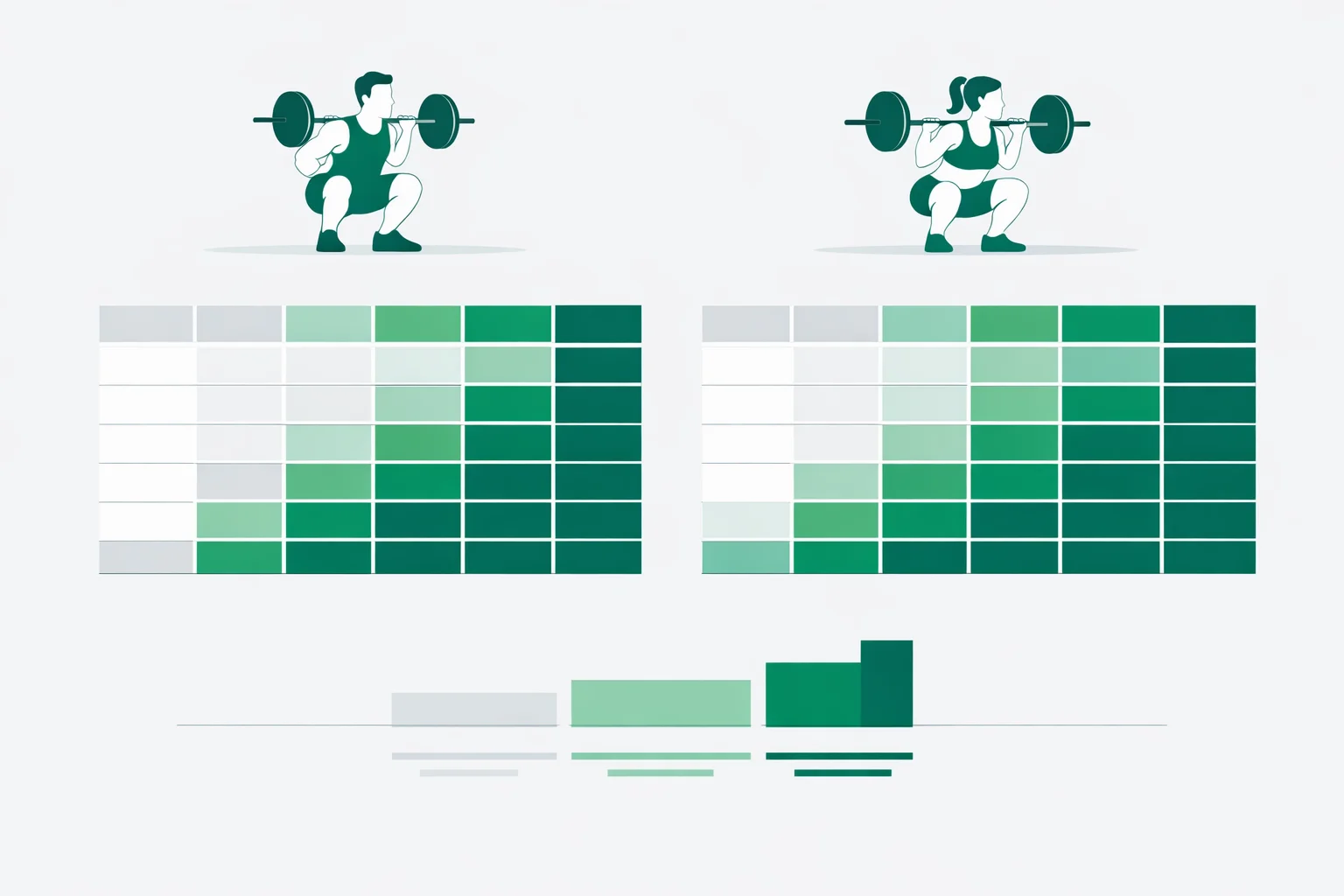
On this page
A squat calculator turns a single working set into strength-level classification, percentage-based training loads, warm-up weights, and plate math all at once. The back squat is biomechanically unique among the big three: it recruits roughly 85% of the lower-body musculature, produces compressive spinal loads of 4–8× bodyweight at heavy intensities, and rewards depth in a way that bench press and deadlift do not. According to USA Powerlifting's 2023 participant registry, the median drug-tested male squats about 1.6× bodyweight and the median female about 1.1× BW—numbers that run roughly 40% heavier than their bench press at every level.
This guide unpacks the three variables most squat calculators ignore: bar position, depth, and stance. Get those wrong and your estimated 1RM can be off by 15–20%—the difference between a PR attempt and a failed grinder. Along the way you'll find a worked example, a program comparison, and a mobility triage protocol.
High-Bar vs. Low-Bar: A 4% Load Difference and Why It Matters
Bar position changes everything. In a high-bar squat the bar sits on top of the trapezius, directly above the mid-foot; the torso stays more upright and knees travel further forward. In a low-bar squat the bar sits on the posterior deltoid shelf (rear delts, not the cervical vertebrae), the torso angles forward about 15° more, and the hips become the primary driver. A 1996 biomechanical study by Wretenberg et al. in Medicine & Science in Sports & Exercise measured hip extensor moment arms 20–30% longer in the low-bar position, which translates into roughly a 4% greater 1RM capacity on average.
Practically, that means an 80 kg lifter who high-bars 140 kg will often low-bar 145–147 kg at the same bodyweight. The calculator's bar-position toggle projects an equivalent 1RM in the other style so you can compare without re-testing. If you train Olympic lifting, stick with high-bar—the more vertical torso transfers directly to the clean and snatch receiving positions. If you train powerlifting or simply want to move more weight, low-bar wins on the scoreboard.
Caveat: low-bar requires greater shoulder external rotation and often elbow mobility too. Lifters with prior shoulder injuries frequently report pain in low-bar that disappears in high-bar. Pick the style your shoulders can sustain for 200+ sessions a year, not the one that produces the biggest meet total on paper.
The Depth Penalty: Half Squats Inflate 1RM by 15–20%
The single fastest way to make your squat look bigger is to stop going down. A study by Pallares et al. in the International Journal of Sports Medicine compared full-depth (below parallel) and partial (~60° knee flexion) squats in trained lifters. Partial squats allowed roughly 25% more absolute load at the same RPE—a meaningful distortion when you're calculating a 1RM from a working set.
The calculator's depth selector normalizes your estimate against this distortion. Here's the multiplier table it applies internally:
| Depth achieved | Hip crease position | Normalization factor | On 140 kg × 5 |
|---|---|---|---|
| ATG (full depth) | Well below knee | 1.04× | 170 kg parallel-equivalent |
| Parallel | At knee level | 1.00× | 163 kg (raw Epley) |
| Half squat | Above knee | 0.85× | 139 kg parallel-equivalent |
Why bother normalizing? Because strength standards assume parallel depth. A lifter reporting a 200 kg half squat and a lifter reporting a 170 kg parallel squat have produced essentially the same training stimulus and deserve the same classification. If you train exclusively partial squats your raw numbers will look impressive, but your parallel-equivalent 1RM is what transfers to sport performance, bar velocity, and powerlifting totals. Our squat max calculator applies the same depth logic across five different 1RM formulas if you want a second opinion on the estimate.
Squat Strength Standards by Body Weight
Squat standards run noticeably heavier than bench press because the posterior chain is larger, better vascularized, and bears bodyweight daily. The thresholds below compile ExRx, Symmetric Strength, and USAPL open-division data from drug-tested raw lifters. They assume parallel depth and either bar position.
| Level | Male (1RM/BW) | Female (1RM/BW) | Approximate timeline |
|---|---|---|---|
| Beginner | < 0.75× | < 0.5× | 0–3 months |
| Novice | 0.75–1.25× | 0.5–0.75× | 3–9 months |
| Intermediate | 1.25–1.5× | 0.75–1.0× | 9–24 months |
| Advanced | 1.5–2.0× | 1.0–1.5× | 2–5 years |
| Elite | ≥ 2.25× | ≥ 1.75× | 5+ years |
Worked example: an 80 kg male squatting 100 kg for 5 reps at parallel has an Epley-estimated 1RM of 117 kg (100 × 1.167), giving a ratio of 1.46× BW—inside the Intermediate band. To reach the Advanced threshold at 1.5× BW he needs another 3 kg on the bar, roughly 6 weeks of linear progression at 2.5 kg per week. The progress bar inside the calculator shows exactly that gap, and the strength-level ladder displays the target 1RM for every tier at his current bodyweight.
Why Your Squat Will Always Outpace Your Bench
Across every strength level, squat numbers run roughly 1.4–1.5× bench press numbers for the same lifter. The reasons are anatomical, not a quirk of training preference. Quadriceps cross-sectional area averages around 140 cm² in trained males versus about 28 cm² for the pectoralis major—a 5× difference in muscle mass driving a 1.5× difference in peak force. The gluteus maximus alone produces roughly 30% more isometric force than the entire upper-chest group.
Beyond gross muscle mass, squats get two structural advantages. The hip and knee share the load across two joints that extend simultaneously, while bench press funnels everything through a single glenohumeral joint. And unlike the upper body, the posterior chain trains daily via walking, stair climbing, and standing—a built-in baseline that means beginners rarely start from true zero. If your squat-to-bench ratio is below 1.3×, your posterior chain is underdeveloped; if it's above 1.7×, your bench is likely the limiting lift. Our bench press calculator tracks the other side of the ratio so you can balance your programming.
Powerlifting coaches use the "big three" ratio—squat : bench : deadlift, ideally in the neighborhood of 1.0 : 0.75 : 1.15 for raw male lifters—as a diagnostic. If your squat lags behind the expected ratio, the fix is rarely more bench work; it's more frequent squatting with better technique. The strength level calculator ranks all three lifts against each other and flags which one is dragging down your total.
Starting Strength vs. StrongLifts vs. 5/3/1 for Squat Progress
The three programs below cover 90% of lifters below the Elite classification. Each maps cleanly to a starting weight derived from your estimated 1RM.
Starting Strength (3×5 linear). Begin at 75% of estimated 1RM. Squat every training day—three times per week. Add 2.5–5 kg per session until you fail reps, then deload 10% and resume. Beginners routinely add 40–60 kg to their squat in the first 12 weeks on this template because squatting nearly every day multiplies neural practice and motor learning. The ceiling is typically hit around 1.5× bodyweight.
StrongLifts 5×5. Begin at 70% of estimated 1RM. Five sets of five reps, three times per week, alternating with presses and rows. Add 2.5 kg per session. The additional volume (25 reps versus 15) accelerates hypertrophy but fatigues faster. Best for lifters with more recovery capacity or those wanting visible leg growth alongside strength. Most stall around 1.75× BW.
5/3/1 Wendler. Begin at 90% of estimated 1RM as your "training max." Four-week cycles progress through 5s, 3s, 5/3/1 (top set for max reps at 95%), and a deload. Add 5 kg to the training max every full cycle. Progress is slower—about 20 kg per year on squat—but sustainable at Advanced levels where linear programs have broken. Pair with the one-rep max calculator to track estimated max drift between cycles.
The Non-Negotiable Squat Warm-Up
Unlike bench press, squats are top-heavy and fatigue sensitive. Research on bar velocity during heavy squats shows that peak bar speed at 90% 1RM drops 12–18% without progressive warm-up sets; the same working weight feels like a grinder rather than a crisp set. Every strong squatter uses approximately this protocol:
- Empty bar × 10 — groove the pattern, get the hips warm, no exceptions.
- 40% × 5 — first neurological contact with the groove of the movement.
- 60% × 3 — last full-volume warm-up; focus on depth consistency.
- 75% × 2 — feel set. If bar speed dies here, the working weight won't fly.
- 85% × 1 — primer single before top sets at 90–95%.
The calculator builds this ladder automatically from your estimated 1RM, rounded to the nearest 2.5 kg or 5 lb so you don't do arithmetic between sets. Rest 2–3 minutes between warm-ups under 70%, and 3–5 minutes before top sets. Shorter rest is the single biggest mistake lifters make—phosphocreatine recovery takes at least 3 minutes, and incomplete recovery caps peak output at roughly 85% of its true value.
Squat Stalls at 100 kg, 140 kg, and 180 kg: What Actually Works
Squat plateaus cluster at predictable bodyweight multiples. Knowing where you are determines the fix.
Stuck at ~100 kg (roughly 1.25× BW for an 80 kg male). Almost always a setup and depth consistency issue. The lifter has technical capacity but loses 5–10% of output to inefficient bracing, bar drift, or inconsistent depth. Fix: pause squats (2-second pause at the bottom) at 70% for 3×5 once a week, plus filming every top set from a 45° angle to audit depth.
Stuck at ~140 kg (~1.75× BW). Volume plateau. Linear progression is squeezed dry; body needs more weekly tonnage to adapt. Fix: switch to two squat sessions per week—one heavy (5×3 at 85%) and one volume (4×8 at 70%). Total weekly sets jump from 15 to 20–24. Schoenfeld's 2017 dose-response meta-analysis found each additional 5 sets per week adds roughly 2% strength gain over 8 weeks.
Stuck at ~180 kg (~2.25× BW, the Elite line). You're approaching genetic and structural limits. Technique is dialed, volume is maxed, and incremental gains require peaking cycles, deload scheduling, and accessory work targeting your weak link. Fix: identify whether you miss out of the hole (quad-driven issue—add front squats and pause squats) or in the mid-range (posterior chain—add good mornings and Romanian deadlifts using our deadlift calculator for percentage targeting). Plan PR attempts 12–16 weeks out, not monthly.
Ankle, Hip, and T-Spine Mobility: The 10-Minute Check
Half of squat plateaus at intermediate weights aren't strength problems—they're range-of-motion problems. Three joints need to cooperate for a clean below-parallel squat:
- Ankle dorsiflexion. Test: knee-to-wall. Touch your knee to the wall with your toe 12 cm (5 in) back from the wall. Under 10 cm indicates restricted ankles—a common cause of forward torso collapse. Fix: calf soft-tissue work plus daily 2×60-second couch-stretch variants.
- Hip flexion and external rotation. Test: 90/90 hip test. Sit in 90-90 (front knee and back knee at 90°) and check that the front shin is perpendicular to the back femur without the back hip lifting. Limited external rotation forces knees to cave inward under load.
- Thoracic extension. Test: wall angels. With heels, hips, and head against a wall, raise your arms overhead while maintaining full contact. Losing wrist or elbow contact signals limited T-spine extension, which caps how upright you can stay under a high-bar load.
Ten minutes of targeted mobility before the main lift—couch stretch, 90/90, thoracic foam-roller extensions—typically adds 2–5 kg to top-set bar speed within four weeks. That's not a technique fix dressed up as mobility; it's the neurological effect of reaching end-range with less resistance.
Squat progress is non-negotiably tied to bar position, depth, and recovery capacity—not just how heavy you can grind. Estimate your parallel-normalized 1RM above, pick the program that matches your current tier, and retest the calculator every 3–4 weeks. Most lifters who log their inputs consistently see their ratio move from one tier to the next within 12–20 weeks of focused training.
References
- Wretenberg P, Feng Y, Arborelius UP. High- and low-bar squatting techniques during weight-training. Med Sci Sports Exerc. 1996;28(2):218–224.
- Pallares JG, Sanchez-Medina L, Perez CE, De La Cruz-Sanchez E, Mora-Rodriguez R. Imposing a pause between the eccentric and concentric phases increases the reliability of isoinertial strength assessments. Int J Sports Med. 2014;35(11):928–934.
- Schoenfeld BJ, Ogborn D, Krieger JW. Dose-response relationship between weekly resistance training volume and increases in muscle mass. J Sports Sci. 2017;35(11):1073–1082.
- LeSuer DA, McCormick JH, Mayhew JL, Wasserstein RL, Arnold MD. The accuracy of prediction equations for estimating 1-RM performance in the bench press, squat, and deadlift. J Strength Cond Res. 1997;11(4):211–213.

Written by Jurica Šinko
Founder & CEO
Entrepreneur and health information advocate, passionate about making health calculations accessible to everyone through intuitive digital tools.
View full profileFrequently Asked Questions
What is a good squat for my bodyweight?
For men, squatting 1.25x your bodyweight to parallel puts you at the Novice-Intermediate border, typically reached around 6-12 months of consistent training. 1.5x bodyweight is solidly Intermediate, 2.0x is Advanced, and 2.25x is Elite. For women, 0.75x bodyweight is Novice, 1.0x Intermediate, and 1.5x Advanced. The calculator classifies your exact level based on your inputs and parallel-normalized 1RM.
How does the Epley formula estimate my squat 1RM?
The Epley equation is 1RM = weight x (1 + reps / 30). For example, squatting 100 kg for 5 reps gives 100 x 1.167 = 116.7 kg. The formula is most accurate between 3 and 10 reps. Below 3 reps it tends to underpredict, and above 10 reps it can overpredict by 5-8% because the weight-rep curve is not perfectly linear at high rep counts.
What counts as a parallel squat?
Parallel depth means your hip crease (the fold where the top of your thigh meets your torso) descends to the same height as the top of your knee cap. Powerlifting standards actually require going slightly below parallel to count the lift. If your hip crease stays above the knee, you are doing a half squat and the calculator reduces your estimate by 15% because partial squats allow about 25% more load at the same RPE.
Is a 140 kg (300 lb) squat considered strong?
A 140 kg squat is Intermediate-Advanced for an 80 kg male (1.75x BW) and solidly Elite for a 60 kg female (2.33x BW). Context matters: the same absolute number can represent wildly different training levels depending on bodyweight. Always compare against your own bodyweight ratio, not a single headline number.
Should I squat high-bar or low-bar?
If you are an Olympic lifter or prefer a more quad-dominant, upright squat, use high-bar. If you are a powerlifter or want to move the most absolute weight, use low-bar, which allows roughly 4% more load for the same lifter by lengthening the hip extensor moment arm. Lifters with shoulder mobility issues often tolerate high-bar better. The calculator projects an equivalent 1RM in whichever style you are not currently using.
How often should I retest my squat max?
Every 4-8 weeks is ideal. Use a clean set of 3-5 reps at a challenging weight and let the calculator estimate your 1RM. Avoid true one-rep max attempts more than once every 10-16 weeks; heavy singles are highly fatiguing and require 48-72 hours of full recovery afterward, especially when squats are a primary lift.
What percentage of my 1RM should I squat for 5x5?
Most programs prescribe 5x5 squats at 70-77% of your estimated 1RM, with 75% being the standard starting point. For a lifter with an estimated max of 140 kg, working sets land at 105 kg. Add 2.5 kg each session until you miss reps, then deload 10% and rebuild. Stronger lifters (over 1.75x BW squat) typically drop to 3x5 at 80-85% to manage fatigue.
Why does my squat feel harder than the calculator predicts?
The three most common reasons are: (1) you are warming up inadequately—bar velocity drops 12-18% at 90% 1RM without progressive warm-up sets; (2) you are under-recovered, with less than 7 hours of sleep or insufficient protein (under 1.6 g per kg bodyweight); or (3) you are squatting deeper than you did when you tested, which increases perceived difficulty. Try standardizing depth and your warm-up protocol before changing the estimate.
Related Calculators
5K Pace Calculator — Splits, Finish Time & Pace Zones
Train smarter with the 5K pace calculator: convert goal time to precise per-km and per-mile pace and split targets. Get fast, accurate results instantly.
Agility Calculator for T‑Test and Pro Agility (5‑10‑5)
Use our agility calculator to time T‑Test and pro agility shuttles, compare attempts, track change‑of‑direction speed, check asymmetry, and monitor progress.
Speed, Agility & Power — Athletic Performance Calculator
Analyze running pace, race predictions, strength 1RM, and jump power in one athletic performance calculator. Mobile‑first with quick inputs and clear results.
Bench Press Calculator — 1RM, Strength Level & Training
Free bench press calculator to estimate your one-rep max (1RM), compare strength standards by body weight and sex, and get percentage-based training loads.
Bench Press Calculator — 1RM Max, Sets & Plate Math
Use our bench press calculator to estimate your 1RM from reps and weight, auto‑build working sets, warm‑up ladder, and plate math in kg/lb. Mobile‑friendly.
Body Recomposition Calculator — Recomp Fat Loss & Muscle
Free body recomposition calculator projects fat loss and muscle gain month by month from your calories, protein, body fat and training age. Plan a real recomp.