Use the Glasgow Coma Scale Calculator
Free Glasgow Coma Scale calculator scoring eye, verbal and motor response from 3 to 15, with mild, moderate and severe brain injury bands and pediatric notes.
Standard 3–15 scale. Score the best response observed, not the average.
Pupil reactivity (optional)
Adds the GCS-P score, which extends the floor from 3 down to 1.
A fall of 2 or more points between assessments is the alarm threshold.
Glasgow Coma Scale score
12/15
E3 V4 M5
Eye opening
3/4
To sound
Verbal response
4/5
Confused
Best motor response
5/6
Localising
GCS-P
—
Set pupil reactivity
| GCS | Severity | What it triggers |
|---|---|---|
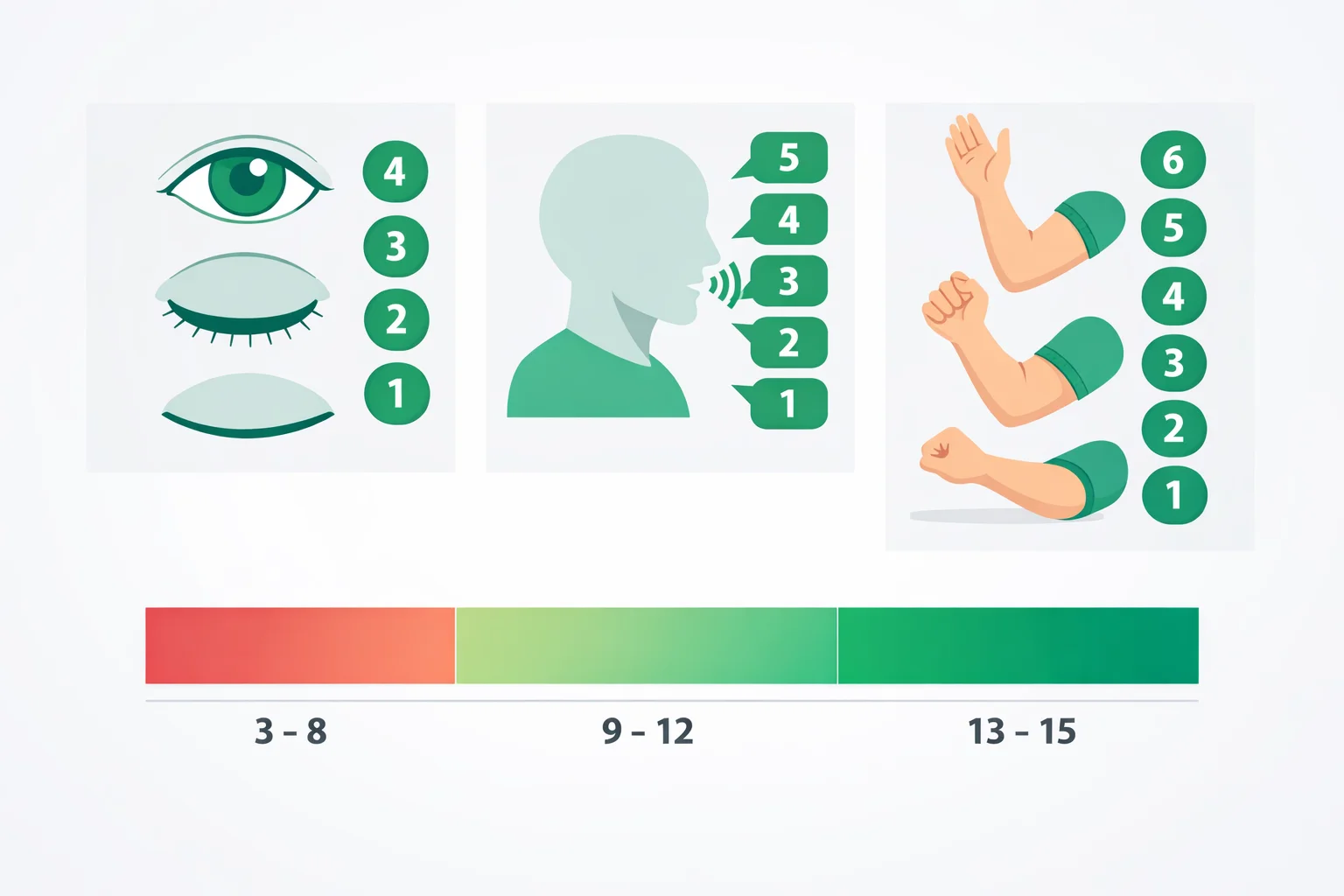
| 13–15 | Mild | Roughly 80% of head injuries. Most are discharged after imaging rules are applied. |
| 9–12 | Moderate | Admission, CT and repeated scoring. A 2-point fall here is a surgical emergency. |
| 3–8 | Severe | Coma by definition. Definitive airway, ICP monitoring considered, neurosurgical referral. |
Important
The Glasgow Coma Scale measures level of consciousness at one moment—it is not a diagnosis and it does not grade brain damage. Alcohol, sedation, seizures, hypoglycaemia, hypoxia and paralytic drugs all lower the score without any structural injury. A single reading matters far less than the trend across repeated assessments. This tool is educational and does not replace assessment by a qualified clinician. If someone has a head injury with drowsiness, vomiting, unequal pupils or worsening confusion, call emergency services now.
Educational tool, not medical advice. Check this tool’s method and limitations before interpreting a result. Talk to a qualified healthcare professional before making decisions about medication, diet, exercise, or treatment. See our Terms of Use.
Your rating helps improve Glasgow Coma Scale Calculator. We store only an anonymized vote (no personal data).
How to Use Glasgow Coma Scale Calculator
Step 1: Pick the right scale
Under "Which scale", choose Adult & child over 2 for the standard 3-15 scale, or Paediatric (under 2) to swap the verbal and motor wording for a pre-verbal child. Tick "Intubated / tracheostomy" if an airway is in place.
Step 2: Score eye opening out of 4
Select Spontaneous (4), To sound (3), To pressure (2) or None (1). Look at the eyes before you speak or touch, because eyes already open score 4 without any stimulus.
Step 3: Score verbal response out of 5
Ask for name, place and date. All three correct is Orientated (5); sentences but disorientated is Confused (4); single words is 3, moans are 2, silence is 1.
Step 4: Score best motor response out of 6
Give a command with no reflex escape, then apply fingertip pressure. Obeys commands is 6, a hand rising above the clavicle towards the stimulus is Localising (5), pulling away is Normal flexion (4).
Step 5: Mark anything you cannot test
Press the dashed NT button on any component blocked by swollen eyes, an airway, aphasia or paralysis. The calculator then reports the components instead of a total, which is what official Glasgow guidance requires.
Step 6: Add pupils and a previous score
Set Pupil reactivity to get the GCS-P value, and type any earlier score into "Previous score" to see the change. A fall of 2 or more points is flagged as the alarm threshold for an expanding bleed.
Key Features
- Scores eye, verbal and motor response for a 3–15 total with severity band
- Non-testable (NT) handling for swollen eyes, aphasia and intubated patients
- Paediatric scale for pre-verbal children under 2 years
- GCS-P pupil reactivity option that extends the floor from 3 down to 1
- Deterioration check that flags a fall of 2 or more points from a previous score
- Copies the full E-V-M notation for handover instead of a bare number
Understanding Results
How the Glasgow Coma Scale is calculated
The total is a plain sum of three independently observed responses: GCS = E + V + M, where eye opening (E) runs 1–4, verbal response (V) runs 1–5 and best motor response (M) runs 1–6. Because every component starts at 1, the range is 3 to 15 — a score of 0 is impossible. Motor is scored on the best arm on the better side; legs are excluded, because leg withdrawal can be a spinal reflex with no brain involvement. The stimulus is up to ten seconds of steady fingertip pressure to the nail bed or trapezius, never a sternal rub. The optional GCS-P variant subtracts a pupil reactivity score (0 for two reactive pupils, 1 for one fixed, 2 for both fixed), giving GCS-P = GCS − PRS over a range of 1 to 15.
Reference Ranges & Interpretation
Severity bands follow the conventional trauma classification:
- 13–15 — mild. Around 80% of head injuries. Imaging is decided by a validated CT head rule, not by the score alone; people with intracranial bleeds routinely present at 15.
- 9–12 — moderate. CT, admission and repeated scoring. This is the band where trend matters most.
- 3–8 — severe. Meets the definition of coma. Airway assessment is immediate and neurosurgical referral is expected.
A single reading is far less informative than a series. A fall of 2 or more points between assessments is the classic warning of an expanding intracranial haematoma; a 1-point change sits inside normal scorer-to-scorer variability and should be repeated rather than acted on. Always hand over the components (E3 V4 M5 = 12), because a total of 9 has twelve possible combinations and they are not clinically equivalent — E1 V2 M6 is a better position than E4 V1 M4.
Assumptions & Limitations
The scale measures level of consciousness at one moment. It is not a diagnosis, it does not grade brain damage, and it does not explain why consciousness is reduced. Alcohol (roughly 1 point on average in large trauma series), blood glucose under about 50 mg/dL, the 20–30 minutes after a seizure, sedatives and opioids, hypoxia and a core temperature below roughly 32 °C all lower the score without any structural injury. Aphasia and language barriers depress the verbal component in patients who are fully alert. Where a component cannot be tested at all — swollen eyes, an endotracheal tube, paralysis — the components must be reported individually rather than summed, which is why this calculator withholds a total whenever you mark something NT. This tool is educational and does not replace assessment by a qualified clinician; a head injury with drowsiness, vomiting, unequal pupils or worsening confusion needs emergency care now.
Complete Guide: Glasgow Coma Scale Calculator
On this page
- Eyes out of 4, voice out of 5, movement out of 6
- Scoring a real patient, step by step
- Why 8 became the intubation threshold
- The patient who cannot be scored: NT, V1T and aphasia
- Two patients both scoring 9
- Under 2, the verbal scale stops working
- GCS-P: breaking the floor at 3
- Six things that lower a Glasgow Coma Scale score without a brain injury
- One reading is nearly worthless. A series is not.
- References
A Glasgow Coma Scale score of 8 or less is the number that puts a breathing tube in someone’s throat. That single threshold has driven more emergency airway decisions over the last fifty years than any other figure in trauma medicine, and it comes out of a scale you can add up on your fingers: eye opening out of 4, verbal response out of 5, motor response out of 6. Total range 3 to 15. Nobody scores zero, because a corpse still scores 3.
What the scale looks like and what it actually means are two different things, and the gap between them is where errors live. This guide walks a real patient through all three components, explains why a score of 9 can describe two people in completely different danger, covers the cases where the three numbers must not be added at all, and lists the six everyday causes that pull a score down when the brain is structurally fine.
Eyes out of 4, voice out of 5, movement out of 6
Graham Teasdale and Bryan Jennett published the scale in Glasgow in 1974 to fix a specific problem: ward staff were handing over words like “stuporous”, “semi-comatose” and “obtunded” that meant different things to different people. Their fix was to stop describing the patient and start describing what the patient does in response to three escalating stimuli. The original 1974 version ran 3 to 14; splitting abnormal flexion from normal flexion in 1976 gave the 15-point scale used today.
| Points | Eye (E) | Verbal (V) | Motor (M) |
|---|---|---|---|
| 6 | — | — | Obeys commands |
| 5 | — | Orientated | Localising to pressure |
| 4 | Spontaneous | Confused | Normal flexion (withdraws) |
| 3 | To sound | Words, not sentences | Abnormal flexion |
| 2 | To pressure | Sounds, not words | Extension |
| 1 | None | None | None |
Two rules from the 2014 Glasgow Structured Approach change the answers people give. First, the word is pressure, not pain — you apply steady fingertip pressure to the nail bed or trapezius for up to ten seconds, and you never use a sternal rub, which leaves bruises and provokes reflexes rather than purposeful movement. Second, motor response is scored on the best arm, on the better side. Legs are excluded entirely, because leg withdrawal can be a spinal reflex that happens with no brain involvement at all. A hemiplegic patient with a dense left-sided weakness is scored on the right arm.
Scoring a real patient, step by step
A 34-year-old comes off a motorbike, helmeted, and is brought in 25 minutes later. Here is how the three numbers get assigned, in the order you actually do it:
- Look before you touch. His eyes are closed. That rules out E4 immediately. Walking in and saying “open your eyes” gets them open after a two-second delay — that is E3, to sound. Had he needed fingertip pressure it would be E2.
- Ask three questions, not one. Name, place, date. He gives his name correctly, says he is “at work”, and cannot name the month. Orientation requires all three; two out of three is not a partial credit. He is speaking in full sentences but disorientated, which is V4, confused.
- Give a command with no reflex escape. “Squeeze my hand” is a bad test because grasp is a primitive reflex. “Stick out your tongue” or “hold up two fingers” is better. He does neither, so M6 is out.
- Apply pressure and watch the hand. Trapezius pressure makes his right hand travel up past his collarbone towards the stimulus. Crossing the clavicle is the line: that is M5, localising. If the arm had simply pulled away without ever rising to the source, it would be M4.
E3 + V4 + M5 = 12. Written the way it should be handed over, that is E3 V4 M5 = 12, which sits in the moderate band of 9 to 12. Notice how little the total tells you compared with the three parts. Forty minutes later he opens his eyes only to pressure, gives single words, and withdraws rather than localises: E2 V3 M4 = 9. A 3-point fall, and every one of those points came from a different component. That trajectory — not the number 9 — is what gets him back into the scanner.
Why 8 became the intubation threshold
Eight is not arbitrary, and it is not really about the number. A patient in coma is defined by three simultaneous failures: does not obey commands, does not speak, does not open the eyes. Score those out — M5 or lower, V2 or lower, E2 or lower — and the arithmetic ceiling is 5 + 2 + 2 = 9. In practice, patients meeting the full coma definition land at 8 or below almost every time, which is how “GCS 8, intubate” entered ATLS teaching. The clinical worry underneath it is airway protection: someone who cannot localise a painful stimulus generally cannot protect their own airway from vomit or blood.
Worth knowing that the rule is more contested than its catchiness suggests. Trials of pre-hospital rapid sequence intubation in head injury have repeatedly failed to show a clean survival benefit, and intubating a patient whose score is falling because of alcohol rather than an expanding bleed exposes them to a procedure they never needed. The honest version of the rule is: a GCS of 8 or below means assess the airway now, not tube everyone automatically. A patient at 7 who is maintaining their own airway, with an obvious reversible cause, is a judgement call rather than a protocol.
The patient who cannot be scored: NT, V1T and aphasia
This is the part most Glasgow Coma Scale pages skip, and it is where the largest real-world errors happen. Sometimes a component simply cannot be tested. Eyes swollen shut from facial fractures. An endotracheal tube through the vocal cords. Limbs immobilised or a patient given a paralytic. In every one of those cases the correct action, per the official Glasgow guidance, is to record NT for non-testable and hand over the components — E4 V NT M6 — rather than invent a total.
The convention most hospitals still use instead is to score verbal as 1 and append a T, producing charts that read “GCS 10T”. Understand what that number is: a floor, not a measurement. An intubated patient who is awake, following commands and writing notes to the nurse scores the same V1 as one who is deeply unconscious. If the verbal component is missing you have lost a third of the scale, and the resulting total will read up to four points lower than the patient’s actual level of consciousness.
Aphasia is the trap that catches people out, because nothing about the patient looks non-testable. Someone with a left middle cerebral artery stroke can be fully alert, aware, terrified and obeying commands, while producing only moans. That is V2 on the scale, dragging a genuinely alert patient down to a total of 12 and, if you read the total alone, into the “moderate injury” band. The same problem appears with a patient who does not share a language with the assessor. This is one reason the scale is a poor fit for stroke, where dedicated tools are used instead — if you are looking at cerebrovascular risk rather than acute consciousness, the stroke risk calculator is the relevant tool.
Two patients both scoring 9
Add three numbers together and you throw information away. A total of 9 has twelve different possible component combinations, and they are not clinically equivalent. Consider two:
| Patient | Components | Total | What it means |
|---|---|---|---|
| A | E4 V1 M4 | 9 | Eyes wide open, silent, only withdraws. Cannot follow a command. |
| B | E1 V2 M6 | 9 | Eyes never open, moans — but obeys commands. Cortex is working. |
Patient B is in better shape, and the reason is M6. The motor component carries most of the prognostic weight in the whole scale — strongly enough that trauma researchers built a simplified motor score with just three levels (obeys / localises / neither) and found it separated survivors from non-survivors about as well as the full 3-to-15 total. That finding is why triage tools so often ask one question, “does the patient obey commands?”, instead of running the whole scale. It is also why the components must be handed over individually. “Nine” is a summary; E1 V2 M6 is information.
Under 2, the verbal scale stops working
Ask a healthy 9-month-old their name, place and date and you will score them V1 on a scale designed for adults, which would put a perfectly well baby at a total of 11. The paediatric Glasgow Coma Scale fixes this by rewriting the verbal and motor rungs around what an infant can actually do. Verbal becomes: 5 coos and babbles, 4 irritable cry, 3 cries to pain, 2 moans to pain, 1 none. Motor becomes: 6 spontaneous purposeful movement, 5 withdraws to touch, 4 withdraws to pain, then abnormal flexion, extension and none as in adults. Eye opening is unchanged.
The measurement problem does not disappear, it moves. A frightened toddler in an unfamiliar resuscitation room cries inconsolably whether or not they have a head injury, which makes the difference between V4 and V3 a judgement about a child you have known for ninety seconds. Involve the parent: “is this how she normally cries?” is a more reliable input than anything the scale asks for. For a newborn in the first minutes of life a completely separate instrument applies — consciousness is not the question there, and the Apgar score calculator scores colour, pulse, reflex, tone and breathing instead.
GCS-P: breaking the floor at 3
The scale has a resolution problem at the bottom. Everyone with no eye opening, no sound and no movement scores 3, yet outcomes inside that group vary enormously. Teasdale’s own team addressed it in 2018 with GCS-P, which subtracts a pupil reactivity score from the total: 0 if both pupils react to light, 1 if one is fixed, 2 if both are fixed. GCS-P therefore runs from 1 to 15 instead of 3 to 15.
The gain is concentrated exactly where it is needed. A patient at GCS 3 with both pupils reactive scores GCS-P 3; one at GCS 3 with both pupils fixed scores GCS-P 1, and in the large IMPACT and CRASH trauma datasets those two groups have visibly different mortality. Fixed pupils signal brainstem compression — the physical sign of a mass pushing the temporal lobe against the midbrain — which the eye, verbal and motor components cannot capture once all three are already at their floor. Toggle pupil reactivity in the calculator above to see the value move.
Six things that lower a Glasgow Coma Scale score without a brain injury
The scale measures level of consciousness. It does not know why consciousness is reduced, and treating a low number as proof of structural brain damage is the single most common misreading. Six routine causes:
- Alcohol. Large trauma series find intoxication shifts GCS by roughly a point on average — enough to blur the mild/moderate boundary, nowhere near enough to explain a 6. Never write off a low score as “just drunk”.
- Hypoglycaemia. Blood glucose under about 50 mg/dL (2.8 mmol/L) can produce coma that reverses within minutes of treatment. Checking a glucose is faster than checking a scan.
- The post-ictal state. After a generalised seizure a patient can sit at 8 or 9 for 20 to 30 minutes and then recover completely. Score the trend, not the moment.
- Sedation and opioids. A patient sedated for transfer has an iatrogenically low score. Record what they were given alongside the number, or the next assessor will read the drug as deterioration.
- Hypoxia and hypercapnia. Consciousness falls before it becomes obvious that the problem is the lungs. Fix the oxygen and reassess before attributing anything to the head.
- Hypothermia. Below roughly 32 °C core temperature, conscious level drops with cooling and returns with rewarming.
One reading is nearly worthless. A series is not.
Two practical consequences follow. First, the scale is a monitoring tool, not a diagnostic one: a single reading tells you little, and a series of readings is one of the most sensitive instruments in medicine. A fall of 2 or more points between assessments is the classic alarm for an expanding intracranial haematoma; a 1-point change sits inside normal scorer-to-scorer variability and should be repeated rather than acted on. Second, the population most likely to need this score is not motorcyclists. In people over 65, ground-level falls are the leading cause of traumatic brain injury, and many of them are on anticoagulants that turn a minor knock into a slow bleed — which makes the falls risk calculator a more useful upstream tool than anything on this page. And because motor scoring depends on applying a standardised pressure stimulus, it is worth understanding how pain scale ratings work alongside it in a patient who can still report.
If you take one habit from this page, make it the notation. Write E3 V4 M5 = 12 rather than “GCS 12”, and write NT where a component could not be tested. It costs four extra characters and it is the difference between a handover that carries information and one that carries a number.
References
- Teasdale G, Jennett B. Assessment of coma and impaired consciousness: a practical scale. The Lancet, 1974.
- The Glasgow Structured Approach to Assessment of the Glasgow Coma Scale. glasgowcomascale.org
- Brennan PM, Murray GD, Teasdale GM. Simplifying the use of prognostic information in traumatic brain injury: the GCS-Pupils score. Journal of Neurosurgery, 2018.
- Centers for Disease Control and Prevention. Traumatic Brain Injury & Concussion. cdc.gov

Written by Jurica Šinko
Founder & CEO
Entrepreneur and health information advocate, passionate about making health calculations accessible to everyone through intuitive digital tools.
View full profileFrequently Asked Questions
What does a Glasgow Coma Scale of 8 mean?
A score of 8 is the top of the severe band (3-8) and is the traditional threshold for securing the airway, because a patient who cannot localise a painful stimulus usually cannot protect their airway from blood or vomit. It roughly matches the definition of coma: no eye opening to speech, no words, and no response to commands. The rule is a prompt to assess the airway immediately, not an automatic instruction to intubate every patient at 8.
Can you have a Glasgow Coma Scale of 0?
No. The minimum possible score is 3, because each of the three components starts at 1 rather than 0 — even a patient with no response at all scores 1 + 1 + 1. A score of 0 on a chart is always an error or shorthand for something else. If you need finer resolution at the bottom of the range, use GCS-P, which subtracts up to 2 points for unreactive pupils and runs from 1 to 15.
What does 10T mean on a GCS chart?
The T means the patient is intubated, so the verbal response could not be tested. The convention scores verbal as 1 and appends T, giving totals like 10T. Treat that number as a floor rather than a measurement: an intubated patient who is wide awake and writing notes scores the same V1 as one who is deeply unconscious, so the total can read up to 4 points below their real level of consciousness. Official Glasgow guidance now says to record V as NT and hand over the components instead.
Is a GCS of 15 normal?
Yes — 15 is the maximum and means eyes open spontaneously, the person is fully orientated to name, place and date, and obeys commands. Anything from 13 to 15 falls in the mild band. A GCS of 15 does not rule out a brain injury, though: patients with intracranial bleeds regularly present at 15, which is why CT decision rules use vomiting, age, anticoagulant use and mechanism of injury rather than the score alone.
How do you score GCS if the eyes are swollen shut?
You do not guess and you do not score 1. Record the eye component as NT for non-testable and hand over the other two, for example E NT V4 M6. Scoring a swollen eye as 1 invents a 3-point deficit that the patient does not have. The same applies to a verbal component blocked by an endotracheal tube or aphasia, and to a motor component in a paralysed or immobilised limb.
What is the difference between GCS and GCS-P?
GCS-P subtracts a pupil reactivity score from the standard total: 0 if both pupils react to light, 1 if one is fixed, 2 if both are fixed. That extends the range from 3-15 down to 1-15. It exists because everyone with no eye, verbal or motor response scores 3, yet outcomes inside that group differ widely. A patient at GCS 3 with two fixed pupils scores GCS-P 1 and has a substantially worse prognosis than one at GCS 3 with reactive pupils.
What is the Glasgow Coma Scale for a baby?
Children under about 2 are scored on the paediatric version, which rewrites the verbal and motor rungs. Verbal becomes 5 coos and babbles, 4 irritable cry, 3 cries to pain, 2 moans to pain, 1 none. Motor becomes 6 spontaneous purposeful movement and 5 withdraws to touch, with the lower rungs unchanged. Eye opening is identical to the adult scale. Asking the parent whether the crying is normal for that child is more reliable than the scale wording alone.
Does alcohol affect the Glasgow Coma Scale score?
It does, but far less than people assume. Large trauma series show intoxication lowers GCS by around 1 point on average — enough to blur the boundary between the mild (13-15) and moderate (9-12) bands, nowhere near enough to explain a score of 6. Never attribute a low score to alcohol. Hypoglycaemia below about 50 mg/dL, a post-ictal state, sedatives, hypoxia and hypothermia all depress the score the same way without any structural injury.
Related Calculators

Adult Vaccination Schedule Calculator — Expert Guide
Use the adult vaccination schedule calculator to see age‑ and risk‑based recommendations. Review boosters, travel needs, and timing with a printable plan.

Age Calculator: Exact Years, Months and Days Online
Use our age calculator to find your exact age in years, months and days. See totals in days, weeks, hours and minutes, compare ages and plan dates. No sign‑in.

Air Quality Calculator: AQI Levels and Health Tips
Calculate AQI from PM2.5, PM10, and O₃ with our air quality calculator. Get color‑coded categories, activity guidance, and smart tips for masks and ventilation.

Allergen Calculator for Pollen Count & Allergy Levels
Check local pollen levels and likely triggers with the Allergen Calculator. See allergen risk tiers, plan for high‑risk days, and get prevention tips.

Pooled Cohort Equations Calculator — PCE ASCVD Risk
Free pooled cohort equations calculator (PCE) estimates 10-year ASCVD risk from cholesterol, blood pressure, and smoking, with visual ACC/AHA risk tiers.

ASCVD Risk Calculator — Free 10-Year ASCVD Risk Estimate
Calculate your 10-year ASCVD risk with the free ASCVD risk calculator. Uses Pooled Cohort Equations with what-if scenarios and ACC/AHA risk categories.