Use the Apgar Score Calculator
Use the Apgar score calculator to rate a newborn at 1 and 5 minutes across heart rate, breathing, muscle tone, reflexes, and skin color on a 0 to 10 scale.
Apgar score at 1 minute
8/10
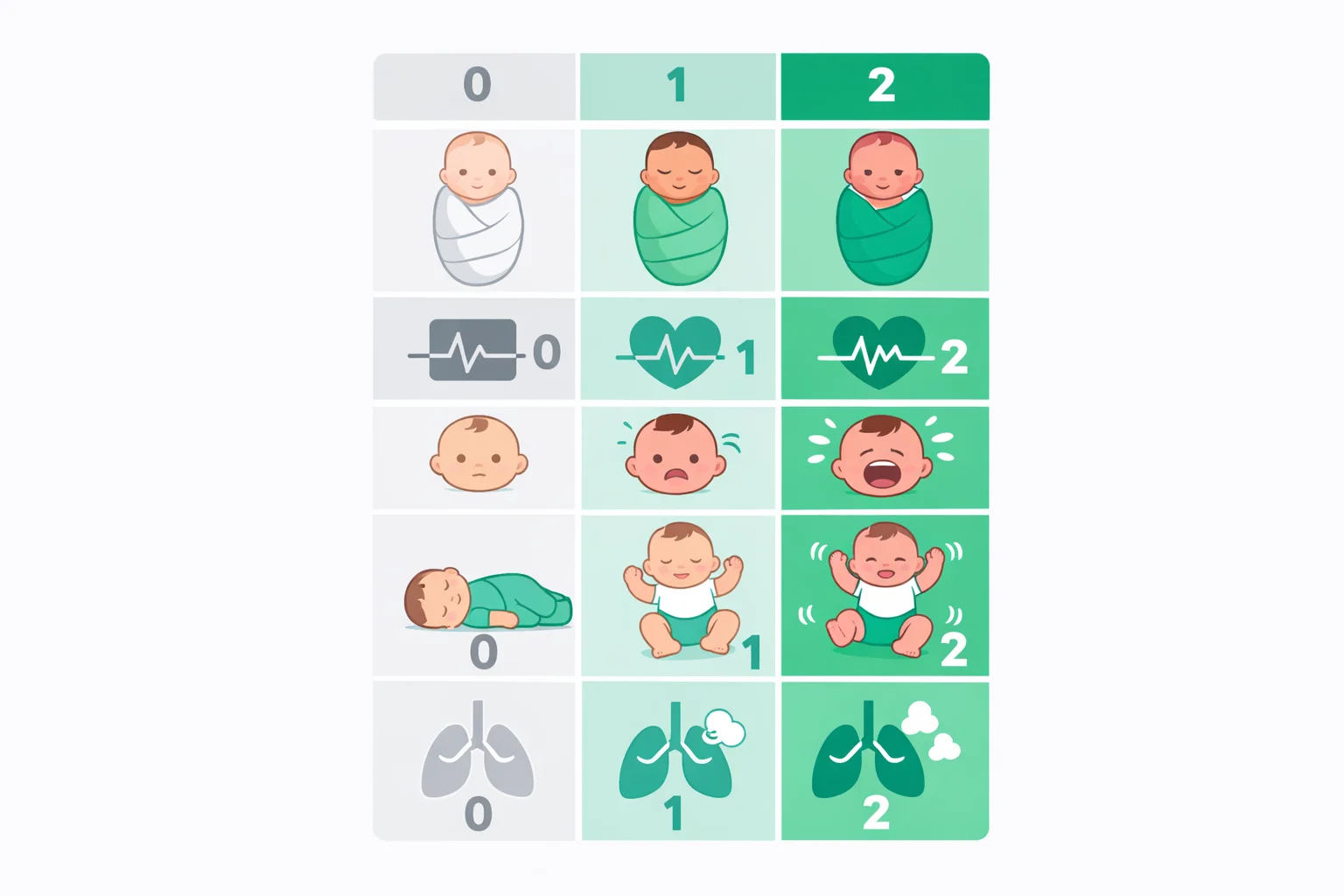
| Sign | 0 | 1 | 2 |
|---|---|---|---|
| Appearance · Skin color | Blue / pale all over | Pink body, blue limbs | Completely pink |
| Pulse · Heart rate | Absent | Below 100 bpm | 100 bpm or higher |
| Grimace · Reflex on stimulation | No response | Grimace / weak cry | Cry, cough, or sneeze |
| Activity · Muscle tone | Limp / floppy | Some limb flexion | Active movement |
| Respiration · Breathing effort | Absent | Slow / irregular | Strong, vigorous cry |
Important
The Apgar score describes a newborn’s condition at a moment in time—it does not predict long-term health and is not used to decide whether resuscitation begins (that starts before the 1-minute score). A low score can also reflect prematurity, maternal anesthesia, or sedation. This tool is educational and does not replace assessment by a qualified clinician.
Educational tool, not medical advice. Check this tool’s method and limitations before interpreting a result. Talk to a qualified healthcare professional before making decisions about medication, diet, exercise, or treatment. See our Terms of Use.
Your rating helps improve Apgar Score Calculator. We store only an anonymized vote (no personal data).
How to Use Apgar Score Calculator
Step 1: Pick the assessment time
Start on the 1-minute tab, then switch to 5 minutes. Tick "Add 10-min score" if the 5-minute total stays under 7.
Step 2: Score each of the five signs
For Appearance, Pulse, Grimace, Activity, and Respiration, tap the 0, 1, or 2 option that matches the newborn.
Step 3: Read the total and band
The calculator sums your picks into a 0 to 10 score labeled reassuring (7-10), moderately low (4-6), or critically low (0-3).
Step 4: Compare the timepoints
Check the 1- and 5-minute cards and the trend line to see whether the newborn is improving.
Step 5: Copy or reset
Use Copy Summary to save every timepoint, or Reset to score a new baby from scratch.
Key Features
- Scores all five Apgar signs: color, pulse, reflex, tone, and breathing
- Separate 1-minute, 5-minute, and optional 10-minute totals
- Color-coded 0 to 10 interpretation (7-10, 4-6, 0-3 bands)
- Shows the score trend between timepoints
- Built-in Apgar scoring chart with the active selection highlighted
Understanding Results
How the Apgar score is calculated
The Apgar score is a simple sum, not a weighted formula. Five signs—Appearance (skin color), Pulse (heart rate), Grimace (reflex response), Activity (muscle tone), and Respiration (breathing effort)—are each rated 0, 1, or 2 points. Adding the five gives a total between 0 and 10: Apgar = Appearance + Pulse + Grimace + Activity + Respiration. The same five signs are scored again at each timepoint, so a baby has a separate 1-minute and 5-minute total.
Reference ranges & interpretation
A total of 7 to 10 is reassuring and describes roughly 90% of newborns. 4 to 6 is moderately low and typically prompts stimulation, airway clearing, or supplemental oxygen. 0 to 3 is critically low and calls for active resuscitation with positive-pressure ventilation. Because blue extremities are normal in the first minutes, most healthy babies score 9 rather than 10 at one minute. The 5-minute value and the trend between the two checks matter more than any single number. Cutoffs follow the joint American Academy of Pediatrics and American College of Obstetricians and Gynecologists guidance.
Assumptions & limitations
The Apgar score reflects a newborn’s condition at a single moment; it is not designed to predict long-term health, intelligence, or cerebral palsy, and it does not decide whether resuscitation begins—that starts before the 1-minute score. Scoring is partly subjective, so two clinicians can differ by a point. Prematurity, maternal anesthesia, sedatives, and magnesium can all lower the score in a baby who is otherwise fine, which is why the tool is educational and never a substitute for the delivery team’s judgment or a confirmatory cord blood gas.
Complete Guide: Apgar Score Calculator
On this page
An Apgar score calculator turns five quick observations of a newborn—color, heart rate, reflexes, muscle tone, and breathing—into a single number from 0 to 10, recorded at 1 and 5 minutes of life. Many parents leave the delivery room convinced that a 7 instead of a 9 means something is wrong with their baby’s brain or future intelligence. It almost never does. This guide explains exactly what each point represents, how to read the 1- and 5-minute pair, and—just as important—what the score was never designed to tell you.
Dr. Virginia Apgar, an anesthesiologist, invented the score in 1952 to give delivery teams a fast, consistent way to spot newborns who needed help breathing. Seventy years later it is still called out loud in nearly every birth worldwide. The memorable backronym—Appearance, Pulse, Grimace, Activity, Respiration—came a decade later, in 1963, as a teaching aid built around her surname.
What the Apgar score actually measures
The Apgar score grades five signs of a newborn’s physiologic transition to life outside the womb. Each sign earns 0, 1, or 2 points, so the total runs from 0 to 10. Three of the five—heart rate, breathing, and reflex response—carry the most clinical weight, because they change fastest when a baby is struggling to oxygenate.
Appearance (skin color) is the least reliable sign. A completely pink baby scores 2, a baby with a pink trunk but blue hands and feet scores 1, and a fully blue or pale baby scores 0. Because blue extremities (acrocyanosis) are normal in the first minutes, most healthy newborns score 1—not 2—for color at one minute. That single point is why a genuine 10 at one minute is genuinely rare.
Pulse (heart rate) is the single most important sign. An absent pulse scores 0, a rate under 100 beats per minute scores 1, and 100 bpm or higher scores 2. A heart rate that stays below 100 is the primary trigger for assisted ventilation. Grimace (reflex irritability) tests how the baby reacts to stimulation such as a gentle heel flick: no response is 0, a grimace or weak cry is 1, and a vigorous cry, cough, or sneeze is 2. Activity (muscle tone) ranges from limp (0) to some limb flexion (1) to active movement (2). Respiration (breathing effort) scores 0 for no breathing, 1 for slow or irregular gasps or a weak cry, and 2 for a strong, lusty cry.
The Apgar score chart: 0, 1, or 2 per sign
Here is the full Apgar score chart the calculator above uses. Add the five signs to get the total, then read the interpretation band beneath it.
| Sign | 0 points | 1 point | 2 points |
|---|---|---|---|
| Appearance (color) | Blue / pale all over | Pink body, blue limbs | Completely pink |
| Pulse (heart rate) | Absent | <100 bpm | ≥100 bpm |
| Grimace (reflex) | No response | Grimace / weak cry | Cry, cough, sneeze |
| Activity (tone) | Limp | Some flexion | Active motion |
| Respiration (breathing) | Absent | Slow / irregular | Strong cry |
The total maps to three bands: 7–10 is reassuring (the range about 90% of newborns land in), 4–6 is moderately low and usually prompts stimulation, airway clearing, or supplemental oxygen, and 0–3 is critically low, calling for active resuscitation with positive-pressure ventilation. These bands describe the baby right now; they are not a grade of how the birth went.
Why the 1-minute and 5-minute scores differ
The Apgar is recorded at two set times because they answer two different questions. The 1-minute score captures how the baby tolerated the birth itself—the squeeze of labor and the abrupt switch from placenta to lungs. It is often lower, and a 1-minute 5 or 6 driven by acrocyanosis and a slow first breath is common and rarely worrying on its own.
The 5-minute score is the one clinicians watch, because it shows how well the baby responded to those first minutes of care and to their own adaptation. A baby who moves from 6 at one minute to 9 at five minutes is doing exactly what you want to see—the trend upward matters more than either single number. That is why the calculator above tracks the change and flags the direction for you. If the 5-minute score is still under 7, guidelines call for repeating the Apgar every 5 minutes up to 20 minutes, which is why the tool lets you add a 10-minute column. For context on how prematurity shifts the whole picture, our gestational age calculator shows why a 33-week baby is scored against a very different physiologic baseline.
The big myth: a low score predicts your baby’s future
This is the misconception that fills online parenting forums, and it is worth stating plainly: the Apgar score was never designed to predict long-term health, intelligence, or the risk of cerebral palsy. The American College of Obstetricians and Gynecologists and the American Academy of Pediatrics say so directly—a single low Apgar score does not establish that a baby suffered oxygen deprivation, and it cannot predict an individual child’s neurologic outcome.
The numbers back this up. The vast majority of infants with a low 5-minute score do not go on to develop cerebral palsy; conversely, most children who do have cerebral palsy had normal Apgar scores at birth. Even a 5-minute score of 0–3—which is genuinely concerning in the moment—is a weak predictor of the future when it stands alone. It becomes meaningful only when combined with other evidence such as cord blood gases, the need for prolonged resuscitation, and abnormalities on newborn brain monitoring.
There is also a nuance most parents never hear: the score is partly subjective. Studies comparing observers show that two experienced clinicians scoring the same baby can differ by a point or two, especially on color and tone. A 8-versus-9 difference on your baby’s chart may reflect who was holding the stopwatch as much as the baby’s actual state.
What a low Apgar score does and doesn’t mean
A low score has many innocent explanations that have nothing to do with a damaged baby. Prematurity is the biggest: a healthy preterm infant naturally has weaker tone, dimmer reflexes, and a bluer color, so the Apgar systematically underscores them—which is why the score is interpreted with caution below 37 weeks. Maternal medications matter too; general anesthesia, magnesium sulfate, and opioids given in labor can leave a baby floppy and slow to breathe for a few minutes even though the baby is fundamentally fine.
Here is the point that surprises people most: resuscitation does not wait for the Apgar score. A team does not stand back, tally a number at 60 seconds, and then decide whether to act. They begin drying, warming, and stimulating from the first seconds, and escalate to ventilation the moment heart rate or breathing demand it. The 1-minute Apgar is a record of what was happening, not the trigger for the response. Once home, parents track a very different set of signals—feeding, weight, and milestones—using tools like our newborn feeding calculator and baby milestone calculator, which say far more about ongoing health than the birth score ever will.
Apgar score calculator: a worked example with real numbers
Picture a full-term boy delivered vaginally. At 1 minute: he has a pink body with blue hands and feet (Appearance = 1), a heart rate of 130 (Pulse = 2), a grimace when his foot is flicked (Grimace = 1), some flexion of his arms (Activity = 1), and an irregular, gaspy breathing pattern with a weak cry (Respiration = 1). That totals 6—moderately low, prompting drying and gentle stimulation.
By 5 minutes, after that stimulation: he is fully pink (Appearance = 2), heart rate 145 (Pulse = 2), cries sharply when suctioned (Grimace = 2), moves all four limbs actively (Activity = 2), and has a strong, sustained cry (Respiration = 2). That totals 10. The recorded score is written as “6 and 10” or “6/10 → 10/10.” The story it tells is textbook: a slow first minute followed by a full, rapid recovery. Nothing in that pair suggests any lasting problem—it is exactly the trajectory the 5-minute check exists to confirm.
Now flip one variable. If that same baby were still at 5 points at five minutes—heart rate lingering under 100, no cry, poor tone—the team would keep resuscitating, add a 10-minute score, draw cord gases, and involve neonatology. Same tool, very different clinical path, decided by the trend rather than the first snapshot.
Apgar vs. cord blood gas: which one flags true asphyxia?
When the real question is whether a baby suffered dangerous oxygen deprivation during birth, the Apgar score is not the definitive answer—umbilical cord blood gas is. The Apgar is a rapid clinical impression; a cord gas is an objective chemistry measurement drawn from the umbilical artery at delivery. The two are complementary, and knowing which does what prevents a lot of needless worry.
| Feature | Apgar score | Umbilical cord blood gas |
|---|---|---|
| What it is | Visual 0–10 clinical rating | Lab measurement of pH and base deficit |
| Speed | Instant, at the bedside | Minutes, needs a blood analyzer |
| Subjective? | Partly — observer-dependent | Objective number |
| Defines birth asphyxia? | No, not on its own | Better — pH <7.0 with base deficit ≥12 suggests significant acidemia |
| Best use | Screening the newborn’s condition and response | Confirming or ruling out intrapartum hypoxia |
This is why a low 5-minute Apgar triggers a cord gas rather than a diagnosis. A depressed score with a normal cord pH points toward a temporary, recoverable cause—medication, a tight nuchal cord, or a sluggish first breath—rather than sustained oxygen deprivation. Tracking the baby afterward, our baby growth calculator gives a far more useful read on health over the following weeks than the birth score does.
References and sources
- The Apgar Score — ACOG & AAP Committee Opinion No. 644
- Apgar Score — StatPearls, NCBI Bookshelf (NIH)
- APGAR test — MedlinePlus Medical Encyclopedia (NIH)
This content is educational and does not constitute medical advice. A newborn’s Apgar score should always be interpreted by the delivery team in the context of the full clinical picture.

Written by Jurica Šinko
Founder & CEO
Entrepreneur and health information advocate, passionate about making health calculations accessible to everyone through intuitive digital tools.
View full profileFrequently Asked Questions
What is a normal Apgar score?
A total of 7 to 10 at both 1 and 5 minutes is normal and reassuring, and about 90% of newborns land in this range. A 1-minute score of 4 to 6 is moderately low and usually climbs to 7 or higher by the 5-minute check.
Is an Apgar score of 9 bad?
No. Nine out of 10 is a normal, healthy score and is the most common top result, because nearly every newborn loses one point for blue hands and feet (acrocyanosis) in the first minutes. A perfect 10 at one minute is actually uncommon.
What does a low 5-minute Apgar score mean?
A 5-minute score of 0 to 3 marks a newborn who needs continued resuscitation, but on its own it does not diagnose brain injury or predict cerebral palsy. Most infants with a low 5-minute score develop normally; it prompts cord blood gas testing and closer monitoring.
Why is the Apgar score taken at 1 and 5 minutes?
The 1-minute score shows how the baby tolerated birth, and the 5-minute score shows the response to those first minutes of care. If the 5-minute total stays below 7, the Apgar is repeated every 5 minutes up to 20 minutes.
Does a low Apgar score affect IQ or cause autism?
There is no reliable link between a single low Apgar score and intelligence or autism. The score was built to flag newborns who need help breathing, not to predict long-term development, and major pediatric bodies say it should never be used that way.
What does APGAR stand for?
APGAR is a memory aid for the five signs: Appearance (color), Pulse (heart rate), Grimace (reflex response), Activity (muscle tone), and Respiration (breathing). Each is scored 0, 1, or 2 for a total of 0 to 10.
Why do premature babies get lower Apgar scores?
Preterm infants naturally have weaker muscle tone, dimmer reflexes, and a bluer color, so a healthy baby born at 32 weeks can score 2 to 3 points lower than a term baby with nothing wrong. That is why the Apgar is read cautiously before 37 weeks.
Related Calculators

Baby Food Calculator — Solids Introduction & Portions
Estimate age‑appropriate portions and plan meal frequency with the baby food calculator. Log new foods, track allergens, and export a simple weekly menu.

Infant Growth Chart Calculator
Track weight, length, and head size with the infant growth chart calculator using WHO percentiles. See trends on clear charts and compare age-based progress.

Baby Length Percentile Calculator — WHO Reference Guide
Check WHO length‑for‑age percentiles with the baby length percentile calculator. Input age, sex, and length to see your percentile and track growth trends.

Baby Milestone Calculator — Track Skills by Age & Stage
Use our baby milestone calculator to see what’s typical by corrected age. Explore early, typical, and later windows for motor, language, and cognitive skills.

Baby Weight Percentile Calculator — WHO Growth Guide
Use the baby weight percentile calculator to see WHO weight‑for‑age percentiles. Enter age, sex, and weight to get your percentile, z‑score, and tips.
Boys Growth Chart Calculator — CDC Height & Weight by Age
Free boys growth chart calculator using official CDC and WHO percentile data. Plot your son's height and weight by age from birth to 20 and get z-scores.