Use the Cat BMI Calculator
The cat BMI calculator estimates your cat's feline body mass index from rib cage and leg measurements to flag underweight, ideal, or overweight body condition.
FBMI (est. body fat)
27.9%
Measurements
Around the chest at the 9th rib (just behind the front legs)
Knee (patella) straight down to the ankle bone (hock)
Adds fat mass, lean mass, and an ideal-weight range
Feline BMI (estimated body fat)
27.9%
≈ BCS 4–5 on the 9-point scale
15–29% body fat. Ribs palpable under a thin fat layer with a visible waist — the healthy target zone for adult cats.
Estimated fat mass
1.45 kg
Estimated lean mass
3.75 kg
Ideal weight (15–25% fat)
4.4–5.0 kg
| Category | FBMI (body fat) | BCS (1–9) |
|---|---|---|
| Underweight | < 15% | 1–3 |
| ▸Ideal | 15–29% | 4–5 |
| Overweight | 30–42% | 6–7 |
| Obese | > 42% | 8–9 |
Educational tool, not medical advice. Check this tool’s method and limitations before interpreting a result. Talk to a qualified healthcare professional before making decisions about medication, diet, exercise, or treatment. See our Terms of Use.
Your rating helps improve Cat BMI Calculator. We store only an anonymized vote (no personal data).
How to Use Cat BMI Calculator
Step 1: Choose your units
Use the toggle at the top of the calculator to switch between cm/kg and in/lb before entering measurements.
Step 2: Measure the rib cage circumference
Wrap a soft tape measure around your cat’s chest at the 9th rib — just behind the front legs, at the widest part of the chest. Keep the tape snug against the body under the fur, and enter the reading in the Rib cage circumference field.
Step 3: Measure the lower back-leg length (LIM)
Measure from the middle of the kneecap (patella) straight down to the ankle bone (hock) on a hind leg, and enter it in the Lower back-leg length field. Most adult cats fall between 10 and 18 cm.
Step 4: Add current weight (optional)
Enter your cat’s weight to unlock the fat mass, lean mass, and ideal weight range cards below the main result.
Step 5: Read the FBMI result
The calculator shows estimated body fat percentage, an underweight/ideal/overweight/obese classification with the matching body condition score, and highlights your cat’s row in the reference table.
Key Features
- Estimates body fat percentage from two tape measurements (9th-rib girth and lower-leg length)
- Classifies underweight, ideal, overweight, or obese with the matching 1-9 body condition score
- Calculates fat mass, lean mass, and an ideal weight range when you enter current weight
- Metric (cm/kg) and imperial (in/lb) unit toggle
- Reference table with your cat’s body fat band highlighted
Understanding Results
The Cat BMI Calculator Formula
The tool uses the feline body mass index (FBMI) developed at the Waltham Centre for Pet Nutrition: FBMI = ((rib cage ÷ 0.7062) − leg length) ÷ 0.9156 − leg length, with both measurements in centimeters. Rib cage is the chest circumference at the 9th rib; leg length runs from the kneecap to the hock on a hind leg. Unlike human BMI, the output is not an index number — it is an estimated body fat percentage, calibrated against DEXA body composition scans of adult cats.
Reference Ranges & Interpretation
An FBMI below 15% body fat suggests an underweight cat (body condition score 1–3). The healthy band is 15–29%, matching the ideal BCS of 4–5 on the WSAVA 9-point scale. Results of 30–42% indicate an overweight cat (BCS 6–7), and anything above 42% points to obesity (BCS 8–9). If you also enter a current weight, the calculator splits it into fat and lean mass and projects an ideal weight range at a target of 15–25% body fat.
Assumptions & Limitations
The FBMI regression was built on adult cats, so it is unreliable for kittens under 12 months and should not be used on pregnant or nursing cats. Measuring over a thick coat instead of against the body can inflate the result by 3–6 percentage points, and very large frames (rib cage above 48 cm or leg length above 17 cm) sit at the edge of the validated range. Treat the result as a screening estimate and confirm body condition with your veterinarian before starting a weight-loss plan.
Complete Guide: Cat BMI Calculator
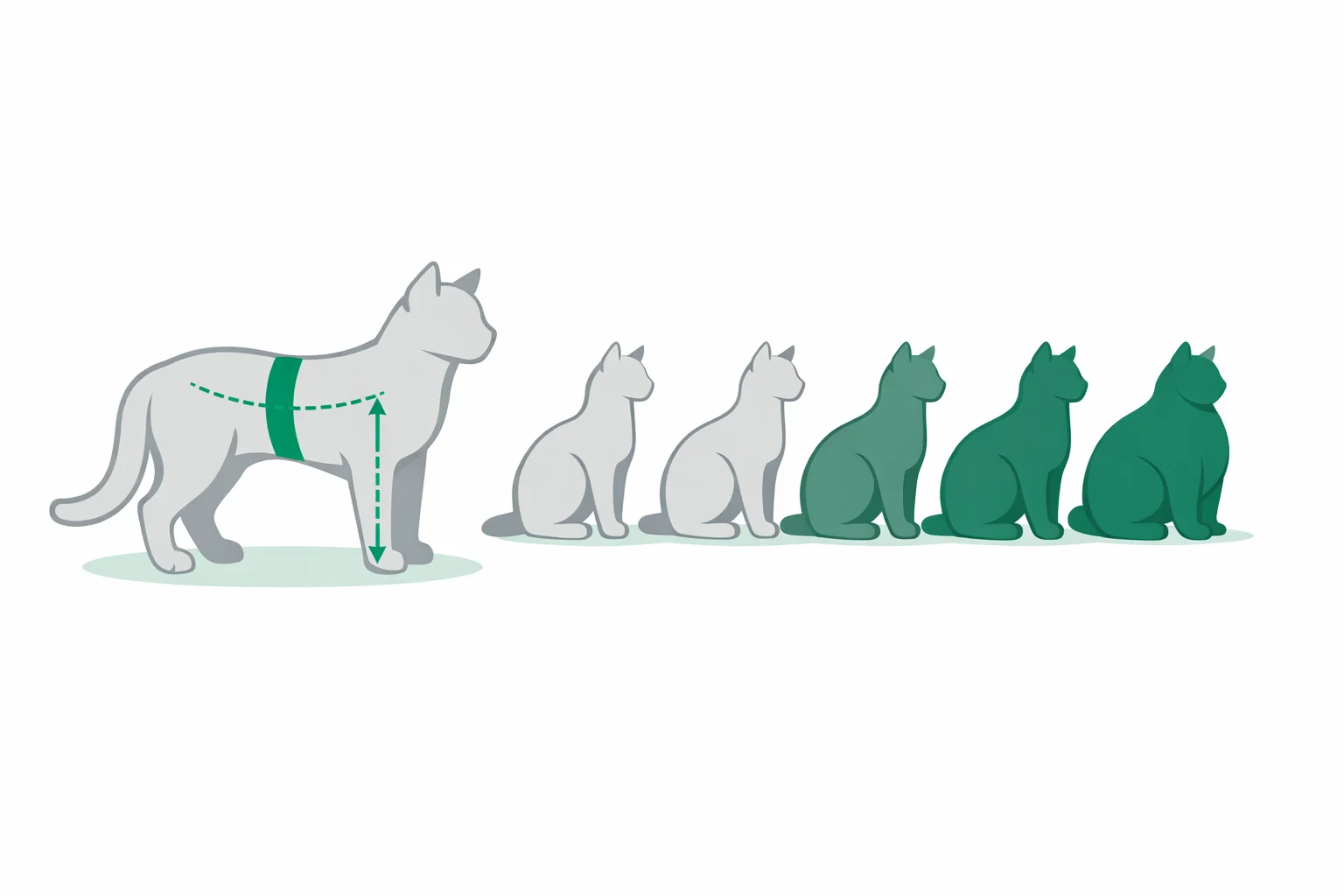
A cat BMI calculator answers a question most owners get wrong: veterinary professionals classified 61% of American cats as overweight or obese in the 2022 Association for Pet Obesity Prevention survey, yet in the same survey most owners of overweight cats described their pet's weight as "normal." The gap exists because a fluffy coat and a slow daily drift in weight hide body fat well. The feline body mass index (FBMI) cuts through that. With two tape-measure readings — rib cage circumference and lower-leg length — it estimates your cat's body fat percentage and flags whether your cat sits in the underweight, ideal, overweight, or obese zone. This guide explains where the formula comes from, walks through the math with real numbers, and shows exactly how to take both measurements without wrestling your cat.
Table of contents
- The Feline Body Mass Index: Body Fat From a Tape Measure
- The FBMI Formula, Worked Through Step by Step
- Where Exactly Is the Ninth Rib?
- FBMI vs. Body Condition Score: Which Should You Trust?
- What 40% Body Fat Costs a Cat
- Losing the Weight: 0.5–2% Per Week, Never Faster
- When the FBMI Misleads: Kittens, Pregnancy, and Maine Coons
- References
The Feline Body Mass Index: Body Fat From a Tape Measure
Human BMI divides weight by height squared. That approach fails for cats — a lean 6 kg Maine Coon and an obese 6 kg domestic shorthair would score identically. So researchers at the Waltham Centre for Pet Nutrition took a different route. Hawthorne and Butterwick (2000) measured cats with dual-energy X-ray absorptiometry (DEXA), the gold standard for body composition, then searched for external measurements that tracked the DEXA fat readings. Two did: the circumference of the rib cage at the level of the ninth rib, which grows as subcutaneous and abdominal fat accumulate, and the length of the lower hind leg from knee to hock, which reflects skeletal frame size and stays constant regardless of fat. The ratio between "how big around" and "how big-boned" became the feline body mass index — and unlike human BMI, its output isn't an abstract index number. It's an estimated body fat percentage.
For adult cats, roughly 15–29% body fat is the healthy band. Below 15% suggests an underweight cat; 30–42% maps to overweight; above 42% indicates obesity. Those cutoffs line up with the 9-point body condition score used in clinics, which matters — it means a tape-measure result at home speaks the same language your veterinarian uses.
The FBMI Formula, Worked Through Step by Step
The published equation uses centimeters for both inputs:
FBMI (% body fat) = ((rib cage ÷ 0.7062) − leg length) ÷ 0.9156 − leg length
Take a real case: a 6.1 kg neutered male domestic shorthair with a rib cage of 42 cm and a lower-leg length of 13 cm.
- Divide the rib cage by 0.7062: 42 ÷ 0.7062 = 59.5
- Subtract the leg length: 59.5 − 13 = 46.5
- Divide by 0.9156: 46.5 ÷ 0.9156 = 50.8
- Subtract the leg length again: 50.8 − 13 = 37.8% body fat
At 37.8%, this cat lands solidly in the overweight band (30–42%), equivalent to a body condition score of about 6–7 out of 9. His lean mass works out to roughly 3.8 kg, so an ideal weight at 20% body fat would be about 4.7 kg — he's carrying around 1.4 kg of excess fat. On a cat, that's no rounding error: 1.4 kg on a 4.7 kg frame is 30% over ideal, proportionally like a 75 kg person gaining 22 kg. The calculator above runs these same steps instantly and adds the fat-mass and ideal-weight breakdown when you enter a current weight.
Where Exactly Is the Ninth Rib?
Measurement placement decides whether your result means anything, and the ninth rib confuses everyone the first time. Practical landmark: it sits just behind the point where your cat's front legs meet the body — roughly the widest part of the chest. Wrap a soft sewing tape around the torso there, snug enough that it doesn't slide but never compressing the coat into the skin. On long-haired cats, part the fur and get the tape against the body; measuring over a Persian's coat can inflate the circumference by 2–4 cm, which alone shifts the FBMI result by 3–6 percentage points.
The second measurement — the leg index measurement, or LIM — runs from the middle of the kneecap (patella) straight down to the top of the ankle bone (the hock, that backward-pointing joint on the hind leg). Measure while your cat stands or lies with the leg naturally bent. Most adult cats fall between 10 and 18 cm. Two tips from people who've done this on uncooperative patients: measure while your cat eats, and take each measurement twice, averaging the readings. A 1 cm error in rib circumference moves the result by about 1.5 percentage points, so precision pays.
FBMI vs. Body Condition Score: Which Should You Trust?
Veterinarians assess cats with the 9-point body condition score (BCS), a hands-on system standardized by the WSAVA: feel the ribs, look for a waist from above, check the belly tuck from the side. Each BCS point above the ideal 5 represents roughly 10–15% excess body weight. The BCS is validated, fast, and needs no tools — but it's subjective, and owner-scored BCS skews low. Owners consistently under-score their own overweight cats by 1–2 points, which is precisely how 61% of cats end up overweight while most owners report "normal."
The FBMI trades some of that clinical nuance for objectivity. A tape measure has no emotional attachment to your cat. The two methods complement each other: use the FBMI for a hard number you can track monthly, and the BCS rib-feel check as a reality test. If the two disagree by a wide margin — say, the tape says 38% but you can easily feel every rib — re-measure, because a coat-inflated rib reading is the usual culprit. Our pet BMI calculator walks through the hands-on BCS method step by step if you want to run both.
| Aspect | FBMI (tape measure) | BCS (hands-on, 1–9) |
|---|---|---|
| Output | Estimated body fat % (e.g., 27%) | Category score (e.g., 6/9) |
| Objectivity | High — numbers, not judgment | Moderate — owners under-score by 1–2 points |
| Tracking progress | Detects 1–2% fat changes month to month | Too coarse; one point ≈ 10–15% body weight |
| Weak spot | Coat thickness, wiggly cats, kittens | Requires practiced hands for accuracy |
What 40% Body Fat Costs a Cat
The numbers here are blunt. In Scarlett and Donoghue's cohort study of over 1,400 cats, obese cats were 3.9 times more likely to develop diabetes mellitus than cats at ideal weight, and 4.9 times more likely to develop lameness requiring veterinary care. Feline diabetes is particularly weight-driven: fat tissue blunts insulin sensitivity, and many newly diagnosed diabetic cats achieve remission after controlled weight loss alone. Excess weight also compounds arthritis — a condition already present in more than 60% of cats over age 12 — because every extra 500 g loads joints that evolved for a 4 kg animal.
There's a quieter cost too. Overweight cats groom less effectively (matted coats and skin disease follow), tolerate anesthesia worse, and hide masses and heart murmurs from physical exams under fat layers. If your cat's FBMI lands above 30%, pairing this result with our cat age calculator adds useful context — weight gained in middle age (roughly cat years 40–60 in human terms) is when diabetes risk climbs fastest.
Losing the Weight: 0.5–2% Per Week, Never Faster
Cats cannot crash-diet. A cat that stops eating or loses weight too fast can develop hepatic lipidosis — fatty liver — a life-threatening condition where the liver becomes overwhelmed mobilizing fat stores. That risk is why every feline weight plan follows the same guardrail: aim for 0.5–2% of body weight per week, which for a 6 kg cat means 30–120 g weekly, or roughly 0.25–0.5 kg per month. A cat that needs to lose 1.5 kg is realistically on a 4–8 month program, not a summer project.
The mechanics are calories. Feed for the target weight, not the current one: start from the ideal-weight estimate this calculator produces, then use our cat calorie calculator to convert that target into a daily kcal budget — typically around 80% of the resting energy requirement at ideal weight for a weight-loss plan. Weigh out meals on a kitchen scale (a "cup" of dry food routinely runs 20–30% over the printed portion), and re-measure the FBMI every 4 weeks. If you want a target range by frame size and breed rather than by body fat, the cat weight calculator approaches the same goal from the other direction.
When the FBMI Misleads: Kittens, Pregnancy, and Maine Coons
The regression behind the FBMI was built on adult cats, and it inherits their proportions. Kittens under 12 months carry different bone-to-body ratios, so their results read artificially low or high — use growth tracking with your vet instead. Pregnant and nursing queens are obvious exclusions: abdominal circumference reflects kittens, not fat. Giant breeds sit at the edge of the validated range too. A Maine Coon's rib cage can exceed 48 cm at a perfectly healthy condition, and very long legs (LIM above 17 cm) pull the formula's output down. For these cats, treat the FBMI as a trend tool — the month-over-month change matters more than the absolute number — and let rib palpation break any tie. Cats with fluid buildup in the abdomen (ascites) or large masses will also read falsely high, which is a veterinary problem, not a diet problem.
One final habit separates owners who catch weight gain early from those who don't: measure on a schedule. A monthly FBMI reading takes three minutes and detects a 2% body-fat drift long before a coat hides it. Put it on the same calendar reminder as the flea treatment.
References
- Hawthorne AJ, Butterwick RF. The feline body mass index: a simple measure of body fat content in cats. Waltham Focus. 2000;10(2):32–33.
- Association for Pet Obesity Prevention. 2022 State of U.S. Pet Obesity Report. Accessed 2026.
- Scarlett JM, Donoghue S. Associations between body condition and disease in cats. J Am Vet Med Assoc. 1998;212(11):1725–1731.
- WSAVA Global Nutrition Committee. Body Condition Score chart for cats. World Small Animal Veterinary Association.

Written by Jurica Šinko
Founder & CEO
Entrepreneur and health information advocate, passionate about making health calculations accessible to everyone through intuitive digital tools.
View full profileFrequently Asked Questions
What is a normal feline BMI for an adult cat?
A healthy adult cat has an FBMI of roughly 15-29% body fat, which corresponds to a body condition score of 4-5 on the 9-point scale. Readings of 30-42% indicate an overweight cat, and anything above 42% points to obesity. Below 15%, the cat is underweight and worth a veterinary check for illness or underfeeding.
How do I measure my cat for the feline body mass index?
You need two measurements in centimeters: the rib cage circumference taken at the 9th rib (just behind the front legs, at the widest part of the chest) and the lower hind-leg length from the middle of the kneecap down to the ankle bone (hock). Keep the tape snug against the body under the fur, not over the coat, and take each measurement twice, averaging the readings.
Is a 6 kg (13 lb) cat overweight?
It depends on frame size, which is exactly why the FBMI uses leg length instead of weight alone. For a medium-framed domestic shorthair with an ideal range of 3.6-5.4 kg, 6 kg usually means overweight. For a large-framed Maine Coon, 6 kg can be perfectly lean. Run the rib cage and leg measurements to get a frame-adjusted answer.
What body fat percentage means my cat is obese?
An FBMI above 42% body fat classifies a cat as obese, roughly matching a body condition score of 8-9 out of 9. Obese cats are 3.9 times more likely to develop diabetes and 4.9 times more likely to develop lameness than cats at ideal weight, so a result in this range warrants a vet-supervised weight plan.
How much weight can a cat safely lose per week?
Aim for 0.5-2% of body weight per week, which is 30-120 grams weekly for a 6 kg cat. Faster loss or sudden food refusal risks hepatic lipidosis (fatty liver), a life-threatening condition in cats. A cat that needs to lose 1.5 kg is realistically on a 4-8 month program with monthly re-measurement.
Is the feline BMI the same as a body condition score?
No. The FBMI is a tape-measure calculation that outputs an estimated body fat percentage, while the body condition score is a hands-on 1-9 rating based on feeling the ribs and looking for a waist. They map onto each other (15-29% fat is about BCS 4-5), but the FBMI is more objective for home tracking, while owners tend to under-score BCS by 1-2 points on their own cats.
Does the cat BMI calculator work for kittens or Maine Coons?
The FBMI formula was validated on adult cats, so results for kittens under 12 months are unreliable, and pregnant or nursing cats should not be measured at all. Giant breeds like Maine Coons sit at the edge of the validated range, since a healthy rib cage can exceed 48 cm. For these cats, track the month-to-month change rather than the absolute number and confirm condition by rib palpation.
Related Calculators
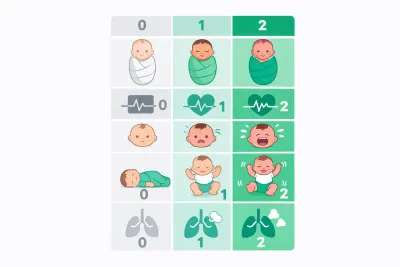
Apgar Score Calculator — Newborn Health at 1 & 5 Minutes
Use the Apgar score calculator to rate a newborn at 1 and 5 minutes across heart rate, breathing, muscle tone, reflexes, and skin color on a 0 to 10 scale.

Baby Food Calculator — Solids Introduction & Portions
Estimate age‑appropriate portions and plan meal frequency with the baby food calculator. Log new foods, track allergens, and export a simple weekly menu.
Infant Growth Chart Calculator
Track weight, length, and head size with the infant growth chart calculator using WHO percentiles. See trends on clear charts and compare age-based progress.
Baby Length Percentile Calculator — WHO Reference Guide
Check WHO length‑for‑age percentiles with the baby length percentile calculator. Input age, sex, and length to see your percentile and track growth trends.

Baby Milestone Calculator — Track Skills by Age & Stage
Use our baby milestone calculator to see what’s typical by corrected age. Explore early, typical, and later windows for motor, language, and cognitive skills.

Baby Weight Percentile Calculator — WHO Growth Guide
Use the baby weight percentile calculator to see WHO weight‑for‑age percentiles. Enter age, sex, and weight to get your percentile, z‑score, and tips.