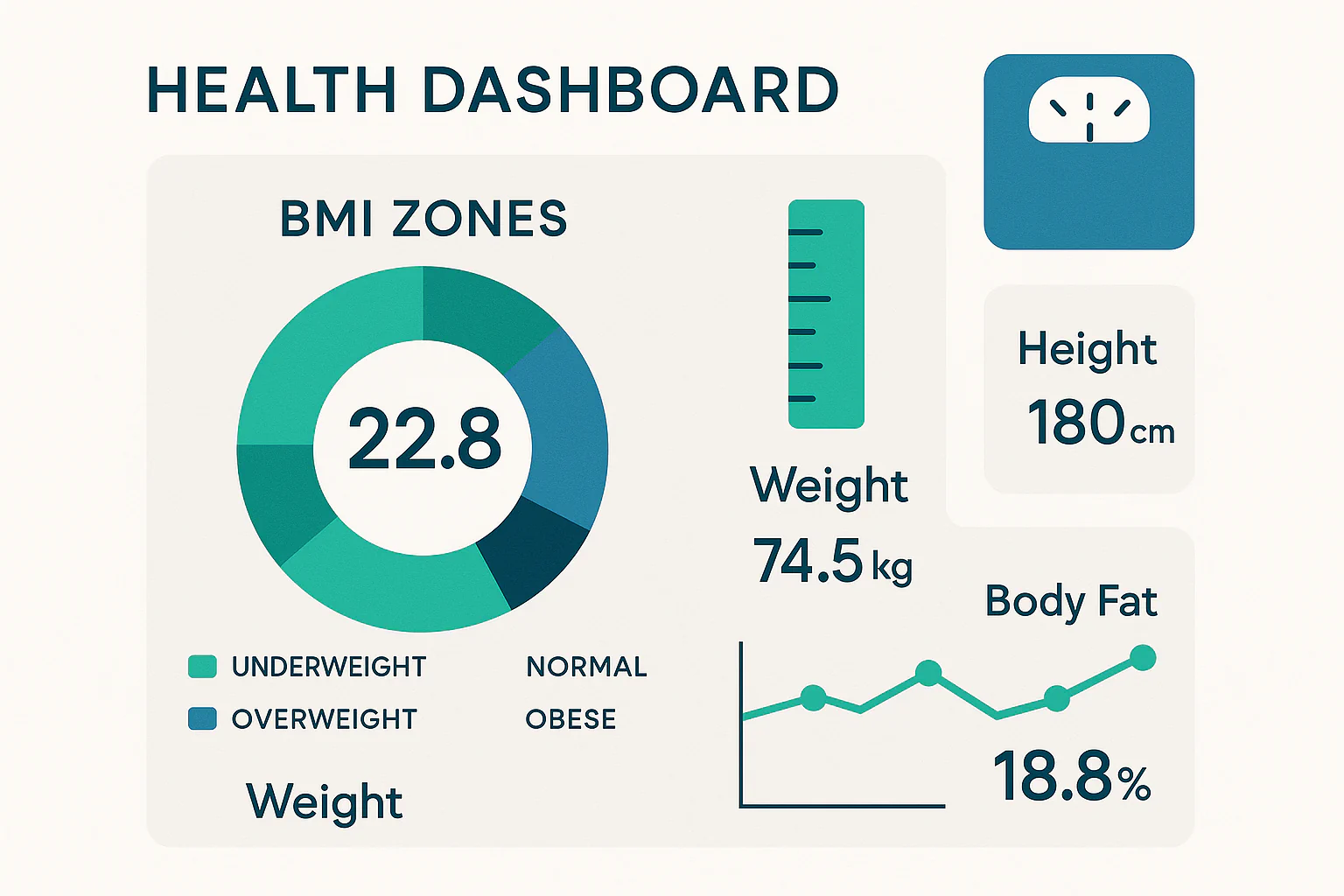
BMI Guide Basics: What Is BMI?
This BMI guide starts with what the ratio actually is: weight divided by height squared, a number Adolphe Quetelet devised in the 1830s to describe populations, not patients. That origin explains most of its behaviour. BMI sorts adults into broad weight categories cheaply and consistently, which is why public health agencies still use it, but it never measures body fat, where that fat sits, or how fit you are. Treat it as a quick context marker — not a diagnosis.
If you want to calculate your BMI right now, try our Adult BMI Calculator. For extra context, pair BMI with body fat percentage or waist‑to‑height ratio.
How BMI Is Calculated
The formulas
Metric: BMI = kg / (m²). Imperial: BMI = 703 × lb / (in²). The result is a single number that can be compared with adult categories. For example, a person who weighs 72 kg and is 1.75 m tall has a BMI of 23.5.
Units and rounding
Most references report BMI to one decimal place. Use consistent units (either all metric or all imperial) to avoid conversion errors. Our calculator handles conversions automatically.
Worked Examples (Metric and US)
Metric example
Weight 72 kg, height 1.75 m: BMI = 72 / (1.75 × 1.75) = 72 / 3.0625 = 23.5. This falls in the normal range for adults.
US (imperial) example
Weight 180 lb, height 70 in: BMI = 703 × 180 / (70 × 70) = 126,540 / 4,900 = 25.8. That is near the lower end of the overweight range.
Measure Correctly to Reduce Noise
Small measurement differences can shift BMI by a few tenths. To improve consistency:
- Weigh at a similar time of day, in similar clothing, on the same scale.
- Measure height without shoes, standing tall against a wall with a flat object on the head.
- Track trends monthly rather than daily; day‑to‑day water shifts are normal.
- Pair BMI with a waist measure for context; see waist‑to‑height ratio.
Adult BMI Categories and Interpretation
For adults, standard cutoffs are commonly used to group BMI values into weight categories:
- Underweight: BMI < 18.5
- Normal weight: 18.5–24.9
- Overweight: 25.0–29.9
- Obesity: ≥ 30.0
These ranges are intended for broad public health guidance. Individual risk varies by many factors— including age, muscle mass, fat distribution, family history, and metabolic markers.
Reference: see CDC guidance on adult BMI categories here.
Children and Teens: Use Percentiles
Pediatric BMI is interpreted using age‑ and sex‑specific percentiles, not adult cutoffs. The gap is wider than most parents expect: at age 8 the obesity threshold is a BMI of about 19.8, a value the adult chart calls perfectly normal. If you're checking a child's number, use a dedicated tool such as our Child BMI Percentile Calculator, and read our guide to what a child BMI percentile actually means for the 85th and 95th cutoffs by age.
BMI Limitations: What the Number Cannot See
What BMI does not measure
BMI does not measure body fat percentage or where fat is stored. A muscular athlete may have a BMI in the overweight range despite low body fat, while someone with central adiposity may have a BMI in the normal range but higher metabolic risk.
Populations where caution is needed
- Highly muscular individuals
- Older adults with sarcopenia
- Different ethnic groups with different risk thresholds
- Pregnancy and postpartum
- Children and teens (use age‑ and sex‑specific BMI percentiles)
Because BMI is a screening tool, clinicians combine it with other measures such as waist circumference, blood pressure, lipids, glucose, and lifestyle factors before making decisions.
BMI Alternatives Worth Measuring
A balanced approach combines BMI with one or more of these tools:
- Body fat percentage — estimates composition directly.
- Waist‑to‑height ratio — screens central adiposity risk.
- Waist‑to‑hip ratio — another lens on fat distribution.
- Ideal body weight — a historical context marker (not a target for everyone).
- Lean body mass or FFMI — highlights the muscle component BMI can't show.
For a thorough discussion of use cases and limitations, see the WHO overview on BMI and obesity epidemiology here.
BMI and Health Outcomes: What Research Shows
Large population studies show that cardiometabolic risk tends to increase as BMI moves from the normal range into the overweight and obesity ranges. This is a trend across groups—not a diagnosis for an individual. Age, cardiorespiratory fitness, sleep, smoking status, and fat distribution all influence risk at a given BMI.
Central adiposity (more fat around the abdomen) carries additional risk. That is why pairing BMI with a waist measure improves context. Use our Waist‑to‑Height Ratio Calculator or Waist‑to‑Hip Ratio Calculator to get another lens beyond a single BMI number.
Weight‑neutral habits that help
Regardless of BMI, regular walking, two to three weekly strength sessions, balanced meals rich in protein and fiber, consistent sleep, and not smoking improve health markers—even when scale weight changes slowly.
BMI Across Ages, Sex, and Backgrounds
Older adults and muscle loss
With age, many people lose skeletal muscle and strength (sarcopenia). Two individuals can share the same BMI while having very different muscle mass. In older adults, a BMI near the lower end of the normal range can sometimes coincide with reduced muscle and functional reserve. Pair BMI with grip strength, walking speed, and a simple waist measurement to get more context about body composition and independence in daily activities.
Sex differences and fat distribution
Typical fat distribution differs by sex and hormones. People who carry more abdominal fat often see higher cardiometabolic risk at a given BMI than those who carry more fat in the hips and thighs. Because BMI alone cannot distinguish these patterns, combining it with a waist‑to‑height ratio adds helpful context without special equipment.
Backgrounds and body composition
At the same BMI, average body fat percentage can vary across populations due to differences in height, frame, and composition. That is one reason guidelines sometimes recommend population‑specific cutoffs or complementary measures. Use BMI as a quick screening tool, then layer in other measures or professional evaluation to guide decisions.
Children and teens use percentiles
For children and adolescents, BMI is interpreted using age‑ and sex‑specific percentile curves rather than adult cutoffs. Growth, puberty, and development change the picture quickly, so a pediatric percentile calculator provides the appropriate context for that age group.
How to Improve BMI Safely
Small, sustainable changes
Most people do best with gradual change. Consider a modest calorie deficit, prioritize protein, and keep weekly movement high. Our tools can estimate targets: Calorie Calculator, TDEE Calculator, and Weight Loss Calorie Calculator.
Keep muscle with strength + protein
Preserving lean mass matters for health and performance. Include resistance training and spread protein across meals. Estimate a daily target with our Protein Calculator.
Expect normal fluctuations
Water, sodium, and routine can shift scale weight day to day. Look for multi‑week trends. Prefer ranges instead of single numbers? See the Healthy Weight Range Calculator for gentle context.
When a Small BMI Change Matters
Day‑to‑day BMI movement is mostly noise from hydration, meals, and measurement timing. Small, sustained changes over weeks to months can be more meaningful, especially when they align with changes in waist measures, fitness, energy, or lab values requested by your clinician. If a small but persistent uptick moves you into a new category, review sleep, stress, and activity patterns first—simple improvements often create measurable progress without extreme restriction.
Track simple, steady signals
Combine BMI with a morning waist measurement, a brisk‑walk heart‑rate check, and a weekly activity total you can sustain. These signals change more slowly and help you focus on habits rather than day‑to‑day scale variation.
Use BMI to inform, not define
BMI is most useful when it prompts the right questions: How am I sleeping? Am I moving regularly? What small changes feel doable this week? Pair the number with context, then choose one low‑friction action you can repeat. Over time, those actions move the needle.
Putting BMI to Work: Practical Tips
Use BMI for trend context
Track BMI occasionally over months, not day‑to‑day. When tracking goals, try to measure under similar conditions to reduce noise—same time of day, similar clothing, and the same scale.
Pair with meaningful actions
If BMI rises into the overweight or obesity ranges, consider practical steps: balanced nutrition, more activity you enjoy, and better sleep habits. Small, sustainable changes compound over time. Our calculators can help you plan: calorie calculator, TDEE calculator, or protein calculator.
BMI Guide: Read Your BMI with Context
Two people with the same BMI can have very different body compositions and risks. Compare your BMI with waist measures and lifestyle factors, and consider tools like healthy weight range for a broader picture.
Talk with your clinician
Discuss results—especially if changes are rapid, you have symptoms, or you live with chronic conditions. BMI is one data point in a bigger picture.
When to Seek Professional Advice
Talk with your clinician if BMI changes rapidly, you have unintentional weight loss, or BMI and waist measures rise with symptoms like shortness of breath, daytime sleepiness, or reduced exercise capacity. A professional can personalize next steps.
This BMI guide is for information only. Health decisions are best made with a clinician who knows your medical history.
One Number Worth Writing Down Today
If you take one action from this BMI guide, make it a waist measurement at the navel, recorded next to your BMI. A waist-to-height ratio above 0.5 flags central adiposity that BMI alone cannot see, and it costs nothing but a tape measure. Two people at a BMI of 27 — one at a ratio of 0.46, the other at 0.58 — are not carrying the same risk, and only the second number tells you which is which.