Use the Wrist Size Calculator
Enter your sex, height, and wrist circumference to classify your body frame as small, medium, or large. This wrist size calculator includes IBW adjustment, bracelet sizing, and full cutoff reference tables.
Frame size
Medium
Ratio
10.52
Sex
Units
Height
Wrist circumference
Wrap tape over the wrist bones, level and snug — not tight.
Your body frame size
Medium Frame
Ratio
10.52
IBW adjust
±0%
Wrist
15.5 cm
6.1 in
Height band
157–165 cm
Ht/Wrist ratio
10.52
IBW adjustment
±0%
for medium frame
Bracelet size
M (15.5–17 cm)
Female wrist cutoffs by height
| Height | Small | Medium | Large |
|---|---|---|---|
| Under 5′2″ (< 157 cm) | ≤ 14 cm | 14–14.6 cm | > 14.6 cm |
| 5′2″–5′5″ (157–165 cm) | ≤ 15.2 cm | 15.2–15.9 cm | > 15.9 cm |
| 5′6″+ (168+ cm) | ≤ 15.9 cm | 15.9–16.5 cm | > 16.5 cm |
Your height band is highlighted. Cutoffs from standard wrist-based frame sizing charts.
Average wrist circumference (adults)
Women
- Average: 15.2 cm (6.0 in)
- Typical range: 13.5–17.0 cm
Men
- Average: 17.5 cm (6.9 in)
- Typical range: 15.5–20.0 cm
Bracelet sizing guide
| Size | Wrist (cm) | Wrist (in) |
|---|---|---|
| XS | < 14 | < 5.5 |
| S | 14–15.5 | 5.5–6.1 |
| M | 15.5–17 | 6.1–6.7 |
| L | 17–18.5 | 6.7–7.3 |
| XL | 18.5–20 | 7.3–7.9 |
| XXL | 20+ | 7.9+ |
Your suggested bracelet size is highlighted based on your wrist circumference.
Disclaimer: This tool provides educational estimates for body frame classification based on wrist circumference. Results are not medical advice. Frame size does not change with weight gain or loss. For men, elbow breadth may provide a more precise classification. Consult a healthcare professional for personalized guidance.
Your rating helps improve Wrist Size Calculator. We store only an anonymized vote (no personal data).
How to Use Wrist Size Calculator
Step 1: Choose sex and units
Select Female or Male, then pick Metric (cm) or US (ft/in). Cutoffs differ by sex and are height-adjusted.
Step 2: Enter your height
Type your height in the field. Stand tall without shoes for the most accurate reading.
Step 3: Measure and enter wrist circumference
Wrap a soft tape over the bony wrist prominences, level and snug. Enter the measurement in centimeters or inches.
Step 4: Read your frame size
The calculator instantly classifies your frame as Small, Medium, or Large and shows the height-to-wrist ratio.
Step 5: Review detail cards and tables
Check the IBW adjustment, bracelet size, and full cutoff reference table. Your active height band is highlighted.
Key Features
- Height-adjusted wrist cutoffs for women and men
- Instant small, medium, or large frame classification
- Ideal body weight ±10% frame adjustment
- Bracelet and watch sizing guide
- Metric and US unit support with auto-conversion
- Full reference tables with active-row highlighting
Understanding Results
Formula
The wrist size calculator uses height-banded wrist circumference cutoffs to classify skeletal frame size. Your sex and height determine which cutoff band applies. If your wrist circumference is at or below the small threshold, you are classified as a small frame. Between the small and medium thresholds, medium frame. Above the medium threshold, large frame. We also compute a height-to-wrist ratio (height in inches divided by wrist circumference in inches) for additional context.
For women in the 5′2″–5′5″ band, small frame means wrist ≤ 6.0 in, medium frame 6.0–6.25 in, and large frame > 6.25 in. For men in the 5′5″–5′10″ band, small frame means wrist ≤ 6.5 in, medium frame 6.5–7.5 in, and large frame > 7.5 in. All values are converted internally when metric units are entered.
Reference Ranges & Interpretation
Average adult wrist circumference is about 15.2 cm (6.0 in) for women and 17.5 cm (6.9 in) for men. A small frame indicates narrower bones relative to height, medium frame is the population baseline, and large frame means broader bones. Classic ideal body weight formulas adjust targets by ±10% based on frame size: subtract 10% for small frames, add 10% for large frames.
These cutoffs originate from the Metropolitan Life Insurance Company tables (1983 revision) and are referenced by the American Dietetic Association for clinical nutrition assessments.
Assumptions & Limitations
This method measures skeletal breadth only and does not account for muscle mass, body fat, or overall body composition. Accuracy depends on correct tape placement over the wrist bones. For men, elbow breadth is sometimes preferred for more precise frame classification. The cutoffs are designed for adults; adolescents and children with ongoing skeletal growth may not receive accurate results. All outputs are educational estimates and do not replace professional health evaluation.
Complete Guide: Wrist Size Calculator
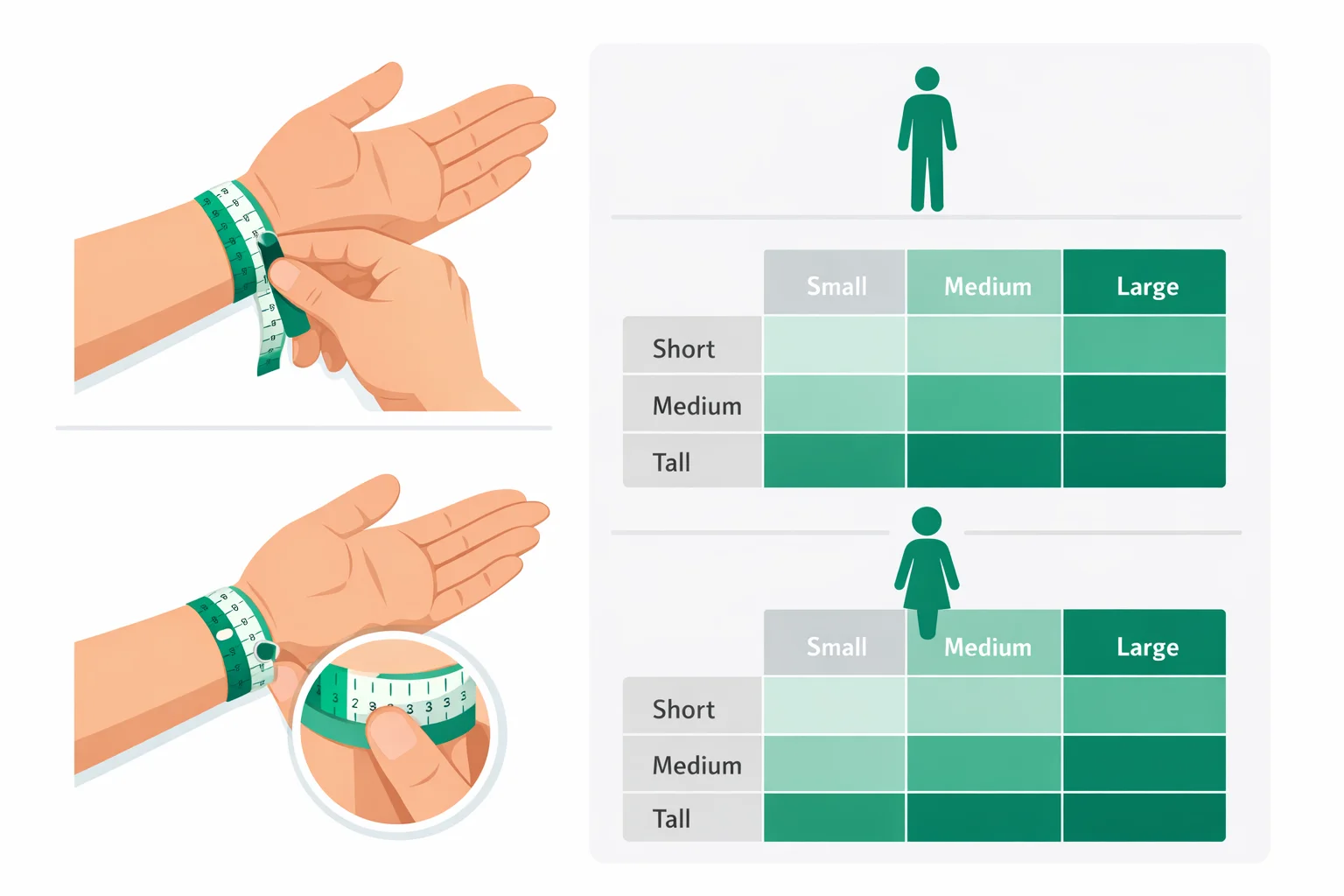
A wrist size calculator tells you whether your body frame is small, medium, or large based on a quick tape-measure reading around your wrist bones. If you have ever wondered why two people of identical height and weight can look completely different, bone structure is a big part of the answer — and your wrist is the easiest skeletal landmark to measure at home. This guide walks through the science, the measurement technique, the cutoff charts, and practical ways to use your frame-size result for ideal-weight planning, bracelet fitting, and more.
What does a wrist size calculator measure and why does it matter?
Wrist circumference is one of the simplest proxies for skeletal breadth. Unlike the bicep or thigh, the wrist carries almost no muscle or fat — what you measure is essentially bone, tendons, and a thin layer of skin. That makes it a remarkably stable metric: your wrist size stays constant whether you gain 10 kg of muscle or lose 10 kg of fat.
Clinically, wrist circumference has been studied as a predictor of cardiometabolic risk. A 2019 meta-analysis in Nutrition & Diabetes found that larger wrist circumference is independently associated with higher fasting insulin and insulin resistance, even after adjusting for BMI. The average adult female wrist measures about 15.2 cm (6.0 in), while the average adult male wrist is about 17.5 cm (6.9 in). These numbers are useful benchmarks, but what really matters for frame classification is how your wrist compares to your height.
How to measure your wrist correctly
Accuracy depends on technique. Follow these steps for a reliable reading:
- Use a soft, non-stretch tape. A flexible sewing tape is ideal. If you only have a rigid ruler, wrap a piece of string around your wrist, mark the overlap, and measure the string flat.
- Locate the bony bumps. Place the tape just distal to the radial styloid (thumb side) and ulnar styloid (pinky side) — the two prominent wrist bones.
- Keep the tape level and snug. It should touch the skin all the way around without compressing it. You should be able to slide a fingertip under the tape with slight resistance.
- Take 2–3 readings and average. Small differences of 1–2 mm are normal. Averaging smooths out measurement noise.
- Measure at a consistent time of day. Wrists can swell slightly after exercise or in hot weather. Morning readings before activity are most reproducible.
How the wrist-based frame size formula works
The method is straightforward: your sex and height determine which cutoff band applies, then your wrist measurement is compared against that band's small and medium thresholds. If your wrist is at or below the small threshold, you have a small frame. Between the thresholds, medium frame. Above the medium threshold, large frame.
Here is a worked example:
Worked example
- Sex: Female
- Height: 5′4″ (163 cm) — falls in the 5′2″–5′5″ band
- Wrist: 15.5 cm (6.1 in)
- Cutoffs for this band: Small ≤ 6.0 in, Medium 6.0–6.25 in, Large > 6.25 in
- Result: 6.1 in is between 6.0 and 6.25 → Medium frame
- Height-to-wrist ratio: 64 in ÷ 6.1 in = 10.49
- IBW adjustment: ±0% (medium frame is the baseline)
The height-to-wrist ratio provides an additional reference point. For women, ratios above 11 tend to correlate with smaller frames, while ratios below 10 often indicate larger builds. For men, the ranges shift slightly lower. However, the official classification always relies on the height-banded cutoff thresholds, not the ratio alone.
Wrist circumference cutoff charts
The tables below are the standard cutoffs used in clinical nutrition and health assessment guides. These values are referenced in the frame size calculator as well, but here we present them with metric conversions side by side.
Female cutoffs
| Height | Small frame | Medium frame | Large frame |
|---|---|---|---|
| Under 5′2″ (< 157 cm) | ≤ 5.5 in (14.0 cm) | 5.5–5.75 in (14.0–14.6 cm) | > 5.75 in (14.6 cm) |
| 5′2″–5′5″ (157–165 cm) | ≤ 6.0 in (15.2 cm) | 6.0–6.25 in (15.2–15.9 cm) | > 6.25 in (15.9 cm) |
| 5′6″+ (168+ cm) | ≤ 6.25 in (15.9 cm) | 6.25–6.5 in (15.9–16.5 cm) | > 6.5 in (16.5 cm) |
Male cutoffs
| Height | Small frame | Medium frame | Large frame |
|---|---|---|---|
| Under 5′5″ (< 165 cm) | ≤ 6.0 in (15.2 cm) | 6.0–7.0 in (15.2–17.8 cm) | > 7.0 in (17.8 cm) |
| 5′5″–5′10″ (165–178 cm) | ≤ 6.5 in (16.5 cm) | 6.5–7.5 in (16.5–19.1 cm) | > 7.5 in (19.1 cm) |
| 5′11″+ (180+ cm) | ≤ 7.0 in (17.8 cm) | 7.0–8.0 in (17.8–20.3 cm) | > 8.0 in (20.3 cm) |
These cutoffs originate from the Metropolitan Life Insurance Company tables (1983 revision) and are referenced by the American Dietetic Association. They are designed for adults and may not apply accurately to children or adolescents whose skeletal development is still in progress.
Frame size and ideal body weight
Classic ideal body weight (IBW) formulas — Hamwi, Devine, Robinson, and Miller — produce a single number based on height and sex. But a 5′7″ woman with a small frame and a 5′7″ woman with a large frame should not aim for the same weight. The standard adjustment is ±10%: subtract 10% for small frames, add 10% for large frames, and use the formula value directly for medium frames.
For example, the Hamwi formula estimates 61.4 kg (135 lb) for a 5′7″ woman. With a small frame, the adjusted target becomes about 55 kg (122 lb); with a large frame, about 68 kg (149 lb). That 13 kg spread is meaningful for goal-setting. You can explore these adjustments with our ideal body weight calculator, which runs multiple formulas simultaneously.
Keep in mind that IBW formulas are population-level estimates, not personal prescriptions. Pair them with body composition data from a body fat percentage calculator for a fuller picture of whether your weight comes from lean tissue or adipose tissue.
Common measurement mistakes to avoid
Even a 2–3 mm error in wrist circumference can push you across a cutoff boundary, especially for women whose bands are narrower (0.25 in apart). Here are the most frequent mistakes:
- Measuring over a watch or bracelet. Remove all jewelry first. Even a thin band adds 1–2 mm.
- Placing the tape too high or low. The tape belongs directly over the bony prominences, not in the soft tissue gap between hand and forearm.
- Pulling the tape too tight. Compression distorts the reading downward, potentially shifting a medium-frame person into the small category.
- Measuring only once. A single reading is unreliable. Take at least two measurements and average them. If they differ by more than 3 mm, take a third.
Wrist size for bracelet and watch sizing
Beyond health assessment, knowing your wrist circumference is essential for buying bracelets, watches, and fitness trackers. Most jewelry brands use a standard sizing system:
| Size label | Wrist (cm) | Wrist (in) | Typical bracelet length |
|---|---|---|---|
| XS | < 14 | < 5.5 | 15.5 cm / 6.1 in |
| S | 14–15.5 | 5.5–6.1 | 17 cm / 6.7 in |
| M | 15.5–17 | 6.1–6.7 | 18.5 cm / 7.3 in |
| L | 17–18.5 | 6.7–7.3 | 20 cm / 7.9 in |
| XL | 18.5–20 | 7.3–7.9 | 21.5 cm / 8.5 in |
| XXL | 20+ | 7.9+ | 23 cm / 9.1 in |
Bracelet length should be about 1.5–2.5 cm longer than your wrist circumference for a comfortable fit. For watches, add only 0.5–1 cm since the strap wraps more tightly. Fitness trackers typically adjust via buckle positions and are sized to the nearest band option.
When to use this calculator
The wrist size calculator is most useful in these scenarios:
- Setting a realistic weight goal. If standard BMI charts or IBW formulas feel off, your frame size may explain the mismatch. Use the ±10% adjustment to personalize targets.
- Choosing jewelry or wearable devices. Your exact wrist circumference maps directly to bracelet, watch, and fitness tracker sizes — no guessing needed.
- Understanding your body type. Knowing whether you have a small, medium, or large frame provides useful context for clothing fit, sports equipment sizing, and comparison with population averages.
- Complementing other health metrics. Pair this result with your BMI, waist-to-height ratio, and body measurements for a well-rounded view of your physique.
References
- Metropolitan Life Insurance Company. “1983 Metropolitan Height and Weight Tables.” Statistical Bulletin, 64(1), 1983.
- Capizzi M, et al. “Wrist circumference is a clinical marker of insulin resistance in overweight and obese children and adolescents.” Circulation, 123(16):1757–1762, 2011.
- Amini A, et al. “Wrist circumference as a novel marker for cardiometabolic risk: a systematic review and meta-analysis.” Nutrition & Diabetes, 9(1):27, 2019.

Written by Jurica Šinko
Founder & CEO
Entrepreneur and health information advocate, passionate about making health calculations accessible to everyone through intuitive digital tools.
View full profileFrequently Asked Questions
What is a normal wrist size for a woman?
The average female wrist circumference is about 15.2 cm (6.0 inches). Typical values range from 13.5 cm to 17 cm depending on height and bone structure. A wrist under 15.2 cm on a woman of average height usually indicates a small-to-medium frame.
What is a normal wrist size for a man?
The average male wrist circumference is about 17.5 cm (6.9 inches), with a typical range of 15.5 cm to 20 cm. Men over 180 cm tall may measure 18 cm or more and still classify as medium frame.
How do I measure my wrist for frame size?
Wrap a soft, non-stretch tape measure over the bony prominences of your wrist (the bumps on the thumb side and pinky side). Keep the tape level and snug without compressing the skin. Take two or three readings and average them for accuracy.
Does wrist size change with weight loss or muscle gain?
No. Wrist circumference reflects bone structure, not muscle or fat. Your frame size stays constant regardless of body composition changes. That stability is what makes wrist measurement useful as a skeletal reference point.
What is the difference between frame size and body type?
Frame size classifies your skeleton as small, medium, or large based on bone width. Body type (ectomorph, mesomorph, endomorph) describes overall shape including muscle and fat distribution. A person with a large frame can still have low body fat, and a small-framed person can carry extra weight.
How does frame size affect ideal body weight?
Classic ideal body weight formulas adjust by plus or minus 10 percent based on frame size. A large-framed person is expected to weigh about 10 percent more than the formula baseline for their height, while a small-framed person is expected to weigh about 10 percent less.
Can I use wrist circumference to find my bracelet size?
Yes. Your wrist measurement maps directly to standard bracelet sizes: under 14 cm is XS, 14 to 15.5 cm is S, 15.5 to 17 cm is M, 17 to 18.5 cm is L, 18.5 to 20 cm is XL, and over 20 cm is XXL. Add 1.5 to 2.5 cm to your wrist measurement for a comfortable bracelet fit.
Related Calculators
Adult BMI Calculator for Men & Women — WHO BMI Guide
Use the adult BMI calculator to find your BMI with WHO categories. Enter metric or imperial units to see your status and BMI ranges quickly and clearly.
Army Body Fat Calculator — AR 600‑9 Standard Compliance
Check compliance with the Army body fat calculator per AR 600-9 standards. Enter circumference measures by sex to estimate body fat % and see pass/fail status.
Body Composition Calculator — Fat, Lean Mass Breakdown
Use our body composition calculator to estimate body fat percentage, fat mass, and lean mass from tape measurements. Switch units and get clear categories.
Body Fat Calculator — Percentage for Men & Women (Tape)
Estimate with the body fat percentage calculator (body fat calculator) using Navy circumference equations. Supports metric/imperial and sex‑specific inputs.
Body Measurement Calculator: Wrist Size & Frame Guide
Use our body measurement calculator to capture wrist, waist, hip, and height. View WHR, WHtR, and a wrist-based frame size hint with metric/US units and labels.
Body Roundness Index Calculator (BRI) — Height & Waist
Estimate adiposity from height and waist with our body roundness index calculator. Get your BRI value and interpretive ranges for clear health risk context.