Use the Sleep Latency Calculator
Free sleep latency calculator to measure how long you take to fall asleep, compare your onset time against clinical norms, and learn how to fall asleep faster.
Estimate the gap between turning the lights off and actually drifting off to sleep.
Your sleep onset latency
Time from lights out to falling asleep
This is the textbook healthy range. A rested adult typically drifts off within 10 to 20 minutes.
- You are in the ideal window. Keep a consistent wake time and get morning light to protect it.
- Track several nights below — a single night tells you little; a 7-night average reveals your true pattern.
Sleep latency reference ranges
| Time to fall asleep | Category | What it usually means |
|---|---|---|
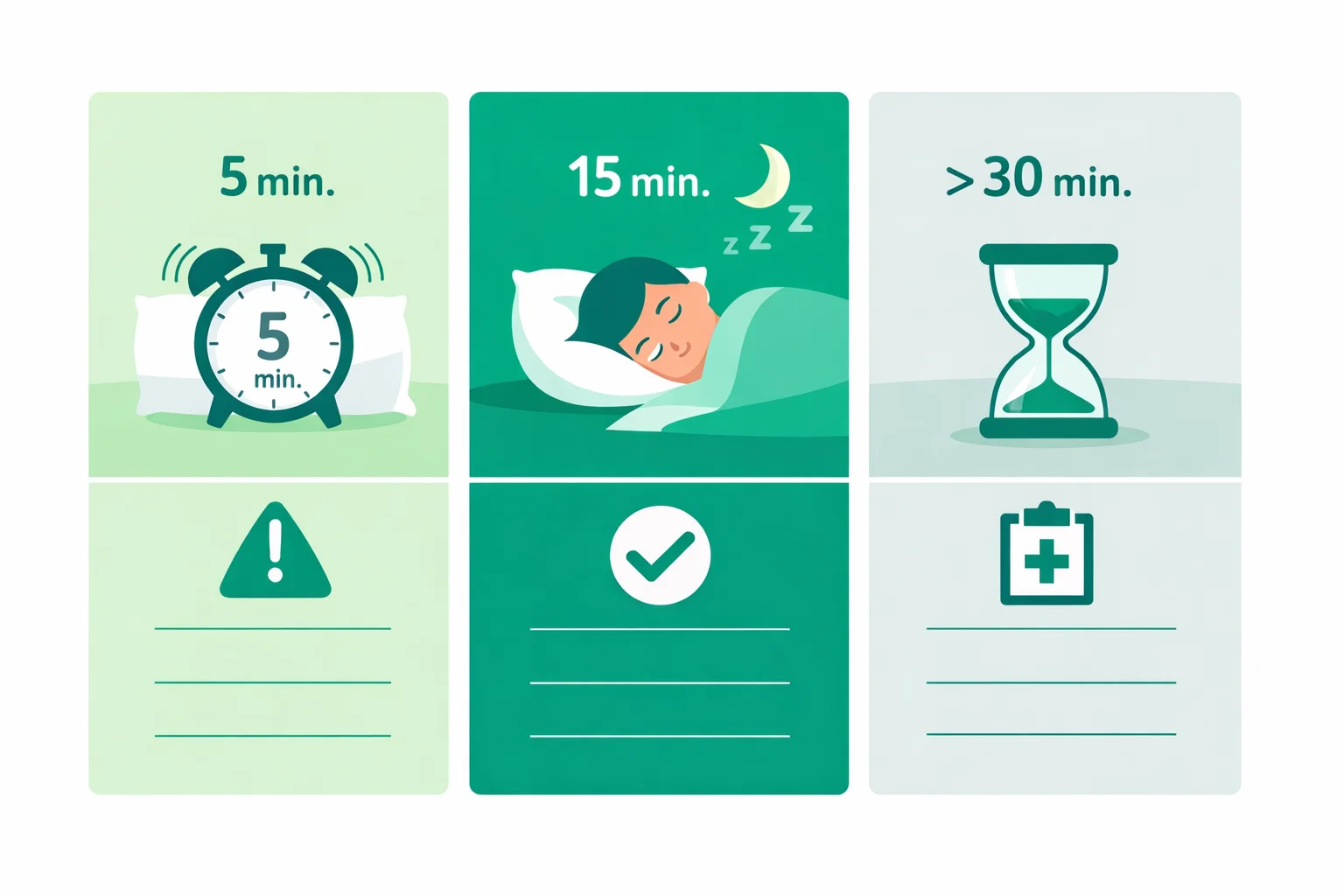
| Under 5 min | Very short | Often a sign of sleep deprivation, not great sleep |
| 5–10 min | Short | Usually healthy; can flag mild sleep debt |
| 10–20 min | Ideal | The healthy adult norm |
| 20–30 min | Slightly prolonged | Borderline; watch for a pattern |
| Over 30 min | Prolonged | Common threshold for sleep-onset insomnia |
Recent nights
Log a few nights to build your trend. Entries save on this device only — nothing is uploaded.
Educational tool, not medical advice. Check this tool’s method and limitations before interpreting a result. Talk to a qualified healthcare professional before making decisions about medication, diet, exercise, or treatment. See our Terms of Use.
Your rating helps improve Sleep Latency Calculator. We store only an anonymized vote (no personal data).
How to Use Sleep Latency Calculator
Step 1: Pick an input method
Choose "Enter minutes" to type your time to fall asleep directly, or "From clock times" to enter lights-out and the time you fell asleep.
Step 2: Enter your night
Type the minutes (for example, 18) or your two clock times. Onset across midnight is handled automatically.
Step 3: Read your range
See your sleep latency in minutes, the category badge, and where your marker lands on the 0–45 minute zone scale.
Step 4: Log the night
Tap "Log night" to save the result on your device and build a 7-night rolling average.
Step 5: Track the trend
Compare several nights. A 7-night average above 30 minutes is a clearer signal than any single night.
Key Features
- Enter minutes directly or from lights-out and asleep times
- Classifies onset against five clinical ranges
- Visual 0–45 minute zone scale with marker
- Flags both prolonged onset and too-fast sleep
- 7-night log with rolling average (saved on-device)
Understanding Results
How sleep latency is calculated
Sleep onset latency (SOL) is the elapsed time between lights out and the moment you fall asleep: SOL = time fell asleep − time lights out. In clock-time mode the calculator does this subtraction for you and rolls past midnight when needed (for example, lights out 11:50 p.m. and asleep 12:20 a.m. gives 30 minutes). In minutes mode you enter your best estimate directly. The result is rounded to the nearest whole minute and capped at 600 minutes to ignore typos.
Reference ranges & interpretation
A healthy adult typically falls asleep in 10–20 minutes. Under 5 minutes points to sleep deprivation rather than great sleep; 5–10 minutes is short but usually fine; 20–30 minutes is borderline; and consistently over 30 minutes meets a standard quantitative criterion for sleep-onset insomnia when it occurs at least three nights a week for three months (American Academy of Sleep Medicine). The visual scale and reference table in the calculator map your number onto these bands.
Assumptions & limitations
This is a subjective estimate, not a polysomnography reading — people are not great at judging the exact second they fell asleep, so use it for trends, not single-night precision. It measures bedtime onset only and is not the daytime Multiple Sleep Latency Test, where shorter values indicate excessive sleepiness. The log is stored on your device, so it does not sync across phones. None of this replaces a clinical evaluation; persistent prolonged or very short latency warrants a professional assessment.
Complete Guide: Sleep Latency Calculator
On this page
A sleep latency calculator turns a fuzzy complaint — "it takes me forever to fall asleep" — into a hard number you can track. Sleep latency, or sleep onset latency (SOL), is simply the time between turning off the light and actually falling asleep. This guide explains what your result means against clinical norms, why both very long and surprisingly short latencies matter, and the specific levers that move the number. You will also see a worked example so you can measure your own onset time tonight.
A real night, measured minute by minute
Say you switch off the lamp at 10:45 p.m. You lie there, mind wandering, and your last clear memory of being awake is somewhere around 11:05 p.m. That 20-minute gap is your sleep latency for the night. Plug 20 minutes into the calculator and it lands at the top edge of the ideal 10–20 minute band — healthy, but close enough to the line that a few more late-night scrolling sessions could push you into "slightly prolonged" territory.
You rarely know the exact second you fell asleep, and that is fine. Sleep latency is meant to be a good estimate, not a stopwatch reading. The trick is consistency: estimate it the same way every night. The calculator's clock-time mode does the subtraction for you — enter lights-out and your best guess of when you drifted off, and it handles the math, even across midnight.
What the sleep latency calculator measures
Sleep latency captures how quickly your brain transitions from quiet wakefulness into stage N1 sleep. It is one of the four numbers sleep scientists use to score a night, alongside total sleep time, wake after sleep onset (WASO), and the ratio of the two — your sleep efficiency. A typical healthy adult logs a latency of 10 to 20 minutes. The American Academy of Sleep Medicine treats an onset time over 30 minutes as one of the quantitative criteria for insomnia when it happens at least three nights a week for three months or longer.
Because latency feeds directly into sleep efficiency, a long onset time drags efficiency down even if you sleep soundly once you are out. If you want the full picture, pair this tool with our sleep efficiency calculator, which combines latency, WASO, and time in bed into a single percentage.
What your number means: the five ranges
The calculator sorts your result into one of five bands. The middle band is the target; both ends carry information worth acting on.
| Latency | Category | Typical interpretation |
|---|---|---|
| < 5 min | Very short | Often a marker of sleep deprivation or a sleep disorder |
| 5–10 min | Short | Usually healthy; consistently under 8 can mean mild sleep debt |
| 10–20 min | Ideal | The healthy adult norm |
| 20–30 min | Slightly prolonged | Borderline; occasional nights are normal, a pattern is not |
| > 30 min | Prolonged | A standard threshold for sleep-onset insomnia |
Why falling asleep too fast is a warning
Most people assume that the faster they fall asleep, the better they sleep. The data says otherwise. A well-rested adult needs a short buffer of quiet wakefulness — that 10-to-20-minute runway is normal physiology. When someone drops off in under 5 minutes night after night, it usually means they are carrying a large sleep debt, and the brain is grabbing sleep the instant it gets the chance. The same fast onset shows up in conditions like narcolepsy and untreated sleep apnea, where daytime sleepiness is severe. If your latency is routinely tiny and you still wake unrefreshed, that combination is worth screening — our sleep apnea risk calculator is a quick first step.
Five things that lengthen sleep latency
A prolonged onset time rarely has one cause. These five push the number up the most, with rough magnitudes:
- Caffeine timing. Caffeine's half-life is about 5–6 hours, so a 3 p.m. coffee still leaves roughly a quarter of the dose circulating at 11 p.m. — enough to add 10+ minutes to onset in sensitive people.
- Evening light. Bright screens and overhead lighting suppress melatonin and can delay your circadian sleep signal by 30–60 minutes, stretching latency even when you feel tired.
- Going to bed too early. If you climb in before your circadian "sleep gate" opens, you may lie awake for 30–45 minutes. This is the most common reason a fixed early bedtime backfires.
- A racing mind. Cognitive and somatic arousal — worry, planning, replaying the day — is the signature of sleep-onset insomnia and the hardest factor to switch off on demand.
- Alcohol. A nightcap can shorten latency at first, but it fragments the back half of the night and often rebounds into longer onset times on following nights.
Nighttime latency vs. the clinical MSLT
There are two very different sleep latency measurements, and people mix them up constantly. What this calculator estimates is your nighttime onset latency — how long it takes to fall asleep at bedtime, where longer means harder to sleep. The clinical Multiple Sleep Latency Test (MSLT) is the opposite: it is a daytime test of how fast you fall asleep across four or five scheduled naps, where shorter means more daytime sleepiness.
| Measure | When | A concerning result |
|---|---|---|
| Nighttime SOL (this tool) | At bedtime | Over 30 min = trouble falling asleep |
| MSLT mean latency | Daytime naps in a lab | Under 8 min = pathological sleepiness |
So an 8-minute result means very different things depending on context: it is a perfectly normal bedtime onset, but on an MSLT it would flag excessive daytime sleepiness. This calculator is built for the bedtime version.
You cannot run an MSLT at home, but you can approximate the question it asks with a validated questionnaire. The Epworth Sleepiness Scale calculator scores your chance of dozing across eight everyday situations for a 0–24 total, where 11 or more marks excessive daytime sleepiness. If your bedtime latency is under 5 minutes and your ESS is above 10, both measures are pointing the same direction — toward genuine sleep pressure rather than good sleep hygiene.
How to shorten a long sleep latency
The most effective fix for a prolonged onset time is counterintuitive: spend less time in bed, not more. Stimulus control and sleep restriction — the core of cognitive behavioral therapy for insomnia (CBT-I) — work by rebuilding the link between your bed and sleep. The practical rules: only get into bed when sleepy, and if you are still awake after about 20 minutes, get up, sit in dim light, and return only when drowsiness returns. Anchoring a single consistent wake time and getting 10–15 minutes of morning light strengthens the circadian signal that sets your evening sleep gate. If you are choosing a smarter bedtime, our sleep calculator times it around 90-minute cycles, and the insomnia calculator helps you gauge whether your pattern crosses into clinical insomnia.
When to talk to a doctor
Track your latency for a week or two using the log built into the calculator. A single rough night means nothing — what matters is the 7-night average and the trend. If your average onset stays above 30 minutes on three or more nights a week for over a month, or if you fall asleep almost instantly yet still feel exhausted during the day, that pattern is worth a conversation with a clinician. Sleep is one of the few health metrics you can measure for free at home, and a consistent record makes that conversation far more productive.
References
- American Academy of Sleep Medicine. International Classification of Sleep Disorders, 3rd ed. aasm.org
- National Heart, Lung, and Blood Institute (NIH). "What Is Insomnia?" nhlbi.nih.gov

Written by Jurica Šinko
Founder & CEO
Entrepreneur and health information advocate, passionate about making health calculations accessible to everyone through intuitive digital tools.
View full profileFrequently Asked Questions
What is a normal sleep latency?
For a healthy adult, 10 to 20 minutes is the normal range to fall asleep. Onset under 5 minutes often signals sleep deprivation, while regularly taking over 30 minutes is a common threshold for sleep-onset insomnia.
Is falling asleep in under 5 minutes bad?
It can be. Dropping off in under 5 minutes most nights usually means you carry a significant sleep debt and your brain grabs sleep the moment it can. Very short onset also appears in conditions like narcolepsy and untreated sleep apnea, especially alongside daytime sleepiness.
How do I measure my sleep latency without a sleep tracker?
Note the time you turned off the light and your best estimate of when you fell asleep, then subtract. You will not know the exact second, and that is fine — an honest estimate made the same way each night is accurate enough to spot trends.
What is the difference between sleep latency and the MSLT?
Nighttime sleep latency measures how long you take to fall asleep at bedtime, where longer is worse. The Multiple Sleep Latency Test (MSLT) is a daytime lab test of how fast you nap, where shorter is worse — under 8 minutes flags pathological daytime sleepiness. This calculator measures the bedtime version.
How long should I lie awake before getting out of bed?
About 20 minutes. If you are still awake after roughly 20 minutes, stimulus-control therapy says to get up, sit in dim light, and only return to bed when sleepy. Watching the clock and staying in bed frustrated tends to lengthen onset further.
Does caffeine really lengthen sleep latency?
Yes. Caffeine has a half-life of about 5 to 6 hours, so a 3 p.m. coffee can leave roughly a quarter of the dose active at 11 p.m. In sensitive people that can add 10 or more minutes to sleep onset. Cutting caffeine after early afternoon often shortens latency within a few days.
When should a long sleep latency prompt a doctor visit?
If your 7-night average onset stays above 30 minutes on three or more nights a week for longer than a month, or if you fall asleep almost instantly yet wake unrefreshed, talk to a clinician. A consistent home log makes that visit far more useful.
Related Calculators
ADHD Test: Free Adult ASRS Screening Score, 18 Items
Free ADHD test using the WHO ASRS v1.1 screener. Answer 18 questions, score Part A against the cut-off of 4, then rule out the four conditions that mimic it.

Anxiety Calculator: Test Your Anxiety Symptom Level
Use our anxiety calculator to rate seven common symptoms, see your severity band, and get practical next steps you can try today. Free and completely private.
AUDIT Alcohol Calculator — Score Alcohol Use Disorder Risk
Use the AUDIT alcohol calculator to score the 10-item screening test, grade hazardous or dependent drinking risk, and see your zone-based intervention level.
Autism Test: Free AQ-10 Adult Screening Score (0-10)
Free autism test using the AQ-10 screening questionnaire: score 10 items against the 6-point cut-off and see what a positive result really means for you.

Bedtime Calculator: Find the Best Time to Go to Bed Now
Enter your wake time and the bedtime calculator suggests bedtimes by 90-minute cycles. Add a fall-asleep buffer and choose 12/24-hour time for better mornings.

Circadian Rhythm Calculator: Align Sleep & Wake Times
Use the Circadian Rhythm Calculator to identify your chronotype and align sleep and wake times. See optimal windows, plan meals, and get blue-light tips.