Use the Skeletal Muscle Mass Percentage Calculator
Free skeletal muscle mass percentage calculator to check your SMM against healthy ranges by age and sex. Interpret InBody, DEXA, or smart scale results.
For adults 18+. Not medical advice.
Enter your skeletal muscle mass percentage (from a smart scale or body scan) and age to see your classification, reference ranges, and personalized insights.
Disclaimer
This calculator interprets skeletal muscle mass percentage readings. Reference ranges are population-level estimates based on published research and may not apply to all individuals. Smart scale bioimpedance readings can vary ±3–5% from DEXA gold-standard measurements. Always consult a qualified healthcare provider for medical decisions.
- Measure at the same time of day and hydration level for consistent readings.
- InBody and DEXA scans are more accurate than consumer smart scales for SMM%.
- Track trends over weeks and months — single readings fluctuate with hydration and meals.
- Enter your height to also see your Skeletal Muscle Index (SMI), used in sarcopenia screening.
Your rating helps improve Skeletal Muscle Mass Percentage Calculator. We store only an anonymized vote (no personal data).
How to Use Skeletal Muscle Mass Percentage Calculator
Step 1: Choose your input mode
Select "Enter SMM %" if your scale or scan gives a percentage, or "Enter SMM Mass" if it reports absolute skeletal muscle mass in kg or lb.
Step 2: Enter your SMM reading
Type the skeletal muscle mass value from your InBody scan, DEXA report, or smart scale into the Skeletal Muscle Mass field.
Step 3: Set sex and age
Select Male or Female and enter your age so the calculator can compare your result to the correct reference range.
Step 4: Add weight and height (optional)
Enter your body weight to see absolute SMM in kg/lb, and add height to calculate your Skeletal Muscle Index (SMI) for sarcopenia screening.
Step 5: Review your classification and ranges
View your SMM% classification (Low to Athletic), the visual range bar, your gap to normal, and the full reference table by age and sex.
Key Features
- Classify SMM% against age- and sex-specific reference ranges
- Accept percentage or absolute mass input from any scan type
- Calculate Skeletal Muscle Index (SMI) for sarcopenia screening
- Visual range bar showing where you fall from low to athletic
- Show gap to normal with actionable muscle-gain targets
- Full reference table for all age groups and both sexes
Understanding Results
Formula
The calculator uses a simple percentage formula when you enter absolute SMM mass:
SMM% = (Skeletal Muscle Mass ÷ Total Body Weight) × 100
When height is provided, the Skeletal Muscle Index is also computed:
SMI = Skeletal Muscle Mass (kg) ÷ Height (m)²
Your SMM% is then classified against age- and sex-specific reference ranges derived from population body composition studies using DEXA and BIA data (Janssen et al., 2000; Cruz-Jentoft et al., 2019).
Reference Ranges & Interpretation
Results are classified into five categories based on your age group and sex:
- Low — Below the healthy range, may indicate muscle loss or sarcopenia risk
- Below Average — Slightly under normal; resistance training can improve this
- Normal — Within the healthy range for your demographic
- Above Average — Indicates good muscular development from regular training
- Athletic — Elite-level skeletal muscle mass typical of trained athletes
For SMI, the EWGSOP2 sarcopenia cutoffs are <7.0 kg/m² for men and <5.5 kg/m² for women. Falling below these thresholds warrants clinical evaluation.
Assumptions & Limitations
Keep in mind:
- Reference ranges are population averages — individual variation of 5–10% exists based on genetics and ethnicity
- Smart scale BIA readings vary ±3–5% from DEXA gold-standard measurements; use consistent conditions for tracking
- This tool is designed for adults 18+ and does not apply to children or adolescents
- Results are informational — consult a healthcare provider for sarcopenia diagnosis or medical decisions
Complete Guide: Skeletal Muscle Mass Percentage Calculator
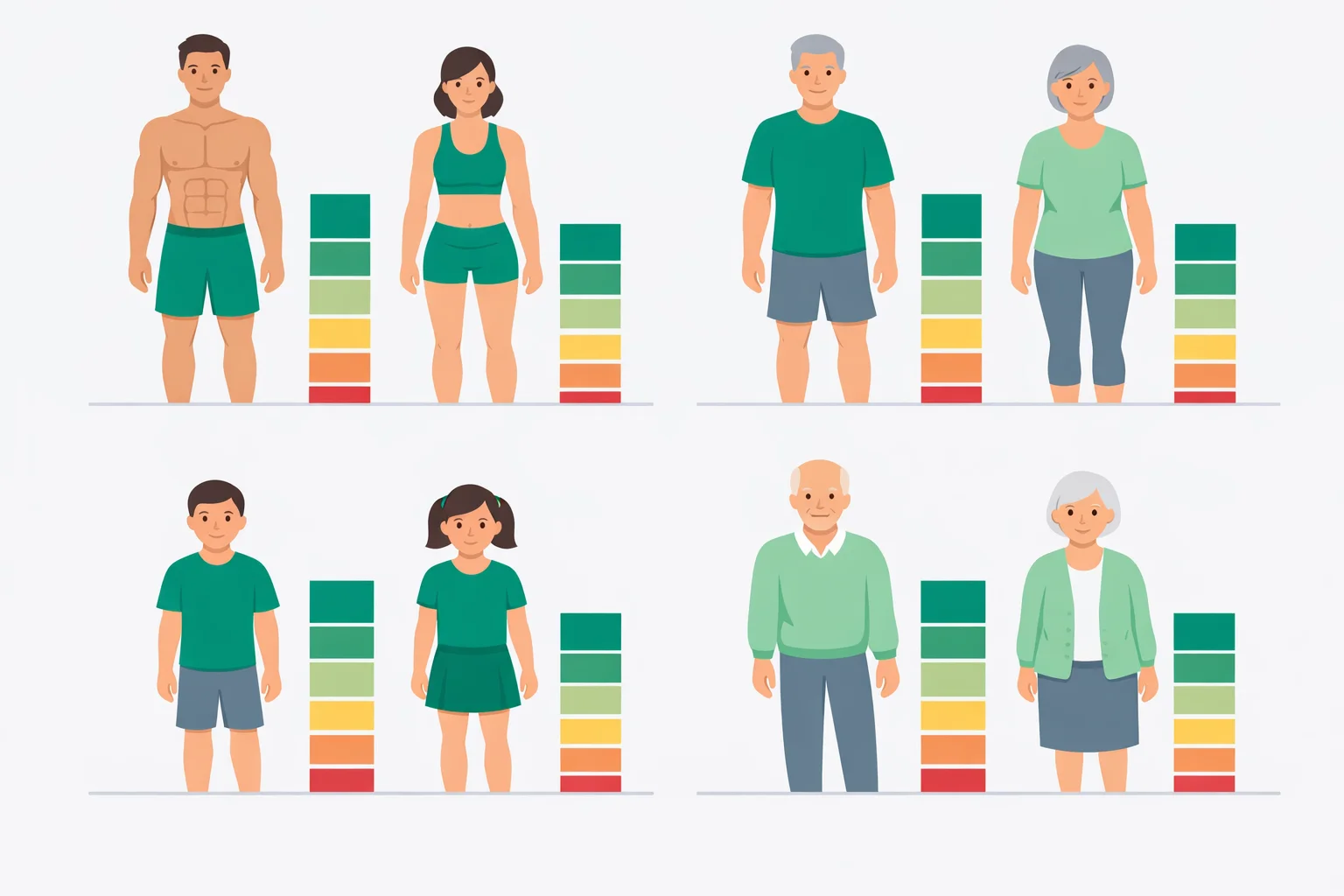
Table of Contents
A skeletal muscle mass percentage calculator helps you understand whether the muscle reading on your smart scale or body composition scan falls within a healthy range for your age and sex. If you have ever stepped off an InBody machine or checked your smart scale app and wondered what "SMM 38%" actually means, this guide breaks it down with reference charts, worked examples, and science-backed thresholds so you can take informed action.
Skeletal muscle mass percentage (SMM%) is one of the most important body composition metrics — more predictive of metabolic health, fall risk, and longevity than body weight alone. Yet most people have no idea how to interpret the number their scale reports. Below, we cover everything from measurement methods to age-specific targets and practical strategies for improvement.
What Is Skeletal Muscle Mass Percentage and Why Measure It?
Skeletal muscle mass percentage is the proportion of your total body weight made up of skeletal muscles — the voluntary muscles attached to bones that you control for movement. It excludes smooth muscle (in organs) and cardiac muscle (the heart). For example, if you weigh 80 kg and your skeletal muscle mass is 32 kg, your SMM% is 40%.
This metric differs from lean body mass, which includes bones, water, organs, and connective tissue in addition to muscle. SMM% isolates the tissue most responsive to exercise and most affected by aging. Research published in the Journal of Bone and Mineral Research shows that adults lose 3–8% of their skeletal muscle mass per decade after age 30, accelerating past 60.
How Is Skeletal Muscle Mass Measured?
There are several methods to measure skeletal muscle mass, each with different accuracy levels and price points:
- DEXA scan (Dual-Energy X-ray Absorptiometry) — The clinical gold standard. Measures lean mass, fat mass, and bone mineral content with ~1–2% precision. Costs $75–$200 per scan at imaging centers.
- BIA (Bioelectrical Impedance Analysis) — Used in smart scales and InBody machines. Sends a small electrical current through your body; muscle conducts better than fat. Consumer scales have ±3–5% margin of error vs. DEXA; medical-grade InBody devices are within ±2%.
- MRI or CT imaging — Research-grade accuracy but impractical for routine tracking due to cost ($500+) and radiation (CT).
- Skinfold calipers — Estimate body fat rather than muscle mass directly. Useful for tracking trends but cannot measure SMM%.
Most people get their SMM% from a BIA smart scale or gym-based InBody scan. These readings are acceptable for tracking trends over time, even if the absolute number is slightly off from DEXA values. Consistency matters more than pinpoint accuracy — measure at the same time, hydration level, and conditions each time.
Healthy SMM% Ranges by Age and Sex
Skeletal muscle mass percentage varies significantly by sex, age, and training status. Men carry more muscle mass due to higher testosterone levels, and both sexes lose muscle progressively with age. The following reference ranges are derived from large-scale body composition studies:
| Age Group | Male Normal | Male Athletic | Female Normal | Female Athletic |
|---|---|---|---|---|
| 18–29 | 36–40% | 40–45%+ | 28–32% | 32–36%+ |
| 30–39 | 35–39% | 39–44%+ | 27–31% | 31–35%+ |
| 40–49 | 34–38% | 38–42%+ | 26–30% | 30–34%+ |
| 50–59 | 32–36% | 36–40%+ | 25–29% | 29–32%+ |
| 60–69 | 30–34% | 34–38%+ | 23–27% | 27–30%+ |
| 70+ | 28–32% | 32–36%+ | 21–25% | 25–28%+ |
These ranges represent population averages from studies using DEXA and BIA. An individual's optimal range depends on genetics, training history, and health goals. A 35-year-old male with 38% SMM is in the normal-to-high range, while the same percentage in a 65-year-old female would be considered athletic.
How to Use a Skeletal Muscle Mass Percentage Calculator
If your scan report gives you absolute skeletal muscle mass in kilograms rather than a percentage, the formula is straightforward:
Worked example:
- Your InBody scan shows skeletal muscle mass = 33.2 kg
- Your total body weight = 82 kg
- SMM% = (33.2 ÷ 82) × 100 = 40.5%
- For a 35-year-old male, 40.5% falls in the "Above Average" range (39–44%)
You can use the calculator above in "Enter SMM Mass" mode to do this conversion automatically. Just enter your skeletal muscle mass in kg or lb along with your body weight, and the tool computes the percentage and classifies it against age-specific reference ranges.
SMM% vs. Skeletal Muscle Index: Which Matters More?
Skeletal Muscle Mass Percentage (SMM%) and Skeletal Muscle Index (SMI) measure muscle from different angles. SMM% tells you what fraction of your body is muscle. SMI normalizes muscle mass by height squared (kg/m²), similar to how BMI normalizes weight by height.
| Metric | Formula | Best For |
|---|---|---|
| SMM% | (SMM ÷ Body Weight) × 100 | Tracking body composition changes, gym progress, weight management |
| SMI (kg/m²) | SMM ÷ Height² | Clinical sarcopenia screening, comparing across body sizes |
The European Working Group on Sarcopenia in Older People (EWGSOP2) uses SMI cutoffs of <7.0 kg/m² for men and <5.5 kg/m² for women to flag low muscle mass. If your SMI falls below these thresholds, a clinical evaluation for sarcopenia is recommended. Our calculator displays both metrics when you provide height and weight alongside your SMM reading.
Key Factors That Affect Your Skeletal Muscle Mass
Several variables influence how much skeletal muscle you carry and how that percentage shifts over time:
- Age — Muscle protein synthesis slows with age. After 30, adults lose 3–8% of skeletal muscle per decade. After 60, the rate accelerates to 1–2% per year (sarcopenia). A 70-year-old has roughly 25% less muscle than their 30-year-old self if untrained.
- Sex — Males typically have 36–42% SMM while females range from 28–35%, driven primarily by testosterone differences. Post-menopausal women experience accelerated muscle loss due to estrogen decline.
- Physical activity — Resistance training is the single most effective intervention. A 12-week progressive overload program can increase SMM by 1–3 kg even in older adults, per a 2021 meta-analysis in Sports Medicine.
- Protein intake — The International Society of Sports Nutrition recommends 1.6–2.2 g/kg/day for muscle growth. Below 0.8 g/kg/day, muscle protein synthesis drops below breakdown rates. Check our protein intake for muscle gain calculator for personalized targets.
- Genetics — Muscle fiber type distribution (fast-twitch vs. slow-twitch), myostatin levels, and hormone receptor density are genetically determined and create a 10–15% variance in muscle-building potential between individuals.
How to Improve Your Skeletal Muscle Mass Percentage
Whether your goal is reaching a normal range or pushing into athletic territory, the principles are the same — progressive overload, adequate protein, and recovery:
- Strength train 3–4 days per week — Focus on compound movements (squats, deadlifts, bench press, rows). These recruit the most skeletal muscle fibers per exercise. Aim for 10–20 sets per muscle group per week.
- Eat 1.6–2.2 g protein per kg body weight daily — Distribute across 3–4 meals with at least 25–30 g per sitting to maximize muscle protein synthesis. Leucine-rich sources (whey, eggs, chicken) trigger the mTOR pathway more effectively.
- Sleep 7–9 hours per night — Growth hormone peaks during deep sleep. Chronic sleep deprivation (under 6 hours) reduces muscle protein synthesis by up to 18%, per a 2020 study in Science Advances.
- Maintain a slight caloric surplus — Building muscle requires energy. A surplus of 200–400 kcal/day supports muscle growth while minimizing fat gain. Use our TDEE calculator to find your baseline.
- Track progress monthly — Weigh yourself and re-test SMM% under the same conditions. Gaining 0.5–1 kg of muscle per month is realistic for intermediates; beginners may gain 1–2 kg/month initially.
For adults over 50, prioritize resistance training over cardio for muscle preservation. Even two sessions per week can halt sarcopenic decline and improve functional independence.
Common Mistakes When Interpreting SMM%
Misinterpreting your skeletal muscle mass reading can lead to unnecessary worry or false confidence. Avoid these pitfalls:
- Comparing smart scale readings to DEXA reference ranges — BIA devices consistently overestimate or underestimate SMM by 3–5% compared to DEXA. Use your device's own trend data rather than cross-referencing with clinical charts built on DEXA data.
- Ignoring hydration state — BIA accuracy depends heavily on hydration. Measuring after a workout (dehydrated) inflates body fat and deflates muscle readings. After a large meal or excess water intake, the opposite occurs. Always measure first thing in the morning, fasted, after using the bathroom.
- Focusing on a single reading — Body composition fluctuates 1–3% day to day due to water retention, glycogen stores, and recent meals. Take the rolling average of 3–4 measurements over two weeks before drawing conclusions.
- Using wrong age/sex comparison — A 25-year-old female at 30% SMM is in the normal-high range, but a 60-year-old male at 30% is below average. Always compare against your specific age and sex group.
Sarcopenia: When Low Muscle Mass Becomes a Health Risk
Sarcopenia is the age-related loss of skeletal muscle mass and function. The EWGSOP2 consensus defines it using three criteria: low muscle mass (SMI <7.0 kg/m² for men, <5.5 kg/m² for women), low grip strength (<27 kg men, <16 kg women), and low physical performance (gait speed <0.8 m/s).
Sarcopenia affects approximately 10–16% of adults over 60 worldwide and is associated with a 3.6× higher risk of falls, 2.1× higher risk of fractures, and increased all-cause mortality. Early detection through regular body composition monitoring — using a tool like this skeletal muscle mass percentage calculator — is the first step toward prevention.
If your calculator results show low SMM% or an SMI below the sarcopenia cutoffs, schedule a clinical assessment. Interventions including progressive resistance training, protein supplementation (leucine-enriched), and vitamin D optimization have been shown to reverse early-stage sarcopenia within 12–24 weeks.
References
- Cruz-Jentoft AJ, et al. "Sarcopenia: revised European consensus on definition and diagnosis." Age and Ageing. 2019;48(1):16-31. doi:10.1093/ageing/afy169
- Janssen I, et al. "Skeletal muscle mass and distribution in 468 men and women aged 18–88 yr." Journal of Applied Physiology. 2000;89(1):81-88. doi:10.1152/jappl.2000.89.1.81
- Morton RW, et al. "A systematic review, meta-analysis and meta-regression of the effect of protein supplementation on resistance training-induced gains in muscle mass and strength." British Journal of Sports Medicine. 2018;52(6):376-384.
You might also find these related calculators helpful: Muscle Mass Calculator for estimating SMM from body fat percentage, Body Composition Calculator for a full breakdown, and Body Fat Percentage Calculator using the Navy method.

Written by Jurica Šinko
Founder & CEO
Entrepreneur and health information advocate, passionate about making health calculations accessible to everyone through intuitive digital tools.
View full profileFrequently Asked Questions
What is a good skeletal muscle mass percentage?
A good skeletal muscle mass percentage depends on age and sex. For men aged 30-39, the normal range is 35-39% and above average is 39-44%. For women in the same age group, normal is 27-31% and above average is 31-35%. These ranges decline with age, so always compare against your specific age bracket.
How do I calculate my skeletal muscle mass percentage?
Divide your skeletal muscle mass in kilograms by your total body weight in kilograms, then multiply by 100. For example, 33 kg of skeletal muscle at 82 kg body weight equals 40.2% SMM. Most smart scales and InBody machines report this percentage directly.
What is the difference between skeletal muscle mass and lean body mass?
Skeletal muscle mass includes only the voluntary muscles attached to your skeleton that you control for movement. Lean body mass includes skeletal muscle plus bones, organs, water, and connective tissue. SMM is typically 40-60% of total lean body mass.
What is Skeletal Muscle Index (SMI) and why does it matter?
Skeletal Muscle Index divides your skeletal muscle mass in kg by your height in meters squared (kg/m2). It normalizes muscle mass for body size and is the primary clinical measure for sarcopenia screening. The EWGSOP2 cutoffs are below 7.0 kg/m2 for men and below 5.5 kg/m2 for women.
Are smart scale skeletal muscle mass readings accurate?
Consumer smart scales using bioelectrical impedance have a 3-5% margin of error compared to DEXA scans. Medical-grade InBody devices are within 2%. Smart scales are reliable for tracking trends over time but may not match clinical DEXA values exactly. Always measure under consistent conditions for best results.
How much skeletal muscle mass do you lose with age?
Adults lose 3-8% of skeletal muscle mass per decade after age 30 without resistance training. After age 60, the rate accelerates to 1-2% per year. By age 70, an untrained person may have 25% less muscle than at age 30. Regular strength training can slow or reverse this decline significantly.
How can I increase my skeletal muscle mass percentage?
Strength train 3-4 days per week focusing on compound movements, eat 1.6-2.2 grams of protein per kilogram of body weight daily, sleep 7-9 hours per night, and maintain a slight caloric surplus of 200-400 calories. Beginners can expect to gain 1-2 kg of muscle per month; intermediates around 0.5-1 kg per month.
Related Calculators
Adult BMI Calculator for Men & Women — WHO BMI Guide
Use the adult BMI calculator to find your BMI with WHO categories. Enter metric or imperial units to see your status and BMI ranges quickly and clearly.
Army Body Fat Calculator — AR 600‑9 Standard Compliance
Check compliance with the Army body fat calculator per AR 600-9 standards. Enter circumference measures by sex to estimate body fat % and see pass/fail status.
Body Composition Calculator — Fat, Lean Mass Breakdown
Use our body composition calculator to estimate body fat percentage, fat mass, and lean mass from tape measurements. Switch units and get clear categories.
Body Fat Calculator — Percentage for Men & Women (Tape)
Estimate with the body fat percentage calculator (body fat calculator) using Navy circumference equations. Supports metric/imperial and sex‑specific inputs.
Body Measurement Calculator: Wrist Size & Frame Guide
Use our body measurement calculator to capture wrist, waist, hip, and height. View WHR, WHtR, and a wrist-based frame size hint with metric/US units and labels.
Body Roundness Index Calculator (BRI) — Height & Waist
Estimate adiposity from height and waist with our body roundness index calculator. Get your BRI value and interpretive ranges for clear health risk context.