Use the Concentration Calculator mg/mL for Medications
Free concentration calculator mg/mL for drug reconstitution and dilution. Enter drug mass, diluent volume, and displacement for accurate mg/mL results.
Calculation mode
Quick presets
Check the package insert. If unknown, leave blank.
Final Concentration
50 mg/mL
5% w/v
Dose Volume Quick Reference
At 50 mg/mL concentration:
| Dose (mg) | Volume (mL) |
|---|---|
| 50 mg | 1 mL |
| 125 mg | 2.5 mL |
| 250 mg | 5 mL |
| 500 mg | 10 mL |
Formula Used
Concentration (mg/mL) = Drug Amount (mg) ÷ Total Volume (mL)
= 500 mg ÷ 10 mL = 50 mg/mL
Common Reconstitution Concentrations
| Drug | Vial | Diluent | Conc. |
|---|---|---|---|
| Vancomycin | 500 mg | 10 mL | 50 mg/mL |
| Vancomycin | 1 g | 20 mL | 50 mg/mL |
| Ceftriaxone | 1 g | 10 mL | 100 mg/mL |
| Ampicillin | 1 g | 3.4 mL | 294 mg/mL |
| Cefazolin | 1 g | 2.5 mL | 400 mg/mL |
| Piperacillin-Tazo | 3.375 g | 5 mL | 675 mg/mL |
Always verify against the manufacturer's package insert. Displacement volumes vary by brand.
Educational tool, not medical advice. Check this tool’s method and limitations before interpreting a result. Talk to a qualified healthcare professional before making decisions about medication, diet, exercise, or treatment. See our Terms of Use.
Your rating helps improve Concentration Calculator mg/mL for Medications. We store only an anonymized vote (no personal data).
How to Use Concentration Calculator mg/mL for Medications
Step 1: Choose calculation mode
Select Reconstitution (powder + diluent), Dilution (C1V1=C2V2), or Mass / Volume depending on your preparation scenario.
Step 2: Enter drug amount
Type the drug mass from the vial label in mg, g, or mcg. Use a quick preset for common drugs like vancomycin 500 mg or ceftriaxone 1 g.
Step 3: Enter diluent volume
Input the volume of sterile water, NS, or other diluent you added to the vial in mL or L.
Step 4: Add powder displacement (optional)
If the package insert lists a displacement volume for the lyophilized powder, enter it in mL for a more accurate final concentration.
Step 5: Read your concentration
The calculator instantly displays the final concentration in mg/mL and % w/v, plus a dose volume reference table for common doses at that concentration.
Key Features
- Reconstitution mode with powder displacement correction
- C1V1=C2V2 serial dilution solver for any unknown variable
- Direct mass-to-volume concentration in mg/mL and % w/v
- Quick presets for vancomycin, ceftriaxone, and ampicillin
- Dose volume reference table generated from your concentration
- Unit conversion between mg, g, mcg, mL, and L
Understanding Your Concentration Calculator mg/mL Results
The Core Formula
Concentration (mg/mL) = Drug Mass (mg) ÷ Total Solution Volume (mL)
In reconstitution mode the total solution volume equals the diluent you added plus any powder displacement volume listed on the package insert. In dilution mode the calculator uses C1 × V1 = C2 × V2 to conserve total drug mass across a volume change.
The % w/v output equals mg/mL divided by 10. A result of 50 mg/mL is 5% w/v, meaning 5 grams of drug per 100 mL of solution.
Common Reconstitution Concentrations
Standard reconstituted concentrations for frequently compounded drugs: vancomycin 50 mg/mL (500 mg/10 mL or 1 g/20 mL), ceftriaxone 100 mg/mL (1 g/10 mL), ampicillin ~294 mg/mL (1 g/3.4 mL), and cefazolin ~400 mg/mL (1 g/2.5 mL). If your result differs significantly from these published values, recheck your vial strength and diluent volume.
Assumptions & Limitations
This calculator assumes a homogeneous solution where the drug is fully dissolved. It does not apply to suspensions that require shaking, or to situations where the solute contributes significant volume (e.g., high-concentration albumin). Always verify concentrations against the manufacturer's package insert. This tool performs arithmetic only—it does not validate drug compatibility, stability, or appropriate clinical dosing.
Complete Guide: Concentration Calculator mg/mL for Medications
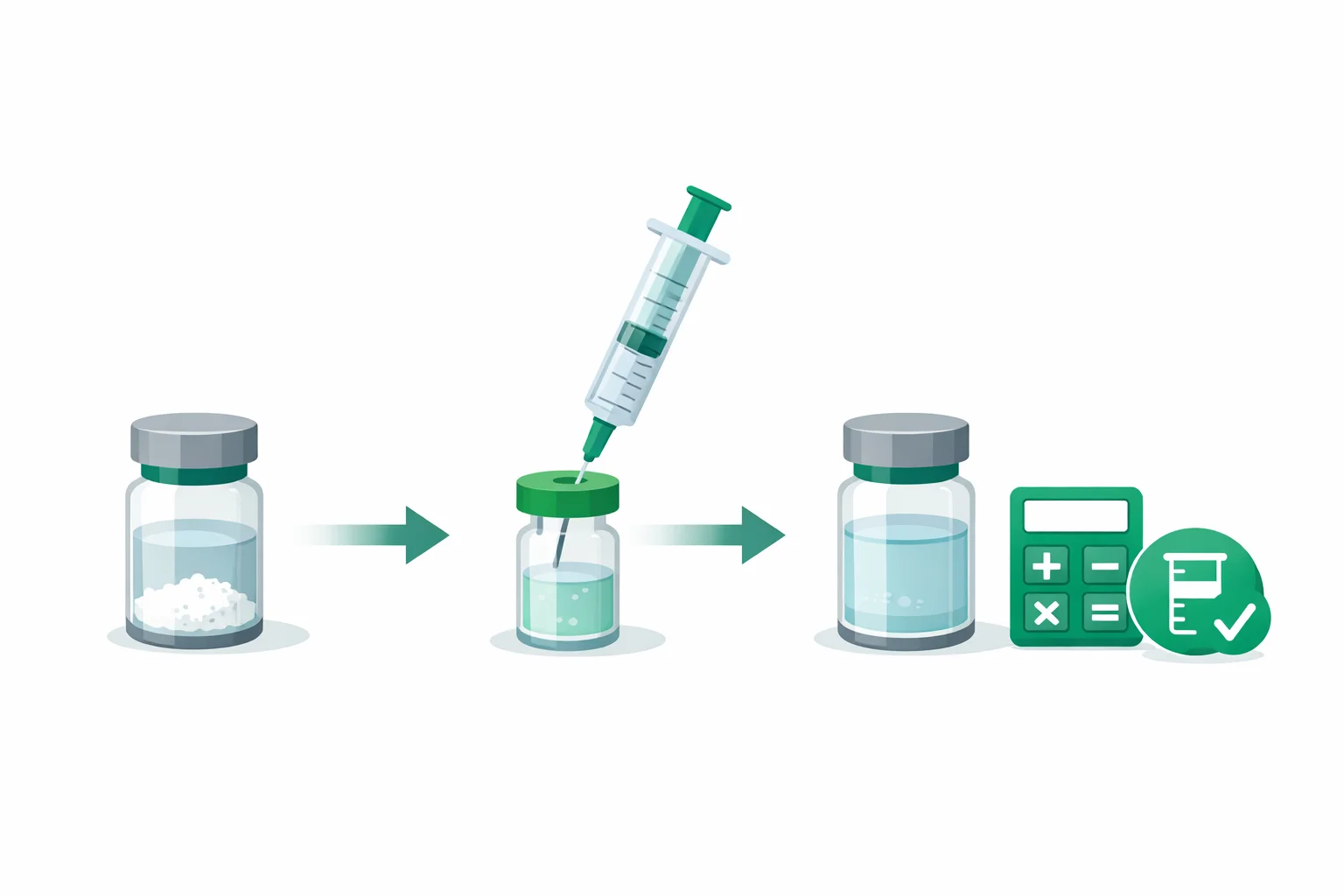
Table of Contents
A medication concentration calculator turns two numbers—drug mass and solution volume—into the mg/mL value that every downstream dose depends on. Medication errors related to concentration miscalculation account for roughly 1 in 5 IV preparation errors reported to the ISMP, and most stem from a single arithmetic misstep: dividing by diluent volume alone while ignoring powder displacement. This guide walks through the three scenarios the calculator handles—reconstitution, serial dilution, and direct mass-to-volume conversion—with the real math so you can verify any result on paper.
Concentration vs. Dose: The Distinction That Prevents Errors
Concentration is mass per unit volume—50 mg/mL means every milliliter contains 50 mg of active drug. Dose is the total mass a patient receives—500 mg, regardless of volume. Confusing the two is how a nurse can draw 10 mL from a vial labeled “1 g/20 mL” intending to give 500 mg and instead administer 500 mg only if the concentration really is 50 mg/mL. If the pharmacist reconstituted with 10 mL instead of 20, the concentration is 100 mg/mL and those 10 mL deliver 1,000 mg—double the intended dose.
Our mg/mL dose calculator takes a known concentration and converts a prescribed dose to a volume. This concentration calculator handles the step before that: establishing the mg/mL value in the first place. They're complementary. If you already know your vial's concentration and need a volume to draw, start with the dose calculator instead.
Reconstitution Math: Powder Displacement Changes Everything
When you add 10 mL of sterile water to a 500 mg powdered vial, the total volume is not always 10 mL. Lyophilized powder occupies space. The package insert for vancomycin 500 mg states a displacement volume of approximately 0.3 mL, making the true reconstituted volume 10.3 mL and the actual concentration 48.5 mg/mL rather than 50 mg/mL.
For a single 500 mg dose the difference is clinically trivial—about 3%. But scale that to a 2 g neonatal vancomycin preparation where the displacement is 1.2 mL across four vials, and the cumulative overshoot matters. The ASHP Guidelines on Compounding Sterile Preparations recommend accounting for displacement whenever the volume exceeds 5% of the diluent volume.
The formula with displacement:
If the package insert doesn't list displacement, reconstitute, let the powder fully dissolve, and measure the final volume in the syringe or graduated cylinder. Record it for future preparations.
The C1V1 = C2V2 Equation in Practice
Serial dilution uses the conservation-of-mass principle: the total milligrams of drug before dilution equals the total milligrams after. Algebraically: C1 × V1 = C2 × V2. Three of the four values must be known; the calculator solves for whichever one you leave blank.
Practical example: you have a 50 mg/mL stock of dexamethasone and need to prepare a 4 mg/mL solution for intratympanic injection. Target volume is 1 mL. How much stock?
V1 = (C2 × V2) ÷ C1
V1 = (4 mg/mL × 1 mL) ÷ 50 mg/mL = 0.08 mL
Diluent to add = 1 mL − 0.08 mL = 0.92 mL
Drawing 0.08 mL accurately requires a 1 mL syringe with 0.01 mL graduations. Using a 3 mL syringe here introduces rounding error up to 0.05 mL, which at 50 mg/mL swings the dose by 2.5 mg—a 62% concentration error. Syringe selection matters as much as arithmetic.
Worked Example: Vancomycin 1 g for a 25 mg/mL Infusion
Vancomycin is one of the most commonly reconstituted drugs in hospital pharmacies, and the concentration changes depending on whether it's for IV push, intermittent infusion, or continuous infusion. Once you know the total milligrams to give — from our vancomycin dosing calculator — here's a two-step approach for a 25 mg/mL infusion bag:
Step 1 — Reconstitute the vial
Add 20 mL of sterile water to 1 g (1,000 mg) vancomycin powder.
Displacement ≈ 0.6 mL → total volume = 20.6 mL
Vial concentration = 1,000 mg ÷ 20.6 mL = 48.5 mg/mL
Step 2 — Dilute into the infusion bag
Target: 25 mg/mL in a final volume of 40 mL.
V1 = (25 × 40) ÷ 48.5 = 20.6 mL from the reconstituted vial
Diluent (NS or D5W) = 40 − 20.6 = 19.4 mL
Notice that ignoring the 0.6 mL displacement in Step 1 would give a vial concentration of 50 mg/mL. Carrying that forward: V1 = (25 × 40) ÷ 50 = 20 mL. The final bag would then contain 20 × 48.5 = 970 mg in 39.4 mL = 24.6 mg/mL instead of the target 25 mg/mL. Clinically marginal for vancomycin, but for a narrow-therapeutic-index drug like phenytoin the same percentage error can flip a level from therapeutic to sub-therapeutic. For weight-based dosing needs, our mg/kg dosage calculator handles the patient-specific step after you've nailed down the concentration.
Concentration Calculator mg/mL: % w/v, Ratios, and Unit Conversions
Drug labels express concentration in at least four ways, and converting between them trips up even experienced pharmacists:
| Expression | Definition | Conversion to mg/mL | Example |
|---|---|---|---|
| mg/mL | milligrams per milliliter | — | Vancomycin 50 mg/mL |
| % w/v | grams per 100 mL | Multiply by 10 | Lidocaine 1% = 10 mg/mL |
| mcg/mL | micrograms per milliliter | Divide by 1,000 | Epinephrine 1,000 mcg/mL = 1 mg/mL |
| Ratio | 1 g in X mL | = 1,000 ÷ X | Epinephrine 1:1,000 = 1 mg/mL |
The most dangerous confusion is between ratio and percentage. Epinephrine 1:1,000 (1 mg/mL) is the IM auto-injector strength. Epinephrine 1:10,000 (0.1 mg/mL) is the IV cardiac arrest formulation. Administering the wrong one is a 10-fold concentration error. The calculator's % w/v output beside every mg/mL result gives you an instant cross-check against the product label.
When Simple Concentration Math Fails
The formula Mass ÷ Volume = Concentration assumes homogeneous distribution, a single active ingredient, and negligible solute volume contribution. Three real-world scenarios break these assumptions:
- Suspensions — Amoxicillin 400 mg/5 mL is a suspension, not a solution. Particles settle. If you skip the “shake well” step, the first doses drawn from the top will be below 400 mg/5 mL and the last doses will be above it. Concentration calculations assume uniform mixing. Our guide to how many mL is 5 mg in oral liquids covers the per-5-mL label formats these suspensions use.
- High-concentration albumin — Albumin 25% occupies volume itself. Mixing 50 mL of 25% albumin into 200 mL NS does not yield 250 mL of 5% albumin. The albumin displaces water, so the final volume is closer to 240 mL, and the true concentration is ~5.2%.
- Multi-electrolyte solutions — Adding potassium chloride 2 mEq/mL (20 mL) to a 1 L bag technically changes the bag volume to 1,020 mL, lowering the concentration of everything else by 2%. For drugs with therapeutic windows wider than 10%, this is noise. For phenytoin, it's not.
For pediatric dosing after you've determined the concentration, our pediatric dose calculator applies weight-based and BSA-based methods to translate mg/mL into an age-appropriate volume.
Verification Habits That Catch Errors Before the Patient
A study in the American Journal of Health-System Pharmacy found that independent double-checks caught 95% of concentration errors before administration when both the preparer and checker performed the calculation from scratch rather than simply confirming a pre-written answer. Three concrete habits:
- Reverse the math. If you calculated 50 mg/mL, multiply 50 × the total volume. Does it equal the drug mass you started with? If 50 × 10.3 = 515 mg and the vial holds 500 mg, something's off.
- Sanity-check the syringe. If the calculated draw volume is less than 0.05 mL or more than 60 mL for a single dose, pause. Sub-0.05 mL draws are unreliable outside a tuberculin syringe. Volumes above 60 mL typically signal a dilution step was skipped.
- Compare to the reference table. The reconstitution reference table in the calculator lists standard concentrations for commonly compounded drugs. If your result differs by more than 10% from the published value, re-check the diluent volume and vial strength before proceeding.
References
- Institute for Safe Medication Practices (ISMP). Guidelines for Safe Preparation of Compounded Sterile Preparations. 2023.
- ASHP Guidelines on Compounding Sterile Preparations. Am J Health-Syst Pharm. 2014;71:145–166.
- Vancomycin hydrochloride for injection, USP. Package insert. Pfizer, revised 2023.

Written by Marko Šinko
Co-Founder & Lead Developer
Computer scientist and developer working on calculator implementation, data handling, and accessible interfaces. His authorship describes development work, not independent medical review.
View full profileFrequently Asked Questions
How do you calculate medication concentration in mg/mL?
Divide the total drug mass in milligrams by the total solution volume in milliliters. For example, 500 mg of vancomycin in 10 mL of diluent gives 50 mg/mL. If there is powder displacement, add that volume to the diluent before dividing.
What is powder displacement volume and when does it matter?
Powder displacement is the additional volume the lyophilized drug powder occupies after dissolving. For vancomycin 500 mg it is about 0.3 mL. It matters most when the displacement exceeds 5% of the diluent volume or when preparing narrow-therapeutic-index drugs like phenytoin.
How do you convert % w/v to mg/mL?
Multiply the % w/v value by 10. A 1% w/v solution contains 1 g per 100 mL, which equals 10 mg/mL. Lidocaine 2% is 20 mg/mL, and normal saline 0.9% is 9 mg/mL.
What does C1V1 = C2V2 mean for drug dilution?
C1V1 = C2V2 is the dilution equation where C1 is the stock concentration, V1 is the stock volume, C2 is the final concentration, and V2 is the final total volume. It works because the total milligrams of drug stay constant before and after dilution.
How much diluent do I add to reconstitute vancomycin 1 g?
The standard reconstitution for vancomycin 1 g is 20 mL of sterile water, yielding approximately 50 mg/mL. The powder displacement is about 0.6 mL, so the true total volume is 20.6 mL and the actual concentration is 48.5 mg/mL.
Is epinephrine 1:1,000 the same as 1 mg/mL?
Yes. A 1:1,000 ratio means 1 g in 1,000 mL, which equals 1 mg/mL. The IV cardiac arrest formulation is 1:10,000, or 0.1 mg/mL. Confusing the two is a 10-fold concentration error.
Can I use this calculator for compounding IV admixtures?
The calculator handles the arithmetic for reconstitution and dilution steps. For IV admixtures you still need to verify compatibility, stability, and beyond-use dating per USP 797 standards. Always confirm with the drug package insert and your facility protocols.
Why does my calculated concentration differ from the vial label?
The most common reason is ignoring powder displacement. A 500 mg vial reconstituted with 10 mL has a true volume of about 10.3 mL (not 10 mL), giving 48.5 mg/mL instead of the expected 50 mg/mL. Using overfill volume from the diluent vial can also add 0.1 to 0.5 mL of extra volume.
Related Calculators

Adjusted Body Weight Calculator — Dosing Weight (ABW)
Compute ABW for dosing with our adjusted body weight calculator, alongside IBW reference. Essential for accurate medication dosing, especially in obesity.

Alcohol Calculator: Drinks, Calories, Cost and BAC
Use our alcohol calculator to track standard drinks, alcohol calories, cost, and estimated BAC. Plan sessions, see time to sober, and make informed choices.

Alcohol Units Calculator UK — Weekly Tracking & Limits
Free alcohol units calculator for UK weekly tracking. Convert drinks to units, check against the 14-unit guideline, and see calories, standard drinks, and more.

BAC Calculator — Estimate Blood Alcohol Level by Drink
Use our BAC calculator to estimate blood alcohol levels from drinks, ABV, weight, sex, and hours. See limit markers, impairment ranges, and time to sober.

Caffeine Calculator: Daily Intake Tracker & Safe Limits
Use our caffeine calculator to total daily milligrams from coffee, tea, energy drinks, and custom doses, then check the running total against the 400 mg limit.
Carboplatin AUC Calculator — Calvert Formula Dosing
Free carboplatin AUC calculator using the Calvert formula to find chemotherapy dose in mg from target AUC, GFR, and Cockcroft-Gault creatinine clearance.