Use the IV Drip Rate Calculator
Free IV drip rate calculator to find drops per minute (gtt/min) and mL/hr. Enter volume, infusion time, and drop factor for accurate flow rate results.
Calculation Mode
Enter hours and minutes for the total infusion duration.
Check your IV tubing package for the drop factor. Macro sets are 10, 15, or 20 gtt/mL. Micro (pediatric) sets are 60 gtt/mL.
Drip Rate Result
Drops per minute
41.7gtt/minFlow rate
125mL/hrVolume
1,000 mL
Infusion Time
8h 0m
Total Drops
20,000
Counting Guide
Drops per 15 seconds
10.4
Drops per 30 seconds
20.9
Count drops for 15 seconds and multiply by 4, or count for 30 seconds and multiply by 2 to verify the rate.
Quick Reference: Common IV Orders
| Order | mL/hr | gtt/min (20) |
|---|---|---|
| 1000 mL over 8 hr | 125 | 41.7 |
| 1000 mL over 10 hr | 100 | 33.3 |
| 1000 mL over 12 hr | 83.3 | 27.8 |
| 500 mL over 4 hr | 125 | 41.7 |
| 250 mL over 2 hr | 125 | 41.7 |
| 100 mL over 30 min | 200 | 66.7 |
| 50 mL over 30 min | 100 | 33.3 |
Values calculated using the 20 gtt/mL drop factor selected above. Your current order is highlighted.
Clinical Reminder
Always verify drip rates with an IV pump when available. Manual drip counting is a backup method. Patient condition, fluid viscosity, IV site height, and tubing kinks can alter actual flow rates. Double-check calculations independently before administration.
Your rating helps improve IV Drip Rate Calculator. We store only an anonymized vote (no personal data).
How to Use IV Drip Rate Calculator
Step 1: Choose calculation mode
Select Volume/Time for standard IV fluid orders or Weight-Based for mcg/kg/min critical-care drips.
Step 2: Enter volume and time
Type the total volume to infuse in mL and the infusion duration in hours and minutes. Use the fluid presets for common IV bags.
Step 3: Select your drop factor
Choose the drop factor printed on your IV tubing package: 10, 15, or 20 gtt/mL for macro sets, or 60 gtt/mL for micro (pediatric) sets.
Step 4: Read your drip rate
The calculator instantly shows gtt/min (drops per minute) and mL/hr. Use the counting guide to verify at the bedside.
Step 5: Copy or compare results
Copy the summary for documentation or check the quick-reference table to compare against common IV orders.
Key Features
- Calculates gtt/min and mL/hr from volume, time, and drop factor
- Supports 10, 15, 20, and 60 gtt/mL tubing types
- Weight-based mode for mcg/kg/min critical-care drips
- Drop counting guide for 15-second and 30-second verification
- Quick-reference table of common IV fluid orders
- Common IV fluid presets for fast entry
Understanding Results
Formula
Drops per minute: gtt/min = (Volume in mL × Drop factor in gtt/mL) ÷ Time in minutes. This tells you how many drops should fall through the drip chamber each minute.
Flow rate: mL/hr = Volume in mL ÷ Time in hours. This is the rate you program into an infusion pump.
Weight-based: mL/hr = (Dose in mcg/kg/min × Weight in kg × 60) ÷ (Concentration in mg/mL × 1,000). Used for critical-care medications ordered per kilogram per minute.
Reference Ranges & Interpretation
Typical adult maintenance IV fluid rates range from 75 to 125 mL/hr. Bolus infusions may run at 200–999 mL/hr for short durations. Rates above 150 mL/hr for prolonged periods require close monitoring for fluid overload, especially in cardiac or renal patients.
For macro tubing (20 gtt/mL), most routine orders produce drip rates between 20 and 60 gtt/min. Rates above 75 gtt/min with macro tubing are difficult to count accurately by hand—consider using an infusion pump or switching to micro tubing.
Assumptions & Limitations
This calculator assumes a constant flow rate and that the drop factor matches the tubing specification exactly. Actual flow rates can vary with IV bag height, tubing kinks, filter resistance, fluid viscosity (especially blood products), and patient movement. Gravity-fed drip rates are inherently less precise than pump-controlled delivery. Always use an infusion pump for high-alert medications, pediatric patients, and any rate requiring titration accuracy below ±10%.
IV Drip Rate Calculator: How to Calculate Drops per Minute and mL per Hour
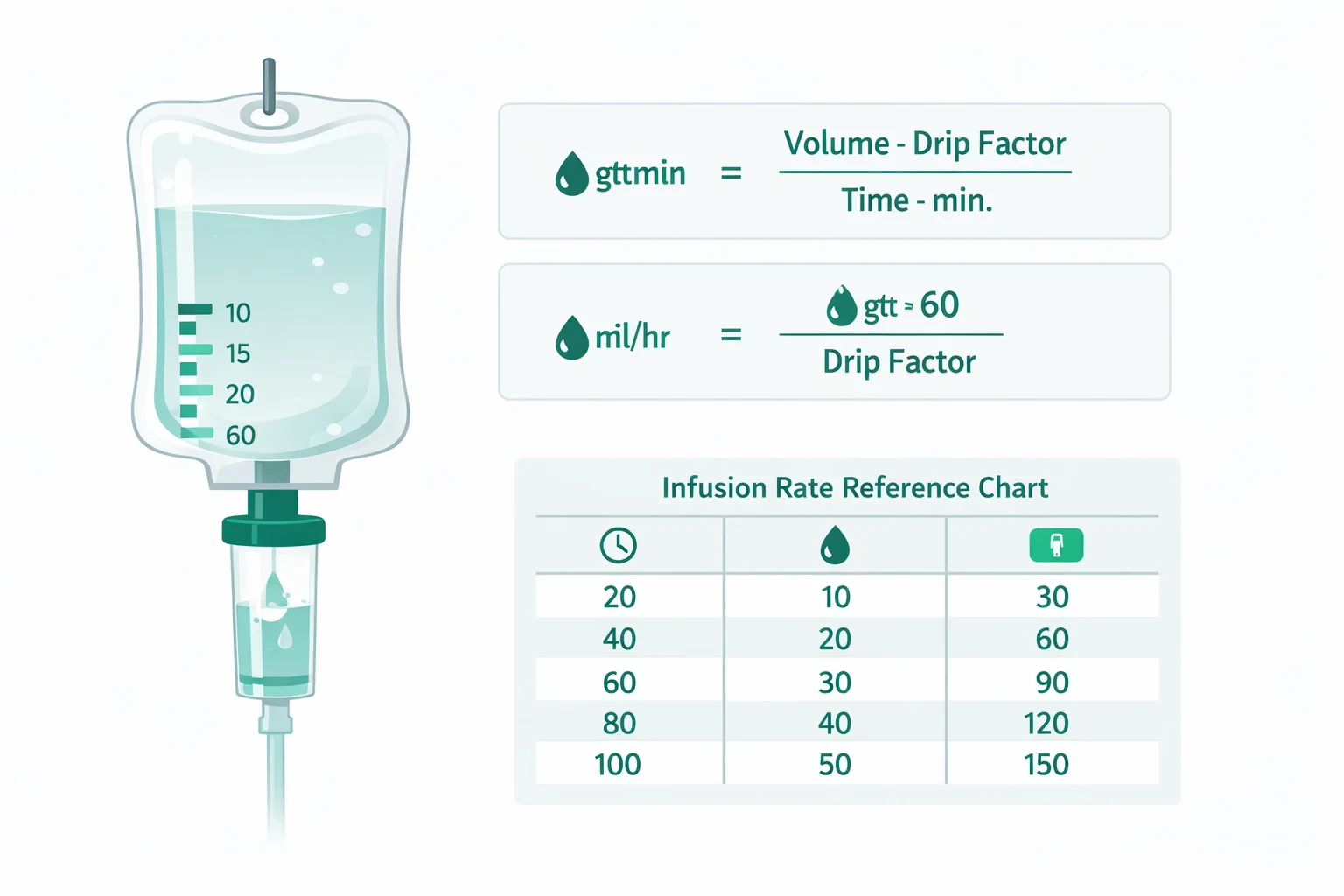
An IV drip rate calculator converts a fluid order—say, 1,000 mL of normal saline over 8 hours—into the exact drops per minute a nurse needs to count at the drip chamber. Miscounting by just 5 drops per minute on a macro set can deliver an extra 150 mL over an 8-hour shift, enough to worsen fluid overload in a cardiac patient. Getting the drip rate right matters more than most clinical tasks that seem routine, and this guide walks through every step from formula to bedside verification.
What is an IV drip rate?
The drip rate is the number of drops falling through the drip chamber of an IV administration set per minute (gtt/min). It controls how fast fluid enters the patient's vein. Two equivalent ways to express the same thing:
- gtt/min — drops per minute, used when manually counting drops at the drip chamber.
- mL/hr — milliliters per hour, the rate programmed into an infusion pump.
These two numbers describe the same flow. Converting between them requires one additional piece of information: the drop factor of the IV tubing, which tells you how many drops equal one milliliter. Without the correct drop factor, even a perfectly calculated mL/hr rate translates into the wrong drip count.
How to Calculate IV Drip Rate Step by Step
Two formulas do the heavy lifting. You only need basic arithmetic—no logarithms, no exponents.
Formula 1 — Drops per minute
gtt/min = (Volume in mL × Drop factor) ÷ Time in minutes
Formula 2 — Milliliters per hour
mL/hr = Volume in mL ÷ Time in hours
The three variables you need to know before calculating:
- Total volume — the amount of fluid ordered, typically 50 mL to 1,000 mL.
- Time — how long the infusion should run, converted to minutes for the gtt/min formula.
- Drop factor — printed on every IV tubing package. Macro sets are 10, 15, or 20 gtt/mL; micro sets are 60 gtt/mL.
Notice that the mL/hr formula doesn't use the drop factor at all. That's because infusion pumps measure volumetric flow directly—they don't count drops. When you're programming a pump, you only need volume and time.
Worked Example: 1,000 mL Normal Saline Over 8 Hours
A provider orders 1,000 mL of 0.9% NaCl to infuse over 8 hours. The facility stocks 20 gtt/mL macro tubing. Here's the math:
Step 1. Convert time to minutes: 8 hours × 60 = 480 minutes.
Step 2. Calculate mL/hr: 1,000 mL ÷ 8 hr = 125 mL/hr.
Step 3. Calculate gtt/min: (1,000 mL × 20 gtt/mL) ÷ 480 min = 20,000 ÷ 480 = 41.7 gtt/min.
Step 4. Round to the nearest whole drop: 42 gtt/min.
Verification. Count drops for 15 seconds. You should see about 10–11 drops (42 ÷ 4 = 10.5).
If the same order used 15 gtt/mL tubing instead, the drip rate drops to about 31 gtt/min. If it used 60 gtt/mL micro tubing, it climbs to 125 gtt/min—exactly equal to mL/hr, which is why micro drip sets are popular for precise titration. With micro tubing, gtt/min always equals mL/hr.
Drop Factors Explained: Macro vs. Micro Tubing
The drop factor (also called drip factor or calibration) is the number of drops the tubing delivers per milliliter of fluid. It's a physical characteristic of the drip chamber—larger orifice means larger drops, fewer per mL.
| Type | gtt/mL | Drop Size | Best For |
|---|---|---|---|
| Macro | 10 | Large (0.1 mL) | Blood, rapid bolus, trauma resuscitation |
| Macro | 15 | Medium (0.067 mL) | Standard IV fluids in many US hospitals |
| Macro | 20 | Medium (0.05 mL) | Standard IV fluids, widely used internationally |
| Micro | 60 | Tiny (0.017 mL) | Pediatrics, neonates, vasoactive drips, precise medications |
A handy shortcut with 60 gtt/mL micro tubing: gtt/min equals mL/hr exactly, so there's no formula to memorize. That's why pediatric and ICU nurses often prefer micro drip sets—mental math errors vanish when the two numbers are identical.
For blood products, most facilities mandate 10 gtt/mL sets because the larger orifice reduces hemolysis (damage to red blood cells from shear forces in a small drop). Always check your facility's policy; the packaging on every set lists the drop factor clearly.
Weight-Based Drip Calculations (mcg/kg/min)
Critical-care medications like dopamine, norepinephrine, and nitroglycerin are ordered in mcg/kg/min rather than mL/hr. The conversion adds two steps: you need the patient's weight and the drug's concentration in the bag.
Step 1. mg/min = (ordered dose in mcg/kg/min × weight in kg) ÷ 1,000
Step 2. mL/min = mg/min ÷ concentration (mg/mL)
Step 3. mL/hr = mL/min × 60
Step 4. gtt/min = mL/min × drop factor
Example: Dopamine is ordered at 5 mcg/kg/min for a 70 kg patient. The pharmacy sends a bag mixed at 1.6 mg/mL (400 mg in 250 mL D5W).
mg/min = (5 × 70) ÷ 1,000 = 0.35 mg/min
mL/min = 0.35 ÷ 1.6 = 0.219 mL/min
mL/hr = 0.219 × 60 = 13.1 mL/hr
gtt/min (60 gtt/mL micro) = 0.219 × 60 = 13.1 gtt/min
In practice, vasoactive drips nearly always run through an infusion pump, not by manual counting. The weight-based mode in our calculator is helpful for verifying pump settings or for pre-calculation during emergency setup. If you also need to figure out the concentration of a drug after mixing, our mg to mL dose calculator handles that conversion.
Common Drip Rate Mistakes and How to Avoid Them
Medication errors involving IV flow rates are among the most frequently reported in hospital safety databases. A 2018 analysis published in the Journal of Infusion Nursing found that 38% of IV-related errors involved incorrect rate calculations. Here are the pitfalls that trip up even experienced nurses:
- Using the wrong drop factor. Grabbing 15 gtt/mL tubing when the calculation assumed 20 gtt/mL changes the actual delivery by 33%. Always check the tubing package before calculating.
- Forgetting to convert hours to minutes. Plugging hours directly into the gtt/min formula inflates the rate by a factor of 60. A 42 gtt/min order becomes 2,500 gtt/min on paper—an obvious error, but mid-shift fatigue makes it less obvious than you'd think.
- Not recalculating after a rate change. If the provider adjusts the order from 125 mL/hr to 100 mL/hr and you only change the pump, the manual backup count no longer matches. Always update both.
- Ignoring positional flow changes. Gravity-fed IVs speed up or slow down when the patient raises or lowers their arm. Recount drops after repositioning, and elevate the IV pole at least 36 inches above the insertion site for consistent flow.
IV Pumps vs. Manual Drip Counting
Modern infusion pumps deliver fluid with ±5% accuracy and alarm when the line is occluded or the bag runs dry. So why learn manual drip calculations at all?
Three scenarios where manual counting saves the day: (1) pump shortage during a mass-casualty event, (2) field or transport settings without reliable power, and (3) facilities in low-resource regions where pumps aren't available for every bed. The Joint Commission still expects nurses to demonstrate competency in manual rate calculation regardless of whether the unit stocks pumps.
The standard bedside verification method: count drops falling through the drip chamber for 15 seconds and multiply by 4. If your count is off by more than ±2 from the target, adjust the roller clamp and recount. For rates below 10 gtt/min, count for the full 60 seconds for better accuracy.
Pediatric dosing and high-alert medications (such as heparin drips) always require an infusion pump—manual counting is too imprecise. For pediatric dosing questions, our pediatric dose calculator helps verify weight-based medication orders.
Quick-Reference Drip Rate Table
This table shows calculated gtt/min for the most commonly ordered IV fluid regimens, covering all four standard drop factors. Print it or save it to your phone for quick bedside reference.
| Order | mL/hr | 10 gtt | 15 gtt | 20 gtt | 60 gtt |
|---|---|---|---|---|---|
| 1,000 mL / 6 hr | 167 | 27.8 | 41.8 | 55.7 | 167 |
| 1,000 mL / 8 hr | 125 | 20.8 | 31.3 | 41.7 | 125 |
| 1,000 mL / 10 hr | 100 | 16.7 | 25 | 33.3 | 100 |
| 1,000 mL / 12 hr | 83 | 13.8 | 20.8 | 27.7 | 83 |
| 500 mL / 4 hr | 125 | 20.8 | 31.3 | 41.7 | 125 |
| 250 mL / 2 hr | 125 | 20.8 | 31.3 | 41.7 | 125 |
| 100 mL / 30 min | 200 | 33.3 | 50 | 66.7 | 200 |
| 50 mL / 30 min | 100 | 16.7 | 25 | 33.3 | 100 |
Notice how the 60 gtt/mL column always matches mL/hr. That's not a coincidence—it's why micro drip sets exist. At 60 drops per mL, the drops-per-minute calculation simplifies to mL/hr ÷ 1, which eliminates one source of arithmetic error entirely.
For medication dosing that involves weight-based calculations beyond IV rates, our dosage calculator covers the full dose-per-kg workflow with safety cap checks and schedule planning.
References

Written by Jurica Šinko
Founder & CEO
Entrepreneur and health information advocate, passionate about making health calculations accessible to everyone through intuitive digital tools.
View full profileFrequently Asked Questions
How do you calculate IV drip rate in drops per minute?
Multiply the total volume in mL by the drop factor (gtt/mL), then divide by the infusion time in minutes. For example, 1,000 mL with a 20 gtt/mL set over 480 minutes equals 41.7 gtt/min.
What is a drop factor on IV tubing?
The drop factor is the number of drops the tubing delivers per milliliter of fluid. Macro sets come in 10, 15, or 20 gtt/mL. Micro (pediatric) sets are 60 gtt/mL. The value is printed on every IV tubing package.
What is the difference between gtt/min and mL/hr?
Both describe the same flow rate in different units. gtt/min (drops per minute) is used for manual drip counting at the bedside. mL/hr (milliliters per hour) is the rate programmed into an infusion pump. Converting between them requires the drop factor.
Why does micro drip tubing make gtt/min equal to mL/hr?
Micro drip sets have a drop factor of 60 gtt/mL. Since there are 60 minutes in an hour, the formula simplifies so that drops per minute numerically equals milliliters per hour, eliminating a common source of calculation error.
How do I verify my IV drip rate at the bedside?
Count the drops falling through the drip chamber for 15 seconds and multiply by 4. If your count is more than 2 drops off from the calculated rate, adjust the roller clamp and recount. For rates below 10 gtt/min, count for the full 60 seconds.
What is a normal IV drip rate for saline?
A typical maintenance rate for adults is 125 mL/hr (1,000 mL over 8 hours). With 20 gtt/mL tubing, that equals about 42 gtt/min. Rates vary based on the clinical situation, patient size, and fluid balance goals.
How do you calculate weight-based IV drip rates?
Multiply the ordered dose (mcg/kg/min) by the patient weight in kg, divide by 1,000 to get mg/min, then divide by the drug concentration (mg/mL) to get mL/min. Multiply by 60 for mL/hr or by the drop factor for gtt/min.
When should I use a macro vs micro drip set?
Use macro sets (10, 15, or 20 gtt/mL) for standard IV fluids and blood products. Use micro drip sets (60 gtt/mL) for pediatric patients, slow infusion rates, and precise medication delivery where small volume differences matter.
Related Calculators

Adjusted Body Weight Calculator — Dosing Weight (ABW)
Compute ABW for dosing with our adjusted body weight calculator, alongside IBW reference. Essential for accurate medication dosing, especially in obesity.

Alcohol Calculator: Drinks, Calories, Cost and BAC
Use our alcohol calculator to track standard drinks, alcohol calories, cost, and estimated BAC. Plan sessions, see time to sober, and make informed choices.

Alcohol Units Calculator UK — Weekly Tracking & Limits
Free alcohol units calculator for UK weekly tracking. Convert drinks to units, check against the 14-unit guideline, and see calories, standard drinks, and more.

BAC Calculator — Estimate Blood Alcohol Level by Drink
Use our BAC calculator to estimate blood alcohol levels from drinks, ABV, weight, sex, and hours. See limit markers, impairment ranges, and time to sober.

Caffeine Calculator — Daily Intake & Half-Life Guide
Use our caffeine calculator to total your intake and see how half-life affects sleep. Track coffee, tea, energy drinks, and custom doses to build better habits.
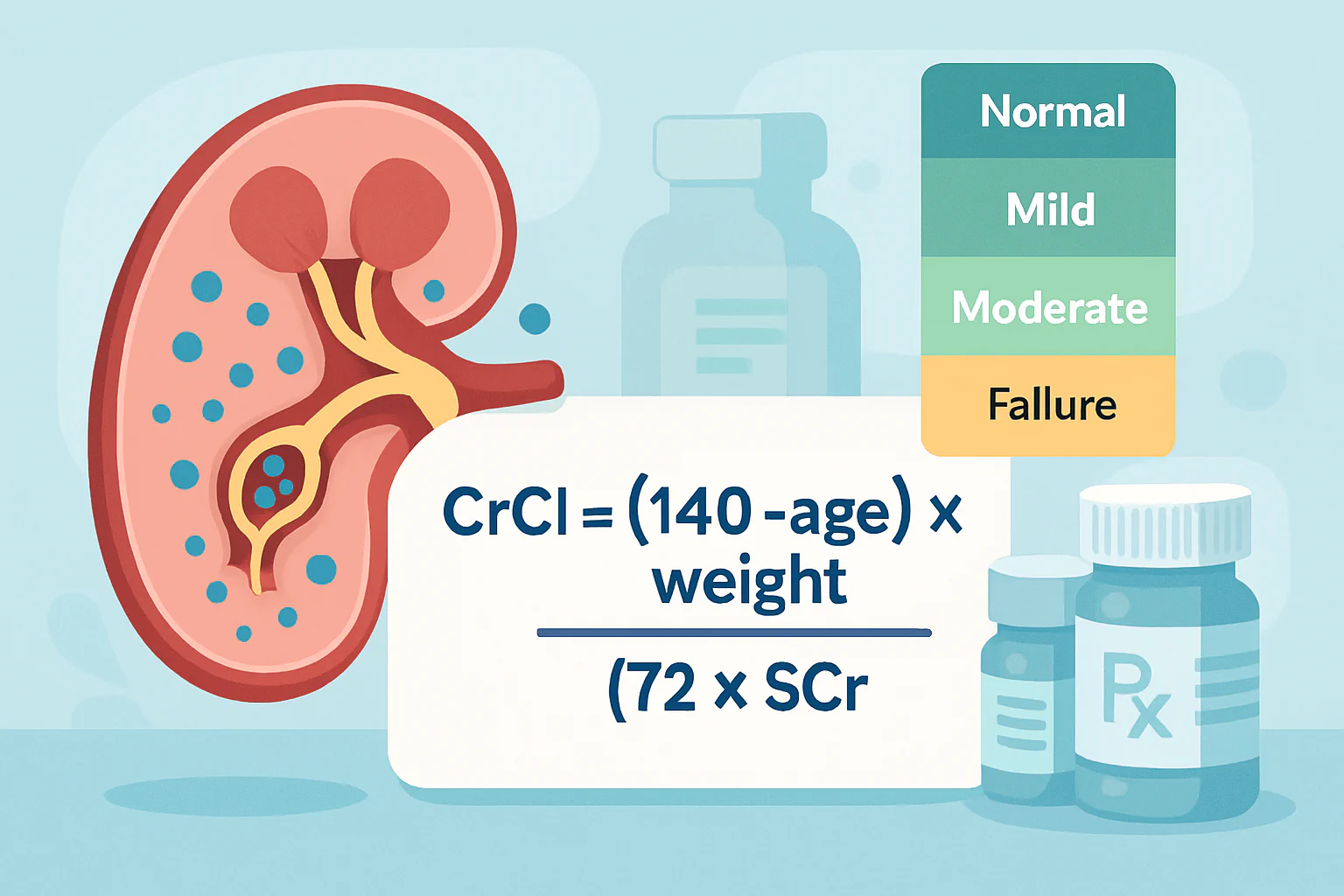
Cockcroft-Gault Calculator — Estimate Creatinine Clearance
Free Cockcroft-Gault calculator to estimate creatinine clearance (CrCl) using age, weight, serum creatinine, and sex for accurate renal dose adjustments.