Sum of all basal + bolus insulin over 24 hours. Check your pump or add up your daily injections.
Standard for most adults with type 1 diabetes (ADA-recognized heuristic).
See how many units your ratio suggests for a specific meal.
Most adults with type 1 fall here. One unit covers 5 to 15 grams of carbohydrate.
500 Rule vs 450 Rule Comparison
| Rule | ICR | Bolus for 60 g | Notes |
|---|---|---|---|
| 500 Rule | 1:12.5 | 4.8 u | Standard for MDI (injections) |
| 450 Rule | 1:11.3 | 5.3 u | Often used for pumps (CSII) |
Meal Bolus Reference (at ICR 1:12.5)
| Meal Type | Carbs | Bolus |
|---|---|---|
| Snack | 15 g | 1.2 u |
| Light meal | 30 g | 2.4 u |
| Standard meal | 45 g | 3.6 u |
| Standard meal | 60 g | 4.8 u |
| Large meal | 75 g | 6.0 u |
| Large meal | 90 g | 7.2 u |
How this ratio was calculated
This insulin-to-carb ratio calculator is for educational purposes only. It does not replace individualized medical advice. Do not change your insulin regimen without consulting your healthcare provider.
Your rating helps improve Insulin-to-Carb Ratio Calculator. We store only an anonymized vote (no personal data).
How to Use Insulin-to-Carb Ratio Calculator
Step 1: Enter total daily dose
Type your average total daily insulin (basal + bolus) into the TDD field. Use a 3-day or 7-day average for the most reliable estimate.
Step 2: Choose an estimation rule
Select the 500 Rule (standard for MDI), 450 Rule (common for pump users), or Custom if your clinician recommends a specific divisor.
Step 3: Select glucose units
Pick mg/dL or mmol/L so the ISF (correction factor) displays in your preferred unit.
Step 4: Preview a meal bolus
Enter grams of carbohydrate for a planned meal to see the estimated bolus dose based on your calculated I:C ratio.
Step 5: Review and refine
Compare the 500 vs 450 rule results in the comparison table and consult the meal dosing reference. Discuss the starting ratio with your diabetes care team before using it.
Key Features
- I:C ratio estimation via 500 and 450 rules
- Side-by-side rule comparison table
- Mealtime bolus preview for any carb amount
- ISF (correction factor) from the 1800 rule
- Meal dosing reference from 15 g to 90 g
- Custom divisor support for clinician-set values
Understanding Your Insulin-to-Carb Ratio Results
The 500 Rule and 450 Rule Formulas
Both rules estimate how many grams of carbohydrate one unit of rapid-acting insulin can cover. The formula is: ICR = Divisor ÷ TDD, where the divisor is 500 (standard for MDI) or 450 (sometimes used for pump therapy). TDD is the sum of all basal and bolus insulin over 24 hours. The companion correction factor (ISF) uses the 1800 rule: ISF = 1800 ÷ TDD in mg/dL, telling you how many mg/dL one unit is expected to lower blood glucose. For mmol/L, divide the result by 18.
Typical I:C Ratio Ranges
Most adults with type 1 diabetes have ratios between 1:5 and 1:15. Type 2 patients on mealtime insulin often land between 1:10 and 1:25 due to residual endogenous secretion. Children frequently need ratios below 1:5. The calculator classifies your result into sensitivity bands—very sensitive (< 5 g/u), typical (5–15), moderate (15–25), and highly sensitive (> 25). These ranges are approximate; post-meal glucose monitoring is the definitive guide.
Assumptions and Limitations
This calculator assumes your TDD is reasonably stable (use a 3–7 day average) and that you are using rapid-acting insulin analogs. It does not account for meal composition (high-fat or high-protein meals delay absorption), exercise timing, illness, steroid use, pregnancy, or automated pump algorithms. The 500 and 450 rules are starting-point heuristics recognized in diabetes education—not individualized prescriptions. Always validate your estimated ratio with structured post-meal testing and guidance from your endocrinologist or certified diabetes educator.
Complete Guide: Insulin-to-Carb Ratio Calculator
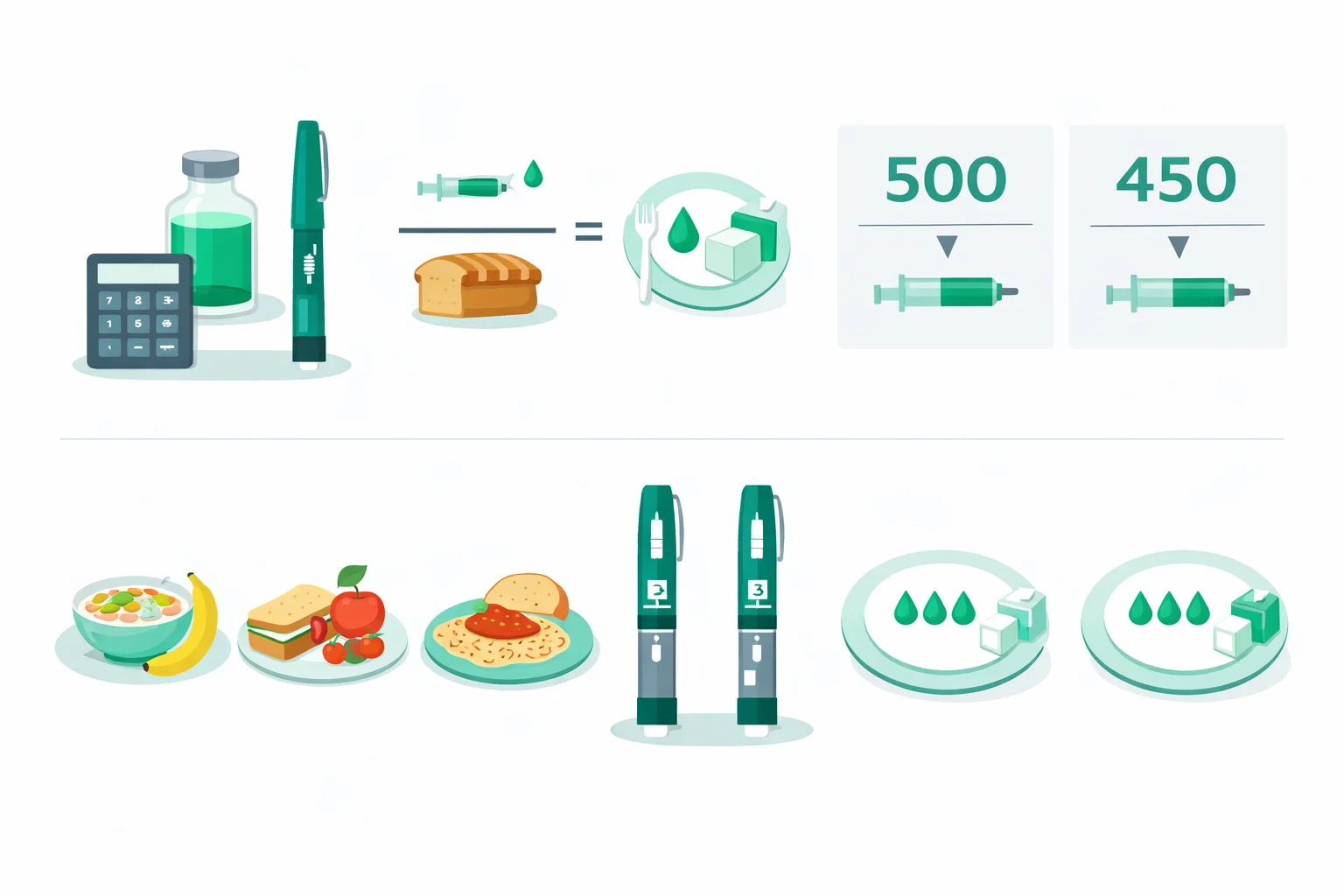
Table of Contents
- What the Insulin-to-Carb Ratio Actually Tells You
- The 500 Rule vs. the 450 Rule
- A 45-Unit TDD, 65-Gram Dinner: Worked Example
- Why Your I:C Ratio Shifts Throughout the Day
- Fine-Tuning Your Insulin-to-Carb Ratio With a 3-Day Log
- I:C Ratio vs. Correction Factor: Two Different Jobs
- Three Mistakes That Wreck Your Insulin-to-Carb Ratio Calculator Result
- References
An insulin to carb ratio calculator turns one number—your total daily dose—into the grams-per-unit ratio that drives every mealtime bolus. Research published in Diabetes Care shows that patients who dial in their I:C ratio within ±20% of their true value spend roughly 2.4 more hours per day in the 70–180 mg/dL target range compared to those who guess. That’s a meaningful swing, and it starts with a 10-second calculation you can do right now.
Whether you call it an I:C ratio calculator, insulin carb ratio calculator, or mealtime insulin calculator, the math is the same. This guide walks through exactly how the ratio is derived, where the two main estimation rules come from, and—most importantly—how to refine the number once real-world meals hit your bloodstream.
What the Insulin-to-Carb Ratio Actually Tells You
The I:C ratio expresses how many grams of carbohydrate one unit of rapid-acting insulin can “cover”—meaning keep blood glucose within your target range after eating. A ratio of 1:12 means 1 unit handles 12 g of carbs; a ratio of 1:8 means each unit handles only 8 g. The lower the number, the more insulin you need per gram.
Most adults with type 1 diabetes land between 1:5 and 1:15. Type 2 patients on mealtime insulin often run higher—1:10 to 1:25—because residual endogenous insulin still contributes. Children under 7 frequently need ratios below 1:5 due to growth-hormone-driven insulin resistance at meals.
Knowing your ratio turns carb counting from guesswork into arithmetic: meal bolus = grams of carbohydrate ÷ I:C ratio. For a 60 g pasta dinner with a 1:10 ratio, that’s 6 units. Any insulin dosing calculator, including ours, starts with this foundational ratio. If you also need to use a bolus insulin calculator that factors in correction and IOB, you’ll still begin with this same ratio.
The 500 Rule vs. the 450 Rule
Both rules do the same thing: divide a constant by your TDD. The difference is the constant.
The 500 rule (ICR = 500 ÷ TDD) originated in clinical diabetes education and appears in the ADA’s Practical Insulin curriculum. It assumes you’re on multiple daily injections (MDI) with a long-acting basal analog. For a TDD of 40 units: 500 ÷ 40 = 12.5, so 1 unit covers about 12.5 g.
The 450 rule (ICR = 450 ÷ TDD) is sometimes recommended for insulin pump users (CSII). Because pumps deliver only rapid-acting insulin—no long-acting analog—the effective TDD is slightly lower, and the smaller divisor compensates. Same TDD of 40: 450 ÷ 40 = 11.25, producing a slightly more aggressive ratio that gives roughly 0.3 units more per 60-g meal.
Neither rule is universally “right.” A 2021 retrospective in Journal of Diabetes Science and Technology found that the 500 rule predicted the final optimized ICR within ±30% for 72% of patients. The remaining 28% required adjustments of >30%, underscoring why these rules are starting points, not prescriptions.
A 45-Unit TDD, 65-Gram Dinner: Worked Example
Suppose your 3-day average TDD is 45 units (27 u basal + 18 u bolus). You’re sitting down to a meal with 65 g of counted carbohydrate.
| Step | Math | Result |
|---|---|---|
| Estimate ICR (500 rule) | 500 ÷ 45 | 1:11.1 |
| Calculate meal bolus | 65 g ÷ 11.1 | 5.9 units |
| Round for pen (0.5 u step) | 5.9 → 6.0 | 6.0 units |
| Estimate ISF (1800 rule) | 1800 ÷ 45 | 40 mg/dL per unit |
If pre-meal glucose is 185 mg/dL with a target of 110, you’d add a correction: (185 − 110) ÷ 40 = 1.9 units. Total dose: 6.0 + 1.9 = 7.9 → 8.0 units. A blood sugar calculator can help you track whether this dose lands you within the 70–180 range two hours later.
Why Your I:C Ratio Shifts Throughout the Day
Many people assume their ratio is a single fixed number. It isn’t. Cortisol peaks around 6–8 AM, driving the “dawn phenomenon”—morning insulin resistance that can push your breakfast ICR 20–40% lower than your dinner ICR. A person who uses 1:10 at breakfast might comfortably use 1:14 at lunch once cortisol recedes.
Exercise reshuffles things further. A 45-minute moderate run can improve insulin sensitivity for 24–48 hours, effectively raising your ratio by 1–3 grams per unit for the next meal or two. Conversely, high-intensity interval training can paradoxically raise glucose for 1–2 hours post-workout due to catecholamine release, temporarily lowering the effective ratio.
Pump users often program 2–4 time-segmented ICR values: aggressive at breakfast (e.g., 1:8), moderate at lunch (1:12), and more generous at dinner (1:14). If you’re on MDI, simply being aware that breakfast usually needs more insulin per gram helps you avoid the chronic post-breakfast spike that frustrates so many patients.
Fine-Tuning Your Insulin-to-Carb Ratio With a 3-Day Log
The calculator gives a starting ratio. Real life refines it. The gold-standard method among certified diabetes educators is the 3-day structured test:
- Eat a known carb load (e.g., 45 g from weighed pasta) for the same meal on 3 consecutive days.
- Dose using your calculated ICR. Start with no correction needed—begin eating only when pre-meal glucose is 80–120 mg/dL (4.4–6.7 mmol/L).
- Check glucose at 2 hours and 4 hours post-meal. Target: return to within 30 mg/dL (1.7 mmol/L) of your starting value by hour 4.
- If 2 out of 3 days overshoot by >40 mg/dL, reduce the ICR by 1–2 (e.g., 1:12 → 1:10). If glucose drops below starting value, increase by 1–2.
This iterative approach typically converges within 2–3 rounds (6–9 test meals). A CGM makes the process much faster—you can spot the 2-hour peak without fingersticks. The carb calculator can help you plan those controlled test meals with precise macronutrient counts.
I:C Ratio vs. Correction Factor: Two Different Jobs
Beginners often conflate these two numbers, but they serve distinct purposes. The I:C ratio answers “how much insulin for what I’m about to eat?” The ISF (insulin sensitivity factor, or correction factor) answers “how much insulin to bring elevated glucose back to target?”
| Parameter | I:C Ratio | ISF / Correction Factor |
|---|---|---|
| Purpose | Cover carbs in a meal | Lower elevated glucose toward target |
| Estimation rule | 500 (or 450) ÷ TDD | 1800 ÷ TDD (mg/dL) or 100 ÷ TDD (mmol/L) |
| Units | grams per unit | mg/dL or mmol/L per unit |
| Example (TDD = 40) | 500 ÷ 40 = 12.5 g/u | 1800 ÷ 40 = 45 mg/dL per unit |
Both numbers derive from TDD but change at different rates. After sustained exercise, your ISF might improve 20% while your ICR barely budges, because meal-related glucose excursions involve gut absorption kinetics that don’t track linearly with background sensitivity. Track them separately.
Three Mistakes That Wreck Your Insulin-to-Carb Ratio Calculator Result
1. Using yesterday’s TDD instead of a 3-day average. A single day’s TDD can swing ±15% depending on activity, missed meals, or a correction bolus for an unexpected high. If you ran 8 km on Tuesday and your TDD dropped to 34 units from a usual 42, basing your ICR on 34 would overestimate the ratio by nearly 25%. Always average at least 3 days, preferably 7.
2. Ignoring fat and protein in high-calorie meals. A 60-g carb pizza and a 60-g carb bowl of rice have the same carb content but wildly different glucose profiles. Fat delays gastric emptying by 30–90 minutes, causing a late glucose rise that a simple ICR-based bolus can’t fully catch. Extended/dual-wave boluses on pumps partially address this, but on MDI you may need to split the dose or add 15–30% extra.
3. Copying someone else’s ratio. Two people with identical TDDs of 50 units can have ICRs of 1:8 and 1:13 because of differences in insulin clearance, hepatic glucose output, and beta-cell reserve. The 500 rule is a population-level heuristic, not an individual prescription. Your 2-hour post-meal glucose log is the only authority.
References
- Davidson PC, et al. “Analysis of guidelines for basal-bolus insulin dosing: basal insulin, correction factor, and carbohydrate-to-insulin ratio.” Endocrine Practice. 2008;14(9):1095-1101. PubMed
- Walsh J, Roberts R. Pumping Insulin, 6th ed. Torrey Pines Press, 2012. Chapter 9: “Carb Boluses.”
- American Diabetes Association. “Standards of Medical Care in Diabetes—2024.” Diabetes Care. 2024;47(Suppl 1):S1-S321. ADA Standards

Written by Jurica Šinko
Founder & CEO
Entrepreneur and health information advocate, passionate about making health calculations accessible to everyone through intuitive digital tools.
View full profileFrequently Asked Questions
How do I calculate my insulin-to-carb ratio from TDD?
Divide 500 by your total daily dose. For example, a TDD of 50 units gives an ICR of 500 / 50 = 10, meaning 1 unit covers 10 grams of carbohydrate. Some clinicians use 450 instead of 500 for insulin pump users. Always verify the starting ratio with 2-hour post-meal glucose checks over several days.
What is a normal insulin-to-carb ratio for adults?
Most adults with type 1 diabetes have ratios between 1:5 and 1:15. Type 2 patients on mealtime insulin typically range from 1:10 to 1:25 because residual beta-cell function handles part of the carb load. Children often need more aggressive ratios below 1:5 due to growth-hormone-driven resistance.
Should I use the 500 rule or the 450 rule?
The 500 rule is the standard starting point for multiple daily injections (MDI). The 450 rule is sometimes preferred for continuous subcutaneous insulin infusion (pump therapy) because pumps use only rapid-acting insulin, which can slightly change the effective TDD calculation. Ask your endocrinologist which divisor fits your regimen.
Why does my insulin-to-carb ratio change at different meals?
Cortisol peaks in the early morning cause the dawn phenomenon, increasing insulin resistance at breakfast by 20-40% compared to dinner. Activity level, stress, and even the macronutrient mix of the meal shift the effective ratio. Many pump users program 2-4 different ICR values across the day for this reason.
What is the difference between I:C ratio and correction factor?
The I:C ratio determines how much insulin covers carbohydrates in a meal (estimated via 500 / TDD). The correction factor, or ISF, determines how much one unit lowers blood glucose (estimated via 1800 / TDD in mg/dL). Both derive from TDD but serve different purposes: one for food, one for bringing down elevated glucose.
Can a high-fat meal throw off my insulin-to-carb ratio?
Yes. Fat delays gastric emptying by 30 to 90 minutes, causing a late glucose rise 3-5 hours after eating. A 60-gram carb pizza and a 60-gram carb bowl of oatmeal produce very different glucose curves despite identical carb counts. For high-fat meals, some patients add 15-30% extra insulin or use a dual-wave bolus on a pump.
How often should I recalculate my insulin-to-carb ratio?
Recalculate whenever your TDD changes by more than 10-15%, which can happen with weight changes, new medications (like GLP-1 agonists), seasonal activity shifts, or illness. Many diabetes educators recommend a formal ratio review every 3-6 months as part of routine insulin management.
Is a TDD of 40 units considered high or low?
For type 1 adults, the average TDD is 0.5 to 0.8 units per kilogram of body weight per day. A 70-kg person at 0.6 u/kg has a TDD of 42 units, which is squarely average. Type 2 patients on full insulin therapy often use 1.0 to 2.0 u/kg, giving TDDs of 70-140 units. Context matters more than the raw number.
Related Calculators

Adjusted Body Weight Calculator — Dosing Weight (ABW)
Compute ABW for dosing with our adjusted body weight calculator, alongside IBW reference. Essential for accurate medication dosing, especially in obesity.

Alcohol Calculator: Drinks, Calories, Cost and BAC
Use our alcohol calculator to track standard drinks, alcohol calories, cost, and estimated BAC. Plan sessions, see time to sober, and make informed choices.

Alcohol Units Calculator UK — Weekly Tracking & Limits
Free alcohol units calculator for UK weekly tracking. Convert drinks to units, check against the 14-unit guideline, and see calories, standard drinks, and more.

BAC Calculator — Estimate Blood Alcohol Level by Drink
Use our BAC calculator to estimate blood alcohol levels from drinks, ABV, weight, sex, and hours. See limit markers, impairment ranges, and time to sober.

Caffeine Calculator — Daily Intake & Half-Life Guide
Use our caffeine calculator to total your intake and see how half-life affects sleep. Track coffee, tea, energy drinks, and custom doses to build better habits.
Cockcroft-Gault Calculator — Estimate Creatinine Clearance
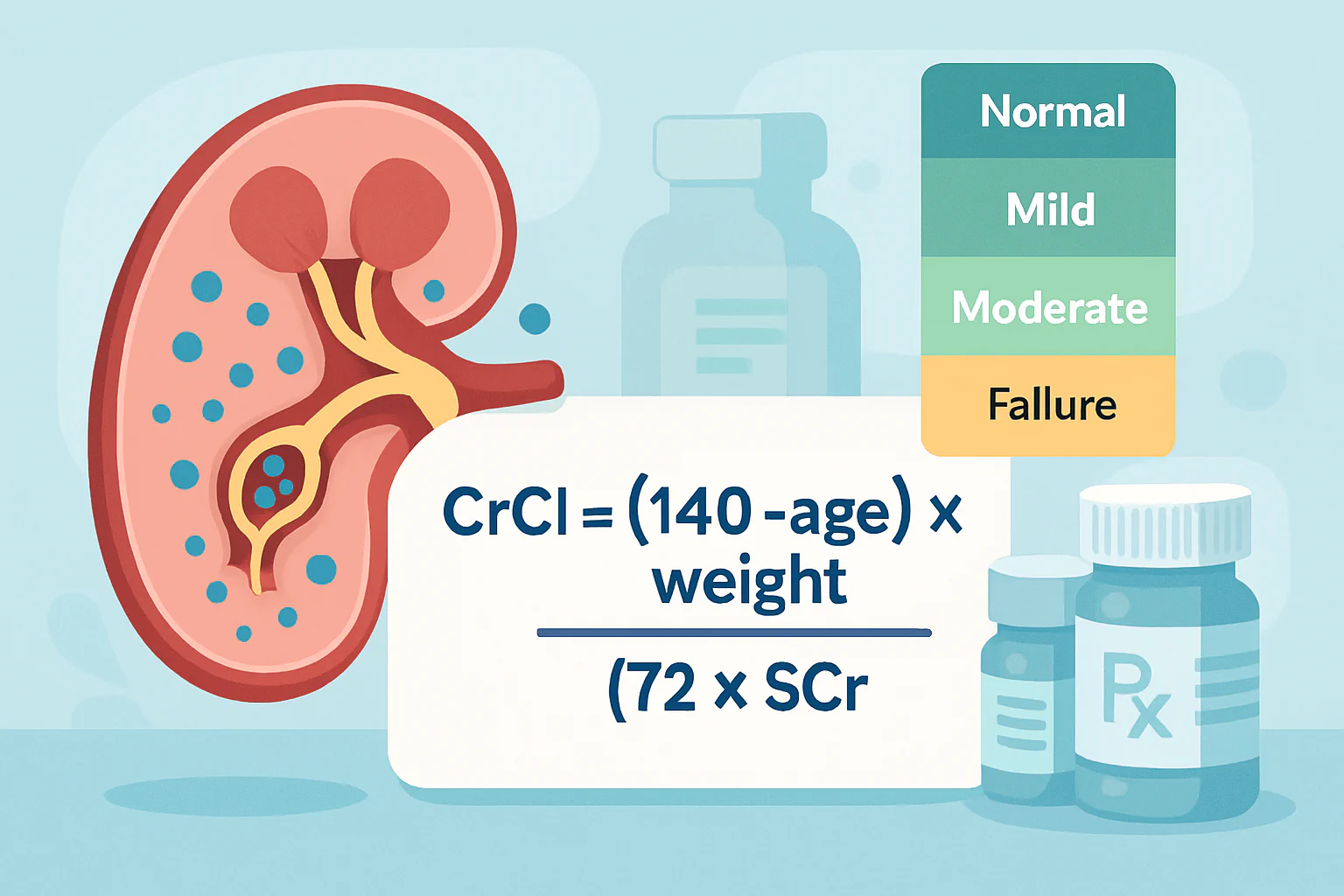
Free Cockcroft-Gault calculator to estimate creatinine clearance (CrCl) using age, weight, serum creatinine, and sex for accurate renal dose adjustments.