Use the Girls Growth Chart Calculator
Free girls growth chart calculator using CDC and WHO percentile data. Plot your daughter's height and weight by age from birth to 20 and get z-scores.
CDC growth charts — standing height for girls ages 2-20
Enter a height to plot your daughter on the chart
Girls Growth Milestones (50th Percentile)
| Age | Height | Weight |
|---|---|---|
| 2 yr | 85.7 cm | 12.0 kg |
| 3 yr | 94.1 cm | 13.9 kg |
| 4 yr | 101.6 cm | 15.9 kg |
| 5 yr | 108.4 cm | 17.9 kg |
| 6 yr | 114.6 cm | 20.0 kg |
| 7 yr | 120.6 cm | 22.4 kg |
| 8 yr | 126.4 cm | 25.0 kg |
| 9 yr | 132.2 cm | 28.1 kg |
| 10 yr | 138.3 cm | 31.9 kg |
| 11 yr | 144.8 cm | 36.9 kg |
| 12 yr | 151.5 cm | 41.5 kg |
| 13 yr | 157.2 cm | 45.8 kg |
| 14 yr | 160.5 cm | 49.4 kg |
| 15 yr | 162.4 cm | 52.0 kg |
| 16 yr | 163.1 cm | 53.5 kg |
| 17 yr | 163.3 cm | 54.4 kg |
| 18 yr | 163.3 cm | 55.1 kg |
| 19 yr | 163.3 cm | 55.7 kg |
| 20 yr | 163.3 cm | 56.2 kg |
Source: CDC/WHO growth reference data (approximate educational values). Highlighted row matches selected age.
Educational Estimate
This calculator uses CDC and WHO reference data approximations for educational purposes. Results are not a substitute for clinical growth charts plotted by your pediatrician. Growth patterns vary among individuals and should be evaluated alongside other health indicators. Consult your child's doctor for concerns about growth.
Your rating helps improve Girls Growth Chart Calculator. We store only an anonymized vote (no personal data).
How to Use Girls Growth Chart Calculator
Step 1: Select age range
Choose Infant (0-24 months) for babies using WHO standards, or Child (2-20 years) for older girls using CDC charts.
Step 2: Enter your daughter's age
Type or use the slider to enter your daughter's age in months (infant mode) or years (child mode).
Step 3: Enter height or length
Type your daughter's standing height or recumbent length in cm or inches. Toggle the unit selector if needed.
Step 4: Enter weight
Type your daughter's weight in kg or lb. You can enter height only, weight only, or both.
Step 5: Read percentile results
View height and weight percentiles, z-scores, and color-coded classification badges showing where your daughter falls on the growth curve.
Step 6: Explore the growth chart
Switch between Height-for-Age and Weight-for-Age charts to see your daughter's position on the percentile curves. Export the chart as PNG or copy a summary.
Key Features
- Height-for-age and weight-for-age percentiles for girls 0-20 years
- WHO growth standards for infants (0-24 months) and CDC charts for children (2-20 years)
- Interactive SVG growth curve with exportable PNG chart
- Z-score calculation with color-coded percentile classification
- Metric and imperial unit support (cm/in, kg/lb)
- Complete milestone reference table with 50th percentile values by age
Understanding Results
Formula
Growth percentiles use the z-score method. For height: z = (measurement − M) / SD, where M is the age-specific median and SD is the standard deviation from the CDC or WHO reference tables. For weight, the LMS method accounts for skewness: z = [(weight/M)L − 1] / (L × S).
The z-score converts to a percentile via the standard normal distribution. A z-score of 0 equals the 50th percentile. A z-score of +1.0 equals approximately the 84th percentile. A z-score of −2.0 equals approximately the 2nd percentile.
Reference Ranges & Interpretation
Percentile classifications used in this calculator:
- Below 3rd percentile: Below typical — evaluate for growth disorder if not tracking consistently
- 3rd–10th percentile: Below average — may be normal, especially with family history of shorter stature
- 10th–25th percentile: Low-normal — within the expected range
- 25th–75th percentile: Normal range — the middle 50% of girls
- 75th–90th percentile: High-normal — within the expected range
- 90th–97th percentile: Above average — may reflect genetic tall stature or advanced maturation
- Above 97th percentile: Above typical — consider evaluation if unexpected
Assumptions & Limitations
This calculator uses smoothed CDC/WHO reference approximations for educational purposes. Results may differ slightly from clinical charts that use precise LMS tables with monthly or semi-annual data points. The reference population is primarily from the United States (CDC) or six international countries (WHO) and may not perfectly represent all ethnic backgrounds. Always compare results with your pediatrician's office growth chart for clinical decisions. Growth assessment should consider family height, pubertal stage, and overall health status — not percentile alone.
Complete Guide: Girls Growth Chart Calculator
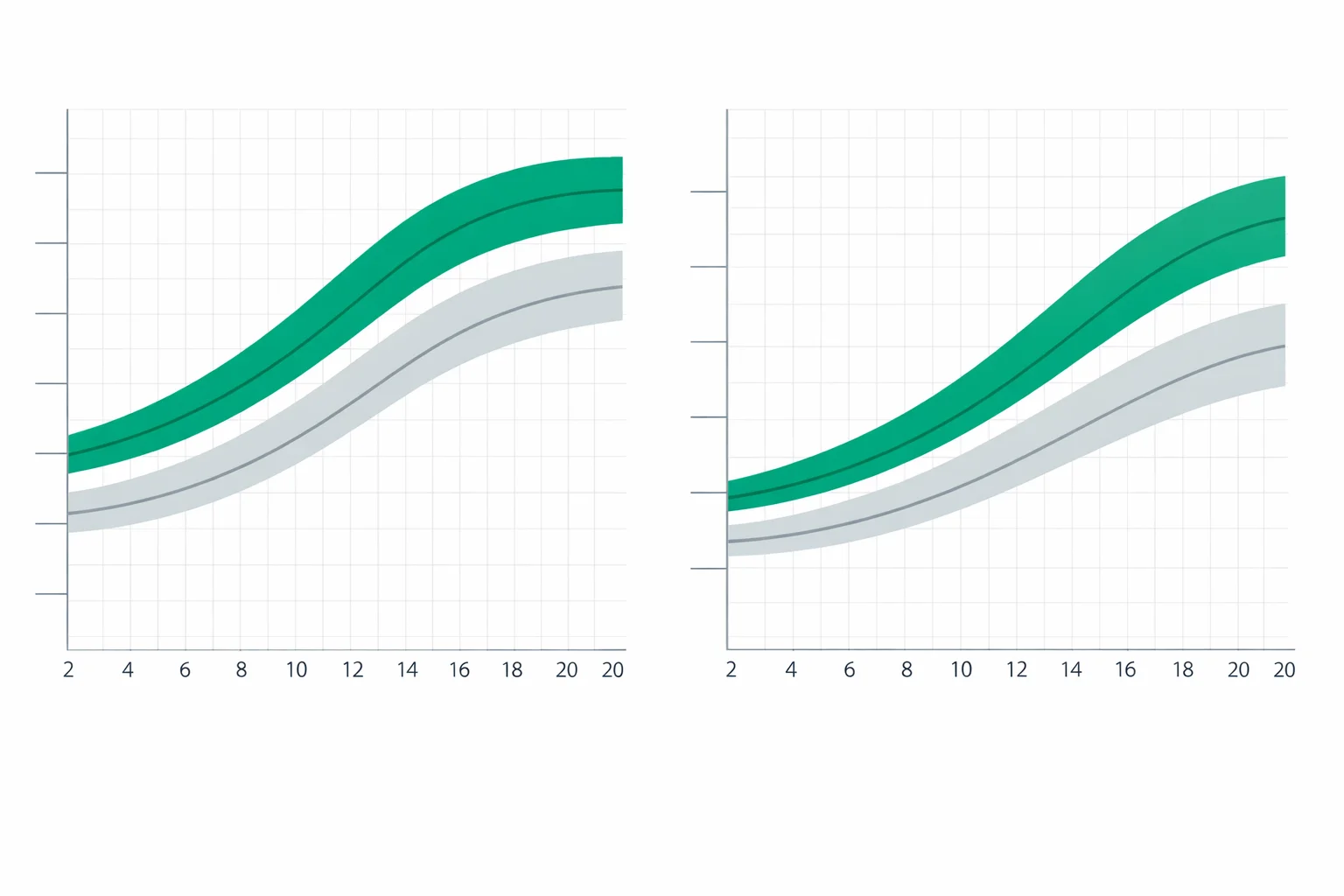
Table of Contents
What Is a Girls Growth Chart Calculator?
A girls growth chart calculator compares your daughter's height and weight to CDC or WHO reference data, telling you exactly where she falls among girls her age. If your 10-year-old daughter measures 138.3 cm (54.4 in), this tool shows she is at the 50th percentile — taller than half of girls that age and shorter than the other half.
Pediatricians have tracked child growth on percentile charts since the 1970s, and parents can now access the same data at home. Whether you need a girls height percentile calculator or want to check your daughter's girls weight percentile, this tool handles both with one set of inputs. The critical insight is that growth charts track trends, not single snapshots. A girl steadily tracking the 20th percentile is growing normally, while a girl who drops from the 70th to the 15th percentile over six months may need evaluation — even though the 15th percentile is within the “normal” range.
How Growth Percentiles Are Calculated
Growth percentiles use the LMS (Lambda-Mu-Sigma) statistical method. For each age and sex, three parameters are defined: L (skewness), M (median), and S (coefficient of variation). The z-score formula is:
When L is close to 1 (as with height), this simplifies to z = (measurement − M) / SD. The z-score maps to a percentile via the standard normal distribution: z = 0 equals the 50th percentile, +1.645 equals the 95th, and −1.645 equals the 5th.
Worked example: A 10-year-old girl measures 144.2 cm. The CDC median (M) for 10-year-old girls is 138.3 cm with an SD of 5.4 cm. Her z-score is (144.2 − 138.3) / 5.4 = +1.09, placing her at approximately the 86th percentile. That means she is taller than 86% of 10-year-old girls in the reference population.
CDC vs. WHO Growth Charts for Girls
Two major growth references exist, and they cover different age ranges. Knowing which one applies to your daughter matters because the same measurement can produce different percentiles on each chart.
| Feature | WHO (0–24 months) | CDC (2–20 years) |
|---|---|---|
| Population | International (6 countries) | U.S. national survey data |
| Standard type | Prescriptive (how children should grow) | Descriptive (how children did grow) |
| Feeding | Breastfed infants | Mixed feeding |
| Measurement | Recumbent length | Standing height |
| Recommended by | AAP for ages 0–24 mo | AAP for ages 2–20 y |
The American Academy of Pediatrics recommends WHO charts for children under 2 and CDC charts for ages 2–20. Our calculator automatically switches between these references based on the age range you select. For a combined view of both sexes, try our Growth Chart Calculator.
Average Girl Height by Age: Growth Milestones
Girls grow fastest during infancy and puberty. A newborn girl averages 49.1 cm (19.3 in) and roughly doubles in length by age 4, reaching about 101.6 cm (40.0 in). Growth then slows to a steady 5–7 cm per year until the pubertal growth spurt, which begins around age 9–11 in girls — roughly 2 years earlier than in boys.
| Age | 50th Pct (cm) | 50th Pct (in) | Annual Gain |
|---|---|---|---|
| Birth | 49.1 | 19.3 | — |
| 1 year | 74.0 | 29.1 | ~24.9 cm |
| 2 years | 85.7 | 33.7 | ~11.7 cm |
| 5 years | 108.4 | 42.7 | ~6.8 cm |
| 10 years | 138.3 | 54.4 | ~5.9 cm |
| 13 years | 157.2 | 61.9 | ~6.3 cm |
| 16 years | 163.1 | 64.2 | ~0.3 cm |
By age 16, the median girl reaches 163.1 cm (5 ft 4.2 in) and has essentially stopped growing. Most girls reach their adult height between ages 14 and 16, with less than 1 cm added after age 16. This is 2–3 years earlier than boys, which is why the sex-specific chart matters. To compare your daughter's height to peers at any age in more detail, our Height Percentile Calculator provides extended percentile rankings.
Average Weight-for-Age in Girls
Weight gain in girls follows a different trajectory than height. Newborn girls average 3.2 kg (7.1 lb) and typically double their birth weight by 4–5 months and triple it by 12 months. After infancy, weight gain steadily increases through puberty, when girls add an average of 4–6 kg per year between ages 10 and 14.
| Age | 50th Pct (kg) | 50th Pct (lb) | Annual Gain |
|---|---|---|---|
| Birth | 3.2 | 7.1 | — |
| 6 months | 7.3 | 16.1 | — |
| 1 year | 8.9 | 19.6 | — |
| 2 years | 12.0 | 26.5 | ~3.1 kg |
| 5 years | 17.9 | 39.5 | ~2.0 kg |
| 10 years | 31.9 | 70.3 | ~2.8 kg |
| 15 years | 53.5 | 117.9 | ~4.3 kg |
| 20 years | 56.2 | 123.9 | ~0.5 kg |
Weight-for-age percentiles become less meaningful after about age 10 because pubertal timing varies widely among girls. An 11-year-old at the 85th percentile for weight may simply be an early developer. For older girls, BMI-for-age from our Child BMI Percentile Calculator is often more clinically useful than weight-for-age alone, because it adjusts for the height-weight relationship.
The Puberty Growth Spurt in Girls
Girls experience peak height velocity (PHV) around age 11–12, growing an average of 7–8 cm (3 inches) per year at the peak. This occurs about 2 years earlier than in boys, which is why girls are often temporarily taller than their male classmates in 5th and 6th grade. The typical sequence:
- Tanner Stage 2 (ages 8–13): Breast budding begins. Growth accelerates to 6–7 cm/year. This is usually the first visible sign of puberty in girls.
- Tanner Stage 3 (ages 10–14): Peak height velocity. Girls may grow 7–8 cm/year. Body composition shifts with increased fat deposition at hips and thighs.
- Menarche (first period): Typically occurs 6–12 months after PHV, around ages 12–13. After menarche, girls typically grow only 5–7 cm more in total height.
- Tanner Stage 4–5 (ages 12–16): Growth decelerates rapidly. Growth plates begin closing. Most girls reach adult height within 2 years of menarche.
Early or late puberty is common and does not necessarily indicate a problem. A girl who starts breast development at 8 is within normal range, as is one who starts at 12. However, if puberty begins before age 8 (precocious puberty) or hasn't started by age 13, a pediatric endocrinology evaluation is recommended.
Common Mistakes When Reading Growth Charts
Parents and even some healthcare providers misinterpret growth charts. Avoiding these four mistakes leads to better decisions:
- Treating a single percentile as a diagnosis. The 10th percentile is not “bad” and the 90th is not “good.” By definition, 10% of healthy girls fall below the 10th percentile. What matters is the trend over time, not any single reading.
- Using a boys' chart for a girl. Girls and boys have different growth trajectories — especially after age 10 when girls hit their growth spurt 2 years earlier. A 12-year-old girl at the 50th percentile on a boys' chart would appear significantly shorter than she actually is relative to peers.
- Mixing up length and height. Recumbent length (lying down, for infants) is about 0.7 cm longer than standing height. Switching from length to height at age 2 can create a false “dip” on the chart if the transition isn't noted.
- Ignoring measurement technique. A 1 cm measurement error at age 5 shifts the percentile by about 5–8 points. Measure without shoes, heels against the wall, and at the same time of day — children are 0.5–1 cm taller in the morning due to spinal disc hydration.
When to Talk to Your Pediatrician
Most growth variations are normal, but certain patterns warrant a medical evaluation:
- Crossing two or more major percentile lines (e.g., dropping from the 75th to the 25th) over 6–12 months
- Height below the 3rd percentile or above the 97th with no family history of short or tall stature
- Growth velocity below 4 cm/year between ages 4 and the onset of puberty
- Height and weight percentiles dramatically different (e.g., height at the 80th but weight at the 10th), which may suggest a nutritional or endocrine issue
- No signs of puberty by age 13 or puberty signs before age 8 in girls
- Menarche before age 10 or absence of periods by age 15
Your pediatrician can order bone-age X-rays, check growth hormone levels, or screen thyroid function if growth patterns are concerning. For tracking your daughter's height percentile over time with more detail, our Child Height Percentile Calculator offers history tracking and growth velocity estimates.
References
- CDC Growth Charts for the United States. National Center for Health Statistics. cdc.gov/growthcharts
- WHO Child Growth Standards: Length/height-for-age, weight-for-age, weight-for-length, weight-for-height and body mass index-for-age. World Health Organization, 2006. who.int/tools/child-growth-standards
- Kuczmarski RJ, et al. 2000 CDC Growth Charts for the United States: Methods and Development. Vital and Health Statistics, Series 11, No. 246. 2002.
- Tanner JM. Growth at Adolescence. 2nd ed. Oxford: Blackwell Scientific Publications; 1962.

Written by Jurica Šinko
Founder & CEO
Entrepreneur and health information advocate, passionate about making health calculations accessible to everyone through intuitive digital tools.
View full profileFrequently Asked Questions
What is a normal height for a 10-year-old girl?
The CDC 50th percentile height for a 10-year-old girl is 138.3 cm (54.4 inches). The normal range spans from about 127 cm (5th percentile) to 150 cm (95th percentile). Any height within the 5th to 95th percentile range is considered normal as long as the child is tracking consistently along her own growth curve.
How do I know if my daughter is growing normally?
Consistent tracking along the same percentile curve over time is the best indicator of normal growth. A girl who stays near the 25th percentile throughout childhood is growing normally. Warning signs include crossing two or more major percentile lines within 6-12 months, or growth velocity below 4 cm per year between ages 4 and puberty onset.
What is the difference between WHO and CDC growth charts for girls?
WHO charts cover ages 0-24 months and describe how breastfed children should grow based on international data from six countries. CDC charts cover ages 2-20 years and describe how U.S. children actually grew based on national survey data. The American Academy of Pediatrics recommends WHO charts for infants and CDC charts for children over 2.
When do girls stop growing in height?
Most girls reach their adult height between ages 14 and 16. The pubertal growth spurt typically peaks around age 11-12 with 7-8 cm of growth per year. After menarche (first period), girls usually grow only 5-7 cm more total. Girls who start puberty later may continue growing later, but nearly all growth is complete by age 16.
What does the 50th percentile mean on a girls growth chart?
The 50th percentile is the median, meaning exactly half of girls that age are taller (or heavier) and half are shorter (or lighter). It does not mean average or ideal. A healthy girl can track anywhere from the 5th to the 95th percentile. The percentile line a child follows matters more than the specific number.
Should I worry if my daughter is below the 5th percentile for height?
Not necessarily. About 5% of healthy girls naturally fall below the 5th percentile, often due to familial short stature or constitutional growth delay. Concern is warranted if the child has crossed downward across percentile lines, if growth velocity is below 4 cm per year, or if there is no family history of short stature. A pediatric evaluation with bone-age X-ray can help clarify.
How much weight should a girl gain each year?
Weight gain varies by age. Girls typically gain about 2-3 kg per year from ages 2-10, then 4-6 kg per year during puberty (ages 10-14). After puberty, weight gain slows to less than 1 kg per year. A newborn girl usually doubles birth weight by 4-5 months and triples it by 12 months.
Related Calculators
Baby Food Calculator — Solids Introduction & Portions
Estimate age‑appropriate portions and plan meal frequency with the baby food calculator. Log new foods, track allergens, and export a simple weekly menu.
Infant Growth Chart Calculator
Track weight, length, and head size with the infant growth chart calculator using WHO percentiles. See trends on clear charts and compare age-based progress.
Baby Length Percentile Calculator — WHO Reference Guide
Check WHO length‑for‑age percentiles with the baby length percentile calculator. Input age, sex, and length to see your percentile and track growth trends.
Baby Milestone Calculator — Track Skills by Age & Stage
Use our baby milestone calculator to see what’s typical by corrected age. Explore early, typical, and later windows for motor, language, and cognitive skills.
Baby Weight Percentile Calculator — WHO Growth Guide
Use the baby weight percentile calculator to see WHO weight‑for‑age percentiles. Enter age, sex, and weight to get your percentile, z‑score, and tips.
Boys Growth Chart Calculator: Height & Weight Percentiles
Free boys growth chart calculator using official CDC and WHO percentile data. Plot your son's height and weight by age from birth to 20 and get z-scores.