Use the Cockcroft-Gault Calculator
Free Cockcroft-Gault calculator to estimate creatinine clearance using age, weight, serum creatinine, and sex for accurate renal dose adjustments.
Female sex applies a 0.85 correction factor.
Adults 18–120. The formula uses (140 − age).
Use actual body weight. For obese patients, consider adjusted body weight separately.
Normal range: 0.7–1.3 mg/dL (62–115 µmol/L) for adults.
Estimated Creatinine Clearance
Weight used
70 kg
Serum Cr
1.2 mg/dL
Dose adjustment
Mild or no adjustment
Formula Breakdown
CrCl = [(140 − 65) × 70 kg] / (72 × 1.2)
CrCl = 5250 / 86.4
CrCl = 60.8 mL/min
Common Drug Dosing by CrCl
Reference only. Always verify with current prescribing information.
| Drug | CrCl-Based Dosing |
|---|---|
| Metformin | < 30: Contraindicated | 30–45: Caution | > 45: Standard dose |
| Enoxaparin (treatment) | < 30: Reduce to 1 mg/kg once daily | ≥ 30: 1 mg/kg twice daily |
| Gabapentin | < 15: 100–300 mg/day | 15–29: 200–700 mg/day | 30–59: 300–1200 mg/day | ≥ 60: Up to 3600 mg/day |
| Vancomycin | Trough-guided; CrCl guides initial interval: < 30: q24–48h | 30–50: q12–24h | > 50: q8–12h |
| Ciprofloxacin | < 30: Reduce dose by 50% | ≥ 30: Standard dose |
| Dabigatran | < 30: Avoid | 30–50: 75 mg twice daily | > 50: 150 mg twice daily |
Kidney Function Stages by CrCl
Clinical disclaimer
The Cockcroft-Gault equation estimates creatinine clearance for drug dosing guidance. It is not a substitute for measured creatinine clearance or eGFR for CKD staging. Results may be less accurate in extremes of body size, unstable renal function, pregnancy, or low muscle mass. Always confirm with current laboratory values and clinical judgment.
Your rating helps improve Cockcroft-Gault Calculator. We store only an anonymized vote (no personal data).
How to Use Cockcroft-Gault Calculator
Step 1: Select biological sex
Choose Male or Female. The equation applies a 0.85 correction factor for female patients to account for lower creatinine production.
Step 2: Enter age in years
Type the patient age (18-120 years). The formula uses (140 minus age), so older patients will have lower estimated clearance.
Step 3: Enter body weight
Input current body weight in kg or lb using the unit toggle. The calculator converts pounds to kilograms automatically.
Step 4: Enter serum creatinine
Type the most recent serum creatinine value. Toggle between mg/dL and µmol/L units as needed — the calculator handles the conversion.
Step 5: Review your CrCl result
Your estimated creatinine clearance appears instantly in mL/min with a visual kidney function stage, formula breakdown, and drug dosing reference table.
Key Features
- Instant CrCl estimation using the original Cockcroft-Gault equation
- Step-by-step formula breakdown with your values
- Drug dosing reference table for common renally cleared medications
- Automatic unit conversion between mg/dL and µmol/L
- Visual kidney function staging with color-coded results
- Copy-to-clipboard summary for clinical documentation
Understanding Your Cockcroft-Gault Results
The Cockcroft-Gault Formula
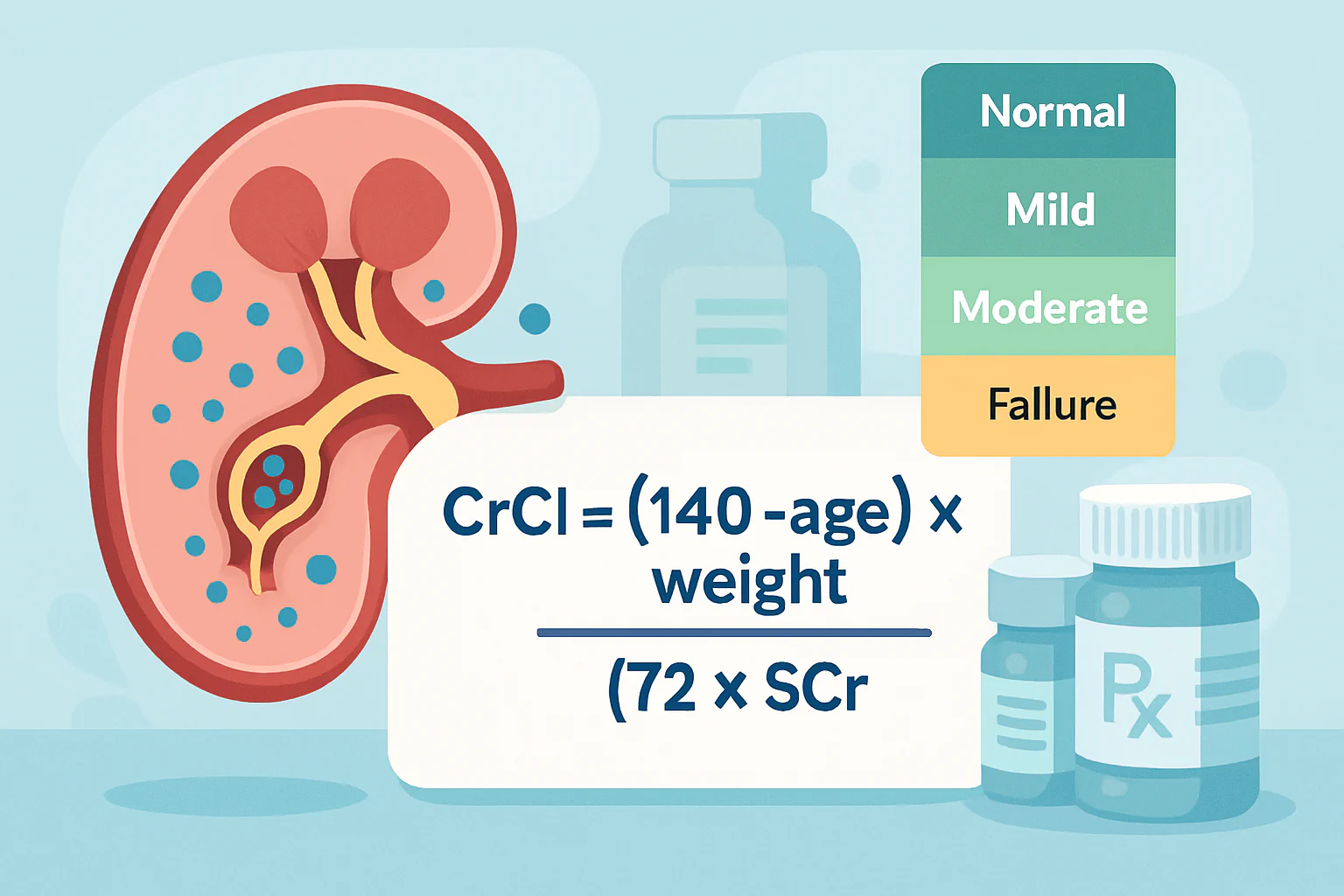
CrCl (mL/min) = [(140 − age) × weight (kg)] ÷ [72 × serum creatinine (mg/dL)]. For female patients, multiply by 0.85. The numerator captures how creatinine production declines with age and scales with body mass, while the denominator normalizes for the serum concentration. The constant 72 converts the result to mL/min.
If your lab reports creatinine in µmol/L, divide by 88.4 to convert to mg/dL before applying the formula. Our calculator handles this conversion automatically when you select the µmol/L unit toggle.
Reference Ranges & Interpretation
Normal creatinine clearance is approximately 90–130 mL/min in healthy young adults. Values are categorized as follows according to the National Kidney Foundation and KDIGO guidelines:
- ≥ 90 mL/min — Normal kidney function
- 60–89 mL/min — Mild decrease; most drugs at standard dose
- 30–59 mL/min — Moderate decrease; many medications require dose adjustment
- 15–29 mL/min — Severe decrease; significant dose reductions or avoidance needed
- < 15 mL/min — Kidney failure; specialist dosing or dialysis consideration
Assumptions & Limitations
The Cockcroft-Gault equation assumes steady-state creatinine, which means it is unreliable during acute kidney injury or rapidly changing renal function. It overestimates CrCl in obese patients when actual body weight is used and may underestimate clearance in highly muscular individuals. The equation was derived from male patients only; the 0.85 female correction factor is an approximation. For CKD staging, use eGFR (CKD-EPI) rather than Cockcroft-Gault. Always verify with current lab values and clinical assessment before making dosing decisions.
Cockcroft-Gault Calculator: How to Estimate Creatinine Clearance for Drug Dosing
The Cockcroft-Gault calculator remains the most widely referenced tool for estimating creatinine clearance (CrCl) when adjusting medication doses for kidney function. Published by Donald Cockcroft and Henry Gault in 1976, the equation was developed from a study of 249 men and has since become embedded in thousands of drug labels approved by the FDA. Despite newer equations like CKD-EPI, the Cockcroft-Gault formula is still the standard for pharmacokinetic dose adjustments because most drug trials used it to define renal dosing categories. This guide walks through the formula, shows a worked example, compares CG to eGFR, and explains exactly when and how to use the results.
What Is the Cockcroft-Gault Equation?
The Cockcroft-Gault equation estimates creatinine clearance in mL/min using four readily available clinical variables: age, body weight, serum creatinine, and biological sex. Creatinine clearance reflects how quickly the kidneys filter creatinine from the blood — a proxy for glomerular filtration rate (GFR) that has been used for over four decades in clinical pharmacology.
Unlike laboratory-reported eGFR (which is normalized to a standard body surface area of 1.73 m²), the Cockcroft-Gault result is an absolute value in mL/min. This distinction matters: drug manufacturers set dose thresholds based on absolute CrCl, not indexed eGFR. A patient with a low body surface area might have a “normal” eGFR but a below-threshold absolute CrCl, leading to potential overdosing if the eGFR is used instead.
The Cockcroft-Gault Formula Explained Step by Step
The equation is straightforward:
CrCl (mL/min) = [(140 − age) × weight (kg)] / [72 × serum creatinine (mg/dL)]
If female: multiply the result by 0.85
Each variable captures a physiological factor:
- (140 − age) — creatinine production declines with age as muscle mass decreases. A 25-year-old generates roughly 40% more creatinine than an 80-year-old of the same size.
- Weight (kg) — heavier individuals produce more creatinine due to greater muscle mass. The original equation uses actual body weight.
- 72 × serum creatinine — the denominator normalizes for the steady-state serum creatinine level. The constant 72 converts units so the result is in mL/min.
- 0.85 for females — women have approximately 15% less muscle mass per kilogram of body weight, reducing creatinine production proportionally.
Worked Example with Real Values
Consider a 72-year-old male weighing 82 kg with a serum creatinine of 1.4 mg/dL:
Step 1: (140 − 72) = 68
Step 2: 68 × 82 kg = 5,576
Step 3: 72 × 1.4 mg/dL = 100.8
Step 4: 5,576 / 100.8 = 55.3 mL/min
A CrCl of 55.3 mL/min falls in the moderate decrease range (30–59). For this patient, drugs like metformin remain usable but warrant monitoring, while enoxaparin treatment doses should be reduced to once-daily administration. If this were a 72-year-old female with identical values, the result would be 55.3 × 0.85 = 47.0 mL/min, which could trigger additional dose reductions.
Cockcroft-Gault vs eGFR: Key Differences
Clinicians often confuse CrCl from Cockcroft-Gault with eGFR from CKD-EPI or MDRD. While both estimate kidney function, they serve different purposes and can yield meaningfully different numbers for the same patient.
| Feature | Cockcroft-Gault | CKD-EPI (eGFR) |
|---|---|---|
| Output | Absolute CrCl (mL/min) | Indexed eGFR (mL/min/1.73 m²) |
| Primary use | Drug dose adjustment | CKD staging and diagnosis |
| Variables | Age, weight, sex, SCr | Age, sex, SCr (race removed 2021) |
| BSA normalized? | No (absolute value) | Yes (per 1.73 m²) |
| FDA drug labels | Used in ~90% of labels | Increasingly adopted |
| Limitations | Overestimates in obesity, elderly | Less validated for drug dosing |
In practice, a 55 kg elderly woman might show an eGFR of 62 mL/min/1.73 m² (Stage G2, “mildly decreased”) yet have a Cockcroft-Gault CrCl of only 38 mL/min. If you use the eGFR for drug dosing, she might receive a standard dose of dabigatran (150 mg twice daily) when she actually qualifies for the reduced dose (75 mg twice daily). This mismatch can have serious consequences. Our eGFR calculator shows the CKD-EPI result side by side for comparison.
Factors That Affect Cockcroft-Gault Accuracy
The equation was derived from a limited population (249 men, ages 18–92, hospitalized in a 1970s Canadian ward). Several patient characteristics can push results away from true GFR:
- Obesity (BMI > 30) — Using actual body weight overestimates CrCl by 10–40% because adipose tissue does not produce creatinine proportionally. Many pharmacists use adjusted body weight (IBW + 0.4 × [actual − IBW]) for patients exceeding 120% of ideal body weight. Our creatinine clearance calculator includes actual, IBW, and adjusted weight toggles.
- Elderly patients (> 80 years) — Muscle mass declines faster than serum creatinine rises, producing a falsely “normal” creatinine level. A serum creatinine of 0.9 mg/dL in an 85-year-old does not indicate the same kidney function as in a 40-year-old.
- Unstable kidney function — The equation assumes steady-state creatinine. In acute kidney injury (AKI), creatinine is rising or falling rapidly, making any estimation unreliable. Measured 24-hour urine creatinine clearance is preferred in these cases.
- Extremes of muscle mass — Bodybuilders and amputees fall outside the equation's assumptions. Very muscular patients will have elevated creatinine that underestimates CrCl; amputees will have reduced creatinine that overestimates it.
- Low creatinine values — Some guidelines recommend rounding serum creatinine to 1.0 mg/dL in elderly patients with very low values (e.g., 0.5 mg/dL) to avoid falsely high CrCl estimates. This practice is controversial but common in geriatric pharmacotherapy.
Common Mistakes to Avoid
In clinical practice and at the bedside, these errors recur frequently:
- Using eGFR instead of CrCl for dose adjustments — When a drug label says “reduce dose if CrCl < 30 mL/min,” it means Cockcroft-Gault CrCl, not the eGFR on the lab printout. Using eGFR can over- or underestimate by 15–30 mL/min in specific populations.
- Forgetting the sex correction factor — Omitting the 0.85 multiplier for female patients inflates CrCl by approximately 18%. This can push a borderline patient above a dose-reduction threshold.
- Wrong creatinine units — Labs in Europe and many international settings report creatinine in µmol/L. Entering 88 µmol/L into a calculator expecting mg/dL would produce a CrCl roughly 88 times too low. Always confirm: 1 mg/dL = 88.4 µmol/L.
- Using weight in pounds without converting — The equation requires kilograms. Using 154 lb instead of 70 kg doubles the numerator and doubles the estimated CrCl. Our calculator handles this conversion automatically.
Drug Dosing Adjustments Based on CrCl
Most drug labels categorize renal function into CrCl brackets. The common thresholds are > 50, 30–50, 15–30, and < 15 mL/min. Here are examples that demonstrate why accurate CrCl matters:
- Metformin — Contraindicated below CrCl 30 mL/min due to lactic acidosis risk. Between 30 and 45, guidelines recommend dose reduction to 500–1000 mg/day with monitoring. A patient incorrectly calculated at CrCl 35 (actual 28) could face a serious adverse event.
- Direct oral anticoagulants (DOACs) — Dabigatran requires dose reduction from 150 mg to 75 mg twice daily when CrCl drops below 50 mL/min. With rivaroxaban, the cutoff for dose reduction is CrCl < 50 mL/min for atrial fibrillation dosing.
- Antibiotics — Vancomycin initial dosing intervals widen from every 8–12 hours to every 24–48 hours as CrCl decreases. Gabapentin maximum daily dose drops from 3,600 mg to 300 mg when CrCl falls below 15 mL/min.
- Low-molecular-weight heparins — Enoxaparin treatment dosing switches from 1 mg/kg twice daily to 1 mg/kg once daily below CrCl 30 mL/min. This is one of the most frequently missed adjustments in hospital practice.
For a broader view of medication dosing principles, our dosage calculator covers weight-based and interval-based calculations across common clinical scenarios.
When to Use This Calculator
The Cockcroft-Gault calculator is most valuable in these specific clinical scenarios:
- Initiating or adjusting renally cleared medications — Before prescribing any drug with a CrCl-based dosing table, calculate CrCl with this tool. This applies to hospital formulary review, outpatient prescribing, and pharmacy verification.
- Geriatric medication review — Elderly patients often have “normal” serum creatinine despite significantly reduced kidney function. Running the Cockcroft-Gault equation with the patient's actual age and weight often reveals CrCl values 30–50% lower than what the creatinine alone suggests.
- Pre-operative assessment — Anesthesiologists and surgeons need CrCl to determine safe dosing of renally excreted anesthetic agents, analgesics, and perioperative antibiotics.
- Clinical pharmacy workflow — Pharmacists routinely calculate CrCl as part of medication therapy management (MTM), especially for anticoagulants, antibiotics, and chemotherapy protocols. A quick CrCl check can prevent costly and dangerous dosing errors.
The Cockcroft-Gault equation is nearly 50 years old, yet it endures because drug dosing data is built on it. Whether you are a clinician rounding on a hospital ward, a pharmacist reviewing a medication list, or a student learning renal physiology, understanding how to calculate and apply CrCl is a foundational clinical skill. For patients with established chronic kidney disease, pair this result with an eGFR calculation and kidney function assessment to get a complete picture of renal status.
References
- Cockcroft DW, Gault MH. Prediction of creatinine clearance from serum creatinine. Nephron. 1976;16(1):31-41. doi:10.1159/000180580
- National Kidney Foundation. KDIGO 2024 Clinical Practice Guideline for the Evaluation and Management of Chronic Kidney Disease. Kidney Int. 2024;105(4S):S117-S314.

Written by Jurica Šinko
Founder & CEO
Entrepreneur and health information advocate, passionate about making health calculations accessible to everyone through intuitive digital tools.
View full profileFrequently Asked Questions
What is the Cockcroft-Gault equation used for?
The Cockcroft-Gault equation estimates creatinine clearance (CrCl) in mL/min to guide drug dosing adjustments. It uses age, body weight, serum creatinine, and biological sex. Most FDA-approved drug labels reference CrCl from this equation when specifying renal dose thresholds.
How do I calculate creatinine clearance with Cockcroft-Gault?
Multiply (140 minus age) by weight in kilograms, then divide by (72 times serum creatinine in mg/dL). For female patients, multiply the result by 0.85. For example, a 65-year-old male weighing 70 kg with creatinine 1.2 mg/dL has a CrCl of about 60.8 mL/min.
What is the difference between CrCl and eGFR?
CrCl from Cockcroft-Gault is an absolute value in mL/min used primarily for drug dosing. eGFR from CKD-EPI is normalized to body surface area (mL/min/1.73 m2) and used for CKD staging. They can differ by 15-30 mL/min in the same patient, especially in elderly or underweight individuals.
Should I use actual or ideal body weight in the Cockcroft-Gault equation?
The original equation uses actual body weight. However, for obese patients exceeding 120% of ideal body weight, many pharmacists use adjusted body weight (IBW + 0.4 times the difference between actual and ideal weight) to avoid overestimating CrCl.
What is a normal creatinine clearance by age?
Normal CrCl is approximately 90-130 mL/min for healthy adults under 40. It declines roughly 1 mL/min per year after age 40. A healthy 70-year-old typically has a CrCl of 50-80 mL/min, and values below 60 mL/min generally warrant medication dose review.
Why does the Cockcroft-Gault formula use a 0.85 factor for females?
Women produce approximately 15% less creatinine than men of the same weight due to lower average muscle mass. The 0.85 multiplier adjusts for this difference. Without it, CrCl would be overestimated in female patients by about 18%.
When should I not use the Cockcroft-Gault equation?
Avoid using it during acute kidney injury when creatinine is rapidly changing, in patients on dialysis, during pregnancy, or in individuals with extremes of muscle mass such as bodybuilders or amputees. In these cases, a measured 24-hour urine creatinine clearance is more reliable.
Related Calculators
Adjusted Body Weight Calculator — Dosing Weight (ABW)
Compute ABW for dosing with our adjusted body weight calculator, alongside IBW reference. Essential for accurate medication dosing, especially in obesity.
Alcohol Calculator: Drinks, Calories, Cost and BAC
Use our alcohol calculator to track standard drinks, alcohol calories, cost, and estimated BAC. Plan sessions, see time to sober, and make informed choices.
Alcohol Units Calculator UK — Weekly Tracking & Limits
Free alcohol units calculator for UK weekly tracking. Convert drinks to units, check against the 14-unit guideline, and see calories, standard drinks, and more.
BAC Calculator — Estimate Blood Alcohol Level by Drink
Use our BAC calculator to estimate blood alcohol levels from drinks, ABV, weight, sex, and hours. See limit markers, impairment ranges, and time to sober.
Caffeine Calculator — Daily Intake & Half-Life Guide
Use our caffeine calculator to total your intake and see how half-life affects sleep. Track coffee, tea, energy drinks, and custom doses to build better habits.
Corrected Calcium Calculator — Albumin Adjustment Guide
Adjust total calcium for albumin levels with our corrected calcium calculator. Supports SI or US units, providing accurate results for clinical interpretation.