Use the Child Vaccine Schedule Calculator
Free child vaccine schedule calculator to track CDC-recommended immunizations by age. Enter your child's birthdate to see due, overdue, and upcoming vaccines.
Enter your child's birthdate above
Get a personalized vaccine timeline showing which shots are due, upcoming, or completed based on the CDC schedule.
Important: This schedule follows the CDC-recommended child and adolescent immunization schedule for informational purposes only. Your pediatrician may adjust the schedule based on your child's health history, risk factors, and regional requirements. Always consult your healthcare provider before making vaccination decisions.
Your rating helps improve Child Vaccine Schedule Calculator. We store only an anonymized vote (no personal data).
How to Use Child Vaccine Schedule Calculator
Step 1: Enter birthdate
Select your child's date of birth using the date picker. The calculator generates a full vaccine timeline instantly.
Step 2: Review the timeline
Scroll through the age-based timeline to see all recommended vaccines. Doses are color-coded: amber for due now, red for overdue, and green for upcoming.
Step 3: Mark completed doses
Check the box next to any dose your child has already received. The progress bar updates to show how far through the schedule you are.
Step 4: Filter by status
Use the filter tabs (All Doses, Needs Action, Upcoming) to focus on what matters most right now.
Step 5: Copy or share
Click "Copy Summary" to save a text version of your child's vaccine status for your records or to share with your pediatrician.
Key Features
- Personalized vaccine timeline from birthdate
- Color-coded dose status: due, overdue, upcoming
- Interactive checklist to mark completed doses
- Visual timeline with age-based milestones
- Copy and share vaccine summary
- Covers all 14 CDC-recommended childhood vaccines
Understanding Results
How Target Dates Are Calculated
The calculator adds the CDC-recommended minimum age for each vaccine dose to your child's date of birth. For example, DTaP Dose 1 has a minimum age of 2 months, so a child born on January 15 would have a target date of March 15. Each dose also has a recommended window (e.g., “12-15 months”) that represents the ideal timeframe for administration. Doses given within this window provide optimal immune response.
Status Classifications
Each dose receives a color-coded status based on your child's current age:
- Due Now (amber) — Your child has reached the minimum age for this dose and is within the recommended window.
- Overdue (red) — Your child is past the ideal window by 2+ months. Schedule this dose as soon as possible.
- Upcoming (green) — This dose is scheduled for the future. No action needed yet.
- Missed Window (orange) — The recommended age window has passed. Discuss catch-up options with your pediatrician.
- Completed (gray) — You marked this dose as administered.
Assumptions & Limitations
This calculator follows the standard CDC immunization schedule for healthy children in the United States. It does not account for medical exemptions, allergies, immunocompromised conditions, or state-specific requirements. Premature infants, children with chronic conditions, and international adoptees may need modified schedules. The rotavirus vaccine has strict age limits not reflected in the general timeline. Always confirm your child's vaccination plan with their pediatrician.
Complete Guide: Child Vaccine Schedule Calculator
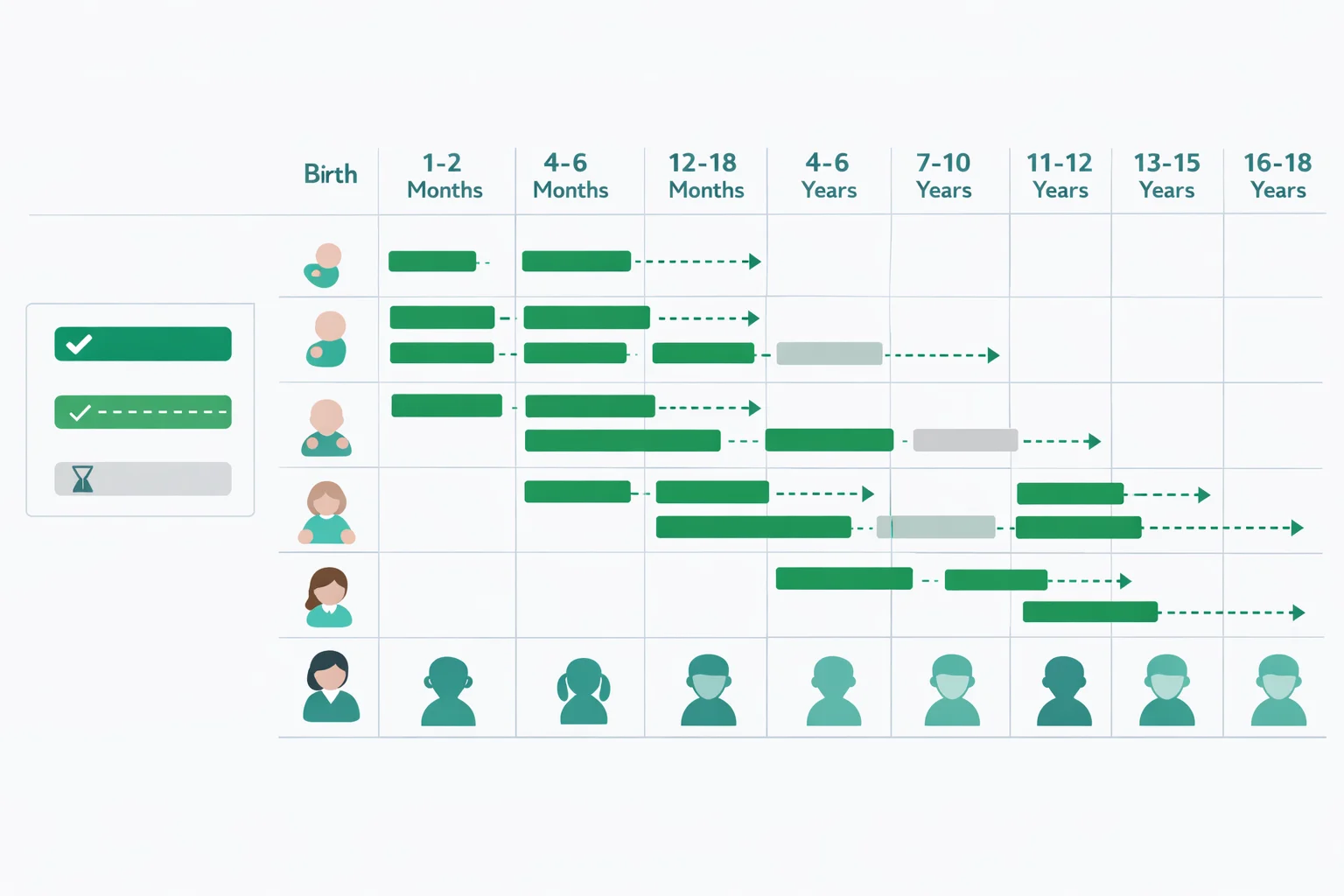
Table of Contents
A child vaccine schedule calculator takes the guesswork out of tracking your child's immunizations by converting their birthdate into a personalized, date-specific timeline of every recommended vaccine from birth through age 18. The CDC recommends up to 36 vaccine doses across 14 different vaccines during childhood, and missing even a single dose can leave a child vulnerable during critical developmental windows. This guide walks you through how the schedule works, which vaccines happen when, and how to use our calculator to keep your child's immunizations on track.
What Is a Child Vaccine Schedule?
A child vaccine schedule is a standardized timeline published by the Centers for Disease Control and Prevention (CDC) and endorsed by the American Academy of Pediatrics (AAP) that specifies which vaccines children should receive at each age. The schedule is not arbitrary — it reflects decades of clinical research showing that specific age windows maximize immune response while providing protection during the period of highest vulnerability.
The current schedule covers vaccines for 14 diseases, from hepatitis B at birth to meningococcal boosters at age 16. Each vaccine has a minimum age for the first dose, a recommended age window, and minimum intervals between doses in a multi-dose series. For example, the first MMR dose must wait until at least 12 months of age because maternal antibodies can interfere with the vaccine before that point.
The CDC-Recommended Vaccination Timeline
The busiest period for vaccinations falls between birth and 15 months, when a child receives the majority of their primary series doses. Here is a simplified breakdown of the recommended schedule by age milestone:
| Age | Vaccines Due | Total Doses |
|---|---|---|
| Birth | HepB (dose 1) | 1 |
| 2 months | DTaP, IPV, Hib, PCV15, RV, HepB | 6 |
| 4 months | DTaP, IPV, Hib, PCV15, RV | 5 |
| 6 months | DTaP, IPV, Hib, PCV15, RV, HepB, Flu | 7 |
| 12-15 months | MMR, VAR, HepA, Hib booster, PCV15 booster, DTaP (dose 4) | 6 |
| 4-6 years | DTaP, IPV, MMR, VAR (all final doses) | 4 |
| 11-12 years | Tdap, HPV (series), MenACWY | 3-4 |
This means a child visiting their pediatrician at the 2-month well-child check may receive up to 6 vaccinations in a single visit. While this sounds like a lot, combination vaccines (such as Pediarix, which covers DTaP, IPV, and HepB in one shot) reduce the actual number of injections. If you want to track your child's developmental milestones alongside their vaccine schedule, our baby milestone calculator can help you monitor both at once.
How the Vaccine Schedule Works: Age-Based Milestones
Each vaccine in the CDC schedule has three critical timing parameters:
- Minimum age — The earliest a dose can be given. For example, the first DTaP dose has a minimum age of 6 weeks (typically given at 2 months). Administering before the minimum age does not count and must be repeated.
- Recommended age window — The ideal timeframe for each dose. Dose 1 of MMR has a window of 12-15 months. Getting vaccinated within this window ensures optimal immune response.
- Minimum intervals — The shortest acceptable time between doses in a series. For DTaP, the minimum interval between doses 1 and 2 is 4 weeks, meaning a dose given at 2 months cannot be followed until at least 3 months of age.
Worked example: A baby born on January 15, 2025, would be due for their 2-month vaccines starting March 15, 2025. Their first MMR dose opens up on January 15, 2026 (12 months old), and the kindergarten boosters (DTaP dose 5, IPV dose 4, MMR dose 2, and Varicella dose 2) become due around January 2029 at age 4. Our calculator generates all these dates automatically from a single birthdate entry.
Key Childhood Vaccines Explained
Understanding what each vaccine protects against helps parents appreciate why the timing matters:
- DTaP (5 doses) — Protects against diphtheria, tetanus, and pertussis (whooping cough). Pertussis is especially dangerous for infants under 12 months, causing up to 20 deaths annually in the U.S. The primary 3-dose series builds initial immunity; the boosters at 15-18 months and 4-6 years reinforce it.
- MMR (2 doses) — Covers measles, mumps, and rubella. One dose provides 93% protection against measles; two doses raise it to 97%. The 12-month minimum age exists because maternal antibodies can neutralize the vaccine in younger infants.
- PCV15 (4 doses) — Pneumococcal conjugate vaccine protects against 15 strains of Streptococcus pneumoniae, the leading cause of bacterial meningitis in children under 5. The updated PCV15 replaced PCV13 in 2024.
- Rotavirus (2-3 doses) — The only vaccine with a strict upper age limit. The first dose must be given before 14 weeks 6 days, and the series must be completed by 8 months. This oral vaccine prevents severe diarrheal illness that hospitalizes about 55,000 U.S. children annually.
- HPV (2-3 doses) — Routinely recommended at 11-12 years. Starting before age 15 requires only 2 doses; starting at 15 or later requires 3. The vaccine prevents 6 types of cancer caused by human papillomavirus.
What Happens If You Miss a Vaccine?
Missing a scheduled vaccine does not mean starting over. The CDC publishes a catch-up schedule specifically for children who fall behind. The key rule is: doses given too early must be repeated, but doses given late still count. A child who misses their 4-month DTaP can receive it at 5 or 6 months and continue the series without restarting.
However, the rotavirus vaccine is the major exception. Because the risk of intussusception (a bowel obstruction) increases with age, the first dose cannot be started after 14 weeks 6 days, and the entire series must be finished by 8 months 0 days. Missing these windows means the child cannot receive the rotavirus vaccine at all. For children who have fallen behind on multiple vaccines, our catch-up immunization calculator can generate a personalized catch-up plan.
Common Parental Concerns About Vaccination Schedules
Can I space out my child's vaccines? Some parents request alternative schedules that spread vaccines over more visits. While the CDC and AAP strongly recommend following the standard schedule, pediatricians can work with families on modified timelines. The risk of spacing out is straightforward: every day without full immunization is a day of vulnerability. A study in Pediatrics found that children on delayed schedules had a 7-fold higher rate of pertussis and a 3-fold higher rate of varicella compared to those following the standard schedule.
Is it safe to give multiple vaccines at once? Yes. The immune system encounters thousands of antigens daily from food, air, and skin contact. The antigens in all childhood vaccines combined represent a tiny fraction of what a child's immune system handles routinely. Combination vaccines (such as MMRV, which adds varicella to MMR) have been extensively tested for safety in simultaneous administration.
What about children with egg allergies? Egg allergy is no longer a contraindication for most vaccines, including influenza (flu) and MMR. The CDC updated its guidance in 2023 to allow flu vaccination in egg-allergic individuals without special precautions, regardless of the severity of their egg allergy.
Tips for Staying on Track with Your Child's Vaccines
Keeping up with over 30 vaccine doses across 18 years requires a system. Here are proven strategies:
- Use well-child visits as checkpoints. The 2-month, 4-month, 6-month, 12-month, 15-month, 18-month, 4-year, and 11-year well-child visits align with major vaccination milestones. Schedule these in advance.
- Keep a digital record. Use our calculator to generate and copy your child's complete schedule. Many states also offer immunization information systems (IIS) where providers log every vaccine administered.
- Schedule the next appointment before you leave. Book the next well-child visit at the current appointment. The intervals between visits (8 weeks for infants) match the minimum spacing between vaccine doses.
- Set calendar reminders. The 12-month and 4-year milestones are easy to miss since the visit spacing increases from monthly to yearly. Set a reminder 2 weeks before each target date.
- Ask about combination vaccines. Pediarix (DTaP-IPV-HepB) and Vaxelis (DTaP-IPV-Hib-HepB) reduce the number of injections while covering the same diseases.
Tracking your child's overall growth alongside their vaccine schedule provides a complete picture of their health. Our child growth calculator lets you plot height and weight percentiles using the same CDC data pediatricians use.
When to Use This Calculator
This child vaccine schedule calculator is designed for these specific situations:
- Before a well-child visit — Enter your child's birthdate to see exactly which vaccines should happen at the upcoming appointment. Print or copy the list to bring with you.
- After switching pediatricians — When changing providers, mark which vaccines are already complete and identify any gaps in the schedule.
- For school enrollment — Most states require proof of DTaP, IPV, MMR, varicella, and HepB for kindergarten entry. Use the calculator to verify all required doses are completed before enrollment deadlines.
- When you suspect a missed dose — The “Needs Action” filter highlights overdue doses and missed windows so you can discuss catch-up options with your pediatrician.
References
- Centers for Disease Control and Prevention. “Recommended Child and Adolescent Immunization Schedule for Ages 18 Years or Younger.” CDC, 2025. cdc.gov/vaccines/schedules
- American Academy of Pediatrics. “Immunization Schedule.” AAP, 2025. aap.org/immunizations
- Glanz JM, Newcomer SR, Narwaney KJ, et al. “A Population-Based Cohort Study of Undervaccination in 8 Managed Care Organizations Across the United States.” JAMA Pediatrics, 2013;167(3):274-281.

Written by Jurica Šinko
Founder & CEO
Entrepreneur and health information advocate, passionate about making health calculations accessible to everyone through intuitive digital tools.
View full profileFrequently Asked Questions
What vaccines does a child need from birth to age 18?
The CDC recommends 14 vaccines from birth to age 18, totaling about 36 doses. These include HepB, DTaP, Hib, PCV15, IPV, rotavirus, MMR, varicella, HepA, influenza (annual), Tdap, HPV, MenACWY, and MenB. The heaviest vaccination period is from birth to 15 months.
How does this child vaccine schedule calculator work?
Enter your child's date of birth and the calculator generates a personalized timeline showing exact target dates for every recommended dose based on CDC guidelines. It shows which doses are due now, overdue, upcoming, or already completed.
What happens if my child misses a scheduled vaccine?
Most missed vaccines can be caught up without restarting the series. The key exception is rotavirus, which must start before 14 weeks 6 days and finish by 8 months. For other vaccines, your pediatrician can create a catch-up schedule based on current CDC guidelines.
Can I space out my child's vaccines over more visits?
While the CDC and AAP recommend following the standard schedule, some parents choose to spread vaccines across additional visits. Research shows children on delayed schedules have higher rates of preventable diseases during the delay period. Discuss any modifications with your pediatrician.
Is it safe to give multiple vaccines at the same appointment?
Yes. A child's immune system handles thousands of antigens daily from food, air, and normal contact. All childhood vaccines combined contain fewer antigens than a single meal. Combination vaccines like Pediarix (DTaP-IPV-HepB) are specifically tested for safety when given together.
Which vaccines are required for school enrollment?
Most U.S. states require DTaP (5 doses), IPV (4 doses), MMR (2 doses), varicella (2 doses), and HepB (3 doses) for kindergarten entry. Requirements vary by state, and some states also require HepA. Check your state health department for specific requirements.
What is the difference between DTaP and Tdap vaccines?
DTaP is given to children under 7 years and contains full-strength diphtheria and pertussis antigens. Tdap is the adolescent and adult formulation given at age 11-12 and contains reduced amounts of diphtheria and pertussis antigens. Both protect against the same three diseases.
Related Calculators
Baby Food Calculator — Solids Introduction & Portions
Estimate age‑appropriate portions and plan meal frequency with the baby food calculator. Log new foods, track allergens, and export a simple weekly menu.
Infant Growth Chart Calculator
Track weight, length, and head size with the infant growth chart calculator using WHO percentiles. See trends on clear charts and compare age-based progress.
Baby Length Percentile Calculator — WHO Reference Guide
Check WHO length‑for‑age percentiles with the baby length percentile calculator. Input age, sex, and length to see your percentile and track growth trends.
Baby Milestone Calculator — Track Skills by Age & Stage
Use our baby milestone calculator to see what’s typical by corrected age. Explore early, typical, and later windows for motor, language, and cognitive skills.
Baby Weight Percentile Calculator — WHO Growth Guide
Use the baby weight percentile calculator to see WHO weight‑for‑age percentiles. Enter age, sex, and weight to get your percentile, z‑score, and tips.
Breast Milk Storage Calculator — Safety & Expiry Guide
Calculate safe storage times for fresh or thawed milk with our breast milk storage calculator. See fridge/freezer expiry dates, cooler limits, and labels.