Use the CHA2DS2-VASc Calculator
Free CHA2DS2-VASc calculator giving your annual AFib stroke risk, the 2024 ESC CHA2DS2-VA score, number needed to treat, and both guideline thresholds.
CHA2DS2-VASc
2
Annual stroke risk
2.2%
Contributes 1 point — 2 if 75 or older, 1 if 65–74, otherwise 0.
Sex
Female sex adds 1 point in CHA2DS2-VASc but is excluded from the 2024 ESC CHA2DS2-VA score.
CHA2DS2-VASc score
2 / 9
Annual ischemic stroke risk
2.2%
without anticoagulation
Risk on anticoagulation
~0.8%
per year, estimated
Strokes prevented
1.4 pp
absolute, per year
Number needed to treat
71
for 1 year, to prevent 1 stroke
Where your points come from
What the two major guidelines say at this score
2023 ACC/AHA/ACCP/HRS — CHA2DS2-VASc 2, male
Oral anticoagulation is recommended (Class 1).
2024 ESC — CHA2DS2-VA 2 (sex excluded)
Oral anticoagulation is recommended (Class I).
Annual ischemic stroke rate by CHA2DS2-VASc score
Swedish Atrial Fibrillation Cohort (n = 90,490), patients not taking anticoagulation.
| Score | Stroke / year | On anticoagulation | Risk tier |
|---|---|---|---|
| 0 | 0.2% | 0.1% | Low |
| 1 | 0.6% | 0.2% | Moderate |
| 2 | 2.2% | 0.8% | High |
| 3 | 3.2% | 1.2% | High |
| 4 | 4.8% | 1.7% | High |
| 5 | 7.2% | 2.6% | High |
| 6 | 9.7% | 3.5% | High |
| 7 | 11.2% | 4.0% | High |
| 8 | 10.8% | 3.9% | High |
| 9 | 12.2% | 4.4% | High |
The rate dips slightly from 11.2% at score 7 to 10.8% at score 8. That is not an error — only a few hundred patients in the cohort reached a score of 8, so the estimate there is statistically noisy.
Educational tool, not medical advice. CHA2DS2-VASc applies to non-valvular atrial fibrillation and does not account for bleeding risk, kidney function, or drug interactions. Anticoagulation decisions balance this stroke risk against bleeding risk and patient preference, and belong with your clinician. Stroke rates shown are cohort averages; an individual's risk can differ substantially.
Educational tool, not medical advice. Check this tool’s method and limitations before interpreting a result. Talk to a qualified healthcare professional before making decisions about medication, diet, exercise, or treatment. See our Terms of Use.
Your rating helps improve CHA2DS2-VASc Calculator. We store only an anonymized vote (no personal data).
How to Use CHA2DS2-VASc Calculator
Step 1: Enter age
Type the age in the Age field, or tap one of the quick bands below it. Age 75 or older adds 2 points; age 65 to 74 adds 1 point. The bands are exclusive, so a 78-year-old scores 2, not 3.
Step 2: Select sex
Choose Male or Female. Female sex adds 1 point to CHA2DS2-VASc but is deliberately excluded from the 2024 ESC CHA2DS2-VA score shown next to it.
Step 3: Tick the clinical risk factors
Check every box that applies: congestive heart failure or LV dysfunction, hypertension, diabetes, prior stroke or TIA, and vascular disease. Prior stroke adds 2 points; the other four add 1 point each.
Step 4: Read the score and annual stroke risk
The score out of 9 and the estimated annual ischemic stroke risk update instantly. The coloured badge shows the risk tier, and the bar underneath places the score on the 0 to 9 scale.
Step 5: Compare the two guideline recommendations
The blue panel gives the sex-stratified 2023 ACC/AHA position on your CHA2DS2-VASc score; the teal panel gives the 2024 ESC position on the sex-free CHA2DS2-VA score. They can differ for women.
Step 6: Copy the summary
Press Copy summary to place the score, annual risk, number needed to treat, and the full point breakdown on your clipboard for notes or a clinic discussion.
Key Features
- Annual ischemic stroke risk from the 90,490-patient Swedish AF cohort
- Both CHA2DS2-VASc (max 9) and the 2024 ESC CHA2DS2-VA (max 8)
- Side-by-side 2023 ACC/AHA and 2024 ESC anticoagulation thresholds
- Number needed to treat and absolute risk reduction on anticoagulation
- Point-by-point breakdown showing exactly which criteria scored
- Full score-to-risk reference table with your score highlighted
Understanding Results
How the CHA2DS2-VASc Calculator Scores Risk
There is no equation to solve — the score is a weighted sum of eight yes/no criteria, and the acronym spells them out. Congestive heart failure or LV dysfunction (1), Hypertension (1), Age ≥ 75 (2), Diabetes (1), prior Stroke, TIA or thromboembolism (2), Vascular disease (1), Age 65–74 (1), and Sex category female (1) sum to a maximum of 9. The subscript 2 in CHA2DS2 marks the two criteria that are worth double. The two age criteria are mutually exclusive: a patient aged 78 scores 2 for the older band and 0 for the younger one, never 3. Removing the sex point gives the 2024 ESC CHA2DS2-VA score, capped at 8, which this calculator reports alongside the classic score.
Reference Ranges & Interpretation
Annual ischemic stroke rates come from the Swedish Atrial Fibrillation Cohort of 90,490 patients not taking anticoagulation: 0.2% at score 0, 0.6% at 1, 2.2% at 2, 3.2% at 3, 4.8% at 4, 7.2% at 5, 9.7% at 6, and 11–12% at scores of 7 and above. The 2023 ACC/AHA/ACCP/HRS guideline recommends oral anticoagulation at a CHA2DS2-VASc of 2 or more in men and 3 or more in women, and calls it reasonable at 1 in men or 2 in women. The 2024 ESC guideline sets a single sex-independent threshold of CHA2DS2-VA ≥ 2 for a Class I recommendation, with Class IIa consideration at 1. Both thresholds sit where the number needed to treat falls below roughly 100 patient-years per stroke prevented.
Assumptions & Limitations
The score applies to non-valvular atrial fibrillation only — mechanical valves and moderate-to-severe mitral stenosis fall outside it and require anticoagulation irrespective of score. It quantifies stroke risk but not bleeding risk, so it is one half of the treatment decision. It carries no time dimension and cannot separate permanent AF from brief device-detected episodes, which carry lower risk. The cohort rates assume no anticoagulation and were derived in a predominantly European population, so calibration elsewhere is assumed rather than proven. Treated hypertension still scores its point, since the criterion marks the diagnosis rather than today's blood pressure reading. Use the result to structure a conversation with a clinician, not to start or stop therapy on your own.
Complete Guide: CHA2DS2-VASc Calculator
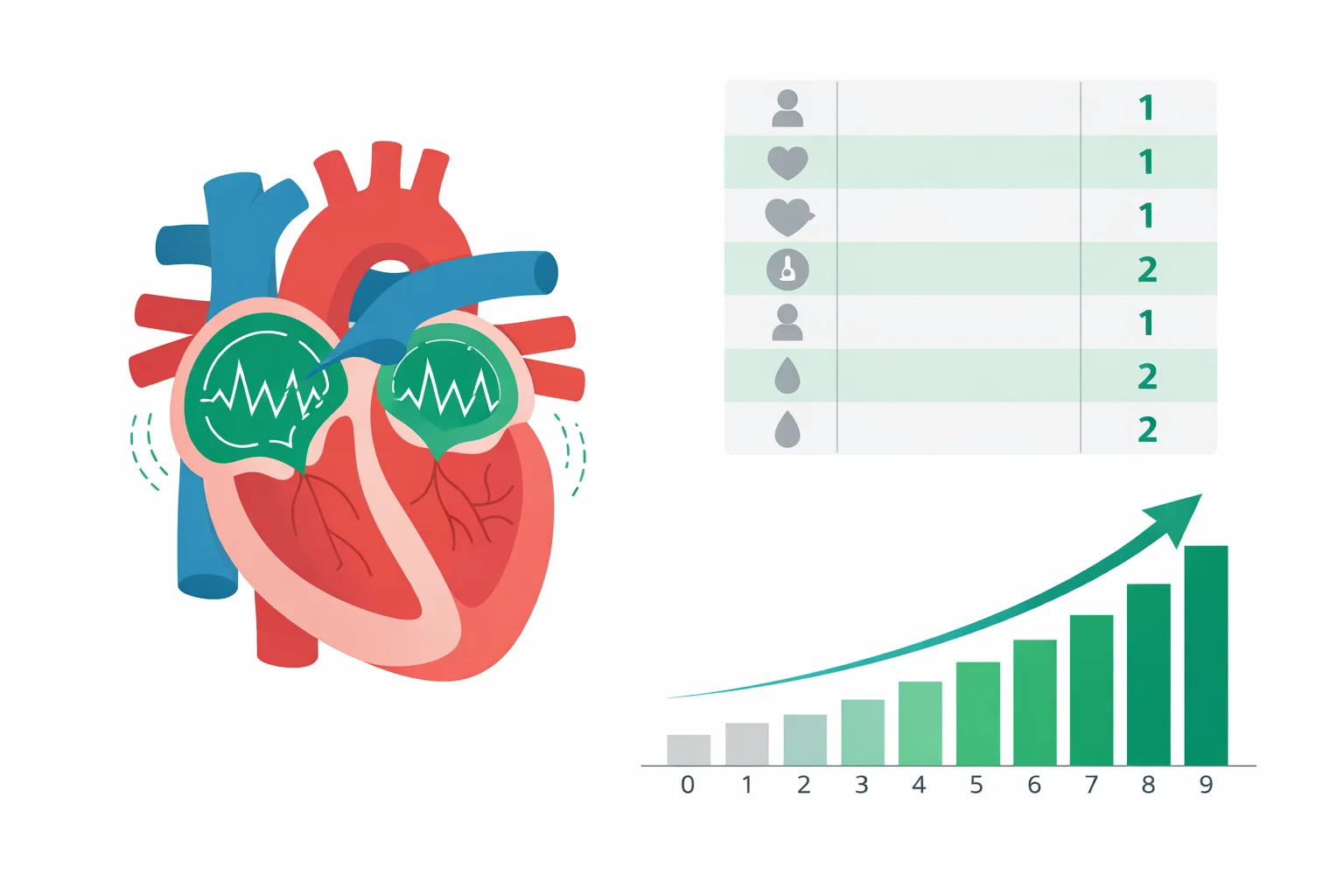
On this page
A CHA2DS2-VASc calculator exists to answer one question: does this person with atrial fibrillation benefit more from anticoagulation than they are harmed by it? The arithmetic behind that question is unusually favourable. Oral anticoagulation cuts ischemic stroke by roughly 64% compared with no therapy. At a score of 4, that turns a 4.8% annual stroke risk into about 1.7% — roughly 32 patients treated for a year to prevent one stroke. At a score of 0, the same 64% reduction moves 0.2% to 0.07%, and you would treat about 780 people for a year to prevent one event, while every one of them carries bleeding risk. Same drug, same relative benefit, completely different decision. The score is what separates them.
CHADS2 vs. CHA2DS2-VASc vs. CHA2DS2-VA
Three scores are in circulation right now, and clinicians routinely mix them up because the acronyms are nested. CHADS2 (2001) used five factors and a maximum of 6 points. CHA2DS2-VASc (2010) added vascular disease, the 65–74 age band, and female sex, pushing the maximum to 9. Then in 2024 the European Society of Cardiology removed the sex category entirely and renamed the result CHA2DS2-VA, capped at 8. The 2023 ACC/AHA guideline still uses CHA2DS2-VASc. Our calculator computes both modern versions simultaneously, because which one your clinician applies depends on which side of the Atlantic they trained.
| Feature | CHADS2 (2001) | CHA2DS2-VASc (2010) | CHA2DS2-VA (2024 ESC) |
|---|---|---|---|
| Maximum score | 6 | 9 | 8 |
| Age scoring | ≥ 75 only (1 pt) | 65–74 (1), ≥ 75 (2) | 65–74 (1), ≥ 75 (2) |
| Vascular disease | Not counted | 1 point | 1 point |
| Female sex | Not counted | 1 point | Removed |
| Treat threshold | ≥ 2 | ≥ 2 men, ≥ 3 women | ≥ 2, sex-independent |
| Main weakness | Called too many people “low risk” | Sex point confuses the threshold | Newest; less validation data |
The practical reason CHA2DS2-VASc displaced CHADS2 is what happened at the bottom of the range. CHADS2 labelled a large group as score 0–1, and those patients still had stroke rates near 1.5–2% per year — too high to leave untreated. Adding vascular disease and the younger age band reclassified most of them upward, leaving a genuinely low-risk group at 0.2%. CHA2DS2-VASc is not better at identifying high-risk patients; it is better at identifying the ones who can safely skip therapy.
Every Point, and the Two That Count Double
The subscript 2 in the acronym is not decoration — it marks the two criteria worth 2 points instead of 1. A2is age 75 or older. S2 is prior stroke, TIA, or systemic thromboembolism. Everything else is worth 1: congestive heart failure or LV dysfunction, hypertension, diabetes, vascular disease, age 65–74, and female sex category. Prior stroke carries double weight because it is by far the strongest single predictor of recurrence — a patient whose only risk factor is a previous stroke starts at 2 points and crosses the treatment threshold on that fact alone.
Note the age criteria do not stack. A 78-year-old scores 2 for A2, not 3 — they do not also collect the 65–74 point. This single mistake is the most common source of inflated scores we see, and it matters because the difference between 1 and 2 points is exactly the treatment threshold in men. If you also want to see how age drives broader cardiovascular risk, the ASCVD risk calculator applies a continuous age term rather than these coarse bands.
Why the ESC Deleted the Female Point in 2024
The sex category was always the awkward part of CHA2DS2-VASc, and the 2024 ESC guideline finally cut it. The evidence had been accumulating for years: female sex behaves as a risk modifier, not an independent risk factor. Women with atrial fibrillation and zero other risk factors have stroke rates statistically indistinguishable from men in the same position. The excess risk seen in older studies was driven by women in those cohorts being older and more likely to have hypertension — confounding, not causation.
This produced a genuinely confusing threshold. Under CHA2DS2-VASc, a woman needed 3 points to reach a Class 1 anticoagulation recommendation while a man needed 2 — but since her sex was already handing her a free point, both were effectively at the same 2 points of real clinical risk. Clinicians who forgot the sex-specific threshold anticoagulated women one tier too early. Dropping the point removes the trap: under CHA2DS2-VA, everyone at 2 or more is a Class I recommendation, regardless of sex. If your calculated score has female sex as its only contributor, treat that as a score of 0.
Two Patients, Same Age, Different Answer
Patient A is a 71-year-old man with treated hypertension and no other history. Age 65–74 gives 1 point, hypertension gives 1 point, everything else is zero. CHA2DS2-VASc = 2. CHA2DS2-VA = 2. His estimated annual ischemic stroke risk is 2.2%. Both the ACC/AHA and ESC guidelines recommend anticoagulation. On therapy his risk falls to roughly 0.8%, an absolute reduction of 1.4 percentage points, or about 71 patients treated for a year per stroke prevented.
Patient B is a 71-year-old woman with treated hypertension, type 2 diabetes, and a TIA three years ago. Age gives 1, hypertension 1, diabetes 1, prior TIA 2, female sex 1. CHA2DS2-VASc = 6. CHA2DS2-VA = 5. Her annual stroke risk is 9.7% — more than four times Patient A's. Anticoagulation drops that to about 3.5%, preventing a stroke for every 16 patient-years of treatment. Same age, same hypertension, and a bleeding risk that has to be extraordinary before it outweighs a 6.2 percentage point absolute benefit. Because her diabetes is doing real work in this score, her blood sugar levels are part of the long-term risk picture too, even though the score treats diabetes as a simple yes or no.
From Percentage to Decision: the NNT at Each Score
Annual stroke percentages are hard to feel. Number needed to treat is not. Applying the 64% relative risk reduction from the Hart meta-analysis to the Swedish cohort stroke rates gives a concrete figure for how many people you would anticoagulate for one year to prevent a single ischemic stroke. This table is the part most calculators leave out, and it is the part that actually explains why the threshold sits at 2.
| Score | Stroke/yr untreated | Stroke/yr treated | NNT per year |
|---|---|---|---|
| 0 | 0.2% | 0.07% | 781 |
| 1 | 0.6% | 0.22% | 260 |
| 2 | 2.2% | 0.79% | 71 |
| 3 | 3.2% | 1.15% | 49 |
| 4 | 4.8% | 1.73% | 33 |
| 5 | 7.2% | 2.59% | 22 |
| 6 | 9.7% | 3.49% | 16 |
| 7 | 11.2% | 4.03% | 14 |
| 8 | 10.8% | 3.89% | 14 |
| 9 | 12.2% | 4.39% | 13 |
Look at the jump between 1 and 2. The NNT collapses from 260 to 71 — a 3.7-fold improvement across a single point. That cliff is the entire justification for the threshold. Major bleeding on a DOAC runs roughly 2–3% per year, so at an NNT of 260 you would cause more major bleeds than you prevent strokes. At an NNT of 71 the balance has already flipped, and by a score of 4 it is not close.
The Score-8 Anomaly Nobody Explains
Read the risk table carefully and something looks broken: stroke risk climbs steadily to 11.2% at score 7, then drops to 10.8% at score 8 before rising again to 12.2% at 9. Every major calculator reproduces this without comment, and it regularly gets flagged as a typo. It is not one. In the Swedish Atrial Fibrillation Cohort of 90,490 patients, only a few hundred reached a score of 8 — reaching it requires an unusual combination such as being under 65 while carrying nearly every other risk factor. With that few events, the confidence interval is wide enough to swallow the difference. Treat scores of 7 through 9 as one band of roughly 11–12% annual risk rather than reading the decimals as a real ordering.
Five Scoring Mistakes That Change the Answer
1. Double-counting age. A 76-year-old gets 2 points, not 3. The bands are exclusive. 2. Scoring “heart failure” from symptoms alone. The C criterion means documented LV systolic dysfunction, recent decompensation requiring admission, or hypertrophic cardiomyopathy — not breathlessness on a busy day. 3. Counting controlled hypertension as zero. Treated hypertension still scores 1; the point marks the diagnosis, not today's reading. 4. Missing peripheral arterial disease. The V criterion covers prior MI, PAD, and complex aortic plaque, and PAD in particular is routinely absent from the problem list. 5. Applying it to valvular AF. Moderate-to-severe mitral stenosis or a mechanical valve puts a patient in a different risk class entirely; they need anticoagulation regardless of score, and warfarin rather than a DOAC.
Where the Score Stops Working
CHA2DS2-VASc says nothing about bleeding. It is half of a two-sided decision, and a score of 5 in a patient with recurrent GI haemorrhage and an eGFR of 22 is a different conversation from a score of 5 in an otherwise well 70-year-old. Kidney function also drives DOAC dose selection independently of stroke risk, which is why creatinine clearance is checked alongside the score — the creatinine clearance calculator uses the Cockcroft-Gault equation that DOAC labelling is actually based on, not eGFR.
Surgery is the other blind spot. CHA2DS2-VASc estimates annual stroke risk on chronic therapy; it has nothing to say about the 30-day cardiac risk of an operation, and atrial fibrillation is not one of the six predictors in the index that does. Anyone whose anticoagulation is being interrupted for a procedure needs both numbers, and our RCRI calculator supplies the perioperative half — the Revised Cardiac Risk Index, where a score of 1 or more triggers NT-proBNP screening under the Canadian Cardiovascular Society pathway.
The score also has no time dimension. It cannot distinguish a patient in permanent AF from one with a single 90-second episode captured by a smartwatch, though the stroke risk in device-detected subclinical AF is meaningfully lower. And it was derived almost entirely in European populations, so its calibration in other groups is assumed rather than demonstrated. What the score does well is triage a population question into three actionable bands. What it cannot do is make the decision for one person in front of you.
References
- Friberg L, Rosenqvist M, Lip GYH. Evaluation of risk stratification schemes for ischaemic stroke and bleeding in 182 678 patients with atrial fibrillation: the Swedish Atrial Fibrillation cohort study. European Heart Journal 2012;33(12):1500–1510.
- Hart RG, Pearce LA, Aguilar MI. Meta-analysis: antithrombotic therapy to prevent stroke in patients who have nonvalvular atrial fibrillation. Annals of Internal Medicine 2007;146(12):857–867.
- Van Gelder IC, Rienstra M, Bunting KV, et al. 2024 ESC Guidelines for the management of atrial fibrillation. European Heart Journal 2024;45(36):3314–3414. European Society of Cardiology
- Joglar JA, Chung MK, Armbruster AL, et al. 2023 ACC/AHA/ACCP/HRS Guideline for the Diagnosis and Management of Atrial Fibrillation. Circulation 2024;149(1):e1–e156. American Heart Association

Written by Jurica Šinko
Founder & CEO
Entrepreneur and health information advocate, passionate about making health calculations accessible to everyone through intuitive digital tools.
View full profileFrequently Asked Questions
What is a dangerous CHA2DS2-VASc score?
Risk rises continuously rather than at one cutoff, but a score of 4 or more puts annual ischemic stroke risk at 4.8% or higher, and 6 or more puts it near 10%. Scores of 2 and above are where guidelines recommend anticoagulation, because that is where the number needed to treat drops from 260 to 71 patient-years per stroke prevented.
Is a CHA2DS2-VASc score of 2 high?
A score of 2 is the treatment threshold, not a high score. It corresponds to roughly a 2.2% annual ischemic stroke risk without anticoagulation, falling to about 0.8% on therapy. Both the 2023 ACC/AHA and 2024 ESC guidelines recommend oral anticoagulation at 2 points in men and at a CHA2DS2-VA of 2 in either sex.
What is the difference between CHA2DS2-VASc and CHA2DS2-VA?
CHA2DS2-VA is the 2024 European Society of Cardiology revision that removed the female sex point, dropping the maximum from 9 to 8. The change was made because female sex acts as a risk modifier rather than an independent risk factor, and the old sex-specific thresholds caused women to be anticoagulated one tier too early. Every other criterion is identical.
Do women need a higher CHA2DS2-VASc score before anticoagulation?
Under CHA2DS2-VASc, yes: women need 3 points for a Class 1 recommendation while men need 2, because the free sex point inflates every woman score by one. Under the 2024 CHA2DS2-VA score there is no sex point and the threshold is 2 for everyone. A woman whose only point is her sex should be treated as a score of 0.
Why is age 75 worth 2 points instead of 1?
Age is the single strongest continuous predictor of stroke in atrial fibrillation, and the risk curve steepens sharply past 75 rather than rising linearly. The 2-point weighting means age alone carries a patient over the treatment threshold at 75, which matches the observed stroke rates in that group. Age 65 to 74 earns 1 point, and the two bands do not stack.
What annual stroke risk does a CHA2DS2-VASc of 4 mean?
About 4.8% per year without anticoagulation, based on the Swedish Atrial Fibrillation Cohort of 90,490 patients. Oral anticoagulation cuts that by roughly 64%, to about 1.7% per year. In absolute terms that is a 3.1 percentage point reduction, or about 33 patients treated for one year to prevent one ischemic stroke.
Can I use CHA2DS2-VASc if I have a mechanical heart valve?
No. The score was derived and validated in non-valvular atrial fibrillation only. Patients with a mechanical prosthetic valve or moderate-to-severe mitral stenosis are in a separate, higher risk class and need anticoagulation regardless of score, using warfarin rather than a direct oral anticoagulant. Scoring them with this tool will underestimate their risk.
Does the CHA2DS2-VASc score include bleeding risk?
No, it measures stroke risk only and says nothing about the harm side of the decision. Major bleeding on a direct oral anticoagulant runs roughly 2 to 3% per year, which is why a score of 1 rarely justifies treatment while a score of 5 usually does. Clinicians pair it with a separate bleeding assessment such as HAS-BLED before starting therapy.
Related Calculators

Adult Vaccination Schedule Calculator — Expert Guide
Use the adult vaccination schedule calculator to see age‑ and risk‑based recommendations. Review boosters, travel needs, and timing with a printable plan.

Age Calculator: Exact Years, Months and Days Online
Use our age calculator to find your exact age in years, months and days. See totals in days, weeks, hours and minutes, compare ages and plan dates. No sign‑in.

Air Quality Calculator: AQI Levels and Health Tips
Calculate AQI from PM2.5, PM10, and O₃ with our air quality calculator. Get color‑coded categories, activity guidance, and smart tips for masks and ventilation.

Allergen Calculator for Pollen Count & Allergy Levels
Check local pollen levels and likely triggers with the Allergen Calculator. See allergen risk tiers, plan for high‑risk days, and get prevention tips.

Pooled Cohort Equations Calculator — PCE ASCVD Risk
Free pooled cohort equations calculator (PCE) estimates 10-year ASCVD risk from cholesterol, blood pressure, and smoking, with visual ACC/AHA risk tiers.

ASCVD Risk Calculator — Free 10-Year ASCVD Risk Estimate
Calculate your 10-year ASCVD risk with the free ASCVD risk calculator. Uses Pooled Cohort Equations with what-if scenarios and ACC/AHA risk categories.