Use the Cat Weight Calculator
Enter your cat's weight and body condition score to estimate an ideal weight range, see how much change is needed, and plan a safe weekly pace. This cat weight calculator works for all breeds and frame sizes.
Check your cat's weight
Ideal weight
5.0 kg
Well-proportioned. Ribs felt under thin fat layer. Clear waist and abdominal tuck.
1–10 years. Stable weight maintenance or gradual loss.
For education only. Not veterinary advice.
Weight Assessment
Current weight
BCS 5/9 · Ideal
Estimated ideal range
Based on ~10\u201315% per BCS point
Target weight
Midpoint of ideal range
Change needed
—
On target
Est. body fat
23%
Ideal: 15\u201325%
Time to goal
—
Maintain
Daily kcal est.
281
Maintenance
Frame Size Check
Estimated ideal (5.0 kg) falls within the typical medium-frame range.
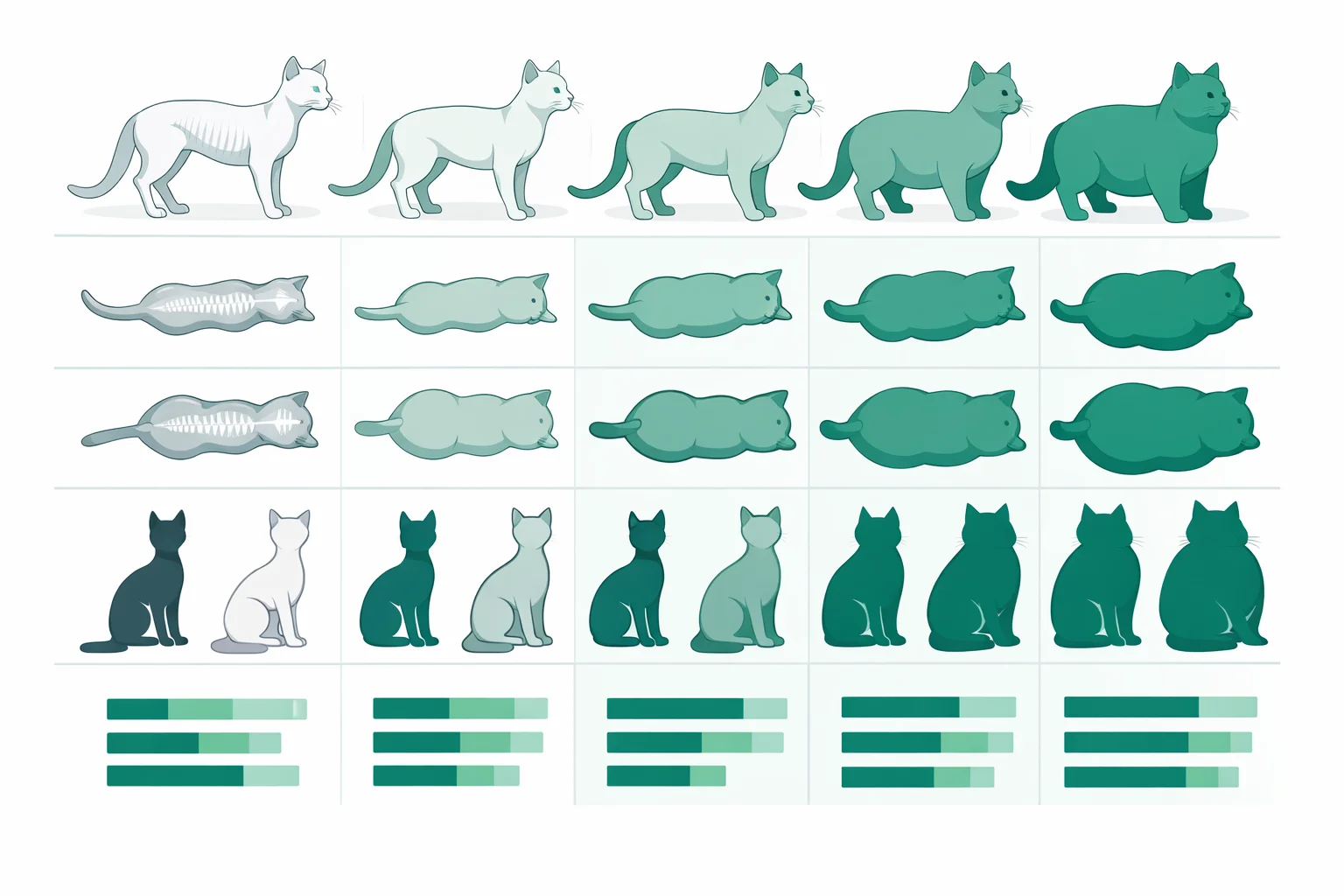
Feline Body Condition Score Reference
| BCS | Category | What to look & feel for |
|---|---|---|
| 1 | Emaciated | Ribs, spine, hip bones visible. Severe muscle wasting. No palpable fat. |
| 2 | Very thin | Ribs easily visible. Minimal muscle mass. Very obvious waist. |
| 3 | Thin | Ribs easily felt, may be visible. Clear waist and abdominal tuck. |
| 4 | Lean ideal | Ribs palpable with slight fat. Waist visible from above. Slight belly tuck. |
| 5 | Ideal | Ribs felt under thin fat layer. Proportional waist. Minimal belly fat pad. |
| 6 | Overweight | Ribs felt with slight pressure. Waist less distinct. Small belly fat pad. |
| 7 | Heavy | Ribs hard to feel. No waist visible. Obvious rounding and belly fat. |
| 8 | Obese | Ribs buried under fat. Belly distended. Fat deposits on limbs. |
| 9 | Severely obese | Massive fat deposits everywhere. Difficulty grooming and moving. |
Disclaimer: This cat weight calculator provides estimates based on the veterinary BCS method. Individual cats vary by breed, bone structure, and health status. Always consult your veterinarian before starting any weight management plan, especially for kittens, seniors, or cats with medical conditions.
Your rating helps improve Cat Weight Calculator. We store only an anonymized vote (no personal data).
How to Use the Cat Weight Calculator
Step 1: Choose units
Pick Metric (kg) or US (lb) to match the scale you use at home or at the vet’s office.
Step 2: Enter current weight
Type your cat’s weight. For accuracy, weigh yourself on a bathroom scale, then weigh yourself holding your cat, and subtract.
Step 3: Select frame size
Choose small, medium, or large based on your cat’s breed or general build. Most domestic cats are medium.
Step 4: Set the Body Condition Score
Move the 1–9 slider to match your cat’s body. Feel the ribs and look at the waist from above. 4–5 is ideal; ask your vet if unsure.
Step 5: Pick life stage and weekly pace
Select kitten, adult, or senior. If your cat needs to lose or gain weight, set a weekly change target (typically ~1%).
Step 6: Review the results
See the ideal weight range, change needed, estimated timeline, daily calorie guidance, and a frame size comparison chart.
Key Features
- Ideal weight range from feline Body Condition Score (1–9)
- Frame size comparison for small, medium, and large cats
- Safe weekly weight change pace and timeline
- Daily calorie estimate for maintenance or weight loss
- Life stage guidance for kittens, adults, and seniors
- Metric and US unit support with instant conversion
Understanding Results
Formula
The calculator uses the veterinary BCS rule: each Body Condition Score point away from 5 on a 1–9 scale represents roughly 10–15% above or below ideal body weight (Laflamme, 1997). For overweight cats (BCS 6–9), ideal weight = current weight ÷ (1 + points above 5 × percent per point). For underweight cats (BCS 1–4), ideal weight = current weight ÷ (1 − points below 5 × percent per point). We compute both ends using 10% and 15% and present the midpoint as a working target.
Reference Ranges & Interpretation
BCS 4–5 is ideal: ribs easily felt under a thin fat cover, waist visible from above, slight belly tuck from the side. BCS 6–7 indicates overweight (more padding, waist vanishing, belly rounding), and BCS 8–9 is obese. The results show two numbers — a lower and upper ideal weight — plus a central target. If your cat's weight falls anywhere in that band with easy-to-feel ribs and a visible waist, they're on track. Frame size (small, medium, large) provides additional context by comparing the estimate to typical breed ranges.
Assumptions & Limitations
The BCS method is a practical screening estimate, not a clinical diagnosis. Breed, bone structure, muscle mass, coat density, and hydration status can shift the true ideal weight. Growth (kittens), pregnancy, lactation, and underlying conditions such as hyperthyroidism or diabetes change both the target weight and safe pacing. Always consult your veterinarian for individualized guidance — especially if weight changes quickly, appetite is different, or your cat seems uncomfortable.
Complete Guide: Cat Weight Calculator
On this page
A cat weight calculator turns two numbers — your cat's current weight and body condition score — into a concrete ideal range you can act on. If your 6-kg tabby scores a 7 out of 9 on the feline BCS chart, that single data point tells you she's carrying roughly 20–30% more body mass than her frame needs. This article walks you through the BCS system, the math behind the ideal-weight estimate, and a realistic plan for safe, gradual change.
Cat obesity is often invisible to owners. A 2022 study in the Journal of Feline Medicine and Surgery found that 61.6% of pet cats in the United States are overweight or obese, yet only 27% of owners correctly identified their cat's body condition. The gap between perception and reality is the first problem to solve — and that starts with an objective score.
Why You Need a Cat Weight Calculator — Over 60% Are Overweight
Picture a domestic shorthair named Milo. He weighs 6.2 kg (13.7 lb) and his vet rates him at BCS 7/9 — two full points above ideal. Using the standard veterinary estimate of 10–15% excess per BCS point, Milo is carrying 20–30% more weight than his frame needs. Let's do the math:
- Conservative estimate (10% per point): Ideal = 6.2 ÷ (1 + 2 × 0.10) = 6.2 ÷ 1.20 = 5.2 kg
- Aggressive estimate (15% per point): Ideal = 6.2 ÷ (1 + 2 × 0.15) = 6.2 ÷ 1.30 = 4.8 kg
- Midpoint target: approximately 5.0 kg
That means Milo needs to shed about 1.2 kg (2.6 lb). It sounds small, but on a 6-kg cat that's nearly 20% of body weight. At a safe rate of 1% per week (62 g), the plan would take roughly 19 weeks — just under five months. Cats are not small dogs: crash diets trigger hepatic lipidosis (fatty liver), a life-threatening condition. Patience matters.
The Feline Body Condition Score Explained
Veterinarians worldwide use a 9-point scale developed by Laflamme (1997). It combines visual assessment with hands-on palpation — you feel the ribs, look at the waist from above, and check the belly profile from the side. Here's how the scale breaks down:
| BCS | Category | What you'll see and feel |
|---|---|---|
| 1–3 | Underweight | Ribs and spine prominent; little or no body fat; obvious waist tuck |
| 4–5 | Ideal | Ribs easily felt under a thin fat layer; waist visible from above; slight abdominal tuck |
| 6–7 | Overweight | Ribs felt with moderate pressure; waist disappearing; belly rounding out |
| 8–9 | Obese | Ribs difficult to feel; belly distended; fat deposits on limbs and face |
The key tell is rib palpation. Run your thumb along the last few ribs with gentle pressure — about the same force you'd use to feel the bones on the back of your hand. If that's how easy the ribs feel, your cat is likely around a 5. If it feels more like pressing the knuckles of a closed fist, you're looking at a 7 or higher.
How the BCS-to-Ideal-Weight Formula Works
The math is the same concept used in the dog weight calculator, but calibrated for cats. Each full BCS point above or below 5 corresponds to roughly 10–15% deviation from ideal body weight. The formula:
If BCS > 5 (overweight):
Ideal = Current weight ÷ (1 + points_above_5 × percent_per_point)
If BCS < 5 (underweight):
Ideal = Current weight ÷ (1 − points_below_5 × percent_per_point)
We show a range (using 10% and 15%) rather than a single number, because individual cats vary. A muscular Bengal at BCS 6 doesn't carry the same proportional fat as a sedentary Persian at the same score. The midpoint is a reasonable starting target, but your vet can narrow it further with a physical exam.
For underweight cats, the formula inverts the direction. A BCS 3 cat at 3.0 kg has an estimated ideal of 3.0 ÷ (1 − 2 × 0.125) = 3.0 ÷ 0.75 = 4.0 kg. The gain needed (1 kg) may call for calorie-dense food and more frequent meals — something you can plan with our cat calorie calculator.
Frame Size and Breed Differences
Unlike dogs, cats don't span a 2–90 kg range across breeds. Still, a Singapura (2.5–3.5 kg adult) and a Maine Coon (5–8+ kg) live in very different weight worlds. The calculator groups cats into three frame sizes:
- Small frame (2.7–4.0 kg): Siamese, Abyssinian, Devon Rex, Cornish Rex, Singapura
- Medium frame (3.6–5.4 kg): Domestic Shorthair, Domestic Longhair, most mixed-breed cats
- Large frame (5.0–8.2 kg): Maine Coon, Ragdoll, Norwegian Forest Cat, British Shorthair, Savannah
These ranges overlap because individual variation within a breed can be significant. A large-boned male DSH at 5.5 kg and BCS 5 is perfectly healthy — he's just on the upper end. The frame check in the calculator flags cases where the BCS-based estimate falls outside the typical range for context, not as a diagnosis.
Safe Weight Loss Pace for Cats
This is the part that trips up well-meaning owners. Cats metabolize fat differently than dogs or humans. Rapid weight loss — more than 2% of body weight per week — can cause hepatic lipidosis (fatty liver disease), which is fatal without treatment. The consensus from the American Animal Hospital Association (AAHA) and the World Small Animal Veterinary Association (WSAVA):
- Target pace: 0.5–2% of body weight per week (most vets prefer ~1%)
- For a 6-kg cat: that's 30–120 g per week, or roughly 60 g at the 1% midpoint
- Expected timeline: a 1-kg loss at 1% per week takes about 17 weeks
- Monthly weigh-ins: step on a scale holding your cat, then weigh yourself — subtract the difference
If your cat isn't losing weight after 4 weeks, reduce daily calories by another 5–10% and re-check. If your cat is losing faster than 2% per week, add calories back immediately and contact your vet.
Turning Your Result Into a Feeding Plan
Knowing the ideal weight is step one. Step two is adjusting calories. The standard approach uses Resting Energy Requirement (RER):
RER = 70 × (ideal weight in kg)0.75
Weight loss kcal/day = RER × 0.8
For Milo (ideal 5.0 kg): RER = 70 × 5.00.75 = 70 × 3.34 = 234 kcal. At 80% of RER for weight loss: 187 kcal per day. That's about ¾ of a standard 5.5-oz can of premium wet food, or roughly 50 g of a calorie-dense dry kibble. Use the cat calorie calculator to dial in exact portions based on your brand's kcal per gram.
Two practical tips from feline nutrition specialists: weigh food with a kitchen scale (measuring cups are notoriously inaccurate for kibble), and split daily portions into 3–4 small meals rather than free-feeding from a full bowl. Puzzle feeders add enrichment and slow down speed-eaters.
Multi-cat households face an extra challenge: the overweight cat often steals food from leaner housemates. Microchip-activated feeders solve this by only opening for the correct cat. Alternatively, feed cats in separate rooms with doors closed until each bowl is empty. Consistent separation is the single most effective change for multi-cat weight management — more impactful than changing food brands or reducing portions.
Kittens, Adults, and Senior Cats
The BCS method works best for adult cats (1–10 years). For other life stages, keep these adjustments in mind:
- Kittens (under 1 year): Still growing. Never calorie-restrict a kitten unless a vet specifically instructs it. A chunky 6-month-old will often slim down as they grow taller and longer. Track growth against breed-specific curves rather than adult BCS targets.
- Adults (1–10 years): Peak BCS assessment accuracy. Monthly or bimonthly weigh-ins catch gradual creep early — a gain of 200 g in a 4-kg cat is equivalent to a 5% increase, which you probably wouldn't notice by eye.
- Seniors (11+ years): Sarcopenia (muscle loss) can mask fat gain. A senior cat may drop in weight but actually increase in body fat percentage. Gentle weight management (0.5–1% per week max) and high-protein diets help preserve lean mass. The cat age calculator can put your cat's age in human-equivalent perspective.
Five Mistakes That Stall Cat Weight Loss
Owners who fail to see results after 8–12 weeks typically share one or more of these habits:
- Eyeballing portions. A tablespoon of dry food can range from 25 to 50 kcal depending on density. Without a kitchen scale, you're guessing — and most people guess generously.
- Ignoring treats. Three Temptations treats add roughly 6 kcal. That sounds trivial, but a cat on 187 kcal/day just got a 3.2% calorie surplus. Multiply by daily frequency.
- Switching food abruptly. New food can cause GI upset and refusal. Transition over 7–10 days by mixing increasing proportions.
- Feeding multiple cats from one bowl. The overweight cat eats more; the healthy cat eats less. Separate feeding stations or microchip feeders solve this.
- Cutting calories too fast. Going from 300 kcal/day to 180 overnight stresses the cat's liver. Reduce by 10–15% every two weeks until you reach the target.
When to Call Your Veterinarian
The BCS method is a screening tool, not a diagnosis. Contact your vet promptly if:
- Your cat loses more than 2% of body weight in a single week
- Your cat stops eating for more than 24–36 hours (hepatic lipidosis risk)
- Weight gain appears sudden or is accompanied by a distended abdomen (could indicate fluid, not fat)
- You feel lumps, asymmetry, or hard masses during the rib palpation
- Your cat's BCS is 1–2 or 8–9 — both extremes need professional intervention
A vet can also run bloodwork (thyroid, glucose, kidney values) that explains why a cat is gaining or losing weight, which a calculator alone can't do.
References
- Laflamme DP. Development and validation of a body condition score system for cats: a clinical tool. Feline Practice. 1997;25(5-6):13-18.
- Association for Pet Obesity Prevention. 2022 U.S. Pet Obesity Prevalence Survey. petobesityprevention.org
- WSAVA Global Nutrition Committee. Body Condition Score Chart — Feline. wsava.org
- American Animal Hospital Association (AAHA). Weight Management Guidelines for Dogs and Cats. 2021.

Written by Jurica Šinko
Founder & CEO
Entrepreneur and health information advocate, passionate about making health calculations accessible to everyone through intuitive digital tools.
View full profileFrequently Asked Questions
What is a healthy weight for a house cat?
Most domestic cats weigh 3.6 to 5.4 kg (8 to 12 lb) at a healthy body condition. Small-frame breeds like Siamese may be healthy at 2.7 kg, while large breeds like Maine Coons can be healthy at 8 kg or more. Body Condition Score is a better gauge than weight alone.
How does the cat weight calculator estimate ideal weight?
It uses the veterinary BCS method: each point above or below 5 on a 1 to 9 scale represents roughly 10 to 15 percent deviation from ideal body weight. The calculator shows a range and a midpoint target based on your cat’s current weight and BCS.
What is a cat body condition score?
A body condition score is a 9-point veterinary scale that assesses body fat through visual inspection and rib palpation. Scores of 4 to 5 are ideal. Below 4 indicates underweight, and above 5 indicates overweight or obese. Your vet can confirm the score during a checkup.
How fast should a cat lose weight?
Cats should lose no more than 1 to 2 percent of body weight per week. For a 6-kg cat that means 60 to 120 grams per week. Faster weight loss risks hepatic lipidosis (fatty liver disease), which is potentially fatal in cats.
Is my cat overweight if it weighs 6 kg?
It depends on frame size and body condition. A large-frame cat at 6 kg with BCS 5 is perfectly healthy. A small-frame cat at 6 kg is likely significantly overweight. Enter the weight and BCS in the calculator to get a personalized assessment.
Can I use this calculator for kittens?
The BCS method works best for adult cats over 1 year old. Kittens are still growing and should not follow adult weight-loss plans. The calculator includes a kitten life stage note, but always follow your vet’s growth guidance for cats under 12 months.
How do I weigh my cat at home?
Step on a bathroom scale and note your weight. Then pick up your cat and step on again. Subtract the first reading from the second. For more precision, use a baby scale or a kitchen scale (for kittens). Weigh at the same time of day for consistency.
Related Calculators

Baby Food Calculator — Solids Introduction & Portions
Estimate age‑appropriate portions and plan meal frequency with the baby food calculator. Log new foods, track allergens, and export a simple weekly menu.

Infant Growth Chart Calculator
Track weight, length, and head size with the infant growth chart calculator using WHO percentiles. See trends on clear charts and compare age-based progress.

Baby Length Percentile Calculator — WHO Reference Guide
Check WHO length‑for‑age percentiles with the baby length percentile calculator. Input age, sex, and length to see your percentile and track growth trends.

Baby Milestone Calculator — Track Skills by Age & Stage
Use our baby milestone calculator to see what’s typical by corrected age. Explore early, typical, and later windows for motor, language, and cognitive skills.

Baby Weight Percentile Calculator — WHO Growth Guide
Use the baby weight percentile calculator to see WHO weight‑for‑age percentiles. Enter age, sex, and weight to get your percentile, z‑score, and tips.
Boys Growth Chart Calculator: Height & Weight Percentiles
Free boys growth chart calculator using official CDC and WHO percentile data. Plot your son's height and weight by age from birth to 20 and get z-scores.