Use the Barthel Index Calculator
Free Barthel Index calculator scoring all 10 activities of daily living on the original and modified scales, with dependency bands and domain sub-scores.
Barthel Index
65 / 100
Moderate dependence
Original
Which scale are you scoring?
Two to four levels per item in 5-point steps. Fast to score, but it cannot record small gains.
How does the patient get around?
Any walking aid — stick, frame, orthosis — still scores as independent.
Enter an admission or last-week score to see the change measured against the 1.85-point clinically important difference.
Barthel Index
65 of 100
Assisted independence — manages much alone but needs regular help with several tasks.
Self-care
25 / 40
Feeding, bathing, grooming, dressing, toilet
Continence
15 / 20
Bowel and bladder — a fifth of the whole score
Mobility
25 / 40
Transfers, walking, stairs
Where the points were lost
35 of 100 available points not scored
| Activity | Scored | Available | Points lost |
|---|---|---|---|
| Feeding | 10 | 10 | 0 |
| Bathing | 0 | 5 | −5 |
| Grooming | 5 | 5 | 0 |
| Dressing | 5 | 10 | −5 |
| Bowel control | 10 | 10 | 0 |
| Bladder control | 5 | 10 | −5 |
| Toilet use | 5 | 10 | −5 |
| Transfers (bed to chair) | 10 | 15 | −5 |
| Mobility on level ground | 10 | 15 | −5 |
| Stairs | 5 | 10 | −5 |
The largest single recovery available is Bathing at 5 points. Because transfers and mobility carry 15 points each while bathing and grooming carry 5, a rehabilitation plan that moves one mobility level is worth three grooming levels on this scale.
Barthel Index dependency bands
| Score | Category | What it usually means |
|---|---|---|
| 0–20 | Total dependence | Needs help with essentially every activity; typically requires 24-hour care. |
| 21–60 | Severe dependence | Needs hands-on help with most activities; usually more than one carer episode a day. |
| 61–90 (you) | Moderate dependence | Assisted independence — manages much alone but needs regular help with several tasks. |
| 91–99 | Slight dependence | Independent in almost everything, with one or two tasks needing supervision or aids. |
| 100 | Independent in basic ADLs | Independent in all 10 basic activities. Says nothing about cooking, money, medication or transport. |
A score of 100 means independence in these ten activities only. Cooking, shopping, managing money, taking medication and using transport are never measured, which is why some people scoring 100 still cannot live alone safely.
Educational Tool Only
This Barthel Index calculator is for informational and educational purposes. It records observed function in ten basic activities of daily living and does not diagnose, predict recovery, or determine eligibility for care funding. Discharge destination, care packages and rehabilitation goals must be set by the multidisciplinary team who have assessed the patient in person.
Educational tool, not medical advice. Check this tool’s method and limitations before interpreting a result. Talk to a qualified healthcare professional before making decisions about medication, diet, exercise, or treatment. See our Terms of Use.
Your rating helps improve Barthel Index Calculator. We store only an anonymized vote (no personal data).
How to Use Barthel Index Calculator
Step 1: Pick the scale version first
Choose "Original (1965)" for a one-off snapshot or audit, or "Modified (Shah 1989)" for serial scoring during a rehabilitation stay. The modified version grades every item across five assistance levels instead of two to four, so it registers progress the original rounds away. Never mix the two across time points on the same patient.
Step 2: Set the mobility route
Select Walking or Wheelchair. A wheelchair user scores a maximum of 5 on the mobility item instead of 15, so the calculator drops the reachable ceiling to 90 rather than scoring the patient against an unattainable 100.
Step 3: Score each of the ten activities on performance, not capacity
Work down feeding, bathing, grooming, dressing, bowels, bladder, toilet use, transfers, mobility and stairs. Record what the patient actually did over the last 24 to 48 hours, not what they managed once in a therapy session. If someone must be present for safety, that is not independent.
Step 4: Read the domain sub-scores, not just the total
The self-care, continence and mobility cards split the 100 points into 40, 20 and 40. Two patients can both score 65 with completely different profiles — one limited by a hemiparetic arm, the other by an unsafe transfer.
Step 5: Enter a previous score to measure change
Type the admission or last-review score in the "Previous Barthel score" field. The calculator reports the point change and tests it against the 1.85-point minimal clinically important difference and the roughly 4-point minimal detectable change.
Step 6: Check the points-lost table for the biggest target
The table ranks every activity by points not scored. Because transfers and mobility carry 15 points each while bathing and grooming carry 5, it shows where a rehabilitation hour buys the most score.
Key Features
- Scores both the original Barthel Index (Mahoney 1965) and the Modified Barthel Index (Shah 1989) in one tool
- Switching scales remaps every item proportionally instead of clearing your answers
- Breaks the total into self-care, continence and mobility sub-scores — the 40/20/40 split behind the number
- Wheelchair mobility route recalculates the reachable ceiling instead of scoring against an unreachable 100
- Compares a previous score against the 1.85-point clinically important difference and 4-point detectable change
- Points-lost table showing which activity holds the largest single recovery available
Understanding Results
Formula
There is no equation to solve — the Barthel Index is a weighted sum of ten observed activities. Feeding, dressing, bowel control, bladder control, toilet use and stairs contribute up to 10 points each; transfers and mobility contribute up to 15 each; bathing and grooming contribute up to 5 each. Ten items, 100 points. Mahoney and Barthel chose unequal weights in 1965 deliberately, giving mobility the heaviest loading because it drives how much physical help another person must provide. Grouped by domain the weighting comes out at 40 points of self-care, 40 of mobility and 20 of continence, which is why the calculator reports those three sub-scores alongside the total. The Modified Barthel Index (Shah 1989) keeps the same ten items and the same 100-point maximum but grades each item across five levels of assistance instead of two to four, so a 10-point item runs 0-2-5-8-10 and a 15-point item runs 0-3-8-12-15.
Reference Ranges & Interpretation
Totals map onto five dependency bands: 0–20 total dependence, 21–60 severe dependence, 61–90 moderate dependence, 91–99 slight dependence, and 100 independence in basic activities of daily living. The most consequential boundary is 60, which Granger and colleagues identified in 1979 as the transition from dependence into assisted independence when tracking repeated Barthel measures through stroke rehabilitation. Admission scores below 40 are associated with longer inpatient stays and a higher rate of institutional discharge, while scores above 85 usually indicate that equipment and supervision, rather than hands-on care, are what is needed. For change over time, the minimal clinically important difference in stroke patients is approximately 1.85 points and the minimal detectable change is around 4 points — so on the original scale, whose smallest possible step is 5 points, any single-level improvement is already meaningful.
Assumptions & Limitations
The index records performance over the previous 24 to 48 hours, not capacity: a patient who walked once in a therapy session but is escorted everywhere else scores as needing help, and anyone requiring supervision for safety is not independent. Its ceiling effect is well documented — a score of 100 covers only these ten basic activities and contains no items for cooking, shopping, managing money, medication, telephone use or transport, so people who reach 100 can still be unable to live alone.
There are no cognitive or communication items at all, which is the sharpest contrast with the 18-item Functional Independence Measure. Wheelchair users are structurally penalised: mobility caps at 5 rather than 15 and stairs usually score 0, so a fully independent wheelchair user cannot exceed 80. Continence contributes a fifth of the total despite not being an activity the patient performs, so a urinary tract infection can cost 10 points in 48 hours with no change in ability.
Original and modified scores are not interchangeable and must not be compared across time points. This tool is educational; discharge destination, care packages and rehabilitation goals must be set by the multidisciplinary team who have assessed the patient in person.
Complete Guide: Barthel Index Calculator
On this page
A Barthel Index calculator turns a ward round observation into a number between 0 and 100, and the number decides things: how many carer visits a person goes home with, whether a rehabilitation bed is justified, whether a family is told that discharge is weeks away rather than days. The scale is sixty years old, takes about three minutes, and is still the most widely used measure of basic activities of daily living in the world. It is also routinely mis-scored, because almost every item contains a trap in its wording. This guide follows one patient through a scoring round, then works through the weighting, the two competing versions of the scale, and the ceiling that makes a perfect score less reassuring than it sounds.
Day nine after a stroke: scoring one patient
Consider a 74-year-old woman nine days after a left middle cerebral artery infarct, with a dense right arm and a right leg that is beginning to take weight. The therapy team scores her on what she actually did over the previous 48 hours — not what she managed once, with encouragement, on her best morning.
She eats a normal tray unaided once the meat is cut for her, so feeding scores 10. She needs a nurse in the bathroom, so bathing is 0. She washes her face and cleans her teeth one-handed: grooming 5. Dressing gets her upper half done but not her socks and shoes — that is about half, so 5. Her bowels are continent at 10, her bladder has one accident most nights, which is "occasional" and scores 5. On the toilet she needs help standing to clean herself: 5. She gets from bed to chair with one nurse giving a steadying hand, which is minor help and therefore 10 of the 15 available. She walks about 60 metres with one person alongside: 10. Stairs need a physiotherapist and a rail, so 5.
Her total is 65 out of 100 — moderate dependence, or what Granger's group called assisted independence. Break that into domains and it becomes more useful than the single figure: self-care 25 of 40, continence 15 of 20, mobility 25 of 40. Two of her three domains sit at roughly 62%, which is the profile of someone whose limiting factor is one hemiparetic arm rather than a global loss of function. The number 65 does not say that. The domain split does, and it is why the calculator above breaks the score apart rather than only totalling it.
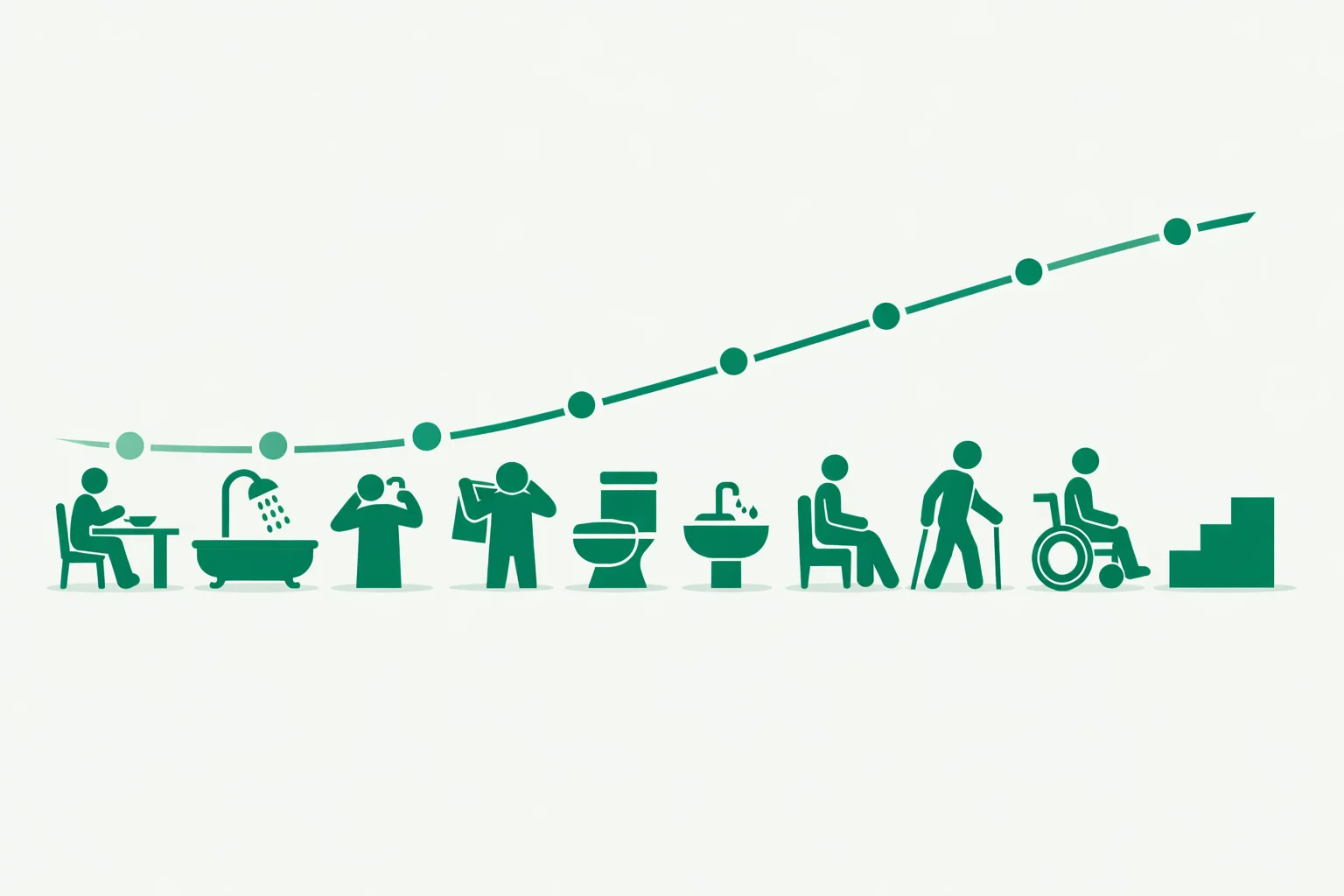
The ten items and what each one demands
Mahoney and Barthel published the scale in 1965 for chronic patients with neuromuscular and musculoskeletal conditions in Maryland hospitals. Ten items, scored in five-point increments, summing to 100. The wording that most services use today comes from Collin and Wade's 1988 reliability study, which tightened the definitions after finding that untrained raters disagreed on roughly a quarter of items.
| Item | Max | The detail that catches people out |
|---|---|---|
| Feeding | 10 | Cutting food or spreading butter for the patient is help, and drops the score to 5. |
| Bathing | 5 | All or nothing. Supervision for safety counts as dependent. |
| Grooming | 5 | Face, hair, teeth, shaving. Implements may be handed over without losing the point. |
| Dressing | 10 | Buttons, zips and laces are included. Adaptive clothing still scores as independent. |
| Bowels | 10 | Needing suppositories or enemas given by someone else scores zero, not 5. |
| Bladder | 10 | A catheterised patient who cannot manage the bag alone scores zero however dry they are. |
| Toilet use | 10 | Covers getting on and off, clothing and cleaning. Independent bedpan use still scores 10. |
| Transfers | 15 | Verbal prompting alone is still minor help, so it costs 5 points. |
| Mobility | 15 | Judged over 50 yards. A stick or frame does not reduce the score; a person alongside does. |
| Stairs | 10 | A full flight up and down. Carrying the walking aid for them counts as help. |
The governing rule sits above all ten: score performance, not capacity. If a patient can theoretically walk but has not walked without a nurse in two days, they score as needing help. Collin and Wade were explicit that the index records what happens, not what a therapist believes is achievable.
Why transfers are worth three times bathing
The Barthel is not an evenly weighted scale, and this is the single most consequential thing about it. Transfers and mobility carry 15 points each. Feeding, dressing, bowels, bladder, toilet use and stairs carry 10. Bathing and grooming carry 5. So mobility-related items — transfers, walking and stairs — account for 40 of the 100 points, self-care for another 40, and continence for the remaining 20.
Two practical consequences follow. First, a rehabilitation programme that moves a patient one level on transfers gains five points, the same as teaching them to bathe independently from a standing start — and moving them from major help to independent transfers is worth 10, which is every point available in grooming and bathing combined. Physiotherapy time spent on sit-to-stand is, in Barthel terms, the highest-yield hour on the ward. Second, continence contributes a fifth of the total despite bowel and bladder control not being activities the patient performs at all. A urinary tract infection can knock 10 points off a score in 48 hours without any change in what the person can do, which is exactly why serial Barthel scores need a reason attached when they fall.
Mobility being the heaviest domain also explains the overlap with fall risk. A patient scoring 10 rather than 15 on both transfers and mobility is, by definition, someone who needs a person present to move safely — the same profile that a falls risk calculator flags through gait and balance testing. The two tools measure the same underlying instability from opposite directions: one counts what help is needed, the other estimates what happens when it is absent.
The wheelchair ceiling: when 80 is a perfect score
Here is a piece of Barthel arithmetic that rarely appears on scoring sheets. Take a person with a complete spinal cord injury who is genuinely independent: they feed, wash, dress and toilet themselves, manage their own bladder and bowel programme, and transfer in and out of their chair unaided. Score them honestly and the mobility item gives 5 for wheelchair independence rather than 15 for walking, and stairs give 0. Their maximum possible total is 80 out of 100.
That 80 is not moderate dependence in any meaningful sense — it is a fully independent adult who happens to use a wheelchair. But the standard bands put 80 in the same category as our day-nine stroke patient at 65, who needs help with bathing, dressing, toileting and walking. The scale conflates "needs assistance" with "does not walk". Anyone using a Barthel Index score to allocate care hours for a wheelchair user is reading a 20-point penalty as a care need. Set the mobility route to wheelchair in the calculator above and it recalculates the reachable ceiling instead of silently scoring against 100.
Original vs. Modified Barthel Index
Shah, Vanclay and Cooper published the Modified Barthel Index in 1989 to fix a specific problem: the original moves in steps too large to see rehabilitation happening. Their version keeps the same ten items and the same 100-point total, but grades each item across five levels of assistance rather than two, three or four — unable, maximal help, moderate help, minimal help, independent. Grooming runs 0-1-3-4-5 instead of 0-5; transfers run 0-3-8-12-15 instead of 0-5-10-15.
The practical difference is resolution. On the original scale the smallest possible change is 5 points. The minimal clinically important difference for the Barthel in stroke patients is about 1.85 points, and the minimal detectable change — the amount two raters can differ by on an unchanged patient — is roughly 4. So on the original scale, any single-level improvement on any item automatically clears both thresholds. That sounds like a virtue, and it is really a symptom: the scale cannot register anything smaller, so a fortnight of genuine progress can score identically to no progress at all. The modified version can move by 1 or 2 points, which detects that progress but also produces changes that fall below measurement error.
Choose on purpose. Use the original for a single snapshot, a screening decision, or a chart audit where speed and comparability matter. Use the modified version for serial measurement during an inpatient rehabilitation stay, where the question is whether this week differed from last week. What you must not do is compare a modified score against an original one, because the same patient scores differently on each — the modified scale's intermediate levels systematically award partial credit that the original rounds to zero.
Where a Barthel Index calculator score changes the discharge plan
A Barthel Index calculator earns its place only if the number changes a decision. These are the transitions that actually move care planning, drawn from how the bands are used in stroke and elderly-care services rather than from any single guideline.
| Score | Band | What it typically changes |
|---|---|---|
| 0–20 | Total dependence | Two-carer handling, hoist, full personal care. Home discharge needs major adaptation or a 24-hour package. |
| 21–60 | Severe dependence | Multiple carer visits daily. This is where inpatient rehabilitation has the most room to change the destination. |
| 61–90 | Moderate dependence | Granger's transition to assisted independence. Home with a package is realistic; the specific failing items decide which visits. |
| 91–99 | Slight dependence | Usually equipment and one supervised task rather than hands-on care. |
| 100 | Independent in basic ADLs | No basic ADL need. Says nothing about cooking, money, medication or transport. |
The 60-point mark carries the most weight historically. Granger and colleagues, tracking repeated Barthel measures through stroke rehabilitation in 1979, identified it as the point where patients cross from dependence into assisted independence, and it has anchored service thresholds ever since. Scores below 40 on admission to rehabilitation are associated with longer stays and a higher likelihood of institutional discharge. None of these are hard cut-offs — they are the points where the conversation changes, and where the trajectory over successive weeks matters far more than any single reading. For patients recovering from orthopaedic injury rather than stroke, mapping those weeks against expected healing milestones with an injury recovery calculator gives the Barthel trend something to be measured against.
What a score of 100 does not tell you
The Barthel measures ten basic activities. It does not measure cooking, shopping, managing money, taking medication, using a telephone, doing laundry or using transport — the instrumental activities of daily living, which are what actually determine whether someone lives alone safely. A person can score a clean 100 and still be unable to manage a pill organiser or recognise that the gas is on.
This is the well-documented ceiling effect, and it is severe: a substantial minority of stroke survivors reach 100 before discharge while still reporting real limitations in daily life. The scale has no cognitive or communication items at all, which is its sharpest contrast with the Functional Independence Measure. The FIM uses 18 items across seven levels for a 18-to-126 range, and five of those items cover comprehension, expression, social interaction, problem solving and memory. A patient with fluent aphasia or significant dysexecutive syndrome can be physically independent and score 100 on the Barthel while the FIM registers the deficit clearly. In United States inpatient rehabilitation facilities the FIM was itself retired from mandatory reporting in October 2019, replaced by Section GG of the IRF-PAI under the IMPACT Act — but the Barthel, requiring no licence and no training package, carried on.
Treat a score of 100 as the answer to one narrow question: does this person need hands-on help with basic self-care and moving around? A ceiling score closes that question and opens the next one. Where longer-term planning is the goal, functional status is only one input alongside the vascular and lifestyle factors that a stroke risk calculator estimates for a further event, since a second stroke is the most common reason a hard-won Barthel score collapses.
Five scoring errors that move the number
Inter-rater reliability for the Barthel is good when raters are trained and mediocre when they are not. These five account for most of the disagreement.
- Scoring capacity instead of performance. The most common error by a wide margin. A patient who walked once in a therapy session but is escorted everywhere else scores 10 on mobility, not 15. Ask what happened, not what is possible.
- Treating supervision as independence. If someone must be present for safety, the patient is not independent. This costs 5 points on bathing and 5 on transfers, and is the difference between a package with visits and one without.
- Giving a catheterised patient continence points. A catheter that the patient cannot manage entirely alone scores 0 on bladder, not 10 for being dry. Getting this wrong swings the total by a full 10 points.
- Scoring a single best moment. The index describes a 24-to-48-hour window. A patient who managed the stairs on Tuesday and refused them Wednesday and Thursday is not a 10.
- Mixing the two scales across time points. Scoring admission on the original and review on the modified index produces a change figure that is an artefact of the instrument, not the patient. Pick one version per episode of care and stay with it.
One last practical note: the Barthel can be scored by direct observation, by asking the patient, or by asking a carer. Direct observation is the reference standard, and self-report tends to run slightly optimistic, particularly on bathing and stairs. If a score is collected by telephone for a follow-up clinic, record that it was, because a 5-point difference between methods is not evidence of recovery.
References
- Mahoney FI, Barthel DW. Functional evaluation: the Barthel Index. Maryland State Medical Journal. 1965;14:61–65.
- Collin C, Wade DT, Davies S, Horne V. The Barthel ADL Index: a reliability study. International Disability Studies. 1988;10(2):61–63.
- Shah S, Vanclay F, Cooper B. Improving the sensitivity of the Barthel Index for stroke rehabilitation. Journal of Clinical Epidemiology. 1989;42(8):703–709.
- Granger CV, Dewis LS, Peters NC, Sherwood CC, Barrett JE. Stroke rehabilitation: analysis of repeated Barthel Index measures. Archives of Physical Medicine and Rehabilitation. 1979;60(1):14–17.
- Hsieh YW, Wang CH, Wu SC, Chen PC, Sheu CF, Hsieh CL. Estimating the minimal clinically important difference of the Barthel Index in stroke patients. Neurorehabilitation and Neural Repair. 2007;21(3):233–238.
- Centers for Medicare & Medicaid Services. Inpatient Rehabilitation Facility Quality Reporting Program: IRF-PAI and Section GG. cms.gov
- National Institute of Neurological Disorders and Stroke. Post-Stroke Rehabilitation. ninds.nih.gov

Written by Marko Šinko
Co-Founder & Lead Developer
Computer scientist and developer working on calculator implementation, data handling, and accessible interfaces. His authorship describes development work, not independent medical review.
View full profileFrequently Asked Questions
What is a good Barthel Index score?
The scale runs from 0 to 100 and higher is better. Scores of 0 to 20 indicate total dependence, 21 to 60 severe dependence, 61 to 90 moderate dependence, 91 to 99 slight dependence, and 100 independence in all ten basic activities. The 60-point mark matters most: Granger and colleagues identified it in 1979 as the transition from dependence into assisted independence, and it still anchors service thresholds today.
What is the difference between the Barthel Index and the Modified Barthel Index?
Both use the same ten activities and both total 100 points. The original scores each item across only two to four levels in 5-point steps, so the smallest possible change is 5 points. The Modified Barthel Index published by Shah in 1989 grades every item across five assistance levels instead: grooming runs 0-1-3-4-5 and transfers run 0-3-8-12-15. That extra resolution detects week-to-week rehabilitation progress the original rounds away, at the cost of producing some changes too small to be reliable.
What Barthel score is needed to go home after a stroke?
There is no fixed cut-off, but scores above 60 are generally where discharge home with a care package becomes realistic, and scores above 85 usually mean equipment and supervision rather than hands-on care. Admission scores below 40 are associated with longer rehabilitation stays and a higher likelihood of institutional discharge. The trend across successive weeks predicts the destination far better than any single reading, and the specific items failing matter more than the total.
Can a wheelchair user score 100 on the Barthel Index?
No, and this is a genuine flaw in the scale. Wheelchair independence scores 5 on the mobility item instead of the 15 available for walking, and stairs usually score 0. A person with a complete spinal cord injury who feeds, washes, dresses, toilets and transfers entirely alone tops out at 80 out of 100. That 80 represents full independence, not the moderate dependence the standard bands imply, so a Barthel score should never be used on its own to allocate care hours for a wheelchair user.
How do you score a urinary catheter on the Barthel Index?
A catheterised patient who cannot manage the bag entirely alone scores 0 on bladder control, no matter how dry they are. Only a patient who empties, changes and cares for the catheter independently scores the full 10. This is one of the most common scoring errors and it swings the total by 10 points, which is enough to move someone between dependency bands.
How many points is a meaningful change in the Barthel Index?
The minimal clinically important difference in stroke patients is about 1.85 points, and the minimal detectable change, which is the amount two raters can differ by on an unchanged patient, is roughly 4 points. Because the original scale can only move in 5-point steps, any single-level improvement on any item automatically clears both thresholds. The Modified Barthel Index can move by 1 or 2 points, and those small changes sit inside measurement error.
What is the difference between the Barthel Index and the FIM?
The Barthel uses 10 items scored 0 to 100 and covers physical function only. The Functional Independence Measure uses 18 items across seven levels for a range of 18 to 126, and five of those items assess comprehension, expression, social interaction, problem solving and memory. A patient with aphasia or executive dysfunction can score a full 100 on the Barthel while the FIM registers the deficit. In United States inpatient rehabilitation facilities the FIM was retired from mandatory reporting in October 2019 and replaced by Section GG of the IRF-PAI.
Can someone score 100 on the Barthel Index and still not manage at home?
Yes, and it is common. The Barthel measures only ten basic activities and contains no items for cooking, shopping, managing money, taking medication, using a telephone or using transport. Those instrumental activities of daily living are what usually determine whether a person lives alone safely. A ceiling score answers one narrow question, which is whether hands-on help is needed with self-care and moving around, and it says nothing about the cognitive tasks of running a household.
Related Calculators

Adult Vaccination Schedule Calculator — Expert Guide
Use the adult vaccination schedule calculator to see age‑ and risk‑based recommendations. Review boosters, travel needs, and timing with a printable plan.

Age Calculator: Exact Years, Months and Days Online
Use our age calculator to find your exact age in years, months and days. See totals in days, weeks, hours and minutes, compare ages and plan dates. No sign‑in.

Air Quality Calculator: AQI Levels and Health Tips
Calculate AQI from PM2.5, PM10, and O₃ with our air quality calculator. Get color‑coded categories, activity guidance, and smart tips for masks and ventilation.

Allergen Calculator for Pollen Count & Allergy Levels
Check local pollen levels and likely triggers with the Allergen Calculator. See allergen risk tiers, plan for high‑risk days, and get prevention tips.

Pooled Cohort Equations Calculator — PCE ASCVD Risk
Free pooled cohort equations calculator (PCE) estimates 10-year ASCVD risk from cholesterol, blood pressure, and smoking, with visual ACC/AHA risk tiers.

ASCVD Risk Calculator — Free 10-Year ASCVD Risk Estimate
Calculate your 10-year ASCVD risk with the free ASCVD risk calculator. Uses Pooled Cohort Equations with what-if scenarios and ACC/AHA risk categories.